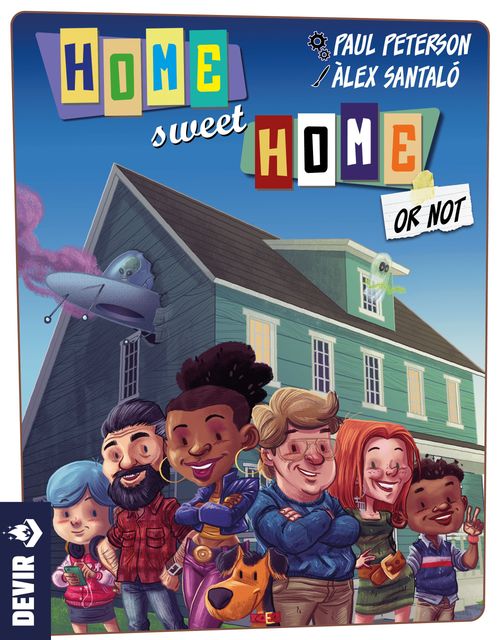
Home Sweet Home (or Not)
Home Sweet Home (or Not) Rulebook
Table of Contents
Table of Contents
Component List
- 1 Item Deck – Contains all of the Items that players can find in the house.
- 2 Event Deck – Cards that create an effect at the start of the players' turns.
- 3 Game Board – The board is separated into 6 different rooms and several hallway tiles. They are configured in different ways depending on the scenario. The rooms are numbered from 1 to 6, to help when determining one of them randomly.
- 4 Player Tokens – These represent the different players in the game and show where they are on the game board and a Alien token, used in a scenario.
- 5 Die – Sometimes you need to do something random.
- 6 Doors, and hallways – You will use these to set up the layout of the house before each game.
The rooms are: 1 Living Room, 2 Garage, 3 Bedroom, 4 Attic, 5 Playroom, 6 Kitchen.
Card Types
Item Cards – These represent Items the players might find around the house:
- Name – The name of the Item.
- Room – The room this Item comes from – Not all Items have a room.
- Type – This describes what category the Item falls under. The types are: Book, Food, Fabric, Tool, Electronic, and Junk. Not all Items have types.
- Ability – A few Items have abilities on them – They do what they say. Not all Items have abilities.
Event cards – These represent the situations that come up during the game, and should be quite self-explanatory.
Scenarios
Home sweet Home (or not) is "scenario-driven." That means that each time you play, you will choose a "scenario" that has its own special rules. Each scenario is like a different game! All scenarios use the rules described below, unless the specific rules for that scenario say otherwise. The special rules for a scenario always take precedence over the basic rules!
Each scenario will have a little introduction and a setup section that is different for each scenario. Make sure you place each of the game pieces depicted in the image in the exact position indicated in the rules.
Most scenarios use special Scenario Item cards. You will always have the "basic" Item deck. In addition, each scenario will tell you which cards (if any) to add to the deck. Leave the deck of cards to the side within reach of the players.
Also, each scenario will give you an objective to achieve, and all the ways to win or lose. As this is a "cooperative game," the players will either all win or all lose at the same time. Generally, the players will lose if they must draw a card from the Event deck and there are no cards there.
Finally, choose which player will take the first turn and you're ready to begin!
Players act in turns, moving around the house and interacting with the Item cards there. If a particular scenario doesn't follow the normal turn sequence, any changes will be called out in the rules for that scenario.
Turn Sequence
Players take turns, going clockwise around the table. Each player's turn has the following steps:
- Turn over the top card of the Event deck and follow its instructions.
- The player may then take up to three actions. They do not have to take any actions, and may decide to stop before or after taking each action. There are two basic actions that every player can take, and more actions may be available depending on the scenario:
- a) Move – The player can use one of their actions to move from their current location to an adjacent room or hallway. Any face-down Item cards in a room are revealed when a player moves into that room.
- b) Interact with Items – The player may use an action to manipulate the items in the same room:
- Pick Up/Drop – Players can pick up face-up cards in the room their token is in and/or drop as many items that they are holding as they want in that room.
- Swap – The player may trade an Item they are holding for a face-up Item in the same room.
- Take/Give – The player may take Items from and/or give Items to another player in the same room, if that player is willing. If this would give a player more Items then they can hold (usually 2), they must drop an Item.
- Multiple – The player can carry out any or all of these interactions as many times as they want in any order they wish as a single action, but they can only interact with each Item in their room once per action. So, you could pick up one Item AND swap another Item you were already holding as a single action, BUT if you want to pick up an Item and give it to another player, you would have to use two actions to do so.
- After the player is done with their actions, they may they are holding to another player in the same room as described above for free, if that player is willing to take it.
Example
Bettie starts her turn in the Living Room. There is a Board Game in the room with her. She knows that Jamir needs a Junk Item, so she decides to take it to him. She uses her first action to Pick Up the Board Game. For her second action, she moves in the hallway above the Living Room, then she uses her last action to move into the Playroom with Jamir.
Since she has finished all of her actions, she can give an Item to another player in the same room for free, so she gives Jamir the Board Game. Unfortunately, she can't take any Items from Jamir, because that would take a fourth action. Jamir has to drop the Toaster he was carrying to make space for the Board Game.
The last thing Bettie does on her turn is add new Item cards to the now-empty Living Room.
Card Rules
Cards in Rooms
Each room can contain cards and has two Item spaces to place them. Item spaces can stack several cards on top of each other. During setup and at the end of each player's turn, every Item space in every room on the board that has no cards gets one from the Item deck. If there are any player tokens in that room, the card is placed face up. Otherwise, it is placed face down.
If a card is put in a space that already has a card (if a player drops an Item in that room, for example), it is put on top of the previous card. A card under another card cannot be accessed until the top card is removed.
Example: Sato Drops the Candy Bar they were carrying on top of the Creepy Doll in the Attic. No one will be able to use the Creepy Doll until somebody picks up the Candy Bar.
Hallways have a single space for cards, but these spaces are not filled normally: Cards can only end up there through Events or player actions.
Inventory
When a player takes an Item card, they place it on the table in front of them. A player can "hold" up to two Item cards this way. They can use them later in whatever room their token is in. If a player ever has more cards than they are allowed to hold, they must immediately drop one in the room their token is in.
Dropping Cards
When a player "drops" a card, they place it face up in the room their token is in. They can place it in any of the Item spaces in the room, even if a card is already there.
Random Rooms
Sometimes, players will need to choose a "random room." To do so, roll the die. The room that matches the number rolled is the random room you must use.
Scenario: Home for the Holidays
Family members, just as chicken, eventually will come home to roost on this special day of the year. To save you all from hearing their complaints and jokes all year long, you'd better get everything nice and tidy before dinner starts.
Starting Point: All players start below the Kitchen, outside the Front Door.
- Find the Home for the Holidays Scenario cards.
- Shuffle the Item deck and fill the Item spaces in the rooms.
- Shuffle the Event deck and deal the cards into six piles. Take the Guest cards and shuffle one random Guest into each of the six piles. Stack the piles to form the Event deck.
Objective: The players are trying to clean the House before all the Guests arrive.
Winning: The players win at the end of any player's turn if two Items have been "Put Away" (see below) in every room.
Losing: The players lose if: The sixth Guest card is drawn from the Event deck, or there are three Guests in the House that are "bored."
A Guest is bored if they have no Item that they like. Each Guest card lists a type of Item that Guest likes. A player may give a Guest an Item that matches their preferred type in the same way they would give it to another player to prevent that Guest from getting bored, regardless of which room that player's token is at the moment.
New Actions:
- Put Away – If a player is holding any Items that match the room they are in, they may use an action to Put Away as many of them as they want. Tuck the cards under the room to show that they have been put away.
The players must Put Away two cards in each room to win the game.
Scenario: Restless Spirits
Just as the visitors leave the house, all the OLDER family members usually feel like this is a good day to pester the house again with hundred-year-old grudges. This time "cleanup" will require a more radical approach.
Starting Point: All players start below the Kitchen, outside the Front Door.
- Find the Restless Spirits Scenario cards.
- Choose a random Ghost Weapon and Ghost card. Put the Ghost Weapon card next to the board and put the Ghost in the room indicated by the number on its card.
- Add the other five Ghost Weapon cards to the Item deck, then shuffle it and fill the spaces in the rooms.
- Shuffle the Event deck and deal the cards into six piles. Take the remaining Ghost cards and shuffle one each into five of the piles. Stack the piles with Ghosts on top of the one without any Ghosts to form the Event deck.
Objective: The players are trying to defeat the Ghosts before time runs out.
Winning: The players win at the end of any player's turn if all six Ghosts have been defeated.
Losing: The players lose if: They must draw a card from the Event deck and it is empty.
New Rules:
- Ghost Weapon Cards – These cards are in the Item Deck. When one is revealed, it is displayed next to the board. Each one contains a list of Item types and a room number: If any player goes to that room with Items that match all of the types listed, they may discard those Items and take the Weapon card as an action. It now counts as an Item being held by that player.
- Ghost Cards – Each Ghost card lists a room number. When a Ghost is drawn from the Event deck, place it in the listed room. Each ghost also has an immunity: Players cannot use a Weapon of that type to defeat that ghost.
- Rooms with Ghosts – Moving into a room with a Ghost takes two actions instead of one. Leaving the room or acting in it is otherwise normal.
New Actions:
- Make a Weapon – If a player is in the correct room with the correct Items, they may discard them to take the Weapon card.
- Defeat a Ghost – If a player is in a room with a Ghost and they have a Ghost Weapon card, they may discard it to remove the Ghost from the board (unless that Ghost is immune to that kind of Weapon).
Restless Spirits Scenario Cards
Ghost Cards (printed as "Inmunity" on the cards):
- 1 Ghostly Quilter – Immunity: Fabric
- 2 Mechanic Monster – Immunity: Junk
- 3 Spectral Librarian – Immunity: Book
- 4 Gluttonous Ghost – Immunity: Food
- 5 Haunted Harlequin – Immunity: Tool
- 6 ZAP Ghoul – Immunity: Electronic
Ghost Weapon Cards (type list and room number):
- 1 Junk Food – Food, Junk
- 2 Improvised Tazer – Electronic, Tool
- 3 Weighted Net – Fabric, Junk
- 4 Book Flail – Book, Tool
- 5 Story Vortex – Book, Electronic
- 6 Cake Sling – Fabric, Food
Scenario: Alien in the House
This day is becoming longer and more tiresome than usual. New and stranger visitors loom over the house, and one of them has made himself comfortable in the living room couch after sending granny up there on that big flying saucer in the sky.
Starting Point: All players start below the Kitchen, outside the Front Door.
- Find the Alien in the House Scenario cards. Shuffle the Item deck and fill the Item spaces in the rooms.
- Place the Space Ship card next to the board.
- Place the Alien character in a random room.
- Shuffle the Event deck and deal the cards into a number of piles equal to the number of players. Shuffle an Abduction card into each pile, then stack the piles to form the Event deck.
Objective: The players are trying to make a Black Hole appear by moving every item that belongs in a room into the Attic before everyone gets abducted by the Alien.
Winning: The players win at the end of any player's turn if all three Items from all of the six rooms are Dumped in the Attic.
Losing: The players lose if: All player tokens are on the Space Ship.
New Actions:
- Dump – If a player is holding any Items that match any room, they may use an action to Dump as many of them as they want. Tuck the cards under the Attic to show that they have been Dumped. The players must Dump all the item cards with a room number (18 cards in total) to win the game.
New Rules:
- Alien – The Alien token starts in a random room and teleports to a new random room each time the starting player is about to begin their turn. Players cannot enter the room the Alien is in. If the Alien moves into a room with a player token, the owner of that token must immediately move it to an adjacent room.
- Abduction Cards – When one of these cards is drawn from the Event deck, the player whose turn it is immediately drops any Items they are holding and moves their player token to the Space Ship card. That player is now "Abducted." If it is drawn during the turn of a player who is already Abducted, shuffle it back into the Event deck.
- Abducted players – Abducted players still take turns: They still draw Event cards but ignore any instructions about moving or modifying items. Abducted players' normal actions don't do anything, as they cannot move and don't have any Items on the Space Ship. But they have a new set of actions they can use instead:
New Actions only for Abducted players:
- Early Warning – The player can look at the top card of the Event deck or Item deck. They can then either put the card back on top of the deck or shuffle it into the deck.
- Scan the Room – The player can choose a room and reveal all face-down cards in it.
- Alert – The player can move the Alien to a random room.
Scenario: Egg Hunt
Easter is here, and all of those colorful funny eggs have sprouted all over the house. Let's go get them and beat the family's speed record.
Starting Point: Place all of the players' tokens in the Living Room (1).
- Find the Egg Hunt Scenario cards.
- Shuffle the 20 Egg cards into the Item deck and then deal the cards into 5 piles, as equally as possible. Take the 5 Basket cards, mix them up, and shuffle one into each pile so no one knows which basket is in which pile. Then, place one pile of cards in each room other than the Living Room.
Objective: The players must get all 20 Eggs to the Living Room before the Event Deck runs out.
Winning: The players win at the end of any player's turn if all 20 Eggs are in the Living Room.
Losing: The players lose if: They must draw from the Event deck and there are no cards.
New Actions:
- Search – A player may use one action to look at the top two cards of a pile. After looking at the cards, they have several choices:
- Take any number of those cards and put the rest back on top of the deck. Normal rules for manipulating Items apply.
- Shuffle the cards back into the pile.
- Spend another action to look at one additional card, after which they have the same choices as long as they have actions still available.
New Rules:
- Baskets – Each Basket is associated with one of the player tokens: Only that player may take their Basket. A Basket may hold up to 3 Eggs.
Scenario: Santa's Little Helpers
Everybody wants to lend a helping hand to good old Santa on his monumental task of visiting all the children of the world with gifts. Can we help him as a family to get together all the gifts that he may need on his quest?
Starting Point: All start below the Kitchen, outside the Front Door.
- Find the Santa's Little Helpers Scenario cards.
- Shuffle the Item deck and fill the Item spaces in the rooms.
- Shuffle the Event cards and deal them into a number of piles equal to the number of players. Place a random Wish List card next to the Bedroom, then shuffle a Wish List card into each pile (return any unused Wish List card to the box). Stack them to form the Event deck.
Objective: The players are trying to wrap and deliver a number of Packages to the sleigh in the Garage before the Event deck runs out. The number of packages needed equals the number of players in this game plus one.
Winning: Win at the end of any player's turn once the last Wish List is placed in the Garage.
Losing: The players lose if must draw from the Event deck and are no cards in it.
New Rules:
- Wish Lists – When comes up from the Event deck, it is placed face up next to the Bedroom. Players need to bring one or two Item cards that satisfy both the required room and type indicated on each Wish List to the Bedroom in order to complete them.
New Actions:
- Drop Off (Interact with Items) – If a player is in the Bedroom and takes an Interact with Items action, they may also place any Items they are holding or that are already in that room onto a Wish List, if those Items help to fill the requirements. It is not necessary to fulfill all of the requirements at the same time.
- Wrap Up – If all of the Items necessary to complete a Wish List are in the Bedroom or on the card, a player may Wrap Up that Wish List. Discard all the cards needed to fulfill it and pick up. It now counts as an Item being held by that player.
- Deliver – If the player is holding a Wish List while in the Garage, they may take this action to put it in the sleigh. Tuck it under the Garage room. It can no longer be affected by players or Events.
Item Cards
The Item deck. Each card lists its name, its room (the numbered room, or "No Room") and its type.
1 Living Room
- TV Tray – Tool
- Remote Control – Electronic
- Coasters – Fabric
2 Garage
- Jam Jars – Junk
- Hedge Trimmer – Tool
- Bike Pump – Tool
3 Bedroom
- Long Johns – Fabric
- Alarm Clock – Electronic
- Hanger – Tool
4 Attic
- Quilt – Fabric
- Phonograph – Electronic
- Cardboard Box – Junk
5 Playroom
- Creepy Doll – Fabric
- Board Game – Junk
- Rubber Ball – Junk
6 Kitchen
- Rice Cooker – Electronic
- Toaster – Electronic
- Frying Pan – Tool
No Room
- Mystery Novel – Book
- Cook Book – Book
- Magazine – Book
- Picture Book – Book
- Candy – Food
- Soda – Food
- Apple – Food
- Chips – Food
- Backpack – Ability: You may hold up to 2 additional items.
- Coffee – Ability: You may discard this to immediately take 2 actions.
- Scooter – Ability: You may discard this to move to any room our outside the Front Door. (Printed as "our" on the card.)
Event Cards
The basic Event deck. Each card's count is shown in brackets.
- You may immediately move to a random room as a free action. [x1]
- You may immediately pick up 1 Item as a free action. [x1]
- You cannot Pick Up any Items this turn. [x2]
- Each player must immediately drop 1 Item. [x1]
- You cannot move into any hallways this turn. [x1]
- Shuffle the Items in this room back into the deck and replace them from the deck. [x1]
- You may immediately move outside the Front Door. [x1]
- You may immediately Swap Items as a free action. [x1]
- Nothing Happens. [x11]
- You may take 1 additional action this turn. [x3]
- Drop 1 Item. [x4]
- You get 1 less action this turn. [x2]
- You may take 1 free Move action this turn. [x2]