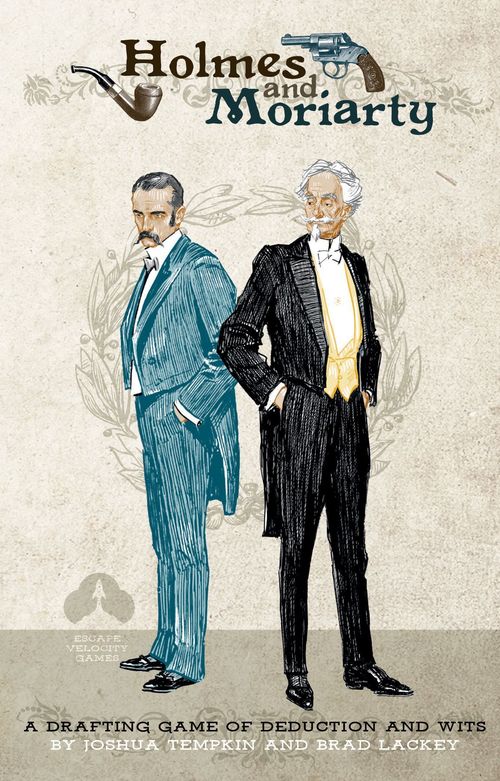
Holmes and Moriarty
Holmes and Moriarty Rulebook
Table of Contents
Table of Contents
Game Overview
Professor Moriarty is almost ready to enact his nefarious plan! Sherlock Holmes suspects that something is about to happen, but he doesn't know the details. As Moriarty's crimes set the final pieces into place, Holmes desperately searches London for the clues he needs to foil his nemesis. London's greatest intellects go head to head in this intense battle of wits!
Holmes and Moriarty is an asymmetric 2-player drafting game in which players take on these iconic roles. Over a series of hands, players try to win "cases" by drafting crimes and clues drawn from Conan Doyle's stories. Players mark their winning positions on the scenario board. If Moriarty can score three in a row, he can activate his master plan for the win! If Holmes can foil Moriarty's plans, he wins!
Components
- 16 Plot cards, numbered 1-16 and marked with a location in London (i.e., a suit): Baker Street, Charing Cross Station, Tower Bridge, and Whitehall.
- 2 role reference cards (one each for Holmes and Moriarty) that also show on the back the distribution of the plot cards in the game and the suit of each plot card.
- 1 Scenario Board: a 4x4 grid printed on the inside of the box lid, showing the layout of the cards that also has room for the tokens.
- 15 Case Cards, 9 showing Moriarty, and 6 showing Holmes and icons for the locations in London.
- 16 double-sided tokens.
Game Setup
Place the Scenario Board on the table.
Shuffle the Case cards and place three of them between the players, face-up in a row next to the Scenario Board. Each Case card indicates where one of the three Cases will take place. The Case closest to the Board represents Case 1, the next one Case 2, the third one Case 3. During the game, the players will play 2 cards to their side of each Case card, one to a "crime" row and the other to a "clue" row. Case cards that show Holmes may grant the Holmes player a scoring bonus, also see "Bonus Tokens" on page 4.
Set the double-sided tokens near the board.
Give each player their role reference card.
If you are playing for the first time, keep the Case cards face-down. Also see "Learning Game" below.
Game Play
Holmes and Moriarty is played over a series of up to 5 hands. Following the resolution of each hand, markers are placed onto specified positions on the Scenario Board. If, after placing the markers to resolve the hand, Moriarty has three of his markers in a straight line (horizontally, vertically, or diagonally), then he wins. If, on the other hand, Holmes can show that it is no longer possible for Moriarty to get three in a row, then Holmes wins. Otherwise, play another hand. If Moriarty has not won by the end of the 5th hand, then Holmes wins the game.
Learning Game
For new players, it is recommended that they start with the Learning Game. Instead of playing the full game, players may simply play individual hands of the game. Flip the Case cards face down and do not record any markers on the Scenario Board after a hand. The player who wins two or more of the Cases in the hand wins the whole hand. The first player to win 3 hands wins the game.
How to Play a Hand
Players will play their Plot cards from their hands to a "Crime" Row on their side of the Case cards and to a "Clues" Row behind the Crime Row. (See Figure 1.) A Plot card played to the Crime row is called a Crime. A Plot card played to the Clue Row is called a Clue. Note that during play, all Plot cards will be placed facedown. (They will only be revealed upon resolution of the hand.) A player may look at any of his facedown cards at any time. Each hand has the same sequence of play:
-
Shuffle the 16 Plot cards and discard 2 cards facedown, removing them from play. No one may look at these discarded cards. Deal the remaining cards, 7 to each player.
-
For Case 1, the players simultaneously select two cards from their hand, placing one facedown in the Crime row at Case 1 and the other in the Clue row at Case 1.
Then the players trade hands, giving their 5 remaining Plot cards to their opponent.
-
For Case 2, proceed in the same way: the players simultaneously select two cards from their hand, placing one facedown in the Crime row at Case 2 and the other in the Clue row at Case 2.
Then the players trade hands again, giving their 3 remaining Plot cards to their opponent.
-
For Case 3, proceed as for the first two cases: the players simultaneously select two cards from their hand, placing one facedown in the Crime row at Case 3 and the other in the Clue row at Case 3.
Then the players discard their last card facedown. No one may look at these discarded cards.
-
Finally, the players may rearrange the cards in their own Clue row in any way that they wish, so long as each Case has exactly one Clue in its Clue row when they have finished. Note that players may rearrange the cards in their row. Once placed, Crimes are locked in place and may not be moved.
At the end of the first hand, your table should look as shown in Figure 1. Note that the Case cards are placed randomly, and you might have different ones.
(Figure 1 - how your table will look at the end of the first hand. From left to right: Holmes' side with Clue row and Crime row, the Case cards, then Moriarty's side with Crime row and Clue row; Cases 1, 2 and 3 are arranged top to bottom. The Scenario Board is beside the Case cards.)
Resolving a Hand
At this point, the players resolve the hand to determine what happened.
Proceeding one Case at a time, reveal all of the cards at that Case, both Crimes and Clues. Compare the numbers on the Crime cards to determine the winning Crime. Normally, the higher numbered Crime card will win, but there are some exceptions as shown below.
- Crime 3 Beats Crimes 2, 1, and 16
- Crime 2 Beats Crimes 1, 16, and 15
- Crime 1 Beats Crimes 16, 15, and 14
(Figure 2.) Because of the "wrap-around" effect, each Crime can be beaten by at least three other Crimes.
The location (e.g. Baker Street, Charing Cross, etc) of the winning Crime card will be the "trump suit" for comparison of the Clue cards in that Case. After the winning Crime has been determined, Clue cards with the location of the winning Crime are considered to be "trump."
To determine who won the whole Case, compare the Clue cards. If any of the Clue cards at the Case are trump, then the highest numbered Clue card with trump wins the Case. If none of the Clue cards at the Case are trump, then the highest numbered Clue card wins the Case.
NOTE: there is never a "wrap-around" effect for Clue cards. For Clue cards (that are either both trump or neither trump), the higher numbered card will always win.
NOTE: as each Case has its own Crime cards, the determination of a trump suit only affects the Plot cards in that Case.
Placing Tokens
After the three cases have been resolved, the players will determine whether to add a marker to the Scenario Board.
For each Case that Holmes wins (that is, Holmes has the winning Clue), check the spot on the Scenario Board corresponding to the number of the winning Clue card. If that spot is empty, then Holmes places a token there, flipped to show his icon. If the spot already had a token (regardless of whose icon is showing), Holmes does not get to place his token.
For each Case that Moriarty wins (that is, Moriarty has the winning Clue), check the spot on the Scenario Board corresponding to the number of the Crime card that Moriarty played (not his winning Clue card, as is the case for Holmes). If that spot is empty, then Moriarty places a token there, flipped to show his icon. If the spot already had a token (regardless of whose icon is showing), Moriarty does not get to place his token.
NOTE: Because Moriarty will "score" his Crimes and Holmes will "score" his Clues, the two players may need to think differently about how they select cards during the drafting portion of the hand.
Bonus Tokens
In addition, the players may get some bonus tokens:
- If Moriarty won two of the three Cases, then Holmes chooses one empty spot on the Scenario Board and places a token there, flipped to show Moriarty's icon.
- If Moriarty won all three of the Cases, Holmes chooses two empty spots on the Scenario Board and places a token in each, flipped to show Moriarty's icon.
- If Holmes wins a case with a Case card that shows Holmes, then Holmes may place one token, flipped to show his icon, in any empty space matching any one of the locations on that Case card.
For example, if Holmes wins at a Case where the Case card shows icons for Charing Cross and Whitehall, then Holmes may place one token in an empty space of his choice on a Charing Cross or Whitehall space.
Holmes must always give Moriarty his bonus, though he may order the placement of any bonuses to benefit himself.
Winning the Game
To complete the resolution of the hand, check to see whether a player has won the game.
If Moriarty has managed to get three of his tokens in a row (horizontally, vertically, or diagonally) before the end of the fifth hand, then Moriarty wins the game.
If Holmes can show that it is no longer possible for Moriarty to get three in a row, or if 5 rounds have been played without Moriarty winning, then Holmes wins the game.
In any other case, play another hand.
Strategy Advice
Much of this game revolves around understanding trump in each of the Cases. If you can set the trump location and back it up with the highest card with that location, then you will win that Case.
For example, playing the Whitehall-16 for Crime and backing it up with the Whitehall-9 for Clue is a strong play, since the 16 will beat most other Crimes and set the trump to be Whitehall.
Of course, you don't have to set the trump yourself, if you can guess what your opponent will play! In particular, if you think your opponent might play something like the Whitehall-16 Crime and back it up with the Whitehall-9, then perhaps you should consider playing one of the "wrap-around" crimes to literally steal the trump out from under your opponent.