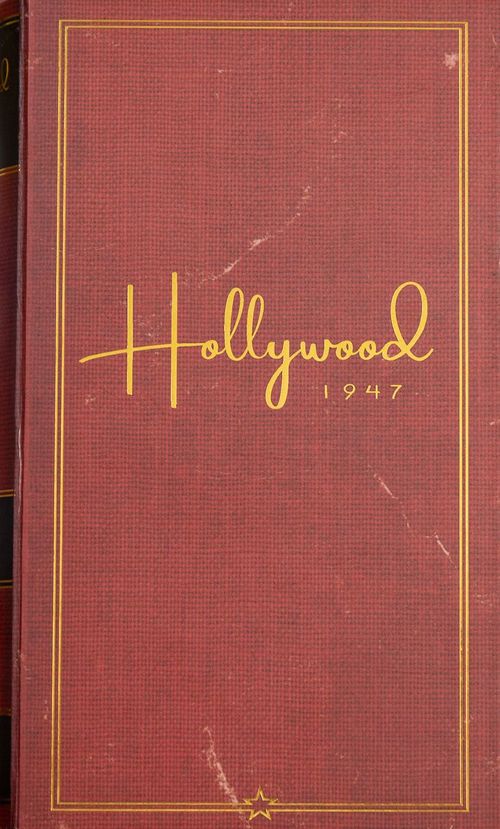
Hollywood 1947
Hollywood 1947 Rulebook
Table of Contents
Table of Contents
Components
- 15 genre posters
- 9 filmstrips
- 60 propaganda cards
- 9 job cards
- 9 loyalty cards
- 9 custom star dice
- 4 sculpted tokens
Set Up
Shuffle the job cards and give one face up to each player. Place remaining job cards into the center face up.
Create a deck of loyalty cards based on the table below. Shuffle and give one to each player face down. Players may view this card but cannot show it to other players. Remove remaining loyalty cards from the game.
| Players | Patriot | Communist | Rising Star |
|---|---|---|---|
| 1 Player | 1 | ||
| 2 Players | 1 | 1 | |
| 3 Players | 2 | 1 | |
| 4 Players | 2 | 1 | 1 |
| 5 Players | 3 | 2 | |
| 6 Players | 3 | 2 | 1 |
| 7 Players | 4 |
All players close their eyes and the dealer directs the Communists to open their eyes to see each other and then close their eyes.
Shuffle the propaganda cards and give three to each player. Place remaining cards in a face down deck in the center. Players may view these cards but cannot show them to other players. These cards form a player's hand. Unless otherwise stated, references to "the deck", "cards", and "hands" refer to these propaganda cards.
Give each player a die. Each player should roll their die and place it in front of them.
Shuffle the genres and place them face down in the center.
Place the four tokens and nine filmstrips into the center.
Overview
The game happens in up to seven rounds. In each round a certain genre of movie will be made as indicated by the genre poster for the round. Players will each get a turn to either perform their unique job or affect the dice in the game. After all players have taken a turn, the players with stars showing on their dice will add a card from their hand face down into the center. These cards will be shuffled and revealed, and the total number of patriot symbols will be compared to the total number of communist symbols. Each round's genre will also affect the symbol total.
If you are a patriot your goal is to make 4 movies that have a majority of patriot symbols. If you are a communist, your goal is to make 4 movies that have a majority (or a tie) of communist symbols. If you are the rising star your goal is to keep the score as close as possible up until the very end (described more later). The game ends as soon as one team has reached their goal.
This game is part strategy and part social deduction. You must never show your cards or loyalty to anyone, but you may say whatever you'd like about the cards you put into a movie, or about your loyalty. Open discussion and strategizing throughout the game about which cards were added into a movie is encouraged. However, if you are a communist or the rising star, lying will often help you accomplish your goals since the majority of players will be patriots.
How to Play
The game happens in up to seven rounds. Each round a movie will be made. For each movie the following process (Production, Post, and Premiere) occurs. Playing cards into the "movie" refers to adding propaganda cards face down into the center.
1 | Production
Starting with the player with the lowest number on their job card and proceeding clockwise around the circle, each player takes a turn. On your turn you may select one of the following three options, or pass.
Option 1: Perform your job
If any job is not currently filled by a player in the game, that job will not be performed this round. When the rules say "any player" it includes yourself.
- Screenwriter draws two genre posters and secretly picks 1 to reveal and place in the center of the table. The other genre is removed from the game face down. Players are not allowed to "interrogate" the screenwriter about anything on the rejected poster (name of the genre, details about the picture, etc) besides the symbol in the bottom corner.
- If there is no screenwriter (or that player chooses a different option on their turn) a genre is simply revealed from the top of the genre deck and placed in the center of the table at this time.
- Producer swaps any 2 job cards. These can include cards from the center as well as any player cards, including their own. If the Producer swaps out their own job with another player, the (former) Producer may immediately perform the new Job if it has not yet been performed this round by another player.
- Director gives any player a token. The same person cannot receive a token in consecutive rounds. (tokens are explained in the Nitty Gritties section)
- Gaffer re-rolls any 3 dice. Unlike other players, the Gaffer is allowed to re-roll the same die more than once as part of those re-rolls. (described more in Option 3).
- Cinematographer forces any player to discard all their cards and draw a new hand.
- Actress allows any player to draw 2 cards & then discard 2 cards.
- Actor allows any player to draw 2 cards & then discard 2 cards.
- Composer draws 2 cards, puts 1 face down into the movie & discards the other.
- Editor indicates whether they would like to edit the upcoming movie by moving their job card closer to the center (described more in the Nitty Gritties section).
Option 2: Swap your job with one from the center
This costs your turn, so you will not be able to perform your new job until the next round. In a 9-player game the job swap action is unavailable.
Option 3: Re-roll any two dice
Roll each die one at a time and then return it to its owner. You may not re-roll the same die more than once. You may select your own die as one of the two. If you would prefer, you may re-roll only one die.
2 | Post
After everyone has had a turn:
- Each player with a star on their die must add 1 card face down into the movie. Next, any player with a token (given to them by the director) may spend it to add an extra card face down directly into the movie (even if they do not have a star showing on their die).
- Add 1 card from the top of the deck face down into the movie. Skip this step if the composer used their turn to add a card to the center.
- Shuffle and remove 1 card from the movie. Shuffle the cards from the movie and discard 1 at random. If the editor chose to perform their job, instead of discarding this card give it to the editor to view. The editor can either discard the card or place it back into the movie. If they placed it back the movie cards are again shuffled and a random card is discarded.
3 | Premiere
- Reveal the remaining cards from the movie to determine the round's winner. The team with the majority of revealed symbols, including the symbols on the bottom corner of that round's genre poster, wins the round! If the total number of symbols are tied, the communist team wins the round. Indicate the winning team for the round by placing the winning team's filmstrip on top of the genre poster.
- Check for Congressional Hearing and Shake-Up cards. If one or more "Congressional Hearing" cards was revealed in the movie, re-roll all dice, otherwise leave them as they are. If one or more "Shake Up" cards was revealed in the movie all job cards (including those from the center) are shuffled and re-distributed.
- Draw. Finally, everyone with less than three cards should draw back up to three.
Discard all played cards from the round and continue the game by repeating the steps above and making a new movie.
An Important Note about the Discard Pile: This game does not use a standard discard pile. Instead, whenever the rules say to "discard" cards you must place them face down in an area away from the table, so that they are never seen or accidentally re-drawn by other players. If the deck runs out, shuffle discarded cards to reform the deck.
Winning the Game
As soon as either team (communist, patriot) has won 4 rounds, that team wins and the game is over!
If seven total movies are made (meaning after six movies the score was tied three to three) and in the seventh movie the symbols are either tied, +1 patriot, or +1 communist, the rising star wins alone. If the patriots or communists win the round by +2 or more, that team wins alone and the rising star loses. Note: in 1, 2, 3, and 5-player games there is no rising star and the 7th round is scored normally.
You are now ready to play! Example Rounds, 1-3 player adjustments, nitty gritty rule clarifications, and optional rules can be read below as needed.
Example Rounds
At the end of a round 3 players have stars showing on their dice so those 3 players each add 1 card face down to the center. A random card is not added from the deck since during the round the composer added a card to the center when they performed their job. The editor chose to perform their job so they shuffle the 4 cards, draw and view 1 and decide to discard it. The remaining 3 are revealed. The cards show a double patriot, neutral, communist and the genre poster shows a patriot. The patriot team wins the round (3 total patriots vs 1 total communist). The double patriot card was a "Congressional Hearing" so all dice are re-rolled before starting the next round.
At the end of a round 4 players have stars showing on their dice so those 4 players each add 1 card face down to the center. A random card is added from the deck since the composer did not perform their job this round. The editor chose not to perform their job so the 5 cards are shuffled and 1 is discarded at random. The remaining 4 cards are revealed. The cards show a neutral, neutral, double communist, and patriot, and the genre poster shows a patriot. The Communist team wins the round (it was a tie with 2 total communists vs 2 total patriots and tied rounds go to the Communist team). The double Communist card was a "Shake-Up" so all jobs are shuffled and re-distributed before starting the next round.
At the end of the 7th round 2 players have stars showing on their dice so those 2 players each add 1 card face down to the center. A random card is not added from the deck since during the round the composer added a card to the center when they performed their job. The editor chose to perform their job so they shuffle the 3 cards, draw and view 1 and decide to put it back in the pile. The pile is shuffled again, 1 card is discarded, and the remaining 2 cards are revealed. The cards show a communist, communist, and the genre poster was a patriot. Even though the communists had more symbols (2 total communists vs 1 total patriot), The Rising Star wins the game since it is the 7th movie and the score was only +1 for the leading symbol.
1-3 Player Adjustments
For 1-3 player games follow all rules in the main game, applying the following adjustments:
- Give each player 2 dice and 2 random jobs.
- Start each round with the player who owns the lowest-numbered job and proceed clockwise around the circle 2 times (for 1-player take 2 consecutive turns). Players may perform either of their jobs on their turn, but no job can be performed twice in the same round (even if it is moved by the producer).
- The screenwriter job can only be used on the first turn of the round, so if the screenwriter is in the center to start the round or the screenwriter does not want to use that job this round, draw a genre at random to start the round.
- Like the normal rules, players can instead use a turn to re-roll any 2 dice or swap either of their jobs (including one they already used that turn) with one from the center.
- If a player has two dice showing stars at the end of a round, they must add two cards to the center.
- Place 1-3 "ghost" propaganda cards (3 for 1 player, 2 for 2 player, 1 for 3 player) face down in the center of the table and roll 1 die next to each of them. If at the end of a round any of those dice show a star, its matching card will be shuffled into the movie and then it will be replaced by a new random face down card. Cards without stars are not added, but will remain in place for the next round. You can spend a turn to view all current ghost cards. At the start of each round you must re-roll each of the ghost's dice. If you spend a turn re-rolling dice you may select ghost dice as one or both of your re-rolled dice.
For 3-player games the communist only needs to win 3 rounds instead of 4 to win the game.
For 2-player games remove the "Monster" and "Horror" genres from the game and the 6 non-Shake Up double communist cards from the deck. In 2-player games if a round ends in a tie the round counts as a victory for both players. If both players reach 4 victories simultaneously the game ends in a tie.
For 1-player games remove the producer job from the game.
Optional Rule Variants
Your group is welcome to try out any of these advanced variants of the game!
Union Strike: Each time a neutral poster is active for the round the players with stars on their dice may each play any number of cards (0-3) at the end of the round and then draw back up to 3 cards.
Random Loyalties: Deal out random loyalties from the 9 available so that nobody will know exactly how many patriots, communists and rising stars are in the game. Some games may be very one-sided, but that will make unlikely victories all the more sweet!
Handpick Jobs: Remove any particular jobs from the game, as long as there are at least enough Jobs for each person to have one.
Nitty Gritties
Director: The director can give themself a token, but only every other round (since the same player can't receive a token in consecutive rounds, even if the director changes). If all tokens have already been assigned, the director may move a token from one player to another for their job. In 1-3 player games if the director gives a token to a ghost, the ghost will spend one token to play their card the next time they don't have a star on their dice.
Editor: If the editor chooses to edit but then loses their editor job because of the producer (or a job swap in a 1-3 player game), they may still edit that round.
Producer: The producer may swap any two job cards, including their own producer job, jobs belonging to other players, or jobs from the center. Swapped players who have not had their turn yet during the round may perform their new job on their turn. However, the same job can not be performed twice in the same round, so a player receiving an already-performed job (including the player receiving the producer job) can only use their turn to reroll dice or swap their job with one from the center. If the producer swaps their own card with another player (not with one from the center) they may immediately perform their new job, unless their new job has already been performed that round, in which case the (original) producer's turn ends. See "Editor" and "Screenwriter" sections for further details.
Screenwriter: The screenwriting job can only be used on the first turn of a round, so if someone becomes the screenwriter mid-round (because of a job swap or producer swap) they will not be able to perform that job until the beginning of the next round.
Tokens: A player does not need to have a star showing on their die in order to spend a token to add a card into the movie. A player is allowed to spend multiple tokens in the same round. If there is a debate about the order that tokens should be played, play all tokens in turn order (starting with the lowest number and proceeding clockwise).
History
In the early years of the second Red Scare and McCarthyism, the US government suspected that the Communist party had infiltrated the Hollywood entertainment industry. They worried that movie-makers would fill the screens with "un-American" messages and undermine the values of capitalism and freedom. The Motion Picture Alliance for the Preservation of American Ideals issued a pamphlet advising movie-makers to avoid "subtle communistic touches" in their films. It recommended that studios "Don't smear the free-enterprise system ... Don't smear industrialists ... Don't smear wealth ... Don't smear the profit motive ... Don't deify the 'common man' ... Don't glorify the collective", etc.
This paranoia led to the "Hollywood blacklist" in which prominent actors, directors, screenwriters, and other crew members were denied employment based on their membership, alleged membership, or sympathy with the Communist party. Some of the most famous victims of the blacklist were known as "The Hollywood Ten", writers and directors who refused to testify at a Congressional Hearing and were subsequently imprisoned. The blacklist was a dark chapter in Hollywood where finger-pointing and whispers shattered lives and careers.