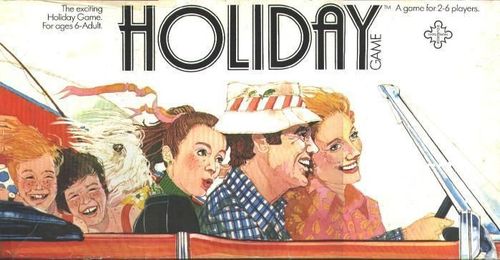
Holiday
Holiday Rulebook
Table of Contents
Table of Contents
Contents
"Holiday" consists of a board, $1,500 holiday money (30 x $20, 90 x $10), one dice, 6 conical markers and 12 "hitch-hiker cards".
Object of the Game
The aim is for each player to take his family on Holiday and return home first without running out of money.
He must pay the normal bills and costs along the way — and also cope with unexpected costs and delays. However, he can also win or earn extra money, depending on the fall of the dice.
Each player tries to gain advantage over his opponents by using his money shrewdly and choosing his route with care.
The game is in two halves:
(a) The trip from home to the airport along a route of the player's choice, and
(b) A stay at one of three resorts, depending on how much the player can afford after the costs of the trip to the airport.
The more costly the resort, the shorter the route home but the higher the bills you may have to pay.
Holiday Money
Each player starts the game with $100 holiday money to spend on the trip — six $10 notes and two $20 notes.
Money can also be won or earned on the trip and this is taken from the bank.
How to Start
Nominate a player to be the banker. Each player is then given $100 holiday money.
Shuffle the hitch-hiker cards and place the pile face down on the space provided on the playing board.
Throw the dice to start, highest number going first. If two or more players get the same high number, they then throw against each other until one gets a higher number. Play clockwise from this first player.
Paying Bills
All bills on the holiday journey are paid to the bank.
Travelling Faster
A player can move faster on his holiday:
(a) By paying $10 to the bank for extra petrol, which gives a second throw. A player must declare his intention to buy this second throw — and must pay for it — BEFORE his first throw.
(b) Or by throwing a six, for which he gets a free second throw — or if he has bought a second throw, a third throw.
Getting More Money
A player throwing a six can, instead of taking his second throw, take $20 from the bank.
A player may use this option to settle debts — e.g. If a six lands his marker on a square costing $50, he can forfeit his second throw and pay $30. If a six lands his marker on a square costing $20, he can forfeit his second throw and settle the debt. If on a square costing $10, he can forfeit second throw and take $10.
Players can try to boost their cash by travelling down Gold Street where a dice game operates at the casinos.
Dice Game: A Player landing on a "Dice Game" square has a second "gambling throw" of the dice. Before doing so, he nominates two numbers between one and six. If either comes up, the player wins the amount specified on the "dice game" square. A player's marker is NOT moved on a gambling throw and a six on a "gambling throw" does NOT give a second throw.
A player can also obtain more money by landing on the two banks, on "sell surfboard" square or any of the squares which denote winning or earning money. Several of these are on the "Lucky Lane" section.
Running Out of Money
Any player who does not have enough money to pay a bill in full must go back to the closest bank where he withdraws the sum nominated on the bank square. He then pays the bank the amount of the bill he incurred and plays on from there on his next turn.
If a player has not passed the first bank and lands on a bill he cannot pay he must return home and start again with $100, again settling his debt in full.
A player reaching the Airport with less than S20 [sic — printed as "S20" in the recreation, read as $20] — that is, without enough money to pay for any resort — waits until his next turn then moves back to the closest bank, collects $100 and plays on from there on his next turn.
Hitch-Hiker Cards
Player landing on a hitch-hiker square takes the top hitch-hiker card from the pile, follows instructions on it then places it at the bottom of pile. Cards should be shuffled before each game.
If a player lands on a hitch-hiker square with a six and draws a "miss a turn" card, he forfeits his second throw immediately then has his next throw as normal when his turn comes up.
If "advance 10 spaces" card comes up:
(a) Three squares from airport, player moves to airport and awaits next turn as normal.
(b) Three squares from home, player wins the game.
(c) 10 squares from "you can fly to airport" pay $50 or play on normally.
If "Go Back Five Spaces" card comes up and player moves back on to a bill or win-money square, the player pays out or collects as the case may be.
Airport
A player throwing a higher number than he needs to land on the airport advances to the airport and remains there until his next turn. He must then nominate and pay for the resort he wants to stay at BEFORE throwing the dice. If the player reaches the airport with a six his next turn is taken immediately.
A player landing on "for $50 can fly you to the airport" square can pay $50 to the bank and move directly to the airport. This is not compulsory and a player may choose to play on normally, in which case he pays no fee.
Being Sent Back
Players sent home by the "Mum left stove on" or "Dad left door open" squares do NOT take another $100.
If a player is sent back to cafe or Fred's garage the $20 charge must be paid again.
If sent back to reception at the resorts, a player moves his marker back to the reception square of the resort he stayed at but he does not pay the accommodation charge again. However he does pay any other bills he may incur.
The Finish
When approaching home a player can still buy a second turn — but if the first throw is too big to land exactly on the "Home" square then no move is made and the second move is forfeited. The same applies when a six is thrown.
The winner is the first to land exactly on the "Home" square.