Hold Everything!
Hold Everything! Rulebook
Table of Contents
Table of Contents
Contents
- 66 playing cards (43 object cards, 15 playing-field cards and 8 blank cards)
- 6 pawns
- 1 die
Game Idea
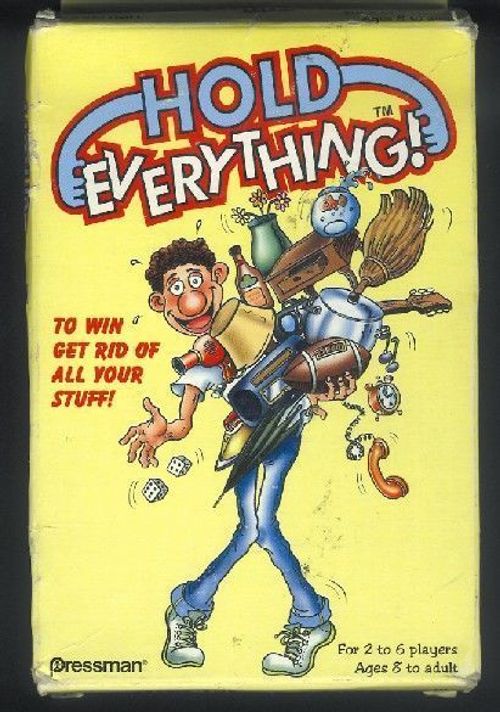
At the start of the game each player is given three objects, which they place on their arm and must hold. During the game, bad luck can add further objects to a player's arm, such as a slipper, a brush, a plush toy or a coat hanger. The first player to place all of their objects on the table, or to hand them to their fellow players, is the winner.
Holding the Objects
To hold the objects, a player may use only their weakest arm. Right-handed players hold the objects on their left arm, left-handed players on their right arm. For holding, a player may also use any other part of the body (in case that helps!?). So the weakest arm, shoulder, cheek or chin, but never the strongest arm. The strongest arm may only be used to roll the die, to take cards, or to take and place objects on the table. Of course, a player may stack several objects on top of each other.
If during the game a player drops one or more objects, they must pick up those objects again and, as a penalty, take one extra object from the table. The player may choose this object themselves. If the player drops something again, they must again take an extra object from the table. In this way a player may end up taking up to a maximum of 4 extra objects in one and the same turn, but no more than that.
During the game, objects are always taken from the table. If a player must give an object to another player, they first place it on the table. The fellow player must then take the object from the table.
Setup
All players stand around the table; chairs are not needed. Five times as many objects are needed as there are players. With three players you therefore need 15 objects, with four players 20 objects, and so on.
All players look through the 43 object cards and find the cards that show objects which are in their home and which may be used in play. If there are not enough objects available at home, the players may also draw the objects they need on the blank cards, provided those objects are available to them.
Collect the objects you need and place them on the edge of the table. The corresponding cards are shuffled and placed face down in a stack in the middle of the table. All other object cards and blank cards are not needed and are put back in the box.
The 15 "playing-field" cards are shuffled and laid face up on the table in a circle or oval. The order of the cards is not fixed.
Each player takes a pawn and places it on the start card with the flag. If there are fewer than six players, the remaining pawns are not used and are put back in the box. The die is placed in the middle.
Beginning with the oldest player and continuing clockwise, each player takes three cards from the face-down stack. Each player takes the matching objects shown on their cards from the edge of the table and places them on their weakest arm as described above. Then all players return their cards to the stack. The oldest player shuffles the stack, first setting their own objects aside for a moment, and then places the cards back face down in the middle of the table.
Course of the Game
The youngest player begins. Play then continues clockwise. The player whose turn it is must carry out three actions one after the other.
1st Action
The player whose turn it is rolls the die and moves their pawn forward clockwise the number of pips rolled. If they roll a four, they move their pawn four cards further clockwise; with a five, they move five cards further.
2nd Action
If the pawn lands on a card where one or more other pawns already stand, the player at random gives one of their objects that are on their weakest arm to one of those players. The player whose turn it is states clearly and audibly which of their objects they want to give to whom. They place the named object on the table, where the relevant fellow player must take it immediately.
Note: if the player whose turn it is lands on a card where no fellow player's pawn stands, this action is void.
3rd Action
The player carries out whatever the card on which they stand indicates.
- If the player whose turn it is lands on the blue stop card, they must skip their next turn.
- If the player whose turn it is lands on a green dice card, they must roll the die again and carry out the three actions one after the other once more.
- If the player whose turn it is lands on the grey start card, they choose a random fellow player with whom they must exchange one of their objects. Both players state which object they want to place on the table. Once this has actually happened, the other player must take the object.
- If the player whose turn it is lands on a yellow gift card, they must give one of their objects to their left-hand neighbour. The player may choose for themselves which object to give. They state which object it is and place it on the table, where the fellow player takes it immediately.
- If the player whose turn it is lands on a red stack card, they must take a card from the face-down stack. They look at the object shown on it:
- If the player whose turn it is already has the object shown on their arm, they set the object and the card aside. Both are no longer used in the rest of the game and are removed from play.
- If a fellow player has the object shown, that player gives this object to the player whose turn it is. They place the object on the table, where the player whose turn it is takes it immediately. The card is turned face up by the player whose turn it is and placed next to the face-down stack.
- If no player has the object shown, the player whose turn it is must take the corresponding object from the edge of the table. The card is turned face up by the player whose turn it is and placed next to the face-down stack.
If a player takes the last card from the face-down stack, they must shuffle all the cards lying face up next to it (using only their strongest hand!) and lay them out again as a new face-down stack. If they drop anything while doing so, they must take an extra object.
End of the Game
The first player who can place all of their objects on the table, or hand them to their fellow players, is the winner. Then all players except the winner help to return the objects to their original places.
Tip
"Alles im Griff" can also be played with 7 or 8 players. You then need only one or two extra pawns.