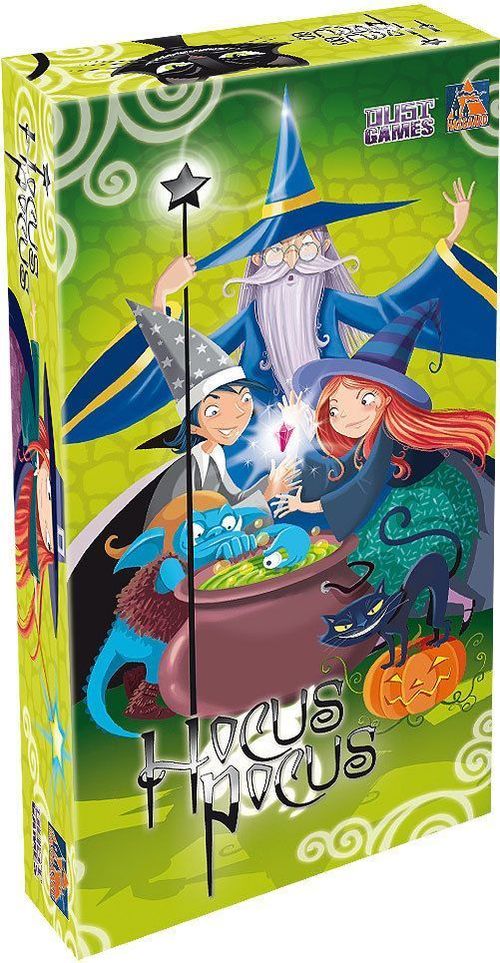
Hocus Pocus
Hocus Pocus Rulebook
Table of Contents
Table of Contents
Overview
The winner is the player with the most Gems at the end of the game.
Gems are gained through cards that you play. These cards let you draw Gems directly from the Cauldron or from your opponents! Gems gained this way must be placed in front of the player who owns them, always in plain view of all other players.
Components
- 50 Hocus cards
- 25 Pocus cards
- 35 plastic Gems
- 1 rules booklet
Card list by type:
| Hocus | Pocus |
|---|---|
| 2 Vortex | 7 Amulets |
| 2 Abracadabra | 4 Magic Wands |
| 3 Crystal Balls | 3 Enchanted Mirrors |
| 3 Owls | 3 Pumpkins |
| 2 Sacrifices | 2 Counterspells |
| 3 Curses | 2 Hourglasses |
| 5 Inspirations | 2 Black Cats |
| 15 Thieves | 2 Lightnings |
| 15 Spells |
Card layout: each card shows its name (Hocus cards: Spell, Thief, and so on), a reminder of the number on numbered cards (for example, the number of Gems to take), a reminder of the card type (Hocus or Pocus), and the card's power.
Setup
-
In a 2-player game: remove the 3 Enchanted Mirror cards from the deck and return them to the box. In a game of more than 2 players: remove 3 Amulet cards from the deck and return them to the box.
-
Shuffle the remaining cards. Each player receives 3 cards face up and 3 cards face down. The face-up cards are placed in plain view in front of each player and form their Grimoire. Players take their face-down cards (without showing them) and keep them in their Hand. Players must never hide the number of cards they have in Hand.
-
The undealt cards are placed in a face-down pile in the centre of the table. This pile is called the Library. A free space must be left beside it. This space will be used during play to form a discard pile.
-
Depending on the number of players, a number of Gems is placed in a pile beside the Library. This pile is called the Cauldron. The length of the game depends directly on the number of Gems in the Cauldron: the more Gems at the start, the longer the game. To find the number of Gems for the Cauldron, refer to the table below:
| Players | Gems |
|---|---|
| 2 | 20 |
| 3 | 25 |
| 4 | 30 |
| 5 and 6 | 35 |
| Quick game | 15 |
Setup diagram (labels): Grimoire of player 1; Hand of player 1; Discard pile; Play area (the central dashed area); Cauldron; Library; Hand of player 2; Grimoire of player 2.
Sequence of Play
Players take turns, in clockwise order. The first player is the youngest.
1. Play one or more Hocus cards
Hocus cards are red.
During your Turn, you may play as many Hocus cards as you wish. However, you may only play them one at a time. You may play cards from your Hand or from your Grimoire. In Hocus Pocus, all cards are played by placing them face up in the Play area in the centre of the table (see the diagram above). The power of a Hocus card is resolved, if it is still in play, after the powers of the Pocus cards played on it have been resolved.
2. Play one or more Pocus cards
Pocus cards are yellow.
When you have played a Hocus card, all players, including you, may play, in no particular order, one or more Pocus cards. Played Pocus cards are placed face up on the Hocus card in the Play area. You may play Pocus cards on your own Hocus card!
When no player wishes to place another Pocus card on your Hocus card, the powers of the Pocus cards are resolved in the order they were played. Then, if it is still in play, the power of the Hocus card is resolved.
3. End your Turn
Your Turn ends when you no longer have, or no longer wish to play, any Hocus cards. You must then choose one of the following:
- draw 2 cards from the top of the Library, or
- draw 1 Gem from the Cauldron.
This drawing action marks the end of your Turn.
Tip: in general, it is better to take 2 cards rather than a Gem, unless you are close to victory. Also, it is best to avoid taking Gems when the Cauldron is almost empty and another player is close to victory!
At the end of your Turn, you may have no more than 5 cards in your Hand. If you have more, you must choose the excess cards, then place them face up on the discard pile.
Then gather all the cards still in the Play area and place them face up on the discard pile.
If the Library is empty, shuffle the cards of the discard pile, then place them face down to form a new Library.
4. Pass to the next player
Once your Turn is over, the player on your left takes their Turn.
The Cards
The power of each card and how to use it are described on the cards themselves.
Hocus Cards
Hocus cards are red. These cards represent your most powerful spells. They may only be played during your Turn. A Hocus card may never be played on another Hocus card or on a Pocus card.
Abracadabra
Choose a player of your choice. Swap your Hand with theirs. You do not need to have any cards in your Hand to play Abracadabra. If you have no cards in your Hand, the chosen player must simply give you the cards from their Hand.
Crystal Ball (Boule de Cristal)
Look at the top 4 cards of the Library and put them back on top, in the order of your choice.
Owl (Hibou)
Choose a player of your choice. That player must give you the number of card(s) from their Grimoire indicated on the Owl card. If this player does not have enough cards in their Grimoire, they must give you their entire Grimoire.
Inspiration
Draw the number of cards from the Library indicated on the Inspiration card. If this card is played successfully, no other Inspiration may be played during your Turn.
Curse (Malédiction)
Choose a player of your choice. Then choose, from that player's Grimoire, as many cards as indicated on the Curse card. These cards must be placed face up on the discard pile.
Sacrifice
Choose a player of your choice. That player must put 2 of their Gems back into the Cauldron. If this player has only 1 Gem, they must still put it back into the Cauldron.
Tip: this card becomes more important toward the end of the game. Indeed, by adding Gems to the Cauldron, it becomes harder for the player who is in the lead to take the last Gem.
Spell (Sortilège)
Take the number of Gem(s) indicated on the Spell card from the Cauldron. Place them in front of you.
Thief (Voleur)
Choose a player of your choice. That player must give you the number of Gem(s) indicated on the Thief card. If this player does not have enough Gems, they must give you all of their Gems.
Vortex
All players give their Grimoire to their neighbour on the left. A Vortex can only be stopped by a Counterspell or a Pumpkin played from a player's Hand. Players with no cards in their Grimoire give nothing to their neighbour on the left.
Tip: use a Vortex after you have played all your cards, so that you do not have to give spells to your opponents.
Pocus Cards
Pocus cards are yellow. These cards do not represent your spells, but are a means of acting on them by amplifying, modifying, neutralising them, and so on. Therefore, they may only be played if there is a Hocus card in the Play area. A Pocus card may be played on a Hocus card or on another Pocus card. Each player may play several Pocus cards on a single Hocus card. Pocus cards may be played by anyone, at any moment of the game, whether during their Turn or not, as long as there is a Hocus card in the Play area. When a Hocus card leaves the Play area (because it has been destroyed, stolen, etc.), all Pocus cards played on that Hocus card are placed on the discard pile.
In case of disagreement about the order in which card powers are resolved, use the order in which the cards were played.
Amulet (Amulette)
The Hocus card aimed at you, on which you play the Amulet card, is destroyed. Place it face up on the discard pile. All Pocus cards in the Play area are destroyed. Place them face up on the discard pile.
Magic Wand (Baguette Magique)
The number on the Hocus card on which you play the Magic Wand card is doubled. For example: Christophe plays a Spell 3, then immediately places a Pocus Magic Wand on top of it. No other player plays a Pocus card. Christophe therefore takes 6 Gems from the Cauldron.
Black Cat (Chat Noir)
Take the Hocus card on which you play the Black Cat card. Put it into your Hand. All Pocus cards in the Play area are destroyed. Place them face up on the discard pile.
Pumpkin (Citrouille)
The Hocus card on which you play the Pumpkin card returns to the Hand of the player who played it. That player may only play it again from their next Turn. All Pocus cards in the Play area are destroyed. Place them face up on the discard pile.
Tip: you may play a Pumpkin on your own Hocus card to remove the Pocus cards played by other players.
Counterspell (Contre-sort)
The Hocus card on which you play the Counterspell card is destroyed. Place it face up on the discard pile. All Pocus cards in the Play area are destroyed. Place them face up on the discard pile.
Lightning (Éclair)
The Hocus card on which you play the Lightning card is protected against all other Pocus cards played afterwards; these will have no effect. In addition, all Pocus cards already played on the Hocus card are cancelled. Place them face up on the discard pile. Only the Magic Wand card works on a Hocus card on which a Lightning card has been played.
Tip: this Pocus card is the most powerful, because it prevents a Hocus card from being stopped, even by Pocus cards already played before the Lightning! For example: Christophe plays a Counterspell on Claire's Thief 4. Claire then plays Lightning, protecting her Thief from the Counterspell, and steals 4 Gems from Christophe. It is more effective to keep your Lightnings for powerful combinations such as: Inspiration 3 + Magic Wand.
Enchanted Mirror (Miroir Enchanté)
Reverse the power of the Hocus card of which you are the target. Choose a player other than the one who played the Hocus card on which you play the Enchanted Mirror card. That player becomes the target of the power of the card of which you were the target. Several Enchanted Mirror cards may be played on a single Hocus card. However, in the end, they can never send the Hocus card back to the player who played it.
Hourglass (Sablier)
End the Turn of the player who played the Hocus card on which you play the Hourglass card. As soon as the power of that Hocus card is resolved, the Turn of the current player ends. That player still draws 2 cards from the Library or 1 Gem from the Cauldron.
Tip: play an Hourglass when you believe an opponent is about to play more than one Hocus card. This will ruin all their plans!
Grimoire and Hand
You must at all times (where possible) keep your Grimoire full. This means that if you play a card from your Grimoire, or if one is stolen from you, and your Grimoire therefore contains fewer than 3 cards, you must immediately replace it with a card from your Hand. You may exchange cards between your Grimoire and your Hand, but only during your Turn. This exchange is impossible once you have carried out the drawing action that marks the end of your Turn.
End of the Game
When a player takes the last Gem from the Cauldron, the game ends immediately. Each player counts the number of Gems they own. The player with the most Gems becomes the Master Wizard and wins the game! A player may not take the last Gem from the Cauldron if doing so results in a tie.
Summary of the Rules
- You may play as many Hocus or Pocus cards as you wish during your Turn, whether from your Grimoire or from your Hand (but only one Hocus card at a time).
- You may play as many Pocus cards as you wish on the current Hocus card, regardless of who played it.
- Hocus cards may not be played on other cards, whether Hocus or Pocus.
- Pocus cards may only be played if there is already a Hocus card in the Play area.
- Players may not hide the number of cards in their Hand or the number of Gems they own.
- When a space is free in a player's Grimoire, that player must fill it with a card from their Hand, unless they have no cards left in Hand. Grimoires must be filled at all times, even when it is not that player's Turn.
- You may exchange cards between your Grimoire and your Hand, but only during your Turn.