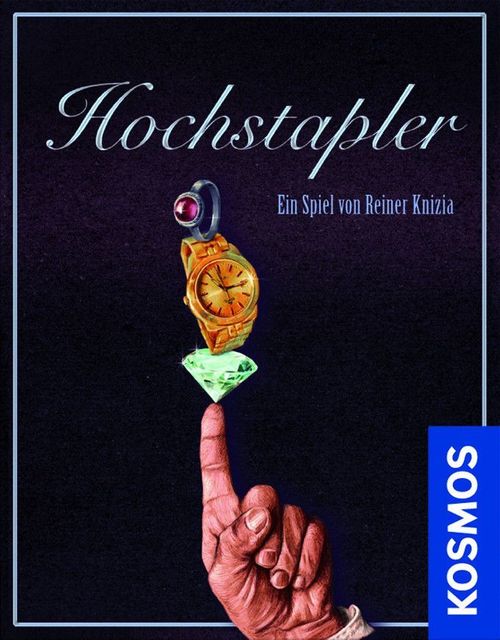
Hochstapler
Hochstapler Rulebook
Table of Contents
Table of Contents
Components
- 105 cards in 7 colours. Values per colour: three cards of value 0; two each of values 1, 2, 3, 4 and 5; one each of values 6 and 7.
- The seven status symbols on the cards: clock, house, car, wine, diamond, yacht and ring.
- 5 cards showing other KOSMOS games. These are not needed for play and can be set aside.
- 1 rulebook.
Object of the Game
Each player starts a round with 7 cards in hand. Each card shows a different colour. Card values range from 0 to 7. The starting player estimates the total of one colour's card values across all players. The next player must either name a higher total, in any colour, or doubt the named total. Whoever is wrong in their estimate or their doubt collects penalty points.
Setup
Sort the cards by colour. Shuffle each colour's pile thoroughly and place it face down in the middle of the table. This gives seven face-down piles in the centre, one per colour. Each player takes one card from each pile. Players should avoid showing their cards to the others.
Playing the Game
The player who most recently bought one of the seven status symbols included in the game starts. If this cannot be determined, the oldest player starts. Play then proceeds clockwise. When it is your turn, you must name a higher total or doubt the total named before.
1. Naming a Total
The player calls out the total of one colour together with the matching symbol (for example, "10 green diamonds"). The card of that colour the player holds is a guide. If the player is not the starting player, at least one player before them has already named a total. They may take this into account as well.
Before naming, the player may place any one card from their hand face up next to the pile of the same colour, and take a face-down card from the top of the pile of that same colour into their hand. The colour of the exchanged card is completely free. It may be the colour of the total the previous player named. It may also be the colour in which the player is about to name their own total. (For example, the player places a green diamond card face up next to the face-down green pile and takes a face-down card from the green pile into their hand.)
However, a player who has exchanged a card must then name a total. They can no longer choose to doubt the previous player's total.
When naming a total, the player may change colour. After "10 green diamonds", for example, they may raise to "11 yellow yachts". They are not required to name a higher total in the same colour as the previous player.
2. Doubting the Named Value
The player calls out that they doubt the total named by the previous player. All players then lay out, in turn, the card they hold in the named colour face up in front of themselves, and add up the values.
- If the total is at least as high as named, the doubting player was wrong. As a penalty, they must take all cards of that colour and place them face down in front of themselves as a pile. This pile counts as one penalty point.
- If the total of the card values in the named colour is lower than announced, the player who made the call is exposed as an impostor (Hochstapler). They must take all cards of that colour and place them face down in front of themselves as a pile.
If the players still hold cards, the player who doubted the call begins the next round with a new call of any kind, and play continues.
Example
In a four-player game, Andrea has the following cards in hand:
(The original rules show Andrea's hand as an illustration. It is not reproduced here.)
Andrea starts and calls "10 green diamonds", since she herself holds a green diamond card with value 6. Bernd raises to "11 yellow yachts". Christoph probably also holds a high green card, because he raises to "13 green diamonds" and exchanges a purple card in doing so. He places purple wine bottles with value 1 face up and takes the top card of the purple pile. Now Dorle is up: she exchanges a yellow card and calls "14 blue rings". This seems a bit too high to Andrea, so she doubts it. All players reveal their blue card:
(The original rules show the four revealed blue cards as an illustration. They are not reproduced here.)
The values are added up. Luckily for Andrea, the total is only 13 rings. Since Dorle named too high a total, she takes all blue cards from the central pile and places them face down in front of herself. The blue cards are now all out of the game, and they count as 1 penalty point for Dorle. Andrea then begins the next round.
End of the Game
The game ends after a player has placed the last card pile in front of themselves as a penalty point, so that no player has any cards left in hand.
The player with the fewest penalty points wins. If several players have the same lowest number of penalty points, those players share the win.
Variant
Several rounds are played. After each round, the penalty points are noted on a sheet of paper. The game ends with the round in which a player reaches 10 or more penalty points. The player with the fewest penalty points wins.