Hochspannung
Hochspannung Rulebook
Table of Contents
Table of Contents
Components
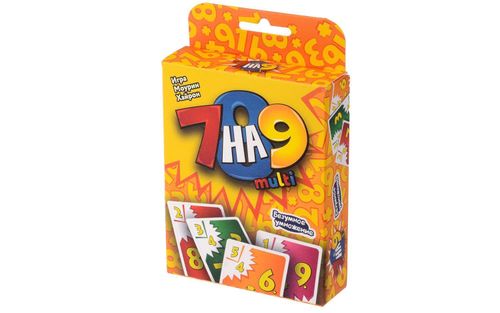
- 61 cards. Each card has two different numbers from 0–8 in the corners and a multiplication problem from 2x3 to 9x9 in the center.
Setup
Shuffle all of the cards and deal them evenly to all players, face down. Place the final card in the center of the table, face up. This is the start of the discard pile.
The cards you've received are your personal draw piles. Keep them face down in front of you. Draw four cards from your own pile for your hand, but don't look at them yet.
Setup for three players (diagram): the discard pile sits in the center, with the three players seated around the table.
The Goal of the Game
You all play at the same time, trying to play your cards to the discard pile in the center of the table. Each card shows a multiplication problem in the center. The first player to solve the problem and have a card in their hand with one of the solution's digits in the corner plays that card on the pile. The new card shows a new problem you need to solve as quickly as possible, and so on.
The first player to get rid of all their cards wins.
Playing the Game
The youngest player kicks off the game by saying "Go!"
All players immediately look at their cards. If you have a matching card (see below), play it on the discard pile from your hand at any time: there are no turns.
The multiplication problem on the top card of the discard pile determines which cards are matches.
Matching Cards
Each card shows two different numbers in the corners and a multiplication problem in the center. In order to find out whether you can play a card, solve the multiplication problem on the top card of the discard pile and find a card with a corner number that appears in the problem's solution.
The problem's solution can have one or two digits: for example 6 or 15. You'd have to play either a card with the number 6 in the corner or a 1 or 5, respectively.
Example 1: The discard pile's top card shows the problem 2x3. The solution is 6. Every card with a 6 in the corner matches.
Example 2: The discard pile's top card shows the problem 3x5. The solution is 15. Every card with a 1 or a 5 in the corner matches.
Rules for Playing Cards
You can only play one card at a time. When you play a card, you must announce the solution out loud, so the other players can check if your card matches. If you're fast enough, you can play a whole series of consecutive matching cards.
Note: Your job is not to announce the result as quickly as possible, but to play a matching card. If another player calls the correct result as quickly as you do, but plays their card faster, you've been unlucky: You have to take your card back into your hand.
Drawing Cards
You may draw individual cards from your draw pile at any time. There's no hand limit.
What Happens If You Get Stuck?
Usually, at least one of you will have a card in hand that you can play. However, towards the end of the game, you may find yourself in a situation where no cards can either be played or drawn. In this case, all of you put your hands of cards on the table, face down. The youngest player takes the bottom card from the discard pile, and places it on top of the pile, face up. Then they say: "Let's go!" You all pick up your hand of cards and continue playing as normal.
The End of the Game
Continue playing until one of you has used up their entire draw pile and has only one card left in their hand. Ignoring the current multiplication problem, put your final card on the pile face down. This signals the end of the game and that player has won.
A Little High-Voltage Tournament
A single game can be over very quickly. So, why not play several games in a row?
All players except the winner of each game gets as many negative points as they have cards left in their hand at the end of the game. The tournament ends after four games. The player with the fewest points wins the tournament.
A Special Challenge for Young and Old Mathletes
If you have both the game Hochspannung and the game Unter Spannung, you can combine them and play them at the same time. Here's how you do it:
Shuffle all of the cards from both games together. Pick a random card from either game and place it in the center of the table, face down. Deal the remaining cards evenly to all players. If you have cards left over, put them back in the box. You now each have one face-down pile in front of you. Draw six of your cards and take them into your hand. One player turns over the card in the center of the table, and off you go.
All rules of both games remain in effect. The top card of the discard pile determines which cards you can play. If the top card is an Unter Spannung card, add or subtract the numbers as usual. For the solution, you may also use a Hochspannung card with the correct number. If the top card is a Hochspannung card, start multiplying as usual. You may use an Unter Spannung card with a correct corner number for your solution, as well.
Important: The corner number 10 on the Unter Spannung card still counts as a 10 in this variant, not as the corner numbers 1 or 0.
Example 3: The top card of the discard pile is from Unter Spannung and shows the corner number 6 and the problem +/-2. Matching cards can be an 8 or a 4, no matter which game they come from.
The first player to get rid of all their cards is the winner and may consider themselves a math genius.