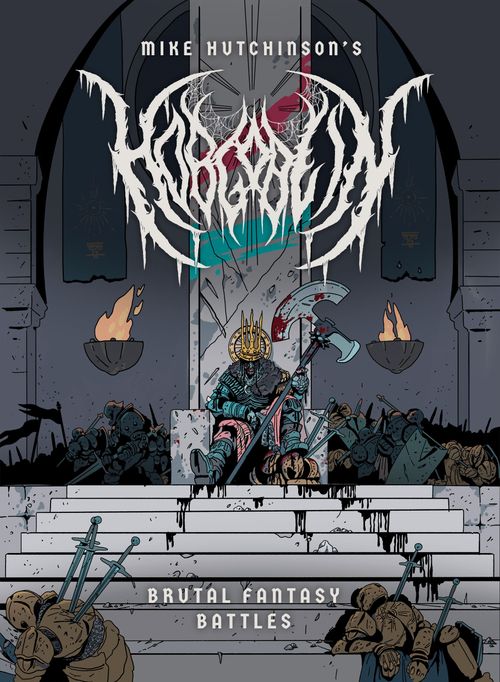
Hobgoblin
Hobgoblin Rulebook
Table of Contents
Table of Contents
The Rule of Carnage
In Hobgoblin, if the rules are ever unclear, pick whichever option results in the most carnage for all concerned.
Build Your Army
A small army is 2000 points. Select units from the chart on page 2 and add the cost of any extra keywords you want to add to them (doubled for units with Keyword Cost X of 2). These Quick Start Rules include a sample of keywords you can buy for your units at the stated cost. See the Hobgoblin rulebook for a full list of keywords to customise your units, as well as rules for spells, magic items and battle standards.
You can use the army builder here: electi-studio.com/hobgoblin
Units
All units are rectangles with an obvious front edge. Give each of your units a Unit Type, which determines their stats, target numbers and the keywords it gets for free. Units with Wide Footprint must have a front edge that is 100-200mm wide, those with a Narrow Footprint 40-100mm wide. A unit's side edges must be 40-150mm long.
| Footprint | Min-Max Width | Min-Max Depth |
|---|---|---|
| Wide | 100-200mm | 40-160mm |
| Narrow | 40-100mm | 40-160mm |
| Horde | 150-200mm | 100-200mm |
Unit Profiles Summary
| Unit Type | Speed | Range | Strikes | Courage | Keywords | Footprint | Keyword Cost x | Points |
|---|---|---|---|---|---|---|---|---|
| Light Infantry | 8 | - | 10 | 10 | Wide | 1 | 300 | |
| Ranged Infantry | 8 | 24" | 10 | 10 | Ranged [24], Skirmishers | Wide | 1 | 300 |
| Heavy Infantry | 6 | - | 10 |
Keywords
Keywords grant special rules to units. A unit cannot have multiple copies of the same keyword, unless it contains a number (e.g. Swift [2]) in which case it stacks.
Common Keywords
Keywords with an asterisk cannot be purchased for units.
Devastating Charge (+50pts)
Strength. If this unit advanced 6" or more this round, it may decrease its target number for close combat attacks by 1, to a minimum of 2, until the end of the round.
Distracted*
Weakness. Reserved. This unit may not end a manoeuvre engaged with an enemy unit it didn't start that manoeuvre engaged with.
Fragile (-50 pts)
Weakness. This unit becomes Broken when it has a number of Doom Tokens equal to or greater than half its Courage value, rounding up.
Immobile*
Weakness. Reserved. This unit may not be activated in the Movement Phase.
Nimble (+75 pts)
Strength. This unit may reform for 2 movement points.
Skirmishers*
Weakness. Reserved. When suffering hits from a shooting attack, this unit does not ignore hits that would result in it receiving a sixth or subsequent Doom Token. It gains one Doom Token for every hit received.
Units with the Skirmishers keyword may ignore Rough terrain.
Tough [X] (+75pts)
Strength. When receiving Doom Tokens from a close combat attack, this unit may ignore the first X Doom Tokens received.
Towering (+25pts)
Strength. When this unit draws line of sight, or when other units draw line of sight to this unit, and when establishing cover, intervening units or terrain may be ignored unless they are Towering or Elevated.
Wild*
Weakness. Reserved. During the Movement Phase, this unit may not take any action that would result in it gaining the Distracted keyword unless it also has a Character-type keyword, or there is a friendly unit with a Character-type keyword within 4".
Keywords Not Defined in This Quick Start
The Quick Start uses the following keywords and terms without printing their rules. They are covered by the full Hobgoblin rulebook, which is not included in this file: Ranged [X] (used by the Ranged Infantry, Light Cavalry and Artillery profiles, and the Shooting Phase refers to Ranged units), Swift [X] (given as the example of a stacking keyword), Character-type (referred to by Wild), Elevated and Rough terrain (referred to by Towering and Skirmishers), and outflanking enemy units (referred to in the Combat Phase).
Doom
A unit which has 10+ Doom (i.e. equal to or greater than its Courage) is Broken. A unit that is Broken causes panic and is removed from play during the Doom Phase; either fled or slaughtered. Use tokens or dice to track Doom.
Setting Up a Battle
Set up some fantasy terrain on a table at least 4'x3'. Roll-off: the winner gets the First Player token. Divide the table in half, and set up your armies on either side, at least 16" apart, alternating the placement of units. See the Hobgoblin rulebook for more ways to set up your battle and full terrain rules..
Battle Rounds
A game of Hobgoblin is divided into five Battle Rounds. Each battle round is split into six Phases:
1. Initiative Phase
Press the Initiative: if First Player rolls higher than the current round number they may choose to keep the First Player token or pass, otherwise they must pass it.
2. Magic Phase
See the Hobgoblin rulebook for the magic rules.
3. Shooting Phase
The first player shoots with any of their unengaged Ranged units. When a unit shoots it gains Distracted. The Second Player then shoots with their unengaged Ranged units.
Units roll 5 attack dice (D6) when shooting. Check the target number chart: rolls that equal or beat that target number are hits. Place 1 Doom on the target for each hit, stopping if the target has 5 Doom (the rest of the hits are ignored).
4. Movement Phase
In the Movement Phase, the First Player moves each of their units. The Second Player then does the same. When an army moves, each unit gains movement points equal to its Speed. Movement points can be spent to perform any of the manoeuvres listed below, any number of times, in any order they like:
- Advance (1+): move directly forward 1";
- Shuffle (1+): move directly left, right or backwards ½", gaining Distracted;
- Wheel (1+) one front corner forward or backwards 1", hinging around the other front corner. Wheeling backwards gains you Distracted.
- Reform (5): spend 5 movement points to spin the unit about its centrepoint to face any direction, gaining Distracted.
A unit that is Distracted must not end a manoeuvre engaged with an enemy unit it didn't start that manoeuvre engaged with.
5. Combat Phase
The First Player must resolve combat attacks with each of their engaged units, in an order of their choosing. The Second Player then does the same.
Units roll 10 attack dice (D6) in combat. Check the target number chart: rolls that equal or beat that target number are hits. Place 1 Doom on the target for each hit.
If a unit is touching multiple enemy units, they assign their 10 attack dice among those enemies, assigning at least 3 attack dice to each. See the Hobgoblin rulebook for rules for outflanking enemy units.
6. Doom Phase
In the Doom Phase, carry out the following steps:
- Panic: All units gain 1 Doom for each friendly Broken unit within 8". If this causes the unit to become Broken, that unit causes panic too.
- Remove Broken Units: Remove all Broken units from play simultaneously.
- Death's Harvest: Gain a fortune card or two Mercury Token for each of your Broken units that was removed from play in the last step. See the Hobgoblin rulebook for how Fortune Cards and Magic work.
- Who's Next?: Any unit that was engaged at the start of this Doom Phase and is now unengaged may make a free reform manoeuvre.
- Ready Units: Remove the Distracted keyword from all units.
Game End & Victory
The game ends after five battle rounds and the player with the most points still on the table wins. See the Hobgoblin rulebook for more scenarios and victory conditions.
Target Number Chart
The chart is read with the attacking unit's Unit Type on the left and the defending unit's type across the top. Each cell gives the target number the attacker needs on each attack die (rolls that equal or beat it are hits). The Speed and Attack Range columns are the attacking unit's.
| Unit Type (Attacking) | Speed | Attack Range | Light Infantry | Ranged Infantry | Heavy Infantry | Mstr. Infantry | Light Cavalry | Heavy Cavalry | Chariot | War Wagon | Monster | Beasts | Artillery |
|---|---|---|---|---|---|---|---|---|---|---|---|---|---|
| Light Infantry | 8 | - | 4+ | 3+ | 5+ | 5+ | 3+ | 5+ | 5+ | 5+ | 6+ | 2+ | 4+ |
| Ranged Infantry | 8 |
Battle Round Summary
This is the Quick Start's one-page summary sheet, reproduced as printed.
1. Initiative Phase
- Press Initiative
- Draw Fortune Card
2. Magic Phase
- Receive Mercury Tokens
- Cast spells
3. Shooting Phase
- Player one shoots with all units.
- Player two shoots with all units.
- Units that used ranged attacks gain Distracted.
4. Movement Phase
- Player one moves with all units.
- Player two moves with all units.
5. Combat Phase
- Player one must resolve all combat attacks with engaged units.
- Player two must resolve all combat attacks with engaged units.
6. Doom Phase
- Panic: Each Broken unit causes Panic: all friendly units within 8" gain 1 Doom Token. If this causes another unit to become Broken, that unit causes Panic too. Repeat this process until all Panic has been resolved.
- Remove Broken Units: These Broken units are considered to be removed from play simultaneously.
- Death's Harvest: Players receive 2 Mercury Tokens or 1 Fortune card for each unit they removed.
- Who's Next?: Free reform if disengaged.
- Ready Units: Remove the Distracted keyword from all units.
Note on the summary sheet: its Shooting Phase line says "all units", while the main Shooting Phase text above says "unengaged Ranged units". Both are transcribed as printed; the main text is the fuller rule.