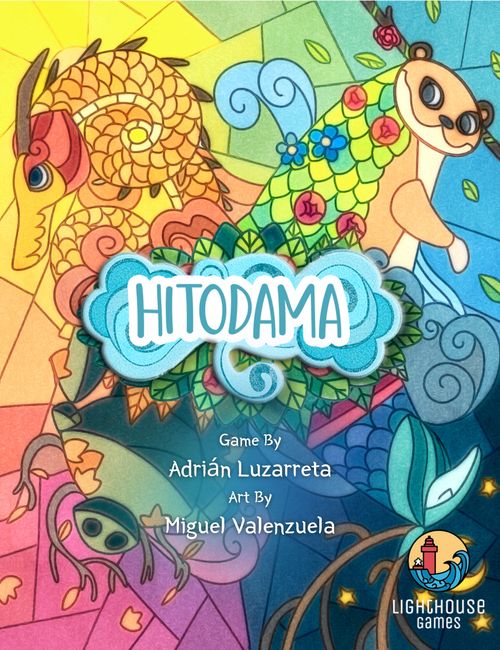
Hitodama
Hitodama Rulebook
Table of Contents
Table of Contents
Components
1 map 4 player boards (Tetté, Genji, Kizune, Eiko) 1 akkus' den board 4 season boards (Haru, Natsu, Aki and Fuju) 4 cardinal point tokens (Haru, Natsu, Aki and Fuju) 1 scoring board 1 reference board 12 essence meeples (3 of each character: Tetté, Genji, Kizune, Eiko) 6 akku meeples 72 cards (24 tribute cards, 6 akku cards, 14 solar cards, 8 ice cards, 20 lunar cards) 8 forest tiles 30 berry tokens 4 ice tokens 4 score track tokens 1 hitodama token 25 amber tokens (orange acrylics) 10 sapphire tokens (blue acrylics) 1 compass coin / first player marker 1 round marker
Game Setup
A. Shuffle the forest tiles and distribute them randomly on the areas of the map marked with a circle. The tiles are double sided: one side is for two players and the other is for three or four players (+3).
B. Place the scoring board in the center of the map. On the left side is the path of chaos. In its upper left corner, place the hitodama token. Find the two Round spaces and put the round marker on the left one. The ice cards have to be shuffled to form a deck and placed face down.
C. Spin the compass coin. When it stops spinning, the compass coin's North will point to a player who shall be the first player. Place the compass, as it landed, in the corresponding space on the reference board; this marks the initial North and the configuration of the cardinal points. Note: If the compass points to a corner of the map, turn it clockwise until it is aligned as a cross (never as an "X").
D. Next to the map, place the reference board and the akkus' den board; on top of this, place the akku meeples. Shuffle the akku cards to make a deck. Place it next to the akkus' den board and reveal the first card, to place the akkus accordingly.
E. Shuffle the lunar cards and deal two, face down, to each player. Shuffle the solar cards and deal one, face down, to each player. In three- or four-player games, an extra berry is granted to the last player of the initial round.
F. Each player chooses a player board and takes the three essence meeples from the corresponding character; then, they place one of those meeples lying (asleep) on the meeple symbol on their board.
G. Place the season boards on the side of the map and the tribute decks face down.
Tribute cards are specific for each season. The four decks have to be shuffled separately, and then take two cards for each season; the rest are returned to the box. Place the cards face down on the marked strip on the season boards and reveal the cards for winter.
Objective and Game Mechanics
The goal in Hitodama is to obtain 25 victory points or complete the tributes of the last season of the year (winter, represented by Fuyu) to prevent the hitodama from freezing the forest.
Actions
In your turn you can perform three actions in the order you choose. These actions can be repeated. After performing your third action, it will be the turn of the player to your left. The actions you can take are as follows:
- Move Essence: Place one of your active meeples from your reserve on any tile on the map, or move one of your sleeping essences on one tile to another place. You cannot move the same essence more than once per turn.
- Discard: You can discard a solar card to gain a berry, or you can discard two solar cards to get a lunar card.
- Play Card: Reveal a card from your hand to activate its effects. Lunar cards have an instant effect. The solar cards played by all players are stacked on the solar cards / visit the akkus tile, up to a maximum of three cards (four in 3 or 4 player games). When the tiles resolution occurs and it is the turn to resolve the solar card / visit the akkus tile, the effects of the cards will be activated starting from the one on top (the last one played) going down.
- Get Essence: Discard two berries, take the sleeping essence you left on your player board and place it in your reserve.
- Draw solar card: Take one from the solar cards deck. The maximum amount of cards you can hold is five (5).
- Displace: Move other player's sleeping essence (meeple lying down) on a forest tile to their reserve, setting down your own meeple, and pay the corresponding cost to that player. The costs are marked on the season board in play (bottom left corner).
Player Board
There are two relevant spaces on your player board. The basket is used to place the resources you get. The third essence zone is where your third sleeping essence (meeple) is placed.
Scoring and Hitodama Board
The round marker has two available spaces, at the end of each round it moves from one to the other. Each time the round marker returns to the starting space, the hitodama token will advance a space on the path of chaos, on the score board.
If the hitodama token reaches the end of the path of chaos, the chaos wins and all players lose the game.
When a player obtains victory points, they advance the corresponding spaces with their score token on the score board. While doing so, if a player passes through space with the image of the hitodama, the effects of the hitodama's wrath are activated. If the score token crosses two hitodama spaces, the effects of the hitodama's wrath are activated twice.
The effects depend on the hitodama's wrath level.
- Level 1: An ice card is revealed, it will indicate the tiles that will be frozen.
- Level 2: Whoever triggers the wrath loses an amber. If the player does not have an amber, they lose a berry. If they don't have berries, this effect is ignored.
- Level 3: the same as level 1.
- Level 4: Whoever activates the wrath loses a sapphire. In case they don't have a sapphire, they lose an amber; if they don't have any either, they lose a berry. If they don't have berries, this effect is ignored.
- Level 5: the same as levels 1 and 3.
Note: the path of chaos diagram shows the path taken by the hitodama at the end of every 2 rounds.
Ice Cards
The hitodama's ice cards indicate the tiles where ice tokens will be placed, which will remain there until Hitodama's rage progresses to Levels 2 or 4, or until a new card is revealed.
The example ice card shows North and East, so the tiles of the North and East will be frozen. Each ice card shows a value of -1 for each of the two indicated tiles.
When a tile is frozen, place the ice token in the space that provides the greatest benefit.
The Akkus
The akkus are placed on the tiles according to the cardinal direction that each akku card indicates when it is revealed. When an akku is removed from the map, if there are no more akkus left in the forest tiles, another akku card is immediately revealed and located where appropriate.
To remove an akku from the map, you must place an essence in the spaces on the solar card / visit the akkus tile; when it is time to resolve this tile, discard the resources marked on the akku card in play. Once this is done, place the removed akku in your player board's basket.
Example: the meeple is placed on the visit the akkus tile. After resolving this tile, the resources shown on the akku card are paid. Then remove the akku from the tile and place it in your basket.
Example: this card indicates that an akku will appear at the South cardinal point. In order to remove the akku from the tile, 2 ambers have to be delivered.
Resolution of Tiles
When all the players have finished their turn (performing their three actions), the tile resolution starts. The first tile to be resolved is determined by the season of the year and is indicated by the season tokens: in spring the tile located in the North is resolved first; in summer, resolve first the tile located in the East; in autumn, resolve first the tile on the South; in winter, the tile to the West is resolved first. After resolving the first tile, continue with the rest in clockwise order.
Example: while Haru is in play, the first tile to be resolved each round will be one in the North.
Essence meeples can be placed in any space that is available. When akkus or ice tokens enter a tile, they will do so as follows:
- If the tile is empty, they will occupy the space that provides the greatest benefit.
- If the tile has some occupied spaces, they will occupy the available space of greatest benefit.
- If the tile is full, they will occupy the space with the lesser benefit, bumping the essences upwards, and the essence (active or asleep) that was in the most beneficial space returns to their player's board.
The meeples, when placed on the tile, are placed standing. When any tile is resolved, players must lay down their essences there to get what the tile provides.
- If any essence is not moved, it remains asleep (lying down). That essence does not get the benefit of the tile, but other players who wish to use that space will have to pay its player the displacement cost indicated on the season board.
- There are special tiles with effects that work in an orderly and specific way. The tiles are:
Solar Cards / Visit the Akkus Tile
In this tile you can place your essences to visit the Akkus' den; the player located on the top circle will go first when paying resources to remove an akku. Also, the solar cards played are set on this tile.
Tribute / First Player Tile
This tile is where meeples are placed to deliver resources to the seasons and get victory points. Whoever is in the larger circle will be the first to pay tribute. Also on this tile you get the first player coin. If the person with the first player coin places an essence here, they will not be able to retain the coin and must hand it over to the first other player placed on this tile. On the 3+ player side, the first player to place themselves on this tile also gets a berry, regardless of whether they have the first player coin or not.
Merchant Tino and Pache Tile
This tile is the itinerant market, here you can exchange some resources for others. It works as follows:
- The player must place an essence on the resource they want to obtain. When the tile is resolved, the player must pay a resource that is not covered in the merchant's tile.
- If any other player is placed on that tile, the possibilities for exchanging resources are limited further.
- When only one space is available, no more essences can be placed here.
Example: If a player wants to get a lunar card and another player wants two solar cards, they can offer an amber or two berries in return.
Resource Tiles
The rest of the tiles are resource tiles, their spaces will provide players the marked resources when the tile is resolved. Spaces marked with a plus sign (+) grant you resources directly. Spaces marked with a colon (:) indicate that you must pay the cost on the left to get the benefit to the right of the colon.
Examples of resource spaces: you get a sapphire; you get a lunar card; you get an amber; you get a berry; you get a solar card.
On both sides of a tile there are effects, these are different depending on the configuration you are playing with.
Seasons of the Year and Victory Points
Seasons of the year award you victory points by fulfilling their tributes.
To pay tribute, an essence is placed on the tribute / first player tile. When this tile is resolved, players will pay in order one by one for each intended tribute.
When a player pays tribute, they will get the victory points corresponding to the resource type and amount. For example, delivering two ambers awards 4 VP; delivering three berries awards 3 VP. Each player can pay one tribute for each essence they placed on the tile.
The resources delivered are placed on the tribute they are paying and each player gets their victory points immediately, then they advance the corresponding places on the score board, and the essence used returns to the player's reserve. Important: If a player goes through the space marked as the hitodama's wrath, its effect is activated immediately, even if there are players left to score.
The victory points awarded by each resource are as follows:
- Berry = 1 VP
- Sapphire = 4 VP
- Amber = 2 VP
- Akku = 5 VP
When the current tribute cards are completed, they are immediately discarded along with the season, and the next season is put in play. If there are players left to pay tribute, they can pay the tribute from the new tribute cards if they have the resources.
The cardinal point token of the completed season is removed from the map and the new cardinal point token is placed; now it will be from this point where the tiles will begin to be resolved.
Cards
In Hitodama there are cards of five different types, each forms a separate deck, and they are explained below:
- Akku Cards: This deck is for the Akkus' den, and it indicates where the akkus are going to appear and what is needed to remove them.
- Solar cards: they have effects that can change the entire strategy or dynamics on the map. These cards are activated when the special tile for them is resolved.
- Ice cards: these have a freezing effect on the tiles. These cards indicate where the hitodama will put an ice token, and are activated when players pass through the wrath spaces on the scoreboard.
- Tribute cards: these are the cards of the seasons, they show the requirements to complete the tributes, obtain victory points and move on to the next season.
- Lunar cards: these are the most devastating cards. They have an immediate effect and go straight to the discard pile. If they run out, the discard pile is shuffled to form a new deck.
Symbology of Solar and Lunar Cards
- Pure light: Immediately get a berry and a solar card.
- Calm: By playing this card, you immediately get 2 more actions in your turn.
- Black: Turn a sapphire in your basket into an akku.
- Pure light: Immediately get 3 berries.
Card Effects (Solar and Lunar)
-
Pure light (+2 ambers): Immediately get two ambers.
-
Moonlight (+1 akku): Immediately get an akku.
-
Journey (+3 Actions): Immediately get three more actions in your turn.
-
Purify (+1 sapphire): Immediately get a sapphire.
-
Vigor UP: When playing this card, choose a tile where you have an essence and get the benefit of that space immediately. This effect is independent of normal tile resolution.
-
March: Move a meeple of any player or akku to an available space of your choosing.
-
Encounter (-1 akku, then a solar card): If any of the tribute cards require an akku, remove it from the requirements. The tribute from which the akku was subtracted does not award victory points.
-
Spot (+1 space): Play this card on a full tile to generate extra space until the end of the round. This space grants one of the same benefit as some other spaces on that tile, at the player's choice. At the end of the round, this card goes to the discard pile and the essence on it goes to its owner's reserve. You can use this card on any tile.
-
Berries (akku: +1 berry): When this card is activated, players with essences on tiles where there are akkus will receive a berry.
End of Game
A game of Hitodama had three ways to end:
- One player reaches 25 victory points.
- The tributes of all seasons are fulfilled. In this case, the player with the most victory points wins.
- The hitodama advances the 8 squares of its track (the path of chaos).
Summary and Special Situations
- Each player has 3 actions in their turn, which can be performed in the order of their preference.
- The tiles are resolved as soon as a game round is over, i.e. when all players have finished their turn.
- Lunar cards take immediate effect and are discarded to a discard pile. If the deck runs out, a new deck is formed with the cards from the discard pile.
- Solar cards are played on a special tile and their effect is activated when that tile is resolved at the end of the round. If solar cards run out, the discard pile is shuffled to form a new deck. This same tile is used to visit the akkus' den.
- The essence meeples are played standing on the tiles and, after providing the corresponding benefit, they lie down to indicate that they are asleep (inactive). If an essence is not moved in subsequent turns, the essence remains asleep and does not grant the benefit of the tile where it is located.
- The hitodama's wrath is activated by passing through the spaces with the hitodama's image on the score board. The wrath's effect depends on the wrath level where the hitodama's meeple is located.
- Every two rounds, the hitodama advances in its spaces (the path of chaos); if it reaches the eighth space, the game ends without any winner.
- If a tile is filled with meeples at the time an ice token or an akuu enter it, the previous meeples are displaced and the meeple leaving the tile is returned to its player's reserve.
Transcriber note: the printed rulebook says "the 8 squares" / "eighth space" for the path of chaos, while the path-of-chaos diagram on page 4 shows five numbered spaces. Both are transcribed as printed; the source's own inconsistency is not resolved here. The printed word "akuu" in the last bullet is kept as printed.
- When an ice token or akku meeple enters a tile, there are three possible placement scenarios:
- If the tile is empty, the ice token or akku is placed in the space of greatest benefit.
- If the tile is occupied and has available spaces, the ice or akku is placed in the available space of greatest benefit.
- If the tile is completely full, the ice or akku enters the lowest benefit space and moves the essences "upwards".
- A player cannot hoard the first player's coin; when another player is placed on the tribute / first player tile, the first player's coin will be yielded to them.
- When the tributes of a season are fulfilled, the change to the next season happens immediately, the new season token is placed at the corresponding cardinal point, which will be the new starting point for the resolution of tiles.
Glossary
- Actions: each turn, players can perform three (3) actions, different or repeated, of their choice; they are move essence, discard, play card, get essence, draw solar card and displace.
- Akkus: they are the figures represented by black meeples; they obstruct spaces on the tiles, can be removed by paying the resources indicated on their card and are placed as a resource in your basket.
- Lunar cards: when played, they have an immediate effect and are then placed in your discard pile.
- Solar cards: when played, they are placed on the solar card / visit the akkus tile; their effect will be performed when that tile is resolved, after which they are placed in the discard pile.
- Essences: the meeples of each character. At the beginning of the game, each player receives three, two active and one sleeping, which can be activated by using an action and paying two berries.
- Sleeping essence: after the resolution of each tile, the essences placed there are laid down to indicate that they have already received the benefit of that space and that, unless they are moved the following turn, they will not provide that benefit in the next tile resolution. Also, if an essence used to pay tribute completes a tribute by paying an akku, the essence will return dormant to the player's board.
- Seasons: each of the four seasons of the year associated with a deity and a cardinal point, they are spring (Haru, North), summer (Natsu, East), autumn (Aki, South) and winter (Fuyu, West).
- Meeples: the figures that represent the essences and the akkus.
- Merchant Tino and Pache: tile where resources can be exchanged.