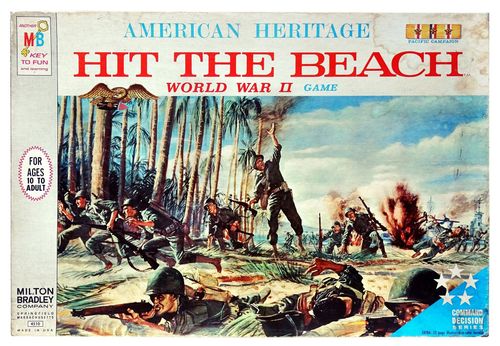
Hit the Beach
Hit the Beach Rulebook
Table of Contents
Table of Contents
Brief Description of the Game
Players, using their own "combined forces," compete with each other to try to be the first to reach the "final objective", the main Japanese headquarters on the large island. The Japanese defense units, strategically placed along the invasion routes, are obstacles for all players. When a player defeats a Japanese unit, he replaces it in another location, possibly to provide an additional obstacle to the progress of an opponent. While each player is assigned his own beach to clear for amphibious landings, he may move his ground units along any of the various routes, by-passing obstacles if possible, and may take advantage of beaches cleared and obstacles removed by his opponents. A player may "relieve" an opponent's ground unit in the land area, sending it back to "start". The throw of the die determines the moves as players deploy their forces in their overall planned strategy.
To Set Up the Game
- Open the board and place it between the players. The board pictures a large central island flanked by two smaller islands and four tiny atolls. The spaces on the land areas are brown circles. Over the water areas, the spaces are white dots. The spaces are connected by a black line showing the paths (invasion routes) for movement. The large red circle in the center of the large island is the Japanese Headquarters, the final objective. The colored beach areas outlined on the board locate the places where landings are to be made to enter the islands.
- Remove the plastic playing pieces from their runners by twisting until they break off. There are 5 types of pieces, as pictured on the box platform.
- Place the 14 yellow Japanese "Defender" pieces on the board, one each, in the yellow centered brown circle spaces. There should be one at each beach landing space and 6 in the marked spaces in the center of the large island.
- Players decide what color "combined forces" they are to play and place the 6 pieces of their color near their "start circle". Each player should have 2 Marine Division pieces (square bases), 2 Army Infantry Division pieces (round bases), 1 Naval Landing support piece (ship), and 1 Strategic Air Support piece (Airplane).
To Play the Game
The object of the game is to be the first player to occupy the "final objective" with one of his units.
Rules for Moving
- In his turn, a player throws the dio [sic] and moves any one of his pieces the number of spaces as shown on the die.
- The "division" pieces (Marine and Army) move from space to space over sea (white dots) and over land (brown circles). The "support" pieces (Ship and Airplane) are used only for beach landing support and do not move along the paths nor occupy spaces. The "support" pieces can be moved only with a throw of six (6) on the die.
- When a 6 is thrown, the player may choose to move one of his "division" pieces (Army or Marine) the 6 spaces, or may move one "support" piece (Ship or Plane). To move the "support" piece, it is immediately placed in a beach area of its own color, but not on a white dot. The "support" pieces may be moved from the start circle to a beach area or from one beach area to another. Each player is responsible for two beach landings.
- A "division" piece may be moved in any direction along any path, but may not be moved back and forth in two directions) in the same turn.
- A "division" piece may move over other pieces of his own or an opponent. Only one piece may occupy a space at the same time.
To Make a Beach Landing
The Japanese Defender piece occupying the brown circle in a beach area can be removed according to these special rules.
- The pieces of the same color as the beach area, must be used to remove the Japanese "defender" piece of that beach. For example, the red forces are to be used for the red beach Japanese "defender."
- Before the beach "defender" can be removed, both "support" pieces of that color must be in (see rules for moving #3); that is, the "ship" and the "airplane" pieces of that color must be present.
- Only a marine division piece (square base) of that color can remove the "defender" in the beach area. To do this, the player must move a marine division on to the "defender's" space, by exact count.
- The player removing the "defender" piece may place it on any empty brown circle on the board - except on another beach area space. Once a beach has been cleared of its defender "obstacle", that brown circle must be kept free of any "defender" piece throughout the game. Other brown circle spaces, even ones just next to the beach space, can be used for placing "defenders."
- After a beach has been cleared, any piece may move on to or through that space, even an opponent's piece of another color. The "support" pieces are no longer required once the "defender" has been removed from that .
To Remove Defenders Not at a Beach Landing Area
- A player moving his "division" piece (either Marine or Army) onto a "defender" obstacle by exact count removes the defender" [sic] and occupies that space. He may then place the "defender" on any unoccupied brown circle space on the board (except on a beach landing space as in rule 4 above.)
- The "defender" may be placed in the same island, on the large island, or on an Atoll (tiny island with 1 brown circle) space. The "defender" piece may be placed ahead of an opponent player to provide further obstacles to his progress, or may be placed behind a player's own "division" piece to block an opponent from relieving his piece, as in "rules for moving" number 8.
- A "defender" piece occupying an Atoll brown circle space may be removed by either an Army or Marine "division" and does not require the beach landing procedure.
- A "division" may move backwards, if desired, (see moving rule No. 4) to remove a "defender" or to relieve an opponent's piece.
- A player must move onto the red "final objective" space by exact count. The first player to occupy the main objective space is the winner.
Some Suggestions for Strategy
- After clearing your first beach, it is usually best to get as many divisions through the small island as possible.
- After a player has cleared both of his beaches, his "support" pieces are no longer needed.
- It is often wise to split your forces, sending one or more divisions along the same route as an opponent. In this way you may wait for him to clear his beach then follow him onto the large island and relieve his divisions. Remember, a piece may be "relieved" only on a land area, not over the sea (white dots).
- Stack your divisions in front of a defender so that any one of several throws on the die will allow a removal of the obstacle.
- Remember, other than for the beach "defender," Marines and Army divisions have the same power.
- Placing obstacles in between your pieces and an opponent is a good protection, especially near the end of the game.