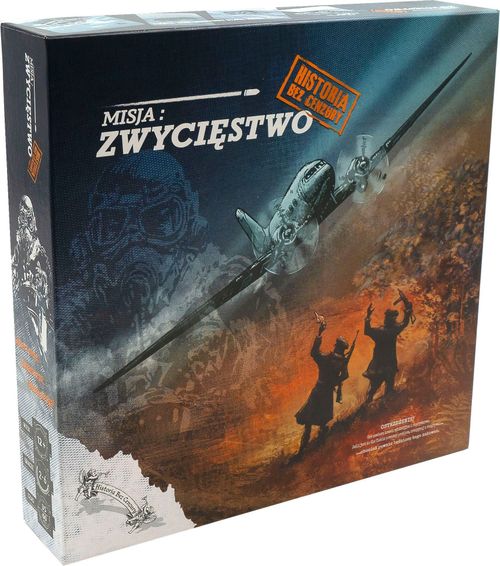
Historia Bez Cenzury. Misja: Zwycięstwo
Historia Bez Cenzury. Misja: Zwycięstwo Rulebook
Table of Contents
Table of Contents
Components
- Board (A)
- Mission cards (B)
- Hero briefcases (C)
- First Player pawn (D)
- Hero pawns (E)
- Enemy pawn (F)
- Start cards (G)
- Journey cards (H)
- Orders (I)
- Weapon and radio tokens (J)
- Health markers (K)
Game contents: board; 55 Journey cards; 24 Mission cards; 8 Start cards; 6 hero pawns; 6 hero briefcases; 15 weapon tokens; 15 radio tokens; 15 health markers; 53 Orders; 6 enemy pawns; 1 First Player pawn; these instructions.
Goal of the Game
The goal of the game is to gain as many points as possible.
Before playing, decide how many points you are playing to:
- Short game: 6 points
- Medium game: 9 points
- Long game: 12 points
Setup
A. Unfold the board on the table.
B. Place the Orders in 3 stacks next to the board.
C. In clockwise order, starting from the oldest player, each player places 2 weapon tokens and 2 radio tokens on any city spaces on the board. Only 1 token may be placed on a single space. The remaining weapon and equipment tokens are placed next to the board in 2 stacks.
D. Place the hero briefcases (see illustration on p. 11). Each of you chooses a hero briefcase and takes the matching pawn. Each hero has a special ability, described in the briefcase. If the ability allows you to take a weapon or radio token, do so. The hero briefcase lies in front of the player. On each heart symbol, place 1 health marker.
E. Shuffle the Mission cards and deal 3 to each player. The cards are secret at this stage; only the player may look at them. Place the Mission cards in the hero briefcase.
F. Shuffle the Start cards and deal 1 to each player. Place the Start cards next to the hero briefcase.
G. Place the pawns at the starting location indicated on the Start card you received. If there is already a weapon or equipment token there, you may take it.
Note! Players may only hold as many weapons and equipment as they have room for on their hero briefcase and on the Holster and Backpack cards acquired later.
H. The player who last watched "Historia bez cenzury" receives the First Player pawn. If you watched it together, the youngest player becomes the First Player.
I. Place the enemy pawns on the board one at a time, starting with the First Player, until there are 6 of them on the board. A pawn may be placed on a weapon or equipment token, but not on a space occupied by another pawn.
J. Shuffle the Journey cards and place them in a face-down stack (back side up) in the upper part of the board.
K. Reveal from the Journey deck as many cards as there are players plus one additional card (3 cards for a 2-player game, 4 cards for 3 players, 5 cards for 4 players, and so on). Place them on the board.
Card backs:
- Start
- Mission
- Journey
Gameplay
The player holding the First Player pawn begins the game. The others take their turns in clockwise order. In each following round the First Player pawn passes to the next player.
Player's Turn
On your turn, choose 1 Journey card from those laid out on the board. Follow the instruction on the card and/or move your pawn in any direction by at most as many spaces as the movement points shown on the card (see: Explanation of Icons on Journey Cards).
You do not have to use all your movement points; any excess is lost. You may carry out the card's instructions in any order.
Example (Transporter card): Together with American soldiers you jump onto the bed of the Half-Track Personnel Carrier M3. When you use the transporter, it acts as a weapon. The printed callout for this card reads: you may acquire a weapon and move your pawn 1 space, or move your pawn 1 space and then acquire a weapon.
Example (Airdrop card, movement 1): Unexpected help from allied forces. Place 1 weapon or radio token on your starting space.
After taking a card, the player does not add a new Journey card to those laid out. (Each subsequent player therefore has fewer cards to choose from.)
Note! Instead of taking a card and moving, you may pause. In exchange, take 1 health marker from the supply.
End of Round
At the end of the round, the First Player:
- Adds to the Journey cards as many cards as were used in this round.
- Passes the First Player pawn to the player on their left.
If the Journey cards run out, shuffle the discarded cards and form a new stack from them.
If, as a result of a card's action, you gain a token and there are none left in the supply, you may take any token from the board.
Missions
Example Mission card, 2 points: Order 63/4120, Mission GDAŃSK. "Deliver weapons to the defenders of the Polish outposts in Gdańsk." Icons: weapon and pistol token. Mission reward: 2 points.
Example Mission card, 3 points: Order 05/2672, Mission BERLIN - MADRYT. "Inform the Polish spies in Madrid about German progress on the Eastern Front." Mission reward: 3 points.
Missions are available only to holders of the appropriate Mission cards (see: Enemy).
Mission for 2 points: acquire a weapon or radio token and deliver it to the indicated city.
Mission for 3 points: receive orders (dispatches) from one city and deliver them to another.
Process for missions:
- If you have or acquire an item from a mission, reveal that mission and place it in front of your hero briefcase. From then on the mission is public. Similarly, when receiving orders (dispatches), reveal the mission when you reach the first city.
- When you fulfil the second condition of the mission (reaching the indicated city), you earn the reward. Discard the weapon or radio token and take an Order token for 2 points. In the case of delivering orders (dispatches), take an Order token for 3 points. It may happen that you complete several missions in the same city.
Players can see their own Mission cards, but until a mission is revealed (that is, when they fulfil the first part of the mission) they do not show them to other players.
Types of Missions
In the game you can carry out three kinds of missions.
Mission for 1 point: does not require a Mission card and is available to everyone.
The other two kinds (2 points and 3 points) are described above and require the matching Mission card.
Order for 1 point: defeating an enemy with a weapon (see: Enemy). Illustration in the rulebook: a pistol token, plus an enemy pawn, equals an Order token.
Completing Missions
After completing a mission, place the card on the discard pile and draw another mission.
If, while carrying out a 2-point mission, you lose all your weapons and radio tokens, you must set aside the revealed Mission card (or cards) and take another.
If you complete a weapon-delivery mission with the help of the Journey cards Tank and Transporter, you do not have to set aside the weapon token, because the heavy equipment was delivered by the card.
Tokens and Other Players
If you pass through or stop on a space with a token, you may pick it up and move it to your hero briefcase. If there is no room, the token stays on the board.
If you stop on a space occupied by another player's pawn, you may exchange Mission cards, weapons or equipment with that player on a 1:1 basis.
If you stop on a space occupied by an enemy, you must fight (see: Enemy).
Note! If you do not reveal a mission in the same turn in which its first part was fulfilled (acquiring a token or reaching the city), the mission is burned. You must exchange that Mission card for another.
Note! When you complete a 3-point mission, place 1 weapon or radio token on the starting space of the mission.
Example: Order 26/1970, Mission OSLO - LUBLIN, 3 points. Printed text (partly illegible at the resolution of the source file): "In the capital of Norway obtain information about [illegible] regarding Narvik and deliver it to Poland."
Enemy
When you enter a space occupied by an enemy pawn, fight:
- Discard 1 weapon token and move the enemy pawn to the nearest free space. In the basic variant, the enemy pawn may not be moved onto a space occupied by another pawn.
- You gain an Order for 1 point.
Note! The Tank and the Transporter act as weapons. Simply move the enemy, losing nothing. You gain an Order for 1 point.
If you do not have a weapon token, you lose 1 health marker. You must still move the enemy pawn, but you cannot complete a 1-point mission in this way (the exception is the Partisan card).
Journey Card Types Named in the Enemy Section
AIRCRAFT (SAMOLOT): allows you to "fly over" a space occupied by the enemy. Aircraft cards shown in the rulebook carry movement points 1–4. Their printed texts (as legible) are: Curtiss C-46 Commando — "You board the transport aircraft, the Curtiss C-46 Commando. Fields along the way do not concern you." Douglas C-47 — "You hitch a ride on board the transport aircraft, the Douglas C-47. Fields along the way do not concern you." Avro York — "You use the British aircraft adapted for carrying passengers, the Avro York. Fields along the way do not concern you." PZL.37 Łoś — "You accompany the crew of a Polish PZL.37 Łoś bomber in the position of airborne gunner. Fields along the way do not concern you."
BETRAYAL (WSYPA): movement 1. Printed text: "Later you will find out who informed on you. For now you must act! Move any enemy pawn by one space." Rule printed beside the Betrayal and Informant cards: in the case of the Informant and Betrayal cards, after combat move the enemy to the nearest free space.
INFORMANT (KONFIDENT): printed text: "No one can be trusted! You must fight!" Second line: "Place your pawn on the nearest space with an enemy and fight."
Loss of Consciousness
If you lose your last health marker, you lose consciousness:
- Move your pawn to your starting space.
- Exchange your revealed Mission cards for new ones.
- You do not lose the weapons or radio tokens you hold.
- Refill your health markers to the maximum.
- If the starting space is occupied by an enemy, move the enemy to the nearest free space.
End of the Game
When any player gains the number of points agreed before the game, the round is played to its end and the game ends. The player who gained the most points wins.
In case of a tie, the winner is the player who holds the most valuable Orders.
Example: The players agreed to play to 6 points. If Sławek has 2 Orders worth 3 points each and 1 Order each worth 1 and 2 points, and Alina has gained 3 Orders worth 3 points each, then Alina wins.
Advanced Variant: Intelligence Fight
In this variant the rule about fighting the enemy changes: after a fight, the enemy pawn may be moved onto a space occupied by another player, who must then fight.
Additionally, at the end of the round the last player moves the enemy pawn by 1 space, to a space that may not be occupied by another enemy. Instead, the last player may provoke a fight by moving the enemy pawn onto their own space or onto another player's space.
Other rules do not change.
Hero Briefcases
Each player takes a hero briefcase, which carries the hero's ability and the health markers placed on its heart symbols, and holds the player's Mission cards and tokens. The rulebook illustrates one hero briefcase in full (page 11):
- Hero: Helena Ligocka, codename "Fuksja" (the printed biography is flavour text and is not transcribed).
- Ability: "When you reveal a mission, draw the next one." (Printed as: Gdy ujawnisz misję, dobierz kolejną. The final word of the printed line is partly obscured in the source file.)
- Three heart-shaped health slots are shown on the briefcase.
Note: the rulebook file does not print the abilities of the other five heroes. Those are printed on their own physical briefcases, which are not part of the PDF. Their abilities are not transcribed here.
Folding the hero briefcase: the printed instruction on page 11 reads "This is how you fold the hero briefcase" and shows the folding diagram.
Errata
Errata. Mission HELSINKI - ARNHEM, 3 points. Printed on the errata card, page 11:
"Attention! Enemy intelligence has carried out a sabotage! On one of the Mission cards you will find an order to travel to Arnhem. Don't be fooled and set off for Amsterdam. It's only a grenade's throw ;)"
Icon Explanation (Journey Cards)
Explanation of icons on Journey cards.
Movement points
- 1 (circle with 1): you may move this many spaces. You do not have to use all the points; for example, on a motorcycle you may travel 1, 2 or 3 spaces. Into battle!
- 1>>2 and 1>>3 (circle with a range): you may move 1 to 2, or 1 to 3, spaces. (Same rule as above.)
- 1>>4 (aircraft): you may fly 1, 2, 3 or 4 spaces. On spaces along the way you do not collect tokens and do not attack enemies. Quick and to the point!
Effect icons
- Green radio icon: you gain a radio. Easy!
- Green weapon icon: you gain a weapon. The enemy holds no fear for you!
- Green "+1" heart: you regain 1 health marker. What a relief!
- Green "+2" hearts: you regain 2 health markers. You feel alive!
- Red weapon icon: you lose 1 weapon. You should have dodged better!
- Red "-1" heart: you lose 1 health marker. Don't walk toward the light!
- Red radio icon: you lose 1 radio. It's going to be a nice brawl!
- Brown enemy-face icon: you move your pawn onto an enemy's space and fight.
- Olive enemy-face icon: you move an enemy pawn 1 space. Maybe it got secret orders, or it's operating on two fronts?
- Grey weapon icon: this is a weapon. It works only this turn. Don't hesitate to use it!
- Grey double-chevron icon: you place 1 weapon or radio token on your starting space. They haven't forgotten about you!
Holster and Backpack cards (Kabura and Plecak): "Hey! Something's inside! Keep this card. Now you have room for an additional token."
Vehicle Index
Printed card notes, transcribed from the rulebook's vehicle index (historical notes on the vehicle cards).
Sokół 200 M411: a Polish motorcycle. The Sokół was built for the civilian market, so it had to be engineered for the not-always-good Polish roads. It was very good equipment. In July 1939 one rode onto Kasprowy Wierch. Fewer than eighty Sokoły designated 200 M411 were produced. In 1939 such a motorcycle cost about a thousand złoty.
BMW R75: a cult German motorcycle with a sidecar. The sidecar had its own drive. It was very expensive to produce, but made up for it in performance (it goes everywhere) and equipment. The Eastern Front version even had special heating so that German soldiers' hands would not freeze.
Indian 340 CAV: an American military motorcycle whose distant ancestor was the civilian Indian Chief. The French liked it and ordered a fair number for their army. Before the machines arrived, the French army had capitulated. Fortunately the British took over the order, and the machines went into battle against the Germans.
MOJ 130: a German engine with a Polish execution. The motorcycle was modelled on designs devised by neighbours from the west, but during production (1937–1939) the Poles used our own parts. The result was a very orderly machine. Ride comfort was average, it was trivial to repair, and it tolerated even the worst fuel. Many of these machines took part in the fighting of September 1939.
T-34: the second most popular export product in the history of the USSR, after communism. Cheap and fast to produce. Thanks to it, the Soviets could flood the battlefields with this equipment and drive the Hitlerites back home, and then destroy that home. One of the most important machines of WWII, which over the years grew into a number of modifications. Regardless of version, the T-34 could comfortably carry a four-person crew, and a dog too if needed.
Pz.Kpfw. IV (Panzer IV): at the start of the war the heaviest tank of the Third Reich. It was worth more than Hermann Göring. Used in the annexation of Austria, in the war against Poland, and even after WWII, since Syrian forces still had this equipment in 1967. Its chassis proved very versatile and served as the basis for many later designs, including self-propelled guns, anti-aircraft vehicles and command vehicles.
M4A4 Sherman: the American counterpart of the Soviet T-34 tank. Also cheap and fast to produce, which allowed the front to be flooded with large numbers. Everything was fine until a Sherman met a German Tiger or Panther. One-on-one the odds were poor, so the American tanks were sent in groups, and the Germans had to be wary. Several specialist versions were built, for example the Sherman as a minefield clearer.
PzKpfw VI Tiger: the Tiger was the king of the front, as the lion is the king of the jungle. Seriously, one could destroy even six American Shermans in a one-on-one fight. To the horror of Soviet tankers, the anti-aircraft gun mounted on the Tiger also knocked out the legendary T-34 without trouble. No wonder the prototype was meant as a birthday present for Hitler, and after deployment became an unwanted present for the enemy's troops. An even better version later appeared, the King Tiger (Tygrys Królewski). Fortunately, production of these machines was too expensive and time-consuming. In another case the outcome of the war could have been different.
Douglas C-47 Skytrain: a transport aircraft which the British called the Dakota. An amazing machine, not only because it could carry things (including people, as Operation Most showed: it carried documents and V2 rocket components to the British). Despite its size it could be flown so precisely that it could descend to very low altitude, catch the line of a transport glider and pull it off the ground. Hard to believe, but such operations were carried out.
Curtiss C-46 Commando: an American transport aircraft that pilots called "The Whale." Most often met over oceans, especially the Pacific, but also flying in Europe during the war, transporting wounded or paratroopers (for example during Operation Varsity). After the war it went into civilian service. Into the early 21st century Whales flew transporting all kinds of goods; by the end of the 1940s they had flown over fifty-eight thousand flights to besieged Berlin.
Avro York: a "winged limousine." This aircraft transported British VIPs, including Churchill and King George. If needed it could be converted into a fairly decent transport aircraft. Fifteen tons of cargo or fifty soldiers could be squeezed in without difficulty.
PZL.37 Łoś: an excellent Polish bomber. Fast and agile, able to reach 400 km/h and carry two and a half tons of bombs. Unfortunately production started too late. Only 120 were made, and not all were ready for combat. Those able to take to the sky on 1 September 1939 bombed German military columns. Those that were evacuated when Romania joined the Germans were later used for bombing in the USSR.
Mittlerer Schützenpanzerwagen Sd.Kfz.251: the very name is unsettling. In direct confrontation this half-track armoured transporter proved even less pleasant. Inside it could hide as many as twelve people, and outside it bristled with two machine-gun carbines. In case of bad luck, mortars could be mounted instead. Nothing to do but run.
Half-Track Personnel Carrier M3: if this American half-track transporter were a band, it would certainly be Slayer. A monstrous, uncompromising beast that gets everywhere and ruthlessly mows down the enemy with its Browning machine gun. It was also used as a tractor, an ambulance and in many other variants. It rarely failed, and it served well in many countries into the early 21st century.
Leichter Beobachtungspanzerwagen Sd.Kfz.253: only 285 were produced, because few people could write its name correctly on the vehicle card. It was very expensive to produce, and at one point even the Germans could not afford it. Those that were built fulfilled their task superbly. This light armoured vehicle let artillery observers watch battlefields, and its standard radio equipment allowed observation results to be reported immediately.