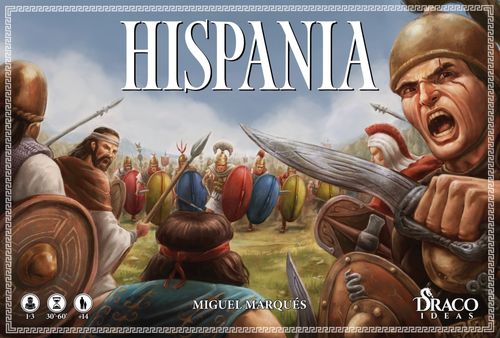
Hispania
Hispania Rulebook
Table of Contents
Table of Contents
The Game
HISPANIA is a cooperative game in which the players (1 to 3) handle the Roman armies that confronted the Iberian peoples in the conquest of Hispania. In the basic mode players cooperate using the Roman generals against the game system, and the Hispano variant allows an additional player to lead the Hispanic resistance. You can adjust the difficulty of the game almost unlimitedly, and the Roman and Hispanic dice mechanism always generates different games in which your decisions will be crucial to achieve victory.
The Roman goal is to occupy the 6 Hispanic capitals with their garrisons before the revolt reserve or time run out. The Hispanic goal is to avoid it!
The Roman generals represent the praetors of the Roman provinces (praetor icon) and the consul sent by the senate (consul icon). By "general" we mean any of them. The first praetors of the provinces Ulterior and Citerior and the first consul sent by Rome were respectively Marcus Helvius Blasio and Gaius Sempronius Tuditanus (197 BC) and Marcus Porcius Cato (195 BC), but the meeples in the game represent all the characters who carried out those functions for almost 200 years.
Components
- 1 board (map).
- 8 wooden meeples:
- 3 Roman generals (red, yellow, blue).
- 1 proconsul (white).
- 3 Hispanic armies (black).
- 1 special army (black).
- 42 wooden discs:
- 15 garrisons (red, yellow, blue).
- 1 Legio Hispana (purple).
- 4 Roman fleets (white).
- 22 revolts (black).
- 5 wooden sticks: the Roman roads.
- 8 metal coins or "denarii".
- 1 turn token.
- 2 dice: 1 Roman die and 1 Hispanic die.
- 1 rulebook (A5 size).
There can only be a maximum of: 1 meeple and 3 discs in each city; 1 fleet and 1 general in each sea; and 1 Hispanic army in each province.
Each Hispanic city is identified by the coordinates of the white banner in its province (Roman numerals from I to VI, clockwise) and of its black shield. For example, I-5 corresponds to Ilerda, city number 5 of province I, Ilergetia. Although those areas of the map did not have formal capitals, we will call the most important city of each Hispanic province the "capital", with number 6, walls and a star symbol.
The board represents the map of Hispania at the beginning of the 2nd century BC. The geography and certain names have been adapted for playability, thus modifying a map of the era and making abstraction of the progressive transition between Iberian settlements and Roman cities. The 49 circles are the board spaces (44 cities and 5 seas, "Mare" in Latin) through which generals, fleets and armies move. The 44 cities are distributed among 2 Roman provinces (Ulterior and Citerior, with 4 cities each) and 6 zones occupied by various Hispanic peoples, which for simplicity we will also call "provinces" (Ilergetia, Celtiberia, Carpetania, Lusitania, Gallaecia and Cantabria, with 6 cities each).
The 49 spaces are connected to some of their neighbors by 1 link that allows movement between them. For example, Dertosa is only connected to Valentia, Salduba, Tarraco and Mare Balearicum. Most links consist of 1 segment, but certain land links have 2 or 3 segments to reflect the difficulty of the terrain they cross (rivers or mountains, such as the Iberus or the Pyrenees). The roads facilitate Roman movement across the links, and some have already been drawn on the map (3 in each Roman province) to represent the increasing Romanization of the Mediterranean coast.
Finally, at the bottom right we see two tracks: the turn track (I-II-III-black disc), which indicates the structure of each round; and the time track, which begins in 198 BC and roughly represents the progress of the conquest (about 18 years per round) during the last two centuries BC. The last stage of each round will be to add a revolt on the time track to indicate that those 18 years have passed.
Map legend: Province banner - City shield - Capital - 1-segment link - 2-segment link (river) - 3-segment link (mountain) - Roman road - Turn track - Time track - Add revolt.
Setup
We recommend starting with the basic mode, the setup of which we describe below. In this mode the proconsul and the special army and legion, which are part of the variants, are not used, so you can leave them in the box. The 3 Roman generals are used in all games with exactly the same rules, and are distributed as follows:
- 1 player: control the 3 generals.
- 2 players: control 1 praetor each and share control of the consul. Should you not agree, praetor I (yellow) would decide the first actions of the consul's turn and praetor II (red) the last ones.
- 3 players: control 1 general each.
Choose the difficulty level of the game according to how many of these pieces you will use (increasing difficulty to the right):
| # | Difficulty Level | Low | Medium | High |
|---|---|---|---|---|
| 1 | Denarii per turn (coin) | 7 | 6 | 5 |
| 2 | Garrisons per general (discs) | 5 | 4 | 3 |
| 3 | Roman Fleets (circle) | 4 | 3 | 2 |
| 4 | Roman Roads (stick) | 5 | 4 | 3 |
| 5 | Initial Hispanic Armies (meeple) with die roll | 1 | 2 | 3 |
The 3 values of these 5 parameters can be combined in 3⁵ different ways, leading to 243 levels! You can refer to each level by listing its 5 values (denarii|garrisons|fleets|roads|armies), the medium level would be 6-4-3-4-2.
If you are used to strategy games, we recommend that you start at the medium level and from there adjust some parameters to the left or right of the table according to your taste. On the other hand, if it is your first game of this type, it might be better to learn the mechanics at the easy level. To complete the setup:
- Place the turn token in space I, the denarii in front of whoever controls praetor I (yellow), and the fleets in consecutive seas starting with number 1.
- Place revolts in 6 Hispanic cities at random, 1 per province. In increasing order of province (from I to VI) roll the Hispanic die in each one of them and place in that city the following number of revolts: 3 revolts if the result is 1-2, 2 revolts if it is 3-4, and 1 revolt if it is 5-6. You will have thus placed between 6 and 18 revolts.
- For each initial army, roll the Hispanic die and place it on the city in revolt of that province (if it already has an army, reroll). Hispanic armies are always on revolt.
- Place the Roman roads on links that extend their network (they must start from a city that already has one) but without reaching a revolt or capital. They are placed one at a time by the players according to the sequence of turns I-II-III.
- Place each praetor (I and II) on any city in his province and the consul (III) on any fleet (the blue arrow symbolizes his arrival from Rome).
Return to the box the pieces (denarii, garrisons, fleets, roads) that you are not going to use.
Setup example at level 6-4-3-4-2: play with 6 denarii and 4 garrisons per general; place 3 fleets in seas 1-2-3; you roll 4-5-2-4-3-6 with the Hispanic die and place 11 revolts in Salduba (2), Segobriga (1), Regina (3), Conimbriga (2), Asturica (2) and Flaviobriga (1); you roll II and V with the die and place 2 armies, in Segobriga and Asturica; you place now 4 roads towards Emerita and Capara (in that order, the network must reach Emerita first), towards Ilerda, and between Basti and Carthago Nova. Finally, you place the praetors in Gades and Valentia, and the consul on the Mare Ibericum fleet. The turn of praetor I begins.
A Game of Hispania
You play the game in a series of rounds alternating Roman and Hispanic phases. The Roman generals will move through Hispania besieging cities in revolt and attacking armies, with the objective of placing their garrisons in all the province capitals. The game ends immediately with:
- Roman victory if there are garrisons in the 6 Hispanic capitals and no revolt in the Roman provinces. Hispania becomes part of the Republic, or of the already established Empire!
- Hispanic victory if you need to place a revolt (during a Hispanic phase or at the end of the round) and there are none left, or if you reach the end of the time track (consuming the last years of the millennium).
At the end of each round a revolt is placed on the next space of the time track. Therefore, a game of Hispania will last a maximum of 11 rounds, when a revolt would be placed on the 18 BC space.
Game Sequence
Each round consists of 3 turns, one for each general in the order I-II-III indicated on the board. In each turn, the player controlling the corresponding general first performs actions in the "Roman phase" by spending the denarii, and then spreads the threats in the "Hispanic phase" by rolling the dice. To end the turn, he advances the turn token on the track and passes all the denarii to the next player.
Each round thus follows this sequence of phases:
Roman I / Hispanic I → Roman II / Hispanic II → Roman III / Hispanic III → End of round
If on his turn a general were not on the board because he had been removed after a previous defeat, he would start the turn directly in any city without revolt of his province (for a praetor) or in any fleet (for the consul). If there were already another general in that space, he would have to leave it with his first action (see Movement). If the whole province of an absent praetor were in revolt, he could not enter the board and his turn would pass directly to the Hispanic phase.
Roman Phase
Spend the denarii on any of the actions Move, Garrison, Besiege or Attack, in the order you wish and even perform a given action several times (you can also pass, ending the phase):
-
MOVE that general or any fleet: 1 denarius per segment of the link between its space and the target (see Example 1).
- The general cannot enter a city in revolt.
- He can move to a sea space (from a city or from another sea) only if there is a fleet in it.
- Fleets only move over sea, and if they already carried a general he would move with them.
- A continuous chain of roads is considered, for movement purposes, as 1 segment.
- The general or fleet can cross a space with another general or fleet (continuing their movement).
If there is another general or fleet in that space, they cannot stop to perform other actions, remember that there can only be 1 meeple and fleet per space!
-
GARRISON of that general in the city he is in: 1 denarius to place it or to remove it (goes back to his reserve). A city can contain up to 3 garrisons, not necessarily of the same color, and each one is placed on top of the previous one (being covered does not prevent them from being removable). But beware:
In order to place a garrison in a Hispanic capital, its entire province must be free of revolt!
If revolts remain in other cities of the province you can enter the capital, but you cannot place a garrison: you should eliminate all the revolts in that province first (see Example 2).
-
BESIEGE a city in revolt connected to that general: choose to spend between 1-3 denarii to try to remove a revolt (without army). Place the denarii in a pile in front of you and roll the Roman die:
- Roman value = die + denarii spent + his garrisons in group(s) connected to him.
Hispanic Phase
Spread the Hispanic threats in two steps, first Revolt and then Move:
-
HISPANIC REVOLT. Roll the dice and check the content of that city:
- If there is a garrison or general: nothing happens, it is protected.
- If it is empty: place a revolt.
- If there is any revolt:
- If there is an army left in the reserve and there is not one already in that province, place an army on the revolt.
- Otherwise, place another revolt on it respecting the limit of 3 discs. If you cannot place the revolt either (that is, you cannot place an army and there are already 3 revolts), then nothing happens (see Example 5).
-
HISPANIC MOVE. All the armies, by increasing order of province from I to VI, try to move towards one of the connected cities of their province:
- If there is only one, it tries to move to that one.
- If there are several, priority goes to those without revolt.
- If among the connected cities there are several alternatives (because they all have revolt or because more than one does not), choose to which of them it will try to move by rolling the Hispanic die: it will move to the alternative with the shield value closest to the result. If the result is equidistant from two alternatives, it does not move.
An army is always on a revolt: if it enters a city without revolt, you must place one immediately.
The Hispanic armies (which hardly coordinated themselves) are thus limited to spreading revolt throughout their own province. However, when its entire province is in revolt, an army feels capable of venturing out further! From that moment on it will also take into account the cities connected to it that are in other provinces without army. The army can thus move to a neighboring province, including the provinces Ulterior and Citerior. If that happens, that province is considered the army's new province, through which it now moves normally (until such moment when it were all in revolt and could change again). An army in a Roman province (without number) would move last.
If a Roman garrison (without a general) or a general block the move, the Hispanic army attacks them. Follow the same procedure of the Roman phase for Besiege (of the garrisoned city) or Attack (to the general), but now the attacker is the Hispanic army with a value (die + revolts) (x2?). The city with the garrison (the one above if there were several) defends with its shield value (x2?), and the general defends with its combat value (die + garrison) (x2?). The respective reinforcements multiply x2 if connected to the enemy, as when the Romans attack. Since they Besiege or Attack, the victorious armies do not advance, the sacrifice of the garrison or general will have served at least to slow down the Hispanic advance (see Example 6).
End of Round
At the end of each round, the turn token reaches the space with a black disc that indicates that you must place a revolt from the reserve on the first free space of the time track, removing it from the game. Covering that space represents the passing of the 18 years of that round (more or less 1 year per denarius spent).
This condition is mandatory:
If you could not place the revolt because there were no more in reserve, you would lose the game!
The decrease of the revolt reserve represents the attrition of a war that is becoming too long for Rome.
If you cover the last space on the track ("18"), the end of the millennium arrives after 11 rounds and the game ends with Roman defeat. If not, the turn marker passes again to the red turn and the next round begins, on the first date now uncovered.
Remember
The rules are simple, but after a quick read it is easy to overlook some details:
- Spaces can contain no more than 1 meeple, seas no more than 1 fleet, and cities no more than 3 discs.
- There can never be more than 1 Hispanic army per province.
- Armies are always on revolt, generals never.
- If there are revolts in other cities of the province you can enter its capital, but not place a garrison.
- When a general or army defeats the enemy, be it a meeple or a disc, it does not advance.
- Combats occur exclusively between two cities (meeple against meeple or against disc).
- Meeples from each side reinforce these combats (with a x2) only if they are connected to the enemy city.
- Generals can combat (or reinforce combats) from any space, including sea spaces.
- Losing an attack against an army ends the Roman phase.
- Each defeated general blocks 1 denarius, which you recover when he returns to the board.
- At the end of each round you must remove a revolt from the reserve and add it to the time track.
And most importantly, Romans must cooperate! Rome did not conquer Hispania by numerical or material superiority, but by greater discipline, strategy and coordination, qualities that were in short supply in the Hispanic tribes. Victorious campaigns often came from the cooperation between several Roman armies, led by the praetors or the consul. The game will force you to put yourself in the shoes of the various generals, optimizing your resources (denarii, garrisons and reinforcements) to control the chaos of war and avoid being at the mercy of the dice.
Game Variants
Once you have assimilated the HISPANIA rules you can add these variants, together or separately, to change some aspect of the game and add even more variety (7 variants can be combined in 128 different ways!). The first ones make the game easier and the last ones more difficult, so you can also use them to compensate the difficulty level.
"Ingenivm"
The Roman army had a corps of engineers that allowed it to build bridges and roads to move its troops with unprecedented speed.
In the game setup you can decide not to place the roads of your choice. For the time being, leave them on one side of the board.
You will be able to place them during the game on a link of the city where your general is, respecting the initial placement rules. Consider it a new action with a cost of 1 denarius per segment of the link covered by the road.
"Imperivm"
The praetors of the Roman provinces were more familiar with the geography of the peninsula and the peoples who inhabited it, while the consul used to bring them direct orders from Rome.
Each general has a special power:
- The praetor of Ulterior (red) can move for free through 1 link when he has completed his Hispanic phase.
- The praetor of Citerior (yellow) adds to the Roman die +1 on his sieges.
- The consul (blue) may spend his denarii to move the praetors.
"Proconsvl"
The white Roman figure represents the proconsul, sent by the senate in critical moments as reinforcement and able to stay in Hispania beyond the natural mandate of 1 year.
Once in the game, if there is an empty fleet in Mare Balearicum any player can spend 3 denarii to place the proconsul on it. From that moment on any player can also spend his denarii with the proconsul. He behaves like a Roman general with two exceptions: he has no garrisons, and if he is removed from the board after losing a battle he dies and leaves the game.
"Legio Hispana"
The "Legio IX Hispana" was created in the 1st century BC and was one of those brought to Hispania by Augustus for his Cantabrian campaign, which earned it its nickname and the bull on its banner. The purple disk represents a special legion brought by the consul.
Add the purple disk to the consul's reserve. It is an additional garrison that serves as a joker for the three generals: once placed by the consul, any general considers it as his and can remove it (it would go to his reserve until that general placed it again). If removed by a Hispanic army after an attack or siege, it would go to the consul's reserve.
"Pirates"
For the first time the Roman fleets were venturing beyond their Mare Nostrum, and pirates operating on the Atlantic trade routes allied with coastal peoples to disrupt their advance.
During setup, once you have placed the Roman fleets place 1 revolt in each remaining sea space (that is, according to the difficulty level: 1, 2 or 3). They represent the Atlantic pirates and have the effects of revolts: they block the passage of the Roman fleets, they add up when connected to a group of revolts in army combats, and they must be removed with the Siege action (the number of their space would be their shield value). They do not belong to any province, so they do not prevent garrison placement in capitals.
"Terror"
The special army represents a fearsome Hispanic leader. It is inspired by the Lusitanian Viriatus, who held Rome in check for years and whose skill at ambushes earned him the nickname "Terror Romanorum". Finally, a consul persuaded his officers to assassinate him and then dismissed them by saying "Rome does not pay traitors".
Return a Hispanic army to the box and use the special army instead. Every time you have to place an army from the reserve on the board, including the setup, place the special army if it is the only one left, if there is also another army left and you roll with the Hispanic die a 4-5-6 (50%), or if all three are left and you roll a 5-6 (33%).
The special army behaves like a Hispanic army with one exception: it multiplies x2 its own Hispanic value (when it besieges, attacks or is attacked, not when it reinforces revolts or armies).
Optional rule: "Rome does not pay traitors" Once in the game, a Roman general connected to the special army may spend 1-3 denarii to attempt the assassination of its leader. Roll the Hispanic die, if the result is less or equal to the number of denarii spent remove the special army from the game permanently and replace it with a third army. If the result is higher, the attempt has failed and triggers an exceptional roll of Hispanic revolt.
"Hispano"
An additional player guides the Hispanic strategy and thus faces from 1 to 3 Roman players, transforming the game into a competitive one! This variant must always be played with 6 denarii, so adjust the difficulty of the game with the other parameters of the table.
During setup, the Hispano player chooses the destination cities of the initial revolts and armies.
On each turn, when you place the 6 denarii in front of the Roman player, place another 2 denarii in front of the Hispano player. The Hispano may spend his denarii on the following actions:
- Repeat the roll of one of the dice in the Hispanic revolt (1 denarius).
- Repeat the roll of the Hispanic die on any attack (1 denarius).
- Before rolling the Hispanic die to decide the destination of the Hispanic movement, choose one of the alternatives (1 denarius).
- When the Roman has declared an attack and before it is resolved, reinforce with denarii (1-2) the Hispanic value of an army (add them to the die) or the shield value of a revolt (add them to the shield).
- During the Hispanic phase of the turn, attack with an army a garrison or a Roman general in a city connected to that army (1-2 denarii, add them to the die). Since this is not movement, the attack can be directed outward from your province, but not toward a fleet.
If there is more than one Roman player, watch out for Hispanic spies! All your discussions must be public.
Scenarios
HISPANIA recreates the Roman conquest in an abstract and global way, but if you want to get closer to history we propose some scenarios associated to real campaigns. Each scenario includes a historical introduction, at what moment of the time/turn track the game starts, specific details of the board setup, the variants used or suggested (although you can use the ones you want), and eventually some special rules.
Choose the difficulty level and, unless there are explicit exceptions, complete the setup according to the basic rules.
"The First Repression" (197-194 BC)
After the Second Punic War it became clear that the Romans had come to Hispania to stay, and this led to a great revolt in its two provinces with the death of the praetor of Citerior. The victory over Macedonia allowed Rome to give priority to Hispania and send in 195 BC the consul Marcus Porcius Cato. He subdued the coast between Gerunda and Tarraco together with one praetor, moved down to Ulterior with the other one to crush the revolt of Turdetans and Celtiberians, returned north inland in a cruel display of power against potential rebels, and put down new revolts near Gerunda. Cato returned to Rome with a huge booty, vaunted himself as having subdued 400 settlements, and declared Hispania "pacified".
- TIME: place the turn token on the consul's turn, who starts as Cato the Elder.
- SETUP: place the following pieces in Corduba (praetor Ulterior), Valentia (praetor Citerior), Baecula (blue garrison + consul), Gerunda (3 revolts), Segobriga (1 revolt), Toletum (1 revolt), Puciala (2 revolts + army) and Castulo (2 revolts + army). The difficulty level must have a minimum of 2 initial armies. Do not place other initial revolts in provinces I-II-III.
- "Display of Power": only in combats of the consul's first turn, the Hispanic value is limited to the die result (Hispanic armies do not add revolts or multiply x2).
"The Siege of Numantia" (153-133 BC)
The praetors and consuls succeeding Cato prolonged his policy. Instead of governing, they extorted and provoked battles to obtain booty and triumphs, which led to the Celtiberian Wars (181-133 BC). In 179 BC Sempronius Gracchus imposed a fair peace that lasted 25 years, but in 154 BC the extension of the walls of Segeda, near Bilbilis, reignited the war. Fulvius Nobilior and Caecilius Metellus led a final phase of the conflict that had Numantia as the main focus of resistance. Rome put an end to what had already become a symbol by sending Scipio Aemilianus, the destroyer of Carthage, who ended up starving the Numantines to death and razing the city to the ground.
- TIME: place 1 revolt in 198-180 BC, and the turn token on the consul's turn, who starts as Scipio Aemilianus.
- SETUP: place the following pieces in Regina (red garrison + praetor Ulterior), Osca (yellow garrison), Salduba (praetor Citerior), Segobriga (blue garrison), Toletum (consul), Calagurris (1 revolt) and Numantia (3 revolts + army). Do not place other initial revolts in Ilergetia or Celtiberia, and those in Carpetania can only start in one of the cities 1-3-5. Do not place an initial army in Ilergetia.
"The Terror of Rome" (147-139 BC)
The Lusitanians took advantage of the continuation of the Celtiberian Wars in 154 BC to harass Ulterior, until the signing of a treaty with their praetor. But in 151 BC Sulpicius Galba summoned some 30,000 Lusitanians with the promise of land, and once disarmed he killed the men and enslaved the women and children. One of the survivors, Viriatus, took revenge in 147 BC by organizing an army that held Rome in check for years. In 140 BC he spared the consul's life in exchange for recognition of an independent Lusitania allied with Rome, but the next consul, Servilius Caepio, broke the treaty and resumed the war. Unable to defeat Viriatus, he bribed his officers to assassinate him and then dispatched them with the famous "Rome does not pay traitors".
- TIME: place 1 revolt in 198-180-162 BC, and the turn token on the praetor's turn, but the game will start in the Hispanic phase of that turn. The consul starts as Servilius Caepio.
- SETUP: place the following pieces in Corduba (praetor Ulterior), Osca (yellow garrison), Salduba (praetor Citerior), Segobriga (blue garrison), Baecula (consul), Calagurris (1 revolt), Numantia (2 revolts) and Abula (3 revolts + special army). Do not place other initial revolts in provinces I-II-III. Do not place an initial army in Ilergetia.
- VARIANTS: use the Terror variant. The special army starts as Viriatus, but later on it could represent other charismatic leaders. The scenario will be even more historical if you also use the Hispano variant.
"The River of Oblivion" (138-136 BC)
With the death of Viriatus, the Romans consolidated their dominion up to the Tagus, and to extend it further in 138 BC they sent Decimus Junius Brutus as praetor of Ulterior. He fortified Olisipo and moved northward, reaching the Durius and penetrating into Gallaecia. His troops stopped at the Limia river, associating it with the superstition of the Lethe, the river of the underworld that erases the memory of those who cross it. Brutus took the banner, crossed the river, and from the other side called his officers by their names to show them that there was no danger. After defeating the Bracari and retaking Talabriga he put an end to the campaign and rewarded his veterans with land in Citerior to found the "city of the valiant", Valentia.
- TIME: place 1 revolt in 198-180-162 BC, and the turn token on the praetor's turn, who starts as Junius Brutus.
- SETUP: place the following pieces in Olisipo (red garrison), Conimbriga (red garrison + praetor Ulterior), Osca (yellow garrison), Salduba (praetor Citerior), Segobriga (blue garrison), Abula (consul), Calagurris (1 revolt), Numantia (2 revolts), Salmantica (1 revolt), Talabriga (1 revolt), Asturica (1 revolt), Pallantia (2 revolts) and Lucus (1 revolt + army). The difficulty level must have a minimum of 3 fleets and a maximum of 4 roads. Do not place other initial revolts. Do not place an initial army in provinces I-III-IV.
- VARIANTS: use the Pirates variant.
- "Lethe River": place a road along the Durius riverbed, which you will remove when Brutus is about to traverse the river at one of the links that cross it. The road indicates that the Romans cannot access the north of the Durius (Gallaecia, Pallantia and Aracillum) or add garrisons to the combat value when attacking towards that area.
"The New Empire" (26-19 BC)
In 26 BC Hispania was mostly Roman, but the new emperor Caesar Augustus wanted it all. The fierce resistance of Asturians and Cantabrians forced him to take the reins and lead a campaign for the first and last time, the Cantabrian Wars.
Guerrilla tactics in mountainous terrain forced Augustus to mobilize the Cantabrian fleet and several legions, including Legio IX Hispana. The final victory put an end to almost 200 years of conquest, sealing Rome's western frontier and imposing the "Pax Romana" on the Hispanic peoples. For several centuries they would stop fighting each other and would become a key element of the Empire, providing it with famous emperors such as Trajan and Hadrian.
- TIME: place 3 revolts in 54 BC, time will pass 3 times slower! The game will end when 3 revolts have been placed in spaces 36 and then 18 BC. Place the turn token on the consul's turn, Caesar Augustus.
- SETUP: place 1 revolt in Asturica, Lancia, Noega, Pallantia, Aracillum and Flaviobriga, 1 fleet in Mare Atlanticum and Cantabricum, and the following pieces in Olisipo (red garrison), Bracara (red garrison), Talabriga (praetor Ulterior), Osca (yellow garrison), Pompaelo (yellow garrison), Deobriga (praetor Citerior), Toletum (blue garrison), Numantia (blue garrison) and Cauca (consul). Rolling the Hispanic die place an army on one of the revolts of Gallaecia and the special army on one of the revolts of Cantabria. Do not place other revolts or initial armies. The difficulty level must have 5 roads and 2 initial armies.
- VARIANTS: use the Imperivm, Legio Hispana and Terror variants. You cannot use the Pirates variant.
- "Guerilla": in the Hispanic revolt roll, the Roman die only corresponds to Gallaecia (odd result) or Cantabria (even).
Rules Summary
Setup:
- Choose the difficulty level (denarii per turn, garrisons per general, Roman fleets, Roman roads, initial Hispanic armies).
- Revolts in 1 city per province (I-VI): roll the Hispanic die — 1-2 gives 3 revolts, 3-4 gives 2 revolts, 5-6 gives 1 revolt.
- Hispanic armies: roll the Roman die to choose their province.
- Place fleets, roads and generals.
Capacity limits: a city holds 1 meeple and 3 discs; a sea holds 1 fleet and 1 general; a province holds 1 Hispanic army.
Turn per general — Roman phase:
- Move: 1 denarius per segment.
- Garrison: 1 denarius to place or remove, in his city.
- Besiege a city in revolt: spend 1-3 denarii; (x2?)(die + denarii + garrisons) versus shield (x2?).
- Attack an army: spend 1-3 denarii; (x2?)(die + denarii + garrisons) versus (Hispanic die + revolts)(x2?).
Turn per general — Hispanic phase:
- Hispanic revolt: roll the dice. Garrison/general present = nothing. Empty = place a revolt. Revolt present = place an army (if none yet in the province, max 3 discs), else another revolt.
- Hispanic move: each army moves toward the connected city with revolt-priority, or the closest alternative by shield value on a tie roll (does not move if equidistant). When its whole province is full of revolt, an army may also consider alternatives in other provinces.
End of round: add a revolt to the time track.
Game Variants (quick reference):
- Imperivm: praetor Ulterior moves free through 1 link at end of his Hispanic phase; praetor Citerior adds +1 to his sieges; the consul may spend denarii to move the praetors.
- Ingenivm: roads cost 1 denarius per segment to place during the game.
- Proconsvl: the proconsul enters in Mare Balearicum for 3 denarii.
- Legio Hispana: adds the purple joker garrison to the consul's reserve.
- Pirates: place revolts in the Atlantic Ocean sea spaces.
- Terror: replaces a Hispanic army with the special army, which multiplies x2 its own value.
- Hispano: the Hispanic player handles 2 denarii per turn.