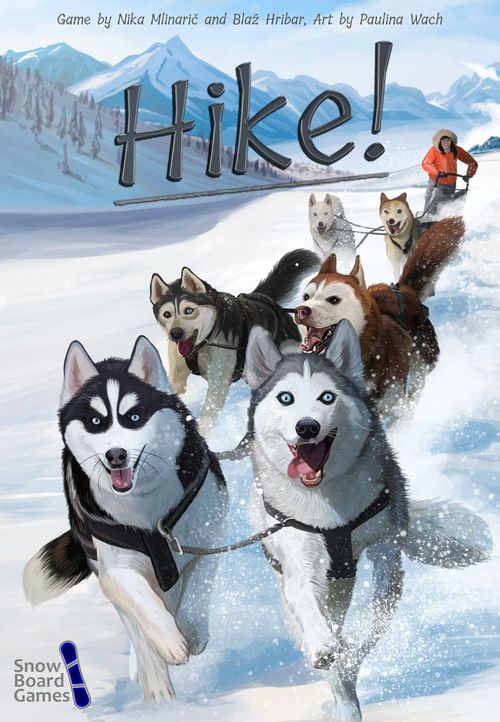
Hike!
Hike! Rulebook
Table of Contents
Table of Contents
Overview
Players take on the role of mushers competing in a dog sledding race. First, they assemble their husky sleds and prepare the equipment they will need for the race. They hand-pick the huskies for their abilities and pay special attention to where in the sled they place them to form a strong and harmonized team. And then, the race is on! Who will have the winning tactics and whose team will perform best in the treacherous terrain? The first one across the finish line is the winner!
Components
- 48 experienced husky cards
- 8 youngster husky cards
- 24 care cards (12 single + 12 double)
- 12 equipment cards
- 20 landscape cards
- 6 player pawns
- 6 sled cards
- 12 mentor cards
- 4 husky on the loose expansion cards
- 48 wooden cubes
Landscape cards form the racetrack, from mountains to forests and frozen lakes. Different terrain types that you move through are represented by different snowflakes.
Terrain type counts:
| Terrain type | Landscape cards | Husky cards |
|---|---|---|
| Snow | 55 | 52 |
| Ice | 25 | 24 |
| Powder | 11 | 16 |
Experienced husky cards are the core of your sled. Some huskies perform best on ice, others in deep snow, and they have preferences over who runs with whom. When assembling the sled, match the edges of the neighbouring huskies. The snowflakes represent movement points and they tell you which terrain fields this husky will get you through each day of the race.
Youngster husky cards are also part of the sled. They don't have movement points, but you can place them next to the edge of any colour and as a bonus action. These youngsters are eager for their first chance to be on a race team. They don't have any experience, but they are willing to learn.
Equipment cards are needed to get the sled through certain special terrain fields. They can also be used to give some huskies an extra movement point. In the deck, there are two terrain fields that require equipment. Some rope, snow hook, axe, dog boots and a headlamp... seems like you are ready to go!
Care cards allow you to use one husky's movement points twice in a day. There are single and double (2x) variants. Treat your huskies well and you'll be rewarded with their loyalty and motivation.
Mentor cards allow you to reveal 1 additional card from the deck. Passing on knowledge through generations is a valuable resource!
Sled cards visually complete the sled and include player aids on the back side. Want to go for a ride?
Husky on the loose cards are an expansion module. "Racing? Woof, I might have a different adventure in mind!"
Game Setup
-
Place the start and finish landscape cards on the table face-up. Shuffle the other landscape cards and place 8 (6 in a five and six-player game) of them face-down in a row between the start and finish cards. The weather is unpredictable, and you'll have to wait for the forecast to know more about the track conditions!
-
Rotate the 4th (3rd in a five and six-player game) face-down landscape card from the start card (not counting the start card) by 90 degrees.
-
Shuffle experienced husky cards, youngster husky cards, equipment cards and 6 care cards (the ones with the same back side as the husky cards) to form a husky deck. Deal 2 cards to each of the players face-down. Reveal 2 cards face-up to the centre of the table. Place the remaining deck face-down next to the racetrack.
-
Take the remaining 6 care cards and 12 double care cards. Each player gets 1 care card and 2 double care cards and places them in a face-up pile in front of them with a single care card on top. Put any remaining cards to the side. They will be used later in the game. If you assemble your sled quickly, you'll have time to do some more training and bonding with your huskies!
-
Each player gets 8 (6 in a five and six-player game) wooden cubes and a wooden pawn of the same colour. They place the cubes in front of them in two equally long rows as shown in the picture. The cubes represent a vacant spot in the husky sled and each cube is a placeholder for a husky card. Players place the pawn next to their pile of care cards. It will be used to represent each player's sled moving over the landscape cards later in the game.
-
Each player gets 2 mentor cards. Players collect the mentor cards and the 2 dealt cards from the husky deck to their hands and they are ready to play!
Gameplay
Hike! is played in 2 phases. It begins with Preparations and continues with a Race.
In Preparations, players reveal cards from the husky deck and draft huskies to assemble their sleds or gather equipment and care cards. The racetrack is slowly revealed as the landscape cards are turned face-up. As you are preparing for the race, the information on the track conditions starts to come in. Last chance to squeeze in some additional training and to make sure you have packed everything!
In Race, players use their husky movement points to move across the racetrack on the landscape cards. They use equipment and care cards to advance their progress. The race is on and every musher is on their own. May the best one win!
The rounds in the game are called days, and each phase takes several days to complete.
First player: First player is the one that was on the snow most recently. Each day, start from the first player and continue clockwise around the table.
Preparations
Each day starts by revealing a landscape card. Then, players go around the table and each takes their turn. When all of them are done, the day ends and then a new one starts.
Begin the day by turning one of the landscape cards face-up. Start with the one closest to the start and continue towards the finish. When all of the landscape cards are turned face-up, skip this step. When revealing the 90-degree-rotated card, rotate it back, so it's in line with other cards. So, I can expect the river to be frozen, and a lot of new snow higher up.
On their turn, each player first reveals one or more cards from the husky deck to the centre of the table and then performs one of the available actions. They may also do a bonus action or declare they are ready to race.
Revealing cards from the husky deck
On the first few days, each player reveals 2 cards from the husky deck on their turn. When the rotated landscape card is revealed and onward, the player reveals 1 card. Additionally, player may discard any number of their mentor cards to reveal more cards from the husky deck.
If the husky deck is depleted, skip this step.
Performing actions
Each player performs exactly one of the following actions:
- Draft a husky to the sled: Take a husky card from the centre of the table and place it in the sled according to placement rules.
- Draft a card to the hand: Take a revealed card from the centre of the table to your hand. This is mostly used to gather equipment and care cards.
- Place a husky from hand to the sled: Place one husky card from your hand into the sled according to placement rules.
- Swap a husky in the sled: Take one husky card from the sled into your hand, and place one husky card from your hand into the sled according to the placement rules. This can be the same card that has been just picked up or any other husky card from your hand. It does not have to be placed at the same place that was just emptied – in this case, replace the placeholder cube on the original place. This action will not help you assemble the sled faster, as the number of huskies will not increase, but if you really want it, you can do it.
Husky cards are both experienced husky cards and youngster husky cards. When taking a card from the centre of the table, players can take any face-up card, it doesn't have to be the one revealed on their turn.
Placement rules, or which huskies like each other?
Husky cards are placed in the sled vertically with images turned towards the player (no rotation allowed). They are placed on free spaces marked by the placeholder cubes. When placing a husky card in the sled, remove the placeholder cube and place it to the side.
If there are huskies around the space where the new husky is placed, the new husky card's borders must match those of the neighbouring cards that are already in the sled. The youngster husky cards can be placed next to any edge.
The new experienced husky card can be placed on:
- A, where it has no neighbours
- B, where its edges match those of cards C and F
- D, where its left edge matches card C's right edge and the bottom edge is placed next to a youngster husky
It can not be placed on E, as its right edge does not match the left edge of card F.
Bonus action
After completing the regular action, the player can place one youngster husky from the centre of the table or from their hand to the sled as a bonus action. This action can help them complete the sled faster. "Pick me, pick me!"
Declaring you are ready to race
If the player's sled is complete (all the cubes have been replaced with huskies), and the player does not wish to draw any more cards from the centre of the table in the next rounds, they declare they are ready to race.
- They move their pawn to its dedicated place on the start landscape card.
- They place any husky cards that they have in their hand to the centre of the table. Other players may use them on their turn.
- Optional: They upgrade an experienced husky which has exactly 1 movement point by placing the equipment card from their hand partially under the husky card. This husky gains 1 additional movement point as described in Race. If the player has multiple equipment cards, they can upgrade multiple huskies. Each husky with one movement point can only have 1 equipment card under them. Huskies with more than 1 movement point and youngster huskies can not be upgraded. Equipment cards used in this way may not be used to get through terrain that requires equipment and must stay with the husky until the end of the race.
From this point onward, when it's this player's turn, they do not reveal any cards from the husky deck and do not perform any actions. Instead, they draw the top care card from their care card pile to their hand. Okay my huskies, let's do some training and bonding!
When someone declares they are ready to race, the phase of Preparations continues for a maximum of 3 more days. In this time, the player that was the first to declare that they were ready to race will empty their pile containing care and double care cards. Players that did not declare their readiness to race and are not on the start at the end of the final day are out of the race.
If all of the players are on the start before that, the preparation ends at the end of the day when all of the players have declared they are ready to race.
At the end of Preparations, collect the care cards from the side and any care cards that players haven't collected and shuffle them. Place the pile next to the racetrack face-down. Remove any cards that are revealed in the centre of the table, the used mentor cards and the mentor cards from the player's hands. They will not be used in the Race. Reveal any landscape cards that are still turned face-down.
Race
On your marks. Get set. Hike!
Each day, the players move their cubes over the landscape cards racetrack fields. Starting with the first player, they use their experienced huskies' movement points, equipment and care cards to move as far as they can. When all of them have taken their turn, the day ends and the sled is reset overnight. Then, a new day begins.
Using husky movement points
To move onto a field, a player must spend a husky movement point identical to the one on the field. From the compact névé to hard ice and fresh powdery snow.
When using a husky card, all of its movement points must be spent together, one husky at a time. Movement points can be used in any order. Any movement points that can't be spent are lost for the day.
When a husky card is used, the player denotes this by placing a cube on it, changing the husky's state from ready to tired. Only one cube may be placed on a husky card at any time.
The player may use as many huskies as they can in any order they want.
Example 1:
- We use husky A to move on to 2 snow fields. We place a cube on husky A and move the pawn 2 fields forward.
- Then we use husky C to move on to a snow field and an ice field.
- We use husky G to move on to a snow field.
- We use husky H to move on to an ice field.
- We use husky D to move on to a snow field. The second snow point can not be used and is lost.
- We use husky B to move on to an ice field and a powder field. The powder point is lost as it can not be used.
Next, we would need an ice point, but none of the ready huskies has it, so we stop for the day.
Huskies with equipment
Huskies with 1 movement point which have an equipment card under them gain one additional point and are treated like a husky with 2 movement points during the race. The additional movement point is custom and can change snow type each use – the possible choices are the snow types on the husky's nearest neighbours. Do you have a husky that is the best one on ice? Motivate the others to learn and place them close, and they'll pick up a trick or two.
Example 2:
Husky G's neighbours are huskies C, F and H. C has one snow point and one ice point. H has one ice point. F has no movement points.
The additional movement point of husky G with equipment can either be snow or ice. The player decides which one it will be every time they use husky G.
Landscape cards that require equipment
Some fields on the landscape cards have an equipment symbol on them. They require the players to spend the appropriate movement point plus an additional equipment card from the player's hand. The equipment card is discarded when the player moves onto the field - each equipment card can only be used once. Equipment from the sled from under the husky cards may not be used.
Example 3:
This field requires you to discard the equipment card from your hand or turn 2 huskies to the rest state.
If a player does not have or does not wish to spend the equipment card, they may still pass, but they turn 2 of their huskies to the rest state. It's a fight to get through, and it takes a team effort. But make sure that your huskies have time to rest, so continue with a lighter pace or take some of the huskies on the sled to ride along with you.
In this case, the player must stop on the field that requires equipment - any unused movement points from the last used husky card are lost. Once the player is on the field, they decide which 2 of their huskies will be turned face-down to the rest state. They must start with ready huskies that have no cube on them. If there are no such huskies, the player may turn tired huskies that have a cube. Youngster huskies can be turned too. Huskies in the rest state have no movement points and stay in this state for the rest of the race.
After the 2 huskies have been turned, the player may use any ready huskies or spend care cards to continue moving on that day.
The two husky states are: Ready and Tired (active state, has a cube once used), or Rest state (turned face-down, no movement points for the rest of the race).
Using care cards
A care card can be used when the player is in a situation where they can use no more husky cards. They discard a care card from their hand and remove the cube from one of the husky cards. The husky goes from tired to ready and can be used again.
After using a care card, players continue their movement. There is no limit on how many care cards can be used in a day, but they can only be used at a time when no husky cards can be used.
Double care cards are used in the same way as single care cards, the difference being that they allow the user to remove 2 cubes from 2 husky cards placed above each other (in a column). If only one husky in the pair is tired, only one cube is removed.
Example 4:
- We stop at field 0. Huskies A, B, C and E are tired. We can't use any of the ready huskies, as no one (including G) has an ice point.
- We discard a care card from our hand to re-use husky B. We remove the cube on husky B and place it back to move over the racetrack on to a powder field, an ice field and a snow field.
- We use the ready husky G with equipment - we choose the additional point to be ice. We move on to a snow field and an ice field.
- We can't use any huskies. But we have a double care card that we discard to remove cubes from huskies A and E. We then use A - we move on to a snow field, the other snow point is lost. Then we use E - we move on to an ice field.
- We can use husky D to move on to two snow fields.
We can't use any more huskies, and we don't have or wish to use any more care cards, so we stop for the day.
End of the day
After all of the players have taken their turns, the day ends.
Starting from the first player, any players that are more than 6 fields behind the leading player (= there are 6 or more fields between the leading player's pawn and the pawn of the player that's behind) and do not have any care cards (single or double) in their hand, draw a card from the care card pile. They place the care card (single or double) in their hand so that it's opened to the rest of the players, and they need to use that care card the next day according to the care card usage rules. Remember that care cards can only be used in a situation where no husky can be used! "I may be behind, but the welfare of the dogs comes first! They know we're all a team, and if we work together, maybe we can turn it around!"
If the care cards pile is empty, collect any care cards that were discarded and shuffle them in. If there are not enough care cards available, use something else to mark that players get care cards - they are not meant to run out.
The players then reset the husky cards by removing the cubes from them. Any huskies in the rest state remain as they are and can not be used again. After that, another day starts. Make camp and rest for the night!
In the following days, the player that is last on the racetrack starts the movements. Next is the player that was second-to-last, and so on. The last to move is the player that was in the lead the day before.
Pro tip: If players are experienced, they can agree to perform the daily movements simultaneously to shorten the playtime. Players always wait for each other at the end of each day and reset the cubes at the same time.
End of the Game and Winner
The game ends at the end of a day in which at least one player has reached the last field of the racetrack.
- If only one player has reached the finish, they are the winner. Winning by a day, well raced!
- If two or more players finish on the same day, the player with more ready huskies is the winner. Each care card in the player's hand counts as one additional ready husky. Double care cards count as 2 ready huskies. The huskies that are in the rest state do not count. Great race! The competition was tough and the victory well earned!
- If players are tied, the one with a lower number of total movement points in their husky sled is the winner. Movement points on all huskies are counted, including the ones in the rest state. Movement points that are gained through the use of equipment do not count. The teams were separated by mere meters! But in the end, it came down to experience and making the most out of the given resources.
Husky on the Loose
Husky on the loose is a small expansion module that you can add to the base game. It brings some player interactions into the Preparations phase and introduces huskies running away and changing sleds.
"Woof. Racing? Well, it sounds fun, but there's this scent that I want to explore first. And have you seen my ball? I think I left it in that snow hole. You know what? just start without me and I might join you later. Woof woof!"
Husky on the loose includes 4 unique cards:
- Husky swap: The player that opened the card chooses another player. They both pick one of their husky cards from their hand or their sled and exchange the cards. If the original card was taken from the sled, the exchanged card can be placed on any free space in the sled according to the placement rules, and if it was taken from hand, the exchanged card is drawn to hand. If the original card was taken from the sled, but the exchanged card can not be placed into the sled according to the placement rules, the player takes it into their hand. If one of the players chosen to be part of the exchange does not have any husky cards, no exchange takes place.
- Husky runaways: The player who opened this card chooses two husky cards revealed in the centre of the table and discards them from the game. If there is only one husky card in the centre of the table, only that one is discarded. If there are no husky cards in the centre of the table, no husky card is discarded.
- Crazy husky swap: All players pick one of their husky cards from their hand or from their sled. They collect all of the picked cards, shuffle them, and deal one back to each player. Each player places the received card into the hand or into the sled, depending on where the original card was taken from. The placement rules are the same as in the husky swap action. If any of the players do not have a husky card at all, they do not take part in the swap.
- Sled huskies on the loose: When this card is revealed, all of the players choose one husky card in their sled each and discard it from the game. If any of the players do not have any huskies in their sled, they do not discard any cards.
Husky cards are both experienced husky cards and youngster husky cards.
When setting up the game, shuffle the 4 husky on the loose cards. Randomly discard one of them (don't look which one) and shuffle the remaining 3 into the husky deck. Then, play Hike! as you would without the module. When a husky on the loose card is revealed, pause the gameplay and execute the appropriate action on the husky on the loose card immediately.
Husky on the loose cards affect only the players who are still preparing for the race. Any players that are already ready to race are immune to their effect and can not take part in discarding cards and card exchanges.
Afterwards, continue the Hike! game at the exact place it was paused at. The husky on the loose cards don't count into the quota of the cards that the player gets to reveal at the beginning of their turn.
Component Note
There are also 6 empty husky cards in the Hike! deck. You can use them to add your own furry friend to the game.
Gameplay Overview
Setup:
- Start and finish landscape cards + 8 (6 for 5-6 players) landscape cards. Rotate 4th (3rd).
- Shuffle husky deck + reveal 2 cards.
- Each player: 1 pawn, 8 (6) cubes, 3 face-up care cards (2 double, 1 single on top), 2 mentor cards, 2 cards from the husky deck, sled card.
Preparations:
- Reveal 1 landscape card.
- Each player:
- Reveal cards from the husky deck (initially reveal 2 cards, from rotated landscape onward reveal 1 card). Use mentor cards to reveal 1 additional card.
- Do 1 action: Draft a husky to the sled. Place a husky to the sled from hand. Draft a card to the hand. Swap a husky in the sled.
- Bonus action: Place youngster husky in the sled.
- Ready to race? Move the pawn to start, discard husky cards from hand, upgrade huskies with 1 movement point with equipment.
Race:
- Spend movement points 1 husky at a time, as many huskies as you want.
- Husky with 1 movement point + equipment card: 1 additional movement point (type depending on neighbours).
- Landscape that requires equipment: discard equipment card or stop at the field and turn 2 huskies to rest state (ready huskies first).
- Care cards: use only when you can't use any huskies! Remove 1 cube from a husky. Double care card: remove 2 cubes from huskies in a column.
- End of day: players more than 6 fields behind the first player get a care card that they need to use the next day.
- Reset huskies.
Winner:
- If only 1 player reaches the last race field in a day, they are the winner.
- If more reach the last field on the same day: who has more ready huskies?
- If tied: who has fewer husky movement points?