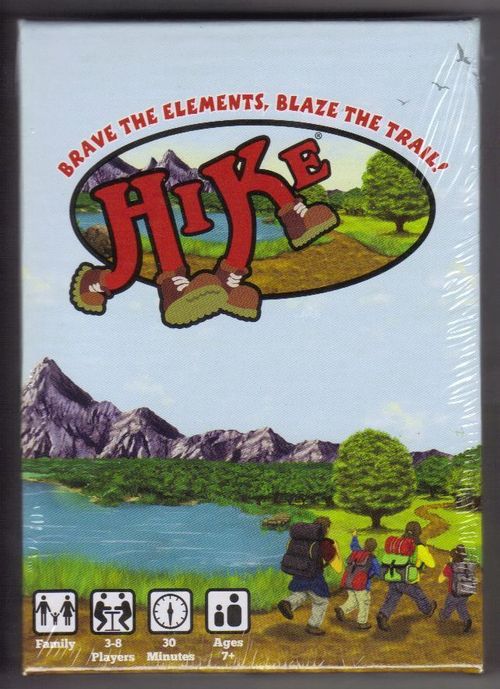
Hike (2011)
Hike (2011) Rulebook
Table of Contents
Table of Contents
The Basics of Hike
- Players receive 7 cards. Each player plays one card on his/her turn.
- Each suited card can be followed by 3 different suits, designated by the 3 suit symbols at the bottom of the card.
- Specialty cards create twists and turns in the game, and can be played on any card.
- If you cannot play a card, you are eliminated from the hand, and your leftover cards result in points for the winning player/s.
- Win the hand by having the fewest leftover cards. Play every card in your hand and receive 3 bonus points!
- 3-4 Players: Play to 25 Pts
- 5-6 Players: Play to 35 Pts
- 7-8 Players: Play to 45 Pts
The Complete Rules of Hike
Number of Players: 3-8
Contents: 80 cards
- 70 suited cards: 10 Birds, 10 Bugs, 10 Lakes, 10 Lights, 10 Peaks, 10 Trails, and 10 Trees
- 10 specialty cards (Avalanche, Drought, Earthquake, Litter, Lost, Poop, Spring, The Sun, The Wind, The Worm)
The objective: To get rid of your cards and score points.
Ways to score points:
- Have the fewest remaining cards at the end of the hand
- Capture The Worm
- Plant Trees in Springtime
Progression of play
- The Dealer shuffles the deck and deals 7 cards to each player.
- The player to the left of the dealer begins by playing any card in his/her hand.
- Play continues to the left. Each player plays one card on his/her turn.
- Players play one card at a time until someone cannot successfully play a card. If a player cannot play a card, he/she is eliminated from the hand. He/she sets his/her remaining cards face up in front of him/her, and they count against his/her leftover card total.
- The hand is over once every player has either been eliminated or has successfully played all of their cards.
- The player who has the fewest leftover cards wins the hand.
Understanding the symbols on the suited cards
Each symbol represents one of the 7 suits. The 3 suit symbols listed at the bottom of the suited cards indicate which suits can be played on that card. For example, the Peak card has the Light, Trail, and Bird symbols at the bottom. That means the next player can only play a Light, Trail, or Bird on his/her turn. He/she can also play a specialty card, because specialty cards can follow any suit.
Specialty Cards
Specialty cards have a variety of effects on the game. The more specialty cards that appear throughout the hand, the more fun and exciting the game gets.
Specialty cards can be played on any card. There are two exceptions to this rule:
- You may not play specialty cards on The Sun, since it requires light from the active player (See The Sun). However, you may play The Wind on The Sun. (See The Wind)
- Litter can never be played.
You can play any card on a specialty card. There are two exceptions to this rule:
- You must play Light on The Sun (See The Sun)
- You must treat The Wind as the suited card it becomes.
Scoring
All of the leftover cards are added up, and the winner receives 1 point for each leftover card. For example, if Player 1 has 2 leftover cards and Player 2 has 4 leftover cards, and Player Three has 1 leftover card, then Player 3 is the winner and receives 7 points.
Any player who has zero leftover cards receives 3 bonus points. For example, if there are 7 leftover cards, and the winner ran out of cards, then the winner receives 10 points (7+3).
If more than one player has the fewest leftover cards, then the points are equally shared. For example, if there are 10 leftover cards and 2 winners, then each winner receives 5 points.
If more than one player wins, and there are an uneven number of points to distribute, what happens?
- If the winning hands have 1 or more leftover cards, then the last winner to successfully play a card receives the extra point/s.
- If the winning hands have zero leftover cards, then the first player to run out of cards receives the extra point/s.
Points are not added up and recorded until the end of the hand.
Ties: If multiple players are tied for the lead when a winning score is achieved, then all participants continue playing until the tie is broken.
Winning the game
- 3-4 players: The first person to 25 points wins.
- 5-6 players: The first person to 35 points wins.
- 7-8 players: The first person to 45 points wins.
The Specialty Cards in Greater Detail
Avalanche: Watch out for the mountain of cards headed your way! Everyone but the player who played Avalanche draws 2 cards. Players who've been eliminated from the hand, or have played all of their cards are unaffected. For the remainder of the hand, anyone who plays a Peak (including whoever played Avalanche) must draw 1 card.
Drought: If a Drought comes, you'd better hope you have plenty of water saved up. When Drought is played, all players must play a Lake on the play pile, including the player who played Drought. Anyone who does not play a Lake is eliminated from the hand. When the Drought is over, the player to the left of the person who played Drought plays the next card. He/she must follow the exposed Lake, rather than play any card.
Earthquake: It's time to shake things up. Whoever plays the Earthquake takes the remaining cards in every active player's hand, shuffles, and re-deals them to the active players. Deal the cards clockwise, starting to the left of the player who played Earthquake. If you have been eliminated from the hand, if you are out of cards, or if you play the Earthquake as your last card, you are unaffected.
Litter: Nature is stuck with our garbage for a looooooooong time. Litter can never be played. If you have Litter, an Earthquake is the only way to get it into someone else's hand.
Lost: Which way do we go? Lost reverses the direction of play. For the remainder of the hand, Trails reverse the direction of play. If the active player plays Lost or a reversing Trail when only 2 players remain, then the active player goes again.
Poop: Bugs cannot resist a steaming pile of Poop. Every player (including the player who played Poop) places their Bugs face-up in front of them. Players with Bugs are not eliminated from the hand, but their Bugs count as leftover cards. Each Bug will result in points for the winning hand. Any Bugs drawn later in the hand are unaffected by Poop. It is possible to fall victim to Poop and still win the hand.
Spring: When Spring is played, every player may plant Trees. In order to plant a Tree, remove it from your hand, and place it face up in front of you. Each Tree you plant is worth 1 point. Planted Trees do not count against your leftover card total. To avoid any confusion, plant your Trees sideways.
The Sun: Don't find yourself in the dark when The Sun comes out! The following player must play Light on his/her turn. If he/she cannot, he/she is eliminated from the hand, and the next player must play Light on the play pile. The Sun remains active until someone successfully plays Light. If none of the other players can play Light, whoever originally played The Sun will need Light to stay alive.
The Wind: When nature gets windy, nature gets wild! The Wind can represent any of the 7 suits in any situation. You can play The Wind on The Sun, and use it as Light. You can play it as a Lake during a Drought. You can play it in Spring, and plant a Tree. You can also play The Wind on a suited card, and then pick one of the 3 suits called for.
The Worm: The early bird gets the worm! Whoever plays The Worm may play a Bird on top of it, immediately capturing The Worm. Capture the Worm (place it in front of you - it is NOT a leftover card) and receive 1 point for each Bird successfully played during the ENTIRE hand. If someone plays The Worm and does not have a Bird, then the Worm remains in the play pile and play continues. The first player to play a Bird may capture The Worm, but he/she must remember to dig it up from the play pile. If no one successfully captures the Worm, then the player who originally played The Worm captures it at the end of the hand. The Worm may only be captured once per hand. If The Worm is a leftover card and was not successfully played, it cannot be captured.