High Score
High Score Rulebook
Table of Contents
Table of Contents
Playing Materials
- 1 playing board
- 5 playing pieces
- 5 30+ markers
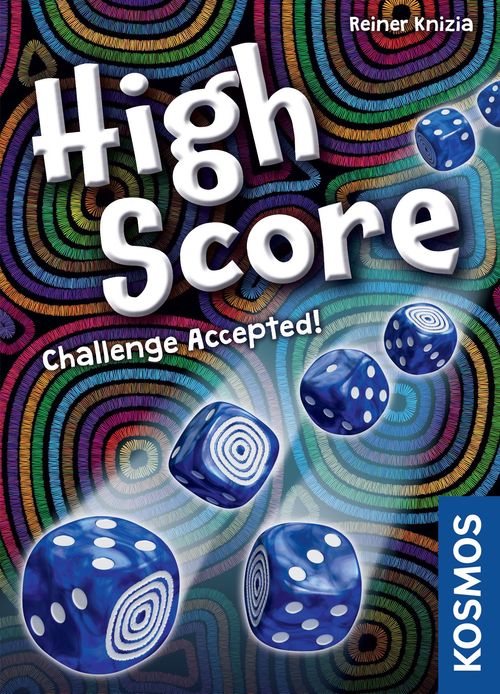
- 7 custom dice (1, 2, 3, 4, 5, vortex)
- 21 challenge cards
- 21 point chips (7x each in gold, silver, bronze)
Before your first game, carefully punch out all of the playing materials.
Game Preparation
Put the playing board in the center of the table.
Each player chooses a color:
- Put your playing piece in the center of the playing board.
- Place your 30+ marker in front of you with the blank side facing up.
Lay the dice and point chips (gold, silver, and bronze) next to the playing board.
Shuffle the challenge cards and place seven of them face down next to the playing board in a pile. Return the remaining cards to the box, also turned face down.
How to Play
This game is comprised of seven rounds, hence there are seven challenge cards for one game. A new challenge card is turned over each round. Take turns rolling the dice and attempting to achieve the highest score according to the current challenge card rules. When a player is finished rolling the dice, use their playing piece to mark their score on the playing board. At the end of each round, the three most successful players receive a point chip in gold, silver, or bronze.
Playing a Round
Turn over a challenge card: Turn over the top card in the challenge card pile and make sure that each of you understands what the new challenge is — see the "Challenge Cards" section for details.
Decide who will start, then proceed in a clockwise direction.
- Roll the dice: The player whose turn it is rolls all seven dice. Follow the rules on the challenge card to determine which dice you can re-roll and then tally your score.
- Move your playing piece: If you manage to achieve a positive score, place your playing piece to the corresponding position on the playing board. (You do not place your playing piece if the outcome is negative or zero). Only one playing piece can be placed on each space on the playing board. If you land on an occupied space, you must place your playing piece on the next lower space. If your score exceeds 30 (e.g. you score 37), indicate the score by turning over your 30+ marker in front of you to the side featuring the number "30" and placing your piece on the space numbered 7.
Note: On the rare occasion that two playing pieces end up on the same space, but with two different scores (person A has the score 37 and person B has the score 7), they may both remain on this space.
Once you have all had your turn rolling the dice and placing your playing pieces, distribute the point chips.
Distribute the point chips: The player whose playing piece corresponds to the highest score receives a gold point chip; the second and third highest scores receive a silver and bronze point chip respectively.
(In a game with two players, only award the gold and bronze point chips.)
Players who do not achieve a positive score cannot receive a point chip.
End of the round: Return the challenge card played to the box and the playing pieces to the center of the playing board. If you turned over your 30+ marker during the round, turn it back over to the blank side again.
New starting player: The player who won the gold point chip then turns over the next challenge card in the pile and starts the next round.
End of the Game and Winner
The game ends after seven rounds. Each of you then adds up the points on your point chips:
- Gold = 3 points
- Silver = 2 points
- Bronze = 1 point
The player with the most points wins.
In the event of a tie, the tied player with the most gold point chips (and then the most silver point chips) wins. Is there still a tie you share the victory.
Challenge Cards
The challenge cards contain three different pieces of information:
- Vortex value — What is the vortex value for this round?
- Type of dice roll — How and how often may the dice be rolled?
- Dice scoring — Which dice count in the scoring?
The challenge cards are explained in detail in the next section. You don't need to read through these explanations now. You can look at the explanations during the game.
Vortex Value
Depending on the challenge card, the vortex die face has a certain value: it can be negative (e.g. vortex = −5), zero (vortex = 0), or positive (e.g. vortex = 10).
Type of Dice Roll
There are three different ways to proceed after rolling all seven of the dice:
- Four full rolls: You must use all seven dice in each new roll! You may roll the dice up to four times in total. The score is determined by your last roll.
- Any three rolls: After your first roll, you may pick up any of the dice (or even all of them) and roll them again. After that, you may pick up any of the seven dice again (including the ones you didn't include in your second roll) and roll them again. The score is determined after your final roll (which can be 1, 2, or 3 rolls).
- Set aside after each roll: After the first roll, you must set aside at least one die, this die cannot be rolled again this turn. You may roll the remaining dice again. After each roll, you must set aside at least one more die until all the dice have been set aside. The final dice result is determined after your last roll.
Dice Scoring
Your score is determined after your final roll. Sometimes certain dice results do not count, or count as negative. The value of the vortex is treated like any other number on the dice.
Total: The faces of all seven dice count.
- Example: dice showing 5, 5, 5, 4, 4, 2, 1 → Yields 26
- Example: dice showing 5, 5, 5, 4, 4, 2, vortex (= −5) → Yields 20
Same number: Only the dice faces for which there are at least two of the same number count.
- Example: dice showing 5, 5, 5, 4, 4 count (2 and 1 do not) → Yields 23
- Example: dice showing 5, 5, 4, 4, vortex, vortex (both = −5) count (2 does not) → Yields 8
Same number minus remainder: Only the dice faces for which there are at least two of the same number count. The remaining dice are then subtracted.
- Example: 5, 5, 5, 4, 4 count, minus 2, 1 → Yields 20
- Example: 5, 5, 4, 4, vortex, vortex (both = 0) count, minus 2 → Yields 16
Tens minus remainder: Only the dice faces that can be grouped to totals of 10 count. The remaining dice are then subtracted.
- Example: 5, 5, 4, 4, 1 count, minus 1, 4 → Yields 14
- Example: 5, 5, 4, 4, 1 count, minus 4, vortex (= 6) → Yields 9
Two of a kind: Only the dice faces that occur in pairs count.
- Example: dice showing 5, 5, 5, 5 count → Yields 20
- Example: dice showing 5, 5, 4, 4, vortex, vortex (both = 6) count → Yields 30
Two of a kind minus remainder: Only the dice faces that occur in pairs count. The remaining dice are then subtracted.
- Example: 5, 5, 4, 4 count, minus 4, 3, 1 → Yields 10
- Example: 5, 5, 4, 4 count, minus 4, 3, vortex (= 0) → Yields 11
Three of a kind minus remainder: Only the dice faces that occur in triples count. The remaining dice are then subtracted.
- Example: 5, 5, 5 count, minus 4, 4, 2, 1 → Yields 4
- Example: 5, 5, 5 count, minus 4, 4, 2, vortex (= 10) → Yields −5
Odd numbers: Only the dice faces with odd values count (1, 3 & 5).
- Example: 5, 5, 5, 1 count (4, 4, 4 do not) → Yields 16
- Example: 5, 5, 5, 1, vortex (= 5) count (4, 4 do not) → Yields 21
Odd numbers minus remainder: Only the dice faces with odd values count (1, 3 & 5). The remaining dice are then subtracted.
- Example: 5, 5, 5, 1 count, minus 4, 4, 2 → Yields 6
- Example: 5, 5, 5 count, minus 4, 4, 2, vortex (= 10) → Yields −5
Values shown minus remainder: Only the dice faces with the values of 4, 3, 2, and 1 count. The remaining dice are then subtracted.
- Example: 4, 4, 2, 1 count, minus 5, 5, 5 → Yields −4
- Example: 4, 4, 2, 1, 1 count, minus vortex, vortex (both = 5) → Yields 2
Ascending values and vortices: The dice faces with the values 1, 2, 3, 4, 5, vortex count as long as they begin with 1 and form an ascending series without gaps. Higher values that come after a gap do not count.
- Example: dice showing 1, 2 (the rest do not continue the series) → Yields 3
Values that occur multiple times also count if the gapless series condition is met.
- Example: dice showing 1, 2, 2, 3 (the duplicate 2 also counts) → Yields 8
Vortex Values for the Type of Dice Roll and Scoring the Dice
- Vortex = 0: If the challenge card has a "0" printed on it for the vortex, then you must set any dice bearing a vortex aside. You may not roll these dice again and they count as "0" in the final score.
- Vortex = 0–6: You can choose which value from 0 to 6 the vortex should have. If you roll several vortices, you can choose their values independent of each other. Example for three of a kind minus remainder: dice showing 5, 5, vortex (chosen as 5) form one triple, and 4, 4, vortex (chosen as 4) form another triple; both triples count, minus the one remaining die (2) → Yields 25.
- The background color already provides an indication: red usually means something not particularly good, green gives hope — but only if the scoring allows it.
About the Author
Reiner Knizia, born in 1957, today lives in Munich. He holds a doctorate in mathematics and has published countless games both in Germany and abroad. His greatest achievements include the "Deutscher Spielepreis" (German Game Prize) in 1993, 1998, 2000 and 2003, and the "Game of the Year 2008" award (Game of the Year) for "Keltis," which is based on "Lost Cities." The author specializes in games offering extensive decision-making freedom, coupled with simple rules. KOSMOS has already published many of his games.
The author and publisher would like to thank all those who participated in the test games, rule reading, and creation of the game.