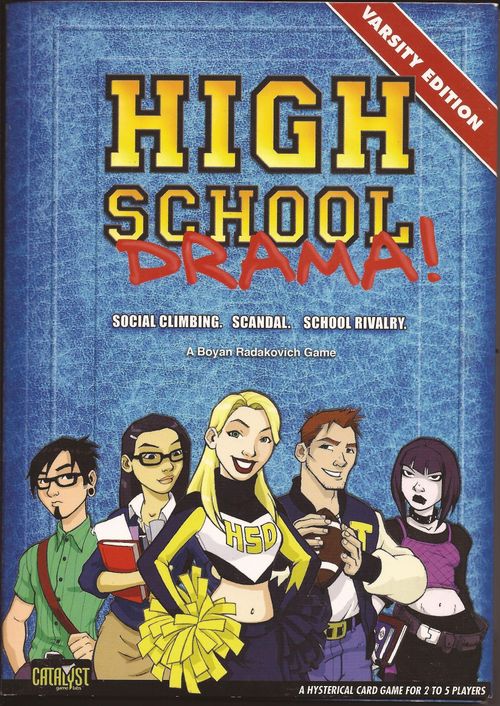
High School Drama: Varsity Edition
High School Drama: Varsity Edition Rulebook
Table of Contents
Table of Contents
- Contents
- Glossary
- Setup
- Game Play Overview
- Pick Your Main Student
- Semester Start
- Midterm Action
- Final Action
- Hookups: Staying Cool in HSD
- Bonds: Having Heart in HSD
- Breakups: Clique Cruelty in HSD
- Events: Making the Scene in HSD
- Summer Semester: HSD Guide to Yearbook Signatures
- Game End: HSD Guide to Graduation
- Expanded Play Options
Contents
Open the box, find some friends and add a dash of trash talking to the mix and you've got the perfect combination for fun. Everything you need to play the game is provided in the box. Here's what should be included:
- 30 Student Cards
- 24 Organization Cards
- 15 Drama Cards
- 40 Special Event Cards
- 90 Bond Markers
- 2 Icons
- Rules Book
- HSD Travel Case
Glossary
Jock (green border): Jocks are students who excel at competitive situations such as sports because of their natural physique and strong spirit. Jocks typically form the center of fast-growing cliques, which gives them an advantage early in HSD.
Popular (pink border): Popular kids are students who excel in social situations because of their natural beauty and easy access to their parents' bank accounts. Popular kids often use their high cruel rating to suppress rival cliques before they become strong.
Artsy (purple border): Artsy kids are students who excel at expressing themselves because of their artistic sensibility and broad emotional depth. Artsy kids often have high cruel and heart ratings, meaning that their cliques can dish out the drama as well as they take it.
Geek (grey border): Geeks are students who excel in academic fields because of their keen intelligence and powerful imagination. Geeks typically have very low cool but high heart, meaning that if they can survive the early attacks, geeks have great long-term potential.
Dual Type (mixed border): A few students in HSD will actually be treated as having two types. These dual type students make relationships very easily and are often the most active in organizations. Dual types are usually welcomed into any clique because of their versatility and expanded potential.
Figure: card anatomy (labels: Name; Type (border color); Relational Arrows; Attributes; Quote).
Setup
Shuffle the student cards, and then shuffle the organization cards. Do not shuffle the two decks into each other. Keep them separated.
Randomly draw two students and two organizations per player.
Place all the drawn student and organization cards face up in the quad, the communal center of your playing area. Arrange the cards nicely.
Return the unused student and organization cards to the box. You will need to draw from these cards again, so keep them nearby.
Example: In a three player game, randomly draw six students and six organizations. Place all these cards in the quad face up for review.
Deal each player one hookup, one bond and one breakup card from the drama cards. These drama cards are effectively all the same except for their flavor text; however, some players may prefer one card over another. These cards should be kept face down in front of the players. Any remaining drama cards won't be needed for the game and can go back into the box.
Example: In a three player game, each player should have their own set of hookup, breakup and bond cards that they keep face down in front of them. The special events deck has been shuffled and placed within easy reach of the players.
These three drama cards represent the basic actions players may take during their turn -- hookups are used to expand your clique, bonds are used to strengthen your relationships and breakups are used to attack your rivals.
Shuffle the deck of special event cards and place it near the quad.
The event cards are more powerful versions of the normal drama cards and also provide a way for players to earn yearbook signatures. However, because they are random, it's best to only think about these cards at higher grade levels.
Game Play Overview
High School Drama! is played in a series of rounds called school years, with each school year composing four distinct semesters. Starting with the semester leader, each semester consists of three phases:
- Semester Start: all players secretly draw action cards into their hand up to the year limit.
- Midterm Action: players alternate playing their first action from their hand of cards.
- Final Action: players alternate playing their last action for the semester from their hand.
At the end of each semester, move the season tracker icon to the next semester and pass the semester leader icon clockwise. Game play continues until students graduate. The player with the most yearbook signatures at the end of graduation wins!
Pick Your Main Student
Players will pick their main student from the selection available in the quad. This main student will represent the nucleus from which you'll expand your clique. Students with high cool will be able to expand quickly while students with high heart have a lot of long-term potential in the game. Also, a student's cruel rating will be used to attack your rivals. Like real life, some students are simply more powerful than others.
While your main student's attributes are important, you really should pick the student you think you'll have the most fun playing, since getting into character and role-playing your actions and reactions is what makes HSD the most fun.
The youngest player picks their main student first, followed by the person to their left and continuing clockwise until each player has selected their main character. Also, each player should take a colored set of bond markers to indicate their clique's influence in the game.
Give the semester leader icon (blue pawn) to the last player who selected their main student.
Semester Start
There are four semesters for each year of HSD -- fall, winter, spring and summer. At the beginning of each semester, players will have an opportunity to plan their actions for that turn by drawing action cards into their hand.
These action cards are taken from either the three face-down drama cards laid out in front of each player or the random special event deck. Players do not have to reveal the cards they draw and may keep their hand secret. Keep any unused cards separate from your hand.
Players continue drawing action cards into their hand until that player has reached the hand size for their school year -- freshman 2, sophomore 3, junior 4, and senior 5. When all the players have alternated in taking their turn drawing their actions for the semester, play continues with Midterm Actions and then Final Actions.
Example: Both Alex and Dana draw one hookup and one bond into their hand. Kim draws a hookup and breakup. Since it's freshman year, the hand size is 2. Everyone is ready to rock and roll.
Midterm Action
Starting with the semester leader, players alternate taking turns playing their first action from any of the action cards in their hand.
Play drama and special events cards face up in front of you. Resolve the action as described on the card or in the rules below.
If the action was a drama card, simply return that played card to the small set of personal drama cards in front of each player. If the action was a special event, discard the card face up near the special events deck.
Example: Alex plays a hookup to have his Emo Boy introduce himself to the Garage Band. Dana has Ping Pong Champ flirt with the Tennis Star. Kim plays a breakup to spread a vicious rumor about Dana's Ping Pong Champ, making him break up with the Tennis Star.
Final Action
The second action of the semester plays just like the first. Players will alternate taking turns playing their second and final action of the semester.
Players must play a card during midterm and final action, even if doing so is to their disadvantage. If a card is played but has no effect, the card is simply discarded.
After the freshman year, players will have more cards in their hand than they can play. That's normal. The hand size represents each player's social calendar for that semester. When you are a freshman, you play what you have. However, as players advance in HSD, they'll have many more options from which to choose. Be careful what actions you take in HSD.
After the freshman year, players may keep any unused cards between semesters or discard them. If cards are kept between semesters, those cards count towards the hand limit for that semester. Move the semester tracker to the next semester after the final actions.
Example: Alex plays a bond to have Emo Boy share food with the Garage Band. Dana tries to play a bond as well, but no longer has any friends so the card is discarded. Kim now has Dumb Blonde hookup with the Tennis Star using a chance meeting. Scandal!
Hookups: Staying Cool in HSD
Select any student in your clique to perform the hookup action. This student may now expand your clique by forming a new relationship with any other student or organization if they follow either rule below:
A) your student and the target are both the same type. (have matching borders)
B) your student is at least as cool as the target cool rating. (target is less than or equal to your cool)
A student or organization's type is indicated by their border pattern and color. Most students have one of the four basic archetypes of HSD -- jock (green), geek (grey), artsy (purple) or popular (pink). Some students and organizations have more than one archetype. This means that every relational arrow on a dual type is considered matching for either type.
A student's cool rating is indicated by the attribute circle under the portrait. Some special event cards function as more powerful hookups. These random events may make it possible for low cool students to make unlikely hookups. Unless the card specifically says otherwise, any changes to a student's cool rating during a special event are temporary.
The new card must physically fit within your clique. If you can make the hookup, place the new card so that its relational arrows line up directly with the student who performed the hookup action. If the new card does not fit, then the hookup action fails and the card is discarded without effect.
Also, once a new student or organization has joined your clique, it cannot normally be rearranged or moved. For this reason, players should be careful how they build their clique and leave room for future expansion.
Place one bond marker over the joined arrows to indicate this new relationship.
Sticky note: Only students can perform the hookup action. Players normally may not use organizations to hookup to other cards.
Example: Emo Boy is an artsy type student with a cool rating of 3. Alex can have Emo Boy hookup with Garage Band because they are both artsy types OR join Soccer, because Soccer has a cool rating of 3. However, Emo Boy (cool 3) cannot hookup with Tennis Star (cool 4) because she is just too cool for him.
Bonds: Having Heart in HSD
Choose an existing relationship in your clique when playing this action. An existing relationship is one that already has at least one bond marker over the adjoining relational arrows.
Add one bond marker to the strength of this relationship.
The more bond markers you have between two cards, the stronger that relationship is. The strength of a relationship is important in game play for two reasons -- 1) strong bonds are difficult to breakup and 2) every bond marker represents a potential yearbook signature.
The maximum strength of any relationship can be found by adding the two heart values of the cards involved in the relationship.
Certain special event cards function as more powerful bond actions and may make it possible to quickly fortify your clique. However, special events normally cannot add more bond markers than the maximum bond strength of the relationship.
If all relationships within your clique have reached their maximum potential strength or if there are no more bond markers of your clique's color, then the bond action fails and the card is discarded without effect.
Sticky note: Two students hooked up to the same card may have entirely different maximum potential strength of their respective relationships.
Example: Dumb Blonde (heart 2) and Man Candy (heart 1) have formed a relationship and their maximum potential strength is only 3 bonds. However, Dumb Blonde (heart 2) and Tennis Star (heart 3) have a maximum potential strength of 5 bonds.
Breakups: Clique Cruelty in HSD
Any student in your clique may play the breakup action to keep your rivals down; however, usually the student with the highest cruel rating will perform the breakup.
Pick any one of your rival's relationships. Remove one bond marker from this relationship if you are at least as cruel as the strength of their bonds.
Normally, you may only remove one bond marker for each breakup played; however, some special event cards will allow players to remove more than one bond marker at a time.
A relationship that has a bond strength of zero is considered broken.
If a relationship is broken and there are no other attachments connecting back to a clique's main student, then the student or organization targeted by the breakup must be returned to the quad. In some catastrophic breakups, it is possible to remove more than one card at a time from a clique during a breakup. This chain reaction can happen if the student who must return to the quad is also attached to another card that is not connected back to the main student of the clique.
Example: Ping Pong Champ is the main student in Dana's clique. If someone attacked the relationship between Manga Girl and Game Master, that relationship would then become only a bond strength 1, weakened but not broken. However, if the breakup were instead played between Game Master and the Ping Pong Champ, Dana would lose both the Game Master and his Manga Girl friend. Oh noes!
Events: Making the Scene in HSD
Normally, there are only two ways to earn yearbook signatures in HSD -- earning student standouts during summer semester and by attending special events. Special events are school-wide events that can potentially affect all the players in the game at once.
During certain events, players may exchange some or all of their bond strength to certain relationships for an equal number of yearbook signatures according to the type of event. Do this in turn order.
Events come in different varieties and are color coded to match each type of relationship -- jock games (green), popular parties (pink), art shows (purple), geek conventions (grey) and bonus cards (blue). Each event card will indicate what type of bonds may be exchanged for yearbook signatures.
Organizations that are considered dual-type count as either type during an event. For example, players hooked up to Varsity Football (a jock/popular dual type) can exchange their bonds to Varsity Football during either a sports game or during a popular party. Because their potential is effectively doubled, dual-type organizations tend to be the focus of a lot of drama in the game.
If an event would affect their clique, players may exchange none, some or all bonds of the type indicated on the special event card.
If a player brings their bond strength for a relationship to zero during an event, that relationship is considered broken. Return any unattached cards to the quad, including any potential chain reactions, as if they were under the normal breakup rules (described above).
Sticky note: Special events often grant a bonus number of yearbook signatures if a player has control over a certain organization in play. The events may be played normally, even if those bonus organizations mentioned on the card are not currently in play.
Figure: Yearbook Signature Tracker (graphic; the tracker is used to record each player's yearbook signatures).
Example: Alex plays the special event Gaming Convention. All players may now exchange bonds to geek organizations for yearbook signatures. Alex removes two bonds to Garage Band and earns two signatures. Dana chooses to remove only one bond from Anime Club and earns one signature. Nobody has Gaming Club in play, so no bonus points were awarded this time.
Summer Semester: HSD Guide to Yearbook Signatures
After three semesters of play (fall, winter, spring), the school year is finished. Move the semester tracker to the summer semester location and then go through each of the following steps below, in order, to finish off that school year:
-
Flunk Out: Remove any students or organizations that are remaining in the quad. Place these cards at the bottom of their respective decks. The quad should now be empty.
-
Vote for Student Standouts: The player with each of the following student standouts during summer session earns one additional yearbook signature.
Each player should keep track of their number of yearbook signatures by placing one of their colored bond markers on the yearbook signature tracker.
-
Summer Lovin': After voting, all players gain a bonus bond marker to be placed on any existing relationship. This functions as a free bond action.
-
Shuffle Events: Return any played and unplayed special event cards to the events deck. Shuffle all event cards and place near the quad.
-
New Year: Draw one new student per player in the game as well as one new organization per player in the game. Place these new cards face up in the quad.
The most important part of summer semester is voting for the student standouts. If there is ever a tie in determining who wins any student standout, all players in the tie are awarded the bonus for that year. This is a good way to earn some extra yearbook signatures and show your strategic skills to the other players.
Players normally start freshman year with zero signatures and work their way up through the school year. It's very common for players to ditch their fake friends once they earn their yearbook signatures. This is especially true for juniors and seniors, who often go to lots of events.
Once all the year-end tasks are finished, play continues with fall semester in the next school year with the new current semester leader. Game play is essentially the same except now the hand size limit has increased by one card, allowing for more flexibility in strategy and opportunities for special event cards.
Student Standouts
- Most Athletic = Most bond markers to jock organizations.
- Most Popular = Most bond markers to popular organizations.
- Most Artistic = Most bond markers to artsy organizations.
- Biggest Dork = Most bond markers to geek organizations.
- Cutest Couple = Clique with the two students with the strongest bond.
- Biggest Flirt = Clique with the largest number of students.
- Most School Spirit = Clique with the largest number of organizations.
Game End: HSD Guide to Graduation
The game is normally finished when the semester tracker reaches senior graduation. However, for a shorter game, players may agree to graduate early and finish after junior year's summer semester.
Remember to vote for student standouts, sign your yearbook and check the final score.
When the game ends, the player with the most yearbook signatures wins. In the event that two or more players have earned the same amount of yearbook signatures, the tie breaker goes to the player who has the most remaining bonds left in play after graduation.
Expanded Play Options
The following rules provide expanded game play options for additional enjoyment of High School Drama!
Travel HSD: Everything you need to play HSD fits neatly inside the HSD Travel Case; however, if you play without the yearbook, you'll need a new scoring system. When a player earns a yearbook signature -- either during a special event or during voting for student standouts -- simply add a bond marker of that player's color to the travel case. At the end of graduation, count the number of bond markers for each player to determine final score.
Transfer Student Bonus: It's easy to add new players to an ongoing game of HSD. Let the new player search through the Student deck and pick a character they would like to play, then give them one of each drama card. Because they start with no friends, give the transfer student a two yearbook signature bonus for every semester of play that they've missed. For example, if a new transfer student joins at the beginning of fall semester sophomore year, they should start play with six (6) yearbook signatures.
Summer School: For a more intense game, players can continue play into summer semester. This means that there will be 16 semesters of play instead of the normal dozen. Vote for student standouts only after summer semester ends. Summer School variant allows for more chained events and for longer strategic play. Look forward to higher scores and a lot more drama.
Public School Draft: Players of the original HSD will notice that the drafting mechanism at the beginning of each semester has changed in the Varsity edition to a private draft. If you'd like to play with a public draft, use the following rules.
Draw out one hookup, one bond and one breakup card for each player in the game. Place these drama cards in three face up stacks near the yearbook. Place the face down special events deck next to the drama cards. During the Semester Start phase, players will alternate turns drawing up action cards into their hands. One at a time, they may take any of the drama cards or the special events cards. Players may take the same type of card multiple times. When the hand limit is reached for each year, game play continues as normal. When cards are played, they are returned to their original stacks.