High Frontier Expansion
High Frontier Expansion Rulebook
Table of Contents
Table of Contents
- 8.0 The Expanded Game
- Expanded Game Passages in Sections 1 - 7
- 2.2 Map Features (expanded passage)
- 2.3 Player Factions (expanded passages)
- 2.6 Cards (expanded passages)
- 3.2 Expanded Game Set-Up
- 5.2 Research Operation (Auction) (expanded passage)
- 5.4 Boost Operation (expanded passage)
- 5.4E Signposts (expanded passage)
- 5.7 Industrialize Operation (expanded passage)
- 6.1 Rocket Modified Thrust (expanded passages)
- 6.2 Spacecraft Move (expanded passages)
8.0 The Expanded Game
8.1 Expanded Game Components (purchased separately)
- 1 Expansion Map.
- 1 Thruster Patent Card (The touchy metastable helium rocket).
- 9 Generator Patent Cards. Two kinds: electricity, or pulsed power.
- 7 Reactor Cards. Three kinds: neutronic, burst plasma, or exotic catalysts.
- 7 Radiator Cards. Each provides one to three therms (^) of cooling.
8.2 Support Cards
Some cards list support cards (reactors, generators, and/or radiators) in their red data field (2.6C). The card can't be used (for movement, prospecting, refueling, industrialization, etc.) without these support cards. The support cards themselves also will often need supports.
Important: When industrializing a site in the expanded game, you will need to decommission not only the refinery and robonaut cards, but also all of their supports, and also all supports of those supports.
Exception: You never need to decommission radiators to industrialize a site (because the nightside of the site itself acts as a radiator).
A. OVERHEATING. Some cards indicate a number of therms (the ^ icon) of radiator cooling required to keep from overheating. For instance, if your rocket stack altogether needs 3 therms of cooling, you will need one or more radiators that add up to at least 3 therms.
Important: Heat rejection is necessary only if the card is in use. If in a turn, a thruster system does not move, or a robonaut system does no prospecting or refueling, then they don't need radiators that turn.
Note: A radiator can be boosted in a light or heavy variant, per 2.5G.
Remember: Afterburning provides 1 therm of cooling per 6.1A.
8.3 Advanced Rocket Maneuvers
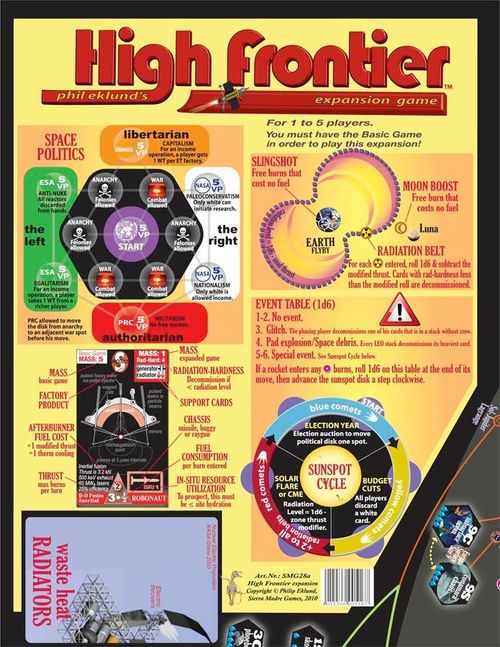
A. SLINGSHOT. A rocket or sail that enters a flyby L-point can perform a slingshot maneuver, giving it a number of free Burns (6.2A) up to the planet's slingshot rating. These are used during the remainder of its move. For instance, after entering the Earth flyby, you may go an extra two burns that do not count against your acceleration and cost no fuel. See example on page 24.
- The Venus flyby bonus may only be used during the blue sector (8.5B).
B. MOON BOOST. Entering this flyby gives you one extra burn for no fuel or acceleration cost, just like a slingshot.
C. RADIATION BELT. Four worlds (Sol, Earth, Jupiter, and Saturn) are surrounded by a purple dashed line indicating a radiation belt*. When entering a radiation belt L-point, find its radiation level by rolling 1d6 and subtracting the spacecraft modified thrust (6.1). All cards in the stack with a rad-hardness (2.6C) lower than this modified roll are decommissioned. This may halt the spacecraft on this spot; see example 8.9.
Example: The green route to Enceladus passes through 7 radiation belts.
- Solar Active Year. If the sunspot disk (3.2A) is in the red sector, add 2 to the radiation levels of all radiation belts..
- UN Cycler. The UN (purple) player may make any spacecraft he designates immune to the radiation effects of the Earth belt.
- Sail Bonuses. Sail cards are immune to damage from radiation belts and solar flares. The Mag Sail receives a +1 thrust bonus for each radiation belt it crosses in a move.
Example: A rocket with a modified thrust of 2 moves from LEO to GEO, crossing the Van Allen belt. A "4" is rolled, so the radiation level is 4 - 2 = 2. The rocket's solar panels (rad-hard = 1) are decommissioned, and without power, its electric thrusters stop working. Having failed to reach GEO, the stack may be left in HEO as an outpost, or else entirely decommissioned.
{Note: D and E below may be used in the Basic Game}
D. JETTISONS. By jettisoning fuel or cargo, your rocket decreases wet or dry mass and so improves its modified thrust.
- Cargo Jettison. If you jettison a card, it is decommissioned. Decrease the stack's dry mass by following the procedure of 5.6A.
- Propellant Jettison. You may jettison water by simply moving your rocket's fuel figure to the left the desired number of steps.
E. DIRT AS PROPELLANT. The "dirt bucket" icon on a thruster card allows a rocket to use regolith (space dirt) as propellant. A rocket with this icon can do the refuel operation at any site hex, adding as much fuel as it can carry, regardless of ISRU!
- Phileas Fogg Tactic. Besides regolith, these thrusters can use decommissioned cards as fuel (the machinery is ground up and fed into the engine hopper). Each mass point adds a tank of fuel. This may be done "on the fly" as part of the spacecraft move operation.
Regolith collected by mass drivers and other "dirt rockets" is treated as water for all game purposes.
F. INITIATING COMBAT. If the political disk is in war (8.6), you (non-freighter) stacks may initiate combat per 8.4 at the end of your movement phase against other cohabitating stacks or factories.
- Interception. Also during war, your stacks or ET factories may initiate combat against any spacecraft which exit your space during their movement phase. This includes interception of spacecraft which pass through the spot you occupy. If such spacecraft are operational after the combat, they may complete their move normally. See the example on page 11.
8.4 Combat Procedure
Combat may be initiated per 8.3F, and proceeds as follows:
- The defender attacks first with each of his rayguns per 8.4A.
- Attacker attacks with each of his rayguns per .4A. [sic: printed as ".4A"; the reference is 8.4A.]
- Defender may attack with any or all of his missiles per 8.4B.
- Attacker may attack with any or all of his missiles per 8.4B.
- The player with the higher modified thrust (if any) may attack with any or all of his buggies per 8.4C.
Note: A robonaut can't attack if any of its supports are decommissioned.
- LEO security zone. No combat is allowed in LEO.
- Crews in rescue pods (6.7B) can't attack and have a rad-hardness of 0.
- Certain cards, as noted on the card, have special combat rules. A rocket carrying the Project Orion reactor or the n-6Li microfission thruster is immune from missiles (it can launch fission bombs towards anything that approaches, and has a shield designed to survive nuclear blasts.) Mass driver or MPD T-Wave thrusters may attack as robonaut rayguns rolling 2d6 instead of 1d6.
A. RAYGUN ATTACK. Choose a single card in the defending stack, or factory cube, and roll 1d6. If the result is greater than its rad-hardness, it is decommissioned.
B. MISSILE ATTACK. Roll 2d6 and apply the sum against each card in the stack, or against each factory cube (see below). A sum greater than its rad-hardness (2.6C), will decommission cards or discard cubes. Any missile card used to attack is decommissioned!
- Kamikazes. A missile needs no lander fuel to attack a site hex, assuming the rocket stack is entirely consumed in the attack. (This is because missiles do not need lander fuel to make a soft landing.) Missile crews are allowed to make suicide attacks; see Year 25 on page 11.
C. BUGGY ATTACK (Piracy). Roll 2d6. The buggy attack succeeds if the sum is greater than 8 if an opposing crew is present on the space, or 6 if an opposing robonaut is present or if the target is a factory, or 4 if there are no opposing crew or robonauts present. If the attack succeeds, choose a white card from the target stack to steal to your stack, or a black card or crew to decommission. If the target is a factory, remove one cube (see 8.4D). Factories with more than one cube are considered crewed, see 6.7B.
Note: A buggy may not attack unless the modified thrust of its rocket stack is greater than the modified thrust of its opponent. The non-phasing player may need to recalculate his thrust as if he were beginning his move for this.
D. FACTORY COMBAT. Each (non-freighter) cube on a factory fights as a robonaut raygun with a rad-hardness of 8.
- Factory Destruction. If all factory cubes at a site are lost, the factory is destroyed, the associated factory product card is immediately re-inverted to its white side and placed into its owner's hand, and the appropriate Resource Exploitation Track is increased by one step.
Example: Project Orion lands on a 2-cube factory at an M site. The defending cubes fire first, targeting Orion's missiles. But one missile survives, rolling a 9 which removes both cubes (but not the claim). The M factory product reverts to its white side, and the M Resource Exploitation Track is increased one step toward "START". [The source shows "lowered" struck through and replaced with "increased"; the final printed text is transcribed.]
- Factory Capture. If a factory's last cube is removed by a buggy attack, re-invert its factory product card per the preceding bullet, but do not adjust the exploitation track. Instead, remove and replace its claim token and last cube with a disk and cube of your color (demonstrating that you have captured the factory). You may later perform an industrialization to establish a new factory product (the old factory product remains with its owner).
8.5 Sunspot Cycle & Event Table [Expanded Game Map]
A. SUNSPOT CYCLE. This diagram (on the expanded map) is divided into three colored sectors. Immediately following each 1d6 event roll, advance the sunspot disk (3.2A) one step clockwise.
B. EVENT TABLE. If your rocket enters one or more triangle burns (2.2A), roll once on the following table after spacecraft move but before operations. Freighters do not trigger event rolls.
- 1 or 2. No Event.
- 3. Glitch. You must decommission one of your cards that is in a stack without a crew card, if any.
- 4. Pad Explosion/Space Debris. Every LEO stack decommissions its heaviest card. If a stack has ties, the victim chooses one.
- 5 or 6. Special Event. The event depends on what color sector the sunspot disk is in; see the Sunspot Cycle.
- Blue: Election Year. An election auction is held per 5.2, except that the winner always pays WT to the bowl (never to the auctioneer) and is allowed to move the political disk (3.2A) to an adjacent spot (8.6). The phasing player decides how ties are settled.
- Yellow: Budget Cuts. Each player (starting with the phasing player, then clockwise) discards a white hand card (if he has any) to the bottom of its corresponding deck.
- Red: Solar Flare/Coronal Mass Ejection. Roll 1d6 for radiation level, which affects all stacks outside a planetary radiation belt (8.3C) or site hex. The radiation level is locally modified by adding the heliocentric zone modifier (2.2D), and the result is compared to the rad-hardness (2.6C) of all cards in each stack. Any cards that have a rad-hardness less than the roll are decommissioned.
C. SYNODIC COMETS. A site hex with a border color (2.2C) cannot be entered unless the Sunspot Cycle is in the same color. (This simulates synodic planetary alignment and launch windows.)
8.6 Space Government
The Space Government* (expanded map) is divided into the 14 spots listed below. With the exception of anarchy and war, all these spots reward VP to the player indicated, if the political disk (3.2A) is there at the end of the game.
- Centrist. This is the start location, and has no special rules.
- Anarchy (3 spots). All players are allowed to commit felonious actions (2.3B). The PRC (red) player may move a political disk in anarchy into an adjacent war spot as a free action at the beginning of his move.
- War (3 spots). All players are allowed felonious actions and combat.
- Militarism. No players may perform the free market operation (5.3).
- Egalitarianism. During an income operation (5.1), take 1 WT from a player who has more WT than you, instead of from the pool.
- Antinuke. No reactor patents are allowed in the hands of any players. Discard them to the bottom of the reactor deck.
- Nationalism. Only NASA (white) may perform the income operation (5.1).
- Paleoconservatism. Only NASA (white) is allowed to initiate a research auction (5.2).
- Capitalism. During an income operation (5.1), a player receives as many WT as the number of factories he owns.
Note: An election per 7.3B is automatically held at the end of the game.
8.7 Expansion Scenarios
A. SPACE RACE (2 to 5 players). The winner is the first to land a crew on Titan, and return them to LEO (in a rescue pod or rocket).
B. ALIEN INVASION (3 players). The red player is an alien race based on Titan. The two human players must find a way to cooperate against the vastly superior aliens.
- Titans. The Titan player has no crew card (thus is vulnerable to glitches).
- Research. Research auctions are conducted like election auctions (8.5B) with the winning bid always going into the pool. The Titans must use the black side of its cards researched.
- Titan Water tank orbital depot. Titan boost operations and WT start in the LTO (Low Titan Orbit) burn instead of LEO.
- War. All players can attack and perform felonious actions (2.3B).
- Factories. No factories allowed on D worlds or any of Saturn's moons.
- End of Game. The game ends if the Titan rocket enters LEO, or if the Earth rocket enters a site hex on Titan.
- Victory Conditions. Each player gets 1 VP for each S factory (military base) and 5 VP for an outpost with at least one operational robonaut in the Rabbithole L3 point in the Mercury zone.
C. HERMES FALL SOLITAIRE GAME. The Earth is threatened by the binary asteroid Hermes [expanded map], which has been calculated to impact in 19 turns. You must decommission a refinery (or mass driver thruster) plus its supports on both of them, before the sunspot disk enters the yellow sector for the third time. (The refineries represent mass drivers that gradually deflect the path of the twin asteroids away from Earth.)
- Revised Sequence of Play. Set-up per 3.2 as any faction.
- Move your rocket or rockets. You may have up to two.
- Pick one operation. For research, pay 2 WT to buy a card off the top (comes with supports per 5.2), or 1 WT to buy one unseen off the bottom (does not come with supports). Ignore bid limits (5.2A).
- Make an event roll and then advance the sunspot disk one step.
- Election Event. Instead of elections, this event removes the top card of one of the six stacks from the game. Roll 1d6 to see which one.
- New Privileges. The Shimizu privilege is to pay an extra WT during a research operation to advance a hand card to its black side (which can be boosted at LEO in this variant.). The UN privilege is to start with 10 WT. He also has his cyclers (8.3C). The PRC starts with extra cards per 3.3. The other two privileges are unchanged (as per 2.3B).
Return to the Moon (Basic Game solitaire Trainer) [scenario credit omitted]
This is intended as a Solo training scenario to get you used to the movement rules. Only the basic rules have to be used in this scenario. This scenario is set a decade before the normal start of the game and uses an older crew module which is obsolete in the main game.
Background: After a few false starts America is at last going back to the Moon. You have the resources you need now you have to plot your course for a successful mission.
Setup: You have an Orion 2 crew module is in Low Earth Orbit [Place your rocket figure here to start]. The crew module has a thrust basic thrust of 9 so place a marker on the 9 thrust space of you sheet. Your rocket is mass 1 so locate the mass 0 to 2 row on the fuel track place the rocket on the (!) at the end of that row to show that it's fuel tanks are empty.
Scenario length: Once you launch from LEO you have 7 turns to return to LEO.
Victory conditions: [Basic Game] Get to the Moon, land on it and get the crew back to LEO anyway you can.
Special Rules:
- Operations. The income operation gains 2 WT instead of 1 WT.
- Remember you can only add fuel when your ship is in LEO.
- You have the Orion 2 Crew module. This has the same characteristics as the American crew module except for the following.
- Afterburner only cost 1 fuel to use. Basic thrust is still 9 with a fuel consumption of 6 per thrust used.
- ISRU = 5 i.e. no refuelling on site.
- Limited Endurance. This crew module can only sustain life for 7 turns outside of Low Earth Orbit [LEO].
Variant: Using the expanded rules. As above with the following change:
- Victory conditions: Get to the Moon, land on it and get back to LEO without using a lifeboat.
Expanded Game Passages in Sections 1 - 7
The passages below are the expanded game's own additions and changes found in the basic-game sections 1 - 7 of the living rules, marked [expanded game] or [expanded map] in the source or stated as applying only with the expansion. They are reproduced under their original section numbers. Basic-game text is not repeated here.
The rocket bullet indicates a rule used in the expanded game only.
2.2 Map Features (expanded passage)
D. HELIOCENTRIC ZONES. The maps are divided into concentric zones, centered on Sol. Each is named after a planet: Mercury, Venus, Earth, Mars, Ceres, Jupiter, and [expanded map] Saturn. Each zone lists thrust modifiers for solar-powered rockets (6.1A).
2.3 Player Factions (expanded passages)
- Chinese War Declaration. You are allowed to move the politics from anarchy to war per 8.6.
- UN Cycler.* You may [expanded game] grant passage of any spacecraft through the radiation belts of Earth without a radiation roll (8.3C).
2.6 Cards (expanded passages)
C. CARD DATA. The data in the white box (left) are for the basic game, and in the red box (right) are for the expanded game.
- Radiation-hardness (expanded game). Resistance to combat damage, solar flares, or radiation belt passages.
- Support Cards required (expanded game). This card requires an "x" reactor, plus one therm of radiator cooling (8.2A).
G. SUPPORT TRIANGLES [expanded game]. Support cards (8.2) with one of these triangles, if used by a thruster that needs them, modify either the thrust or fuel consumption, as indicated.
H. RADIATOR ORIENTATION [expanded game]. Each radiator (8.2A) lists a different mass on each end of the card. During boosting (5.4) or production (5.8), play it on your mat in one of two orientations: with either the "heavy" or the "light" end uppermost. Once boosted, a heavy radiator can be freely reoriented into its light version, but not vice versa. Reorientation adjusts the dry mass (6.7A).
3.2 Expanded Game Set-Up
The expanded game uses the basic game set-up, plus:
A. POLITICAL & SUNSPOT DISKS. One blue disk starts on the "Start" dot (center) in the Space Politics, and another starts on the "Start" dot (uppermost) in the Sunspot Cycle (8.5). Both diagrams are on the expanded map.
B. SUPPORT DECKS. The expanded game has three extra patent decks (generator, reactor, and radiator), which are shuffled and placed white-side up in the slots provided on the expanded map.
C. BUSTED MINES. If playing with fewer than 5 players, roll a 1d6 a number of times = [5 – X], where X = the number of players, and consult the following table. If a site is rolled one or more times, place a black disk on its site hex, showing it is off-limits: 1 = Mercury, 2 = Venus, 3 = Luna, 4 = Mars (all three sites), 5 = Ceres, 6 = Hertha [all on the basic map].
5.2 Research Operation (Auction) (expanded passage)
- Support Cards [expanded game]. If the auctioned card lists supports (7.2) [sic: the reference is 8.2], the winner gets the top card from each category deck (generator, reactor, or radiator) listed. Support cards are free.
Note: A player wins only the auctioned card plus its supports, not supports of the supports.
Example [expanded game]: The UN bid wins the cermet NERVA thruster in an auction. This card lists a support: a reactor n. The UN player takes the top reactor card. Unfortunately, this is a reactor x, which doesn't support the cermet NERVA. So he sells it next turn on the free market for 3 WT.
5.4 Boost Operation (expanded passage)
- Radiator Mass [expanded game]. When boosting radiators, see 2.5G [sic: the radiator orientation rule is 2.6H].
5.4E Signposts (expanded passage)
- Gravity Assist. If the numbers of burns in the basic and expanded games differ (due to slingshots 8.3A), they are listed separated by a slash.
5.7 Industrialize Operation (expanded passage)
To build an ET factory, take a refinery and a robonaut card to a site with a claim disk and decommission them [plus their supports (8.2B) in the expanded game]. This adjusts the rocket's dry mass (6.7A). Any refinery, regardless of its product letter, can industrialize a site.
6.1 Rocket Modified Thrust (expanded passages)
A. THRUST MODIFIERS.
- Reactor Thrust Modifier [expanded game]. Some reactor cards have a thrust modifier in their support triangle (2.6G). This applies only if your thruster needs the reactor as a support.
- Open-cycle Cooling. The afterburner icon on many thrusters signifies that you can dump coolant into the exhaust to increase thrust and get rid of heat. This option increases your thrust by one for the turn, and [expanded game] satisfies one therm (8.2A) of cooling. This option costs fuel; decrease your fuel figure the number of steps listed on the icon. Immediately adjust your acceleration disk up one step, plus another step if your wet mass modifier improves due to the fuel burn.
Example [expanded game]: A rocket uses a vortex-confined thruster (1 therm) and a D-T Tokamak as a support (2 more therms). This rocket has but a single 2-therm radiator, however, and thus must use open-cycle cooling every move the thruster is used, to keep from melting down. This increases the thrust (from 6 to 7), at a cost of an extra fuel step.
B. MOVEMENT REQUIREMENTS.
Example: A rocket with a dry mass of 6 and one tank of fuel is transport class (wet mass thrust modifier of -1). Using a thruster with a thrust of 1, its modified thrust is 1 - 1 = 0. It can't move with zero thrust, so it jettisons one step of fuel to bring it to scout class [using expanded game rule 8.3D]. This class has a wet mass modifier of 0, allowing it to move.
6.2 Spacecraft Move (expanded passages)
A. PROCEDURE.
- Advanced Maneuvers [expanded game]. As part of your move, you may perform one attack (8.4) and one or more advanced maneuvers (8.3).
B. FUEL CONSUMPTION.
- Fuel Economy [expanded game]. Some space-built reactors have a triangle (2.5G) that halves or quarters your fuel expenditure, if used in support of a thruster.
6.4 Rocket Landing and Blast-Off (expanded passages)
A. LANDING PREREQUISITES.
- Synodic Comets [Expanded Game]. If the site has a colored border (2.2C), the Sunspot Cycle sector must be the same color per 8.5C.***
F. AEROBRAKE HAZARD.
- Atmosphere Scooping. A rocket carrying the Atmospheric ISRU Scoop refinery [plus its supports, in the expanded game] may perform aerobrakes without risk. If ending its move on an aerobrake hazard, it may then perform a Refuel Operation, which adds as many tanks of fuel as the rocket can carry. You are scooping and liquefying the atmosphere to use as propellant. [The source shows the earlier wording "It can also" and "on an aerobrake space" struck through in revision; the final wording is transcribed.]
6.6 Freighter Movement (expanded passage)
- A freighter rolls per 8.3C when entering a radiation belt [expanded game].
7.1 Victory Conditions (expanded passage)
- Space Government [expanded game]. If the political disk (3.2A) is on a spot of a player color, it awards him the VP indicated.
7.3 The End of the Game (expanded passage)
B. FINAL REGIME. The phasing player automatically initiates an election auction (8.5B) at the end of the expanded game.