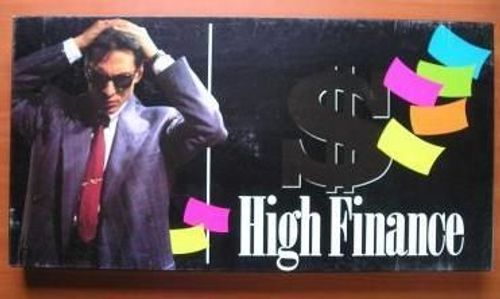
High Finance
High Finance Rulebook
Table of Contents
Table of Contents
- Dotazione (Components)
- Preparazione (Setup)
- Svolgimento (Play)
- Stopping on the Stock Exchange ("Borsa")
- Stopping on the "Tessera" space
- Stopping on the "Telex" space
- Stopping on the "Press Room" ("Sala Stampa")
- Stopping on the "Bomb" ("Bomba")
- Stopping on the "Coupon Collection" ("Incasso Cedole")
- Stopping on the "Trust"
- Stopping on the "Credit" ("Credito")
- Stopping on the "Inheritance" ("Eredità")
- Stopping on the "Theft" ("Furto")
- Stopping on the "Share Tax" ("Tassa sulle Azioni")
- Stopping on the "Race Winnings" ("Vincita alle Corse")
- Termine del Gioco (End of the Game)
- Per diventare esperti giocatori di Alta Finanza (To Become an Expert Player of Alta Finanza)
- Strategia del Gioco e Consigli Utili (Strategy of the Game and Useful Advice)
Dotazione (Components)
- 1 board ("Tabellone"), a track of 40 spaces laid out as: 1 Press Room ("Sala Stampa"), 2 Bomb ("Bomba"), 7 Tessera, 12 Stock Exchange ("Borsa"), 5 Coupon Collection ("Incasso Cedole"), 6 Telex, 2 Trust, 1 Inheritance ("Eredità"), 1 Theft ("Furto"), 1 Credit ("Credito"), 1 Share Tax ("Tassa sulle Azioni"), 1 Race Winnings ("Vincita alle Corse"). A central area carries 6 rotating discs that show the share quotations ("quotazioni") of the 6 types of shares.
- 200 banknotes in denominations of 1,000, 10,000, 50,000 and 100,000 dollars.
- 150 Share markers ("Azioni"), in 6 types of 6 different colours, 25 per type: Automobile ("Automobilistiche"), Shipping ("Navali"), Oil ("Petrolifere"), Computers, Insurance ("Assicurazioni") and Banks ("Banche").
- 20 Telex cards, to be drawn when a player stops on the matching spaces, as explained below.
- 16 Tessera cards, to be drawn when a player stops on the matching spaces of the track.
- 6 Credit Card markers ("Carte di Credito").
- 2 calculation tables ("Tabelline-prontuario").
- 6 pawns ("pedine segna-posto"), in different colours, one per player.
- 2 dice.
Preparazione (Setup)
Two to six players take part. Each receives the pawn of the colour they have chosen, and the following starting supply:
- one Credit Card;
- banknotes of various denominations totalling 100,000 dollars;
- 6 Shares (free of charge), one of each type.
One of the players, or another person not taking part in the game, is named Game Director ("Direttore di Gioco") and is responsible for keeping the Bank ("Cassa").
The Game Director then determines the initial quotation of each type of share, meaning the price at which each share of a given type can be bought or sold at the start of the game. This is done by rolling the dice six times, once for each type of share. To each dice result the number 10 is added, and the resulting sum, multiplied by one thousand, gives the initial quotation of that type of share. For example, rolling for Automobile shares gives 8; 8 + 10 = 18, so the initial quotation of that share is 18,000.
The quotation of each type of share is shown on the central part of the board by turning the discs until the figure for that quotation lines up with the arrow printed in the centre of the board.
All players then place their pawn on the Press Room ("Sala Stampa") space of the track and begin play from there. Each player rolls the dice on their turn and moves their pawn forward along the track, following the direction of the arrow.
Svolgimento (Play)
Moving the pawn forward along the track by as many spaces as the total of the two dice, each player may encounter the following cases.
Stopping on the Stock Exchange ("Borsa")
The player may buy from the Bank or sell to the Bank up to a maximum of 5 or 10 shares of the same type, depending on the number written on the board space. The price paid to the Bank (when buying) or received from the Bank (when selling) is the current quotation multiplied by the number of shares bought or sold. For example, buying 3 Oil ("Petrolifere") shares quoted at 19,000 costs 57,000 dollars.
To calculate the sum to pay or receive, use the calculation tables ("Tabelline-prontuario") supplied with the game.
As a result of a purchase or sale, the quotation of the type of share bought or sold rises or falls by as many thousands of dollars as the number of shares bought or sold. For example, buying 5 Shipping ("Navali") shares raises their quotation by 5,000 dollars; selling 7 Banks ("Banche") lowers their quotation by 7,000 dollars.
The change in quotation must be made immediately after the purchase or sale, by turning the relevant disc on the board until the new figure lines up with the "quotazione" arrow.
Buying and selling is allowed only between each player and the Bank, and must be done for one type of share at a time.
Stopping on the "Tessera" space
Whoever stops on this space draws a Tessera card from the holder on the board.
A Tessera may be used on any later turn in place of rolling the dice. It entitles the player to move their pawn forward along the track to the nearest Stock Exchange ("Borsa") space, or to the Credit ("Credito") or Press Room ("Sala Stampa") space.
The Credit and Press Room spaces can be reached by using a Tessera only when the player's pawn is no more than 10 spaces away from the space to be reached, that is, when it is on the same side of the track as the space to be reached.
Tessere cannot be transferred. A player may keep them (more than one is allowed) for as long as they wish. When used, one at a time, they must be returned to the holder on the board.
Stopping on the "Telex" space
The player who stops on this space draws a Telex card from the holder on the board. The Telex contains confidential information on the trend of the various types of shares and their quotations. The player reads the Telex and adjusts their buying and selling according to the information received.
The Telex is revealed and made known to all players only when the player who holds it arrives on the Press Room ("Sala Stampa") space, either by rolling the dice or by using a Tessera.
As soon as the text of the "Telex" is read aloud, the Game Director carries out what it provides. The player who revealed the Telex has the right, if they wish, to buy or sell immediately, up to a maximum of 10 shares of any type.
Once revealed, the indications of the Telex apply to all players. The Telex card is then placed at the bottom of the holder.
No player may hold more than one Telex at a time.
The cases provided for in the 20 Telex cards are as follows:
a) 6 Telex cards provide an increase and a decrease of two different types of shares. In this case the effect of the Telex is to change the quotations independently of the players' purchases and sales.
b) 6 Telex cards provide the "Crack" of a certain type of share and the "Recovery" ("Ripresa") of the type of share that previously suffered a Crack. In this case, when the Telex is read, the quotation of the shares that suffered the Crack automatically drops to the Crack, and all shares of that type held by players must be returned to the Cashier without compensation. Their trading remains suspended until another Telex of this type is revealed. The quotation of any type of share that at that moment stands at zero because of a previous Crack is brought up to 10,000 dollars, and buying and selling of the share that was in Crack restarts. Consequently, at the start of the game (that is, until the first Crack card is revealed) there are 6 types of shares in circulation. From the moment the first Crack card is revealed onwards, there are always 5 types of shares in circulation, because each new Crack always corresponds to a Recovery.
c) 5 Telex cards provide a special dollar prize that the Cashier will pay, according to the instructions on the Telex itself, either to the players holding the majority of a certain type of share (at least 13 of the 25 shares of each type), or to the sole holder of the Telex.
d) 3 Telex cards provide no change.
[Transcription gap: the last line of printed page 4 is cut off at the bottom edge of the scan. It begins "Naturalmente lo spostamento di un Telex di aumento e diminuzione" and the rest of the sentence is not legible in the source scan.]
Stopping on the "Press Room" ("Sala Stampa")
Stopping on this space (by rolling the dice or by using a Tessera) obliges the player to reveal the Telex in their possession, and the Cashier carries out what it provides (see "Stopping on the Telex space" above).
Stopping on the "Bomb" ("Bomba")
A player who lands on this space must draw a Telex (even if they already hold another one) and reveal it immediately. What the revealed Telex provides is carried out at once, and the Telex is then placed at the bottom of the holder.
Stopping on the "Coupon Collection" ("Incasso Cedole")
The player who lands on this space takes 1,000 dollars from the Bank for each share held at that moment, plus 20,000 dollars for each majority holding ("maggioranza") they have.
Stopping on the "Trust"
If the player who lands on this space has one or more majority holdings (13 shares of each type), they receive 20,000 dollars from each player for each majority holding they own.
Stopping on the "Credit" ("Credito")
A player who arrives on this space by rolling the dice or by using a Tessera may ask the Bank for a loan of 100,000 dollars, giving their Credit Card in their possession as collateral. The loan must be repaid during the game by returning with the pawn to the same space. To repay it, the player must pay the Bank 130,000 dollars, that is, the amount of the loan plus interest, and the Cashier will return the Credit Card to the player. Repayment is mandatory if the player lands on the "Credito" space.
A loan and its repayment may be carried out several times during the game. Note that a player cannot win the game without holding the Credit Card (see "End of the game" below).
Stopping on the "Inheritance" ("Eredità")
The Game Director gives the player, free of charge, one share from among those that have the highest quotation at that moment.
Stopping on the "Theft" ("Furto")
The player hands over to the Bank, free of charge, the one of their shares that has the highest quotation at that moment. If the player has no shares at that moment, they lose nothing.
Stopping on the "Share Tax" ("Tassa sulle Azioni")
The player pays the Cashier 1,000 dollars for each share held.
Stopping on the "Race Winnings" ("Vincita alle Corse")
The player receives 20,000 dollars from the Cashier.
Termine del Gioco (End of the Game)
The winner is the player who, holding their own Credit Card and at least 15 shares, of the same or different types, is the first to reach a total of 1,000,000 (one million) dollars in cash. Players may agree at the start of the game on a sum higher or lower than the one above, to lengthen or shorten the game, but the requirement to hold one's own Credit Card and at least 15 shares still applies.
If during the game a player needs to pay more than the cash they have, they may sell their shares to the Bank at 10,000 dollars each (their nominal value), which does not cause any fall in quotations. If even with this income the player cannot meet the payment, they must withdraw from the game, returning all their supplies to the Bank.
If a player who has withdrawn wishes to re-enter the game, they receive a new initial supply from the Bank, but are penalised by 150,000 dollars. To win, they must therefore exceed by 150,000 dollars the sum set at the start of the game.
Per diventare esperti giocatori di Alta Finanza (To Become an Expert Player of Alta Finanza)
Presentazione e scopo del gioco (Presentation and Object of the Game)
The game "Alta Finanza" is inspired by the world of business that revolves around the Stock Exchange.
The mechanics of the game reflect, in a simplified and fanciful way, the typical operations of the Stock Exchange world: the buying and selling of large blocks of shares, the sudden rise and fall of quotations, the takeover bid ("scalata") for majority share packages, information and forecasts about the successes of the various industries, company failures and their consequences.
The alternation of the various events of the game gives each player the possibility to choose between different lines of conduct. However, as the saying goes, a player cannot "make the weather" as they please, because other wills, different from their own, act in the opposite direction.
As in real life, the player, however skilful, attentive and prepared, always runs a great risk, because unforeseeable events occur which can change the course of things to the point of total ruin. Just as, conversely, a pinch of luck can help the player overcome even the most difficult moments.
The game does not provide for bargaining between players, but only between each player and the Bank.
The price at which buying and selling takes place is not negotiated between the player and the Bank. It refers to the current quotation ("quotazione"), that is, the price fixed by the market. On this price the player, who is a big financier, can influence things in various ways, but their influence is opposed by the actions of the other players and by events independent of their will.
The negative effects of such events (a fall in quotations, the "Crack" of a certain industry) can sometimes be foreseen, and it is precisely here that the player's ability will make the damage turn out to be reduced or counteracted. Just as, in the face of positive events (a rise in quotations, bonuses for majority holdings, the "Recovery" of a previously failed industry), the player's ability, intuition and shrewdness will let them achieve the greatest profits.
Like all games, Alta Finanza is based on simulation and on risk.
The events of the game will create rapid and sudden swings, allowing large gains and equally large losses. Each player will have ample opportunity to express their own character, adopting different styles of play, cautious or risky, and dramatic turns will not be lacking in any case. The victory, awarded to the one who, under certain conditions, is the first to reach a given sum of money, is the fair recognition of the player's ability, although that ability, as always, will not be separated from a pinch of luck.
Strategia del Gioco e Consigli Utili (Strategy of the Game and Useful Advice)
The strategy of the game can be developed in various ways, at the same time or alternatively.
Try to buy shares at a low price and then resell them at a higher price. Bear in mind that every purchase corresponds to a certain rise in the quotation, which is why reselling the shares bought should be advantageous. However, between the time of purchase and the time of resale, other factors may intervene that cause a fall, for example the sale of shares of the same type by another player, or the revealing of a "Telex" that causes a fall in quotation or a "Crack".
Act in relation to the indications of the "Telex" cards you hold: sell the shares of the type for which a fall or a "Crack" is foreseen, and buy the shares for which a rise is foreseen. Also in this case the manoeuvre may be hindered by operations carried out by other players. However, since the obligation to reveal the Telex in one's possession arises only when one lands on the Press Room ("Sala Stampa") space, there is a good chance of passing that space without stopping on it (by rolling the dice, or by using a Tessera to reach the next Stock Exchange space), so as to delay revealing the Telex until a more favourable moment in later rounds.
Try to obtain a majority holding, that is, 13 shares of one or more types, in order to be able to take advantage of the Telex cards that provide prizes for majority holdings, or to collect the prizes foreseen for majority holdings on the "Trust" and "Coupon Collection" spaces.
To carry out the operations described more easily, it is important to hold Tessere, which allow various movements. Moreover, especially at the start, and generally when the money available is scarce, it is advisable to use the loan provided by the Credit Card, even though repaying it costs 30,000 dollars more.
When a good amount of cash is in sight, prepare for victory by repaying the loan and making sure you always hold 15 shares. As seen in the paragraph "End of the Game", a player cannot win if, beyond cash, they do not also hold at least 15 shares and their Credit Card.
Pay close attention to the situation of the other players, because given the technique of the game, another player's victory may come quickly and unexpectedly.
It is also possible to hinder the manoeuvres of other players. For example, if you notice that a player can make a good profit by selling a certain type of share that has a high quotation, you should, if possible, prevent it by selling shares of the same type so as to cause a fall in quotation. Or, if you notice that a player is about to obtain the majority of a certain type of share, you should hinder them by buying shares of the same type.
The Telex may also be of the "neutral" type, that is, it may foresee no change. In this case, the tactic of buying a certain type of share after reading the reserved Telex may induce the other players to buy shares of the same type, causing further rises in quotation.
In this way one obtains the same result that would have been obtained had a Telex foreseeing a rise in quotation been drawn instead of the neutral one.
This short exposition does not claim to exhaust the subject of strategy because, as experience has shown, the intuition and perspicacity of the players have revealed, in practice, far wider possibilities of play than the creators themselves could imagine.
For this reason it is better to refrain from further examples, so as to leave free scope to the imagination of the players, to whom we wish good fun!