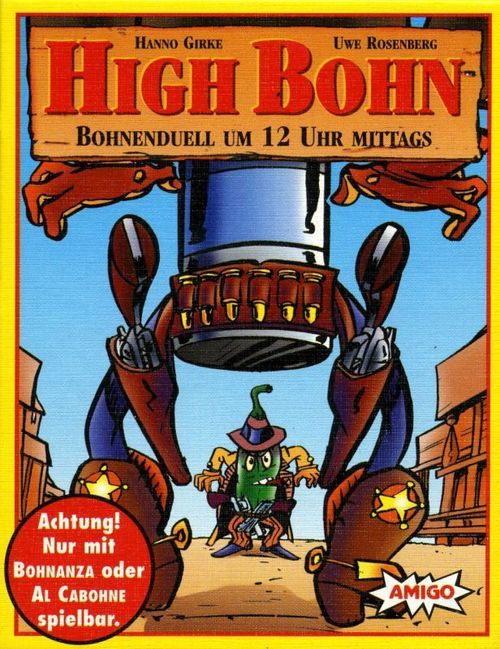
High Bohn: Bohnenduell um 12 Uhr mittags
High Bohn: Bohnenduell um 12 Uhr mittags Rulebook
Table of Contents
Table of Contents
Setup
For High Bohn you need all bean types and the "3rd bean field" cards from the Bohnanza base game. From the expansion, the building cards of these bean types come into play. The Cognac Bean cards and the four Distillery building cards stay in the box. They are used for the COGNAC VARIANT (see page 11).
Setup is identical to that of the Bohnanza base game. The building cards are sorted by type and purchase price and set aside, ready to hand. Each player receives an overview card.
Overview card (text printed on the card):
OVERVIEW CARD FOR HIGH BOHN
For owning buildings, there are bonus Talers at game end:
- 4 buildings = 1 Taler
- 5 buildings = 2 Talers
- 6 buildings = 3 Talers
- 7 buildings = 5 Talers
- 8 buildings = 8 Talers
Each building type is available:
- with 3 players, at most two times
- with 4 players, at most three times
- with 5 players, at most four times
At game end, count:
- the buildings at their purchase price
- the Talers of cash assets
- the bonus Talers for buildings
The Building Cards
Each bean type has a specific building; for example, the Saloon belongs to the Breakbean and the Bank belongs to the Blackeyed Bean. Each building has four cards, one each with a purchase price of one, two, three and four Talers. The higher the purchase price, the better the building's ability.
Note: Talers invested in buildings are not lost. At game end, the purchase price of a building is added to each player's total.
Legend for Building Cards
(Example: the "4-Bank" building card.)
- Bean type
- Building name
- Explanation of the ability
- Bean with building
- Ability symbol
- Purchase price of the building
Buying Building Cards
Each building card can only be bought with Talers from a certain bean type. For example, the four Saloons must be paid for with Talers from the Breakbean depicted on their other side, or the four Banks must be paid for with Talers from the Blackeyed Bean depicted on their other side. Note: Unlike the Bohnanza base game, it is therefore important to know which bean harvests the bean Talers come from!
The purchase price of a building is shown by the golden Taler stack on each card. So the 3-Saloon costs three bean Talers from three Breakbeans, or the 1-Bank costs one bean Taler from one Blackeyed Bean.
Each player may buy each building type only once. So, for example, only one Saloon or only one Bank. A player may, however, buy several building cards at once. In doing so, it does not matter which card of a building type is bought first. The purchase price of the buildings does not represent an order.
In principle, each player may buy buildings at any time, even when not on turn. If, however, several players want to buy building cards at the same time, the following order applies: the player whose turn it is may buy first. After that, the other players may buy clockwise. If the player whose turn it is does not want to buy a building card, the order nevertheless begins with him.
Bean Talers used to pay for a building are placed on the discard pile. The ability of a purchased building can be used by its owner immediately!
Turn Sequence with Building Cards
The turn of the player whose turn it is consists, as in the Bohnanza base game, of the following four phases:
- Phase: Play bean card(s)
- Phase: Turn over beans and trade
- Phase: Plant bean cards
- Phase: Draw new bean cards
The sequence of the phases can be changed by the abilities described on the building cards. These abilities partly override rules of the Bohnanza base game. This applies only to the player who bought the corresponding building card.
The 1-building cards have no special ability for the course of play. Nevertheless, owning a 1-building can become important at game end. Like every other building card, this card also helps its owner to bonus Talers (see End of Game).
During the game, building cards are removed from the game depending on the number of other players. Which building cards are removed is determined by the course of play:
- With three players: If two players have each bought one building of the same type, for example the 2-Farm and the 4-Farm, then the remaining two buildings, in this case the other two Farms, are immediately removed from the game entirely. The third player can therefore no longer buy a Farm.
- With four players: If three players have each bought one building of the same type, for example the 1-, 3- and 4-Bank, then the fourth building, in this case the 2-Bank, is immediately removed from the game entirely. The fourth player can therefore no longer buy a Bank.
- With five players: Only with five players are no building cards removed from the game. If a player has bought the 3-Saloon, then only the 1-, 2- and 4-Saloon remain for the other four players. A player will not be able to buy a Saloon.
The Buildings
The 2-, 3- and 4-buildings enable turns according to special rules. These rules are described on the cards. Further information on the individual buildings follows.
Garden Beans → Goldmine
The owner of the 2-Goldmine pays only one bean Taler for a "3rd Bean Field" card.
For the owner of the 3-Goldmine, the bean meter for garden beans shown on the card applies. In addition, he may always harvest individual garden beans from his fields. This ability applies only to garden beans.
The 4-Goldmine is an additional bean field. If the owner buys a "3rd Bean Field" card, he has four bean fields.
Red Beans → Indian Tepee
At game end, depending on the tepee, the owners receive for every eighth, sixth or fifth bean Taler in their cash assets an additional card from the discard pile, which is placed as a Taler with the cash assets.
Blackeyed Beans → Bank
The abilities of the Banks must be carried out directly before the turn or when drawing new cards. Whoever misses the right moment may not make up these abilities.
Soy Beans → Farm
The ability of the 2-Farm applies only if one or more soy beans are placed on bean fields on which another bean type already lies. If a soy bean is the first card on a field, the 2-Farm cannot be applied. For a Bean Stew (see also the 3- and 4-Saloon), the ability of the 2-Farm likewise does not apply.
The owner of the 3-Farm must still play a bean card. However, he may also play two or three bean cards.
Through the ability of the 4-Farm, the owner always receives five instead of four bean Talers. The 4-Farm combines well with the abilities of other buildings, especially with the 3-Saloon, the 4-Saloon and the 3-Jail. For example, whoever owns the 4-Farm and the 3-Jail can already receive five bean Talers from a harvest of eight Blue Beans.
Breakbeans → Saloon
The 2-Saloon does not count as a "3rd bean field." Nevertheless, its owner must note that he may not harvest an individual Breakbean from the 2-Saloon if he has a regular field on which several beans lie. Conversely, he also may not harvest from the regular bean fields if one bean lies on each of them and the 2-Saloon has more than one Breakbean.
The owners of the 3- and 4-Saloons may plant on their fields so that each bean type occurs only once. This planting is called a Bean Stew.
(Illustrated on page 7: an example of a Bean Stew.)
At the harvest of a Bean Stew, the bean meter shown on the 3- or 4-Saloon applies. No building cards may be bought with the bean Talers a player receives through a Bean Stew. Therefore these Talers are placed under the Saloon until game end, but are added to the cash assets at the final scoring (see also Indian Tepee). Whoever buys the 3- or 4-Saloon may immediately apply its abilities to a regular bean field on which a bean already lies.
Broad Beans → General Store
The owners may place one, two or three beans on the respective General Store. The General Store thereby becomes a temporary storage for bean cards played in phase 1, for beans turned over from the draw pile in phase 2, and for beans received through trading and giving in phase 3 that the player does not want to plant. These beans may be used for trading and giving with other players. However, they may be placed neither from one's own General Store onto one's own fields nor onto other General Store cards.
Fire Beans → Blacksmith
The 2-Blacksmith does not count as a "3rd bean field." Nevertheless, its owner must note that he also may not harvest an individual Fire Bean if he has a regular field on which several beans lie. Conversely, he also may not harvest from the regular bean fields if one bean lies on each of them and the 2-Blacksmith has more than one Fire Bean. Whoever acquires the 2-Blacksmith while already having Fire Beans lying on a regular field may apply the ability of the 2-Blacksmith only once the Fire Beans on that regular field have been harvested.
For the owner of the 3-Blacksmith, the new bean meter for Fire Beans shown on this building card applies.
The owner of the 4-Blacksmith may always harvest fields with one bean.
Blue Beans → Jail
For the owners of the 2- and 3-Jail, the new bean meter for Blue Beans shown on the corresponding building card applies. The owner of the 4-Jail must himself make sure that he co-collects with all sales of Blue Beans (also his own) that are worth at least one Taler. He may also still co-collect if a bean field with Blue Beans is only harvested at game end.
End of Game
With three and four players, the game ends when the draw pile has been used up for the third time. With five players, the draw pile must be played through four times.
Now building cards may still be bought. The player who was last on turn begins. After that, the other players may buy buildings clockwise. Only when no player wants to buy any more buildings is the score settled.
Each player now adds together the Talers he has earned and the purchase prices of his buildings. If a player owns four or more buildings, bonus Talers for the buildings are added:
- 4 buildings = 1 bonus Taler
- 5 buildings = 2 bonus Talers
- 6 buildings = 3 bonus Talers
- 7 buildings = 5 bonus Talers
- 8 buildings = 8 bonus Talers
The player with the highest sum of Talers wins.
Example: A player has cash assets of six Talers. He owns the following buildings: the 2-Saloon, the 2-Blacksmith, the 4-Jail, the 3-Goldmine, the 4-Indian Tepee and the 4-Farm. All buildings together have a value of 19 Talers. The 4-Indian Tepee brings the player one additional Taler for the fifth Taler of cash assets. Since he owns six buildings, he additionally receives three bonus Talers.
This makes a total score of (6 + 19 + 1 + 3) 29 bean Talers.
Cognac Variant
(Illustrated on page 11: the Cognac Bean card, which shows the coin values 5, 7, 9 and 10 along its bottom edge.)
In this variant the Cognac Beans and their building type, the Distillery, are needed. Then nine bean types and nine building types are in play. Apart from the special abilities of the Distillery, nothing in the High Bohn rules changes.
Cognac Beans → Distillery
The ability of the 2-Distillery must be carried out directly after its purchase.
The player who harvests and sells a Bean Stew earns one Taler less if the owner of the 3-Distillery demands one Taler from him. Which Taler the player hands to the owner of the 3-Distillery is left to him. The owner of the 3-Distillery also collects a Taler even if a Bean Stew is only harvested at game end. At game end, Talers under the 3-Distillery are added to the cash assets (see also Indian Tepee).
For the owner of the 4-Distillery, the new bean meter for Cognac Beans shown on this building card applies.