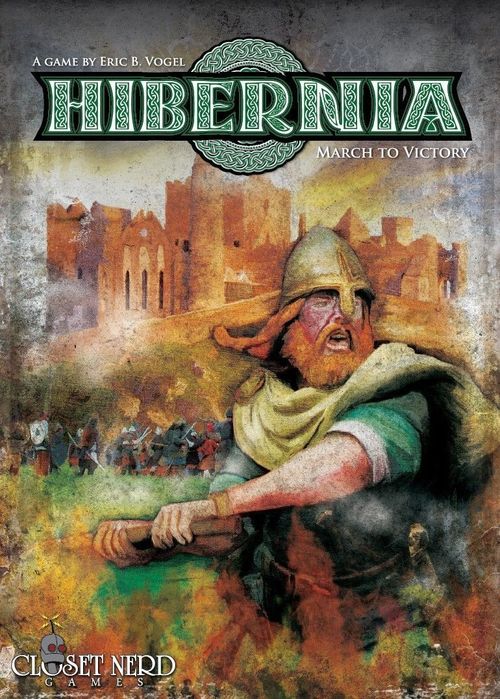
Hibernia
Hibernia Rulebook
Table of Contents
Table of Contents
Components
56 warriors (wooden cubes) in 4 colors, 1 color die, 1 start player marker (wooden pawn), 1 game board, and 1 rules sheet.
Setup
Each player takes a set of warriors in 1 color. Each player puts one of their warriors on the start space (sword) of the scoring track. Take one warrior from each player and use these to randomize a start player. Then randomly place these warriors on the 4 spaces marked with castle icons on the game board; this creates the starting position for each player. The first player places 3 warriors on the shield space in the upper left part of the game board, the second player places 2 warriors on the shield, and the third places 1 warrior there. Play proceeds left from the start player.
Player Turn Sequence
The active player Rolls 1 die. The die has each of the colors blue, green, red, yellow, black and purple on one face. Rolling blue, green, red or yellow allows the active player to play into a county of that color on the board. A black roll allows the active player to play into 1 county of any color. A purple roll allows the active player to move up 1 space of any color on the scoring track when scoring (see scoring). In addition to their roll, each player gets to make 1 wild play (equivalent to a black roll) each turn. For each non-purple play, a player may do 1of the following:
March: The active player chooses a county matching the color of the die roll, or any color for a wild play. The player must place 1 warrior from her supply into this county for each adjacent county she has warriors in. Marches must always be made with this number of warriors, even if they are not all needed to conquer the county. If the active player does not have enough warriors in her supply to conduct the march, she may take warriors from her other counties on the board, leaving at least 1 warrior in each of her counties. When marching to reinforce, (see below) warriors pulled off the board may not be placed back into the county they were taken from. If the active player does not have enough warriors, she may not conduct this march. It is not legal for the active player to march into a county if she holds no counties adjacent to it. Note: the four counties in the center of the board are all adjacent to each other, as indicated by the arrow icons. The active player may not march into another player’s last 2 adjacent counties, nor conduct a march that leaves another player without any adjacent counties.
If, after placing pieces, the active player’s warriors co-occupy a county with the warriors of another player, then these eliminate each other on a 1 for 1 basis. Battles between tied forces will leave the contested county empty. Eliminated units are moved onto the shield space in the upper left corner of the board. At the end of each march, no more than 1 player may have warriors in any 1 county.
It is legal for the active player to use the march action to reinforce a county she already holds. Count only the adjacent counties, not the destination county, when determining how many pieces to place when marching to reinforce.
Raise Warriors: The active player can use 1 die of any color, or their wild play, to return all of her own warriors from the shield space to her supply. All other players return half their warriors (rounded down) from the shield space to their supplies when the active player takes this action.
Players may not pass on using their actions. If the active player cannot conduct a march for one or both of her actions, then she must raise warriors instead.
Example: John rolls yellow. His counties are not adjacent to any yellow counties. He holds 3 counties adjacent to a blue county held by Alison with 2 warriors. John has only 2 warriors left in his supply, so he takes 1 warrior from one of his counties with 2 warriors, and then places 3 warriors into Alison’s blue county. 2 of John’s warriors and Alison’s 2 warriors are moved to the shield space. John now holds the blue county with 1 warrior. He would like to use his new county to march against an adjacent yellow county, however he has no warriors left in his supply, and all his counties have just 1 warrior left in them. He uses his yellow die to raise warriors instead.
Scoring
The active player scores at the end of her turn. For each county she holds, she can advance 1 space of corresponding color on the score track. For each purple roll, the active player must move over the first space on the scoring track on which they would have otherwise stopped. This may allow the active player to continue scoring for additional counties held.
Example: the five spaces in front of Alison’s scoring marker on the track are RED, BLUE, BLUE, YELLOW, RED. At the end of her turn, she holds 1 blue, 2 green, 1 red and 1 yellow counties; she also has 1 purple die roll. She moves up to the first blue space. Normally, she would stop scoring, because she does not have a second blue; however she can use her 1 purple roll to cross this space. She then is able to use her yellow county to advance 1 more space, and then must stop because she does not have a second red county. Her green counties do not help her score this turn.
Game End
Whenever a player’s score wraps the scoring track, advances around the sword back onto the yellow space at the start of the score track, this triggers game end. Play continues back to the start player. The player furthest along the score track is the winner. In the event of a tie, continue taking additional turns back to the start player until there is a single player with the highest score.
3 Player Setup
After assigning starting spaces for each of the players, place 1 warrior from the unused set of warriors on the remaining castle space; place 1 warrior from the unused set on each space matching the color of this castle space. These warrior pieces follow the normal rules for defenders in battle, but do not score or return to the board after defeat.
Optional Rules
For a more difficult game, have all the players start with 1 warrior on each space matching the color of their castle county. On the first turn, no player can be left without 2 counties which are 1 county apart from each other.
Strategy Tips
Sometimes it is worth sacrificing the maximum possible score on a turn in order to build a stronger board position.
It can be very effective to create defensive positions along your borders, especially in the 4 center counties.
Remember that if 2 players tie for the lead after lapping the scoring track, the game will have an extra turn. If another player laps the scoring track, and you cannot tie them, you may want to help another player tie the lead player to give you a later shot at victory. This does not constitute “kingmaking.”