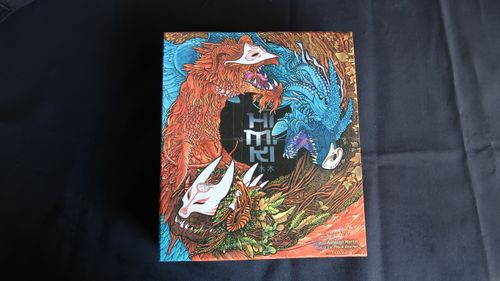
Hi Mi Ki
Hi Mi Ki Rulebook
Table of Contents
Table of Contents
Content of the game
- 1 Rulebook
- 4 black Yokaï cubes
- 4 white Yokaï cubes
- 3 black Yokaï Chaos tiles
- 3 white Yokaï Chaos tiles
- 6 Chaos tiles in reserve
- 3 Elemental Influence tiles
- Game board
- Black Yokaï tracker
- White Yokaï tracker (score trackers: regular points (white or black) and Chaos points (brown))
Hierarchy of Elemental Influence
- Fire burns Wood.
- Water extinguishes Fire.
- Wood floats on Water.
1 VS 1 MODE
"Young apprentice, you are now knowledgeable about the dark and dangerous Art of Yamabushi. The road is long and strewn with pitfalls to master each aspect of it. To evolve and make a name for yourself within our caste, you will have to face your peers in duels, with honor and cold blood. May your spirit be as agile as a summer zephyr."
Goal of the game
You will face your opponent by summoning elemental Yokaï symbolized by 3 cubes. The first of you to score 5 points wins the game.
Set Up (see page 62)
Each player takes 3 cubes of the same colour. The player with the white cubes plays first.
By choosing the side and orientation that you want, place 1 of your cubes on one of the 3 squares 5B, 5C or 5D. Then your opponent does the same with 2 cubes on 2 of the 3 squares 2B, 2C or 2D. Then, you place your 2 remaining cubes on the unoccupied spaces 5B, 5C or 5D. And finally, your opponent places his last cube on the 2B, 2C or 2D space that is still free.
Note
A player can NEVER move one of their opponent's cubes.
A DROPPED cube is a PLAYED cube (if your hand no longer touches the cube you just played, you can no longer change your mind).
Rotate
Rotating a cube means having it execute a 90° turn (clockwise or counter clockwise, it is the same because the symbols of the opposite sides are identical) while remaining on the same square.
In doing so, it does not move (the faces of the cube must always face the 4 squares surrounding it).
Warning: if you Rotate, your opponent cannot Rotate as his or her next move, they must necessarily Tilt a cube.
Tilt
Tilting a cube means rolling it sideways onto one of the 4 adjacent squares.
When it is Tilted, the cube rolls from one side in the direction of its movement.
Warning: A cube NEVER moves diagonally. The cube that was just Tilted this way will be now referred as the Active Cube.
Conflicts
We call Conflict the situation where 2 cubes find themselves next to each other (adjacent). Three things may happen:
- The 2 elements shown on the cubes (on the top) are different. If the Active Cube displays the dominated element, it loses the Conflict. Your opponent does not score a point (white or black die) because, in the event of a Conflict, only the Active Cube can score a point.
- The 2 elements shown by the cubes (on the top) are different but the Active Cube displays the dominant element, it wins the Conflict. The owner of the cube scores a point.
- The 2 elements shown by the cubes are identical, and the Yokaïs ignore each other and the owner of the Active Cube plays again. A cube that is played again can NEVER return to a space it has just left.
Process
The player who is brave enough to read the rules takes the white cubes and plays first. Tossing a coin or a game tile might work too.
On your turn, you can Rotate one or more of your cubes OR Tilt one of your cubes. Either, depending on your choice, but never both.
After Tilting a cube, several situations can occur:
-
If the Active Cube finds itself adjacent to an opponent's cube and you lose the Conflict, your turn ends (it is now your opponent's turn).
-
If the Active Cube finds itself adjacent to an opponent's cube and you win the Conflict, increase your Score one. It is the end of your turn (it is now your opponent's turn).
-
If the Active Cube finds itself adjacent to several of your opponent's cubes and you win several Conflict, increase your Score as many times as Conflicts won. It is the end of your turn (it is now your opponent's turn).
Example: your Active Cube displays a Water Yokaï and finds itself next to 3 opposing cubes. Two display a Fire Yokaï and the other a Wood Yokaï. Water extinguishes Fire, you increase your Score twice. The Wood floats on Water, but your opponent scores no points because only the Active Cube can score a point.
-
If the Active Cube finds itself adjacent to a cube (opponent or one of yours) displaying the same element as it, you can play again by Rotating one or more of your cubes or by Tilting one of your 3 cubes again.
If a new Tilting creates the same situation, you can replay again for as long as possible or until your turn comes to an end.
-
If the Active Cube is adjacent to a cube it defeats and a cube that allows it to play again, you win the Conflict but you cannot play again (even if one of the cubes is yours).
-
If after Tilting the Active Cube, four cubes display the same element (wherever they are on the game board), you gain an Elemental Influence (Fire Influence, Water Influence or Wood Influence).
In doing so, take the Elemental Influence tile corresponding to this element, and increase your Score once. If your opponent had this tile in their possession, they must give it to you and decrease their Score by one.
The Active Cube must be one of the 4 cubes forming the Elemental Influence for it to be valid. In other words, an Elemental Influence only counts if the Active Cube completes it.
Example: if there are 5 cubes displaying the Fire element and on your turn, you switch one of your cubes to the side of the Water element, there are now 4 cubes displaying the Fire element. However, you do not win the Fire Influence tile because the Active Cube is not one of the 4 Fire cubes.
End of the game
As soon as a player reaches five points, the game ends immediately and they win.
Yes, the rules are very simple, but hang in there because it's the vigilance and the focus of the players that sets the difficulty. Don't let your guard down!
2 VS 2 MODE
"Young apprentice, sometimes the enemy is deceitful and forms alliances. To win, you too will have to make a pact with a Yamabushi from your clan. Choose wisely because, in the heat of the moment, your two spirits will become one so that the invocations of one can be controlled by the other."
Goal of the game
With your partner, you will face the opposing team by summoning elementary Yokaï symbolized by 4 cubes. Again, the first team to score 5 points wins the game.
Set Up (see page 62)
Establish two teams of two. Each player takes 2 cubes of the same colour.
Within each team, one of you plays in the Light area of the board and the other in the Dark area of the board.
Whoever has the white cubes of Light begins.
By choosing the side and orientation that is better for you, place one of your cubes on one of the 2 squares 5E or 6D. Then your next opponent does the same on one of the 2 squares 6B or 5A, then the next in 2A or 1B, then the last in 1D or 2E. So on until all 8 cubes are placed.
Note
The Rotate, Tilt and Conflict rules are exactly the same as in 1 vs 1 mode, with the exception of the points described in the Process chapter (below).
During the game players of the same team cannot talk about the game. If your opponents catches you talking about the game, they get to score a point as a penalty. Be discreet. Even better: be quiet.
Process
Each of you controls the cubes of your color on your side of the board (Dark or Light). Thus, a Light player who moves their cube to the Dark side controls it until the end of the turn. Afterwards he will not be able to play it until it comes back on the Light side of the board.
Be careful though, because the balance of forces. Be wary of this.
If after Tilting the Active Cube, six cubes display the same element (wherever they are on the game board), you get an Elemental Influence (instead of 4 in 1 vs 1 mode).
Game over
As soon as one team scores five points the game is over and this team wins.
EXPERT MODE
"Young apprentice, do you really now believe you know everything about the Art of the ancients? Fool that you are. The mysteries are still far from having revealed all their secrets. Now it's time for you to face the reality of Chaos."
Chaos tiles
If you wish, to spice up your games of HI MI KI a little, you can choose to use the 12 Chaos tiles. These tiles are made up of 6 Event tiles and 6 Land tiles.
At the start of the game, during setup, place all Chaos tiles face down on the table. Then, each in turn, each player draws a tile at random until they have 3. Look at your tiles and place them in the space provided on the game board.
To make the game always ready to play we advise you to mix up the tiles and put them in the box at the end of the game. This way, the game can be started in no time.
This mode can be used 1 vs 1 or 2 vs 2, the rules and the effects are identical.
Each time you increase your Score to 2, 3, or 4, you may (but do not have to) use one of your Chaos tiles and immediately apply its effect.
After resolving tile effect, if the Active Cube finds itself in a situation of conflict with an opposing cube, apply the conflict management rules described in the basic game mode.
The resolution of a tile's effect takes priority over the resolution of Conflicts.
Example: Your cube lands on a square covered by the Mirror tile and one of the adjacent squares is occupied by an opposing cube. You are therefore in a Conflict situation. However, the Mirror effect being applied BEFORE the management of the Conflict, the latter is simply ignored. On the other hand, if the effect of the tile cannot be applied (destination space occupied), then the rules for managing Conflict are taken into account.
Events tiles
They have immediate effect (except the Major Yokaï) and can only be used once.
- Fire Mana: This tile enables you to Tilt one of your cubes that shows the Fire element.
- Wood Mana: This tile enables you to Tilt one of your cubes that shows the Wood element.
- Water Mana: This tile enables you to Tilt one of your cubes that shows the Water element.
- Conjuration: You can pick up one enemy cube and put it back on the same square on any side you want (but its position does not change).
- Major Yokaï: This tile invokes an overpowered Yokaï. After tilting, you can use this tile to start a confrontation with Yokaï that are one empty square away. Conflict rules remain the same.
- Confusion: This tile forces you and your opponent to Rotate or Tilt a cube of the opposing team the next turn. Then, the turn resumes normally.
- If you play as White then move a Black cube. If you play as Black then move a White cube.
- In the event of a Conflict during the Confusion, it is the player who played the cube that scores one point (even if it is not its original color).
Terrain tiles
Once you reveal a terrain tile you have to place it on any unoccupied square of the board. The tile will remain on the board until a cube Tilting to this square. When it happens the tile's effect is applied.
- Gate of Hell: Your Yokaï is inexorably sucked through the Gate of Hell, and the cube is permanently removed from the board. You will have to finish the game without this cube.
- Impulse*: You must Tilt your cube one additional space in the direction of your choice.
- Transfer: You must switch this cube with another cube of your choice (including with an opposing cube). Both cubes become Active and Conflict resolutions must be applied after the exchange. Be careful to maintain the side shown and orientation during the exchange.
- Vortex: You must Rotate your cube once. The Rotation is made before any additional movement or any other resolution.
- Teleportation*: You must slide your cube 2 squares in the direction of your choice. By doing so, your cube can pass through an allied or opposing cube. Be careful to maintain the side shown and orientation during the move.
- Mirror*: Your cube is transported to the other side of the board along the median axis, WITHOUT changing the side shown or the orientation. Thus, he passes to the Light side if he was on the Dark side or vice versa. For example: if the Mirror square is at A2, the cube is immediately found at A5.
* The effects of the Impulse, Teleportation and Mirror tiles are not applied if all the squares where they should land are occupied. They remain on the board until it can occur.
Terrain tiles apply their effect only once and must be discarded after their activation.
The effects are triggered when a cube enters the space. If the effect becomes possible afterwards, it does not apply.
Example: Your cube tilts on the Mirror tile but as the destination square is occupied by your opponent, the power does not trigger. On the next turn, your opponent moves his cube and frees the destination square. On your turn, you cannot use the effect of the tile because you are already in place. You will have to return to this square to trigger it.
SOLO MODE: MUK YAN (training)
"As a young apprentice, you now know how to summon the Yokaï and control their actions, but you are still far from being able to master an opponent. You are not ready, but be patient. Your clumsiness and inexperience can easily be swept away by the breath of Muk Yan. Train against him... What doesn't kill you makes you stronger."
Goal of the game
You will face the terrible Muk Yan, a training dummy who reacts instinctively to your attacks. Score 5 points before him to win the game.
Set Up
Take three cubes of the same color.
By choosing the side and orientation you prefer, place your 3 cubes on squares 5B, 5C and 5D. Next, roll your opponent's 3 cubes into the lid of the box, and place them on squares 2B, 2C, and 2D.
The remaining 2 White and Black cubes will be used to determine Muk Yan's moves. In the following rules, we call them Muk Yan Cubes.
Note
The victory conditions, and the rules (Rotating, Tilting and Conflicts) are the same as in a 1vs1 game.
Process
The human player starts the game. For each turn play your turn normally and then roll the Muk Yan Cubes and then refer to the Action table below. The Black Muk Yan cube gives the line and the White one gives the Column of the table.
Each of the 9 squares of the table gives the same list of 9 actions, but their order differs from one square to another. You just have to go through them, from the first to the last, and apply the first possible action. In other words, if an action is not possible, move on to the next one.
Actions
-
Multiple strike: Tilt a Muk Yan cube so it enters a Conflict with two or more players cubes and wins at least twice.
-
Strike: Tilt a cube so it enters a Conflict and wins.
-
Threaten: Tilt or Rotate a Muk Yan cube so it can enter a Conflict and win in the next turn.
-
Influence: Tilt a Muk Yan cube in order to earn an Elemental Influence tile (after Tilting the Active Cube, four cubes display the same element).
-
Block: Tilt or Rotate a cube so it blocks a players' cube. In order to block a cube the Muk Yan Cube needs to be next to a players cube and show an element dominating the players cube. Its side elements must also be dominating the side elements of the players cube.
Example: On the picture, the black cube blocks the white one. The black cube's top face (Wood) defeats the white cubes top face (Water). ALSO the black cube's side faces (Fire) show an element defeating the white cube's side elements (Wood). In this situation, wherever the white cube may Tilt the black cube can Tilt in the same direction and win, therefore the white cube is blocked.
-
Dodge: Rotate all the Muk Yan cubes that are blocked.
-
Pressure: Tilt a Muk Yan cube so two cubes show an element matching an Elemental Influence the Muk Yan does not own.
-
Play again: Tilt a cube so it can play again. Roll the Muk Yan Cubes again for the new turn.
-
Offensive movement: Tilt a Muk Yan cube that does not yet threaten a players' cube.
Defensive move: Tilt a Muk Yan cube that does not already block a players' cube.
This cube must move to the square with the highest value closest to the value of the starting square (see table below).
| 1 | 2 | 3 | 3 | 2 | 1 |
| 2 | 4 | 6 | 6 | 4 | 2 |
| 3 | 5 | 7 | 7 | 5 | 3 |
| 2 | 4 | 6 | 6 | 4 | 2 |
| 1 | 2 |
Example: If the cube is on a square 4, it will first try to Tilt to 5, then to 6. Otherwise, it will Tilt to 2.
Table of actions
The row is given by the face shown by the Black Muk Yan cube (Fire, Water or Wood) and the column by the face shown by the White Muk Yan cube (Fire, Water or Wood). The list of actions in each cell is applied in the order shown. (In the printed table the actions are colour-coded: Fire is red, Water is blue, Wood is brown; the Black cube is shown on the left of each cell and the White on the right. Cell 9 reads "offensive" or "defensive" as printed.)
Black: Fire
- White Fire: 1 Multiple strike, 2 Strike, 3 Threaten, 4 Influence, 5 Block, 6 Dodge, 7 Pressure, 8 Play again, 9 Movement (offensive)
- White Water: 1 Multiple strike, 2 Strike, 4 Influence, 3 Threaten, 6 Dodge, 5 Block, 7 Pressure, 8 Play again, 9 Movement (offensive)
- White Wood: 1 Multiple strike, 2 Strike, 4 Influence, 3 Threaten, 8 Play again, 6 Dodge, 5 Block, 7 Pressure, 9 Movement (offensive)
Black: Water
- White Fire: 1 Multiple strike, 2 Strike, 4 Influence, 8 Play again, 3 Threaten, 7 Pressure, 5 Block, 6 Dodge, 9 Movement (offensive)
- White Water: 1 Multiple strike, 2 Strike, 4 Influence, 8 Play again, 6 Dodge, 3 Threaten, 7 Pressure, 5 Block, 9 Movement (offensive)
- White Wood: 1 Multiple strike, 4 Influence, 2 Strike, 8 Play again, 5 Block, 6 Dodge, 3 Threaten, 7 Pressure, 9 Movement (defensive)
Black: Wood
- White Fire: 1 Multiple strike, 4 Influence, 2 Strike, 5 Block, 8 Play again, 3 Threaten, 6 Dodge, 7 Pressure, 9 Movement (defensive)
- White Water: 1 Multiple strike, 4 Influence, 2 Strike, 8 Play again, 3 Threaten, 5 Block, 6 Dodge, 7 Pressure, 9 Movement (defensive)
- White Wood: 1 Multiple strike, 4 Influence, 2 Strike, 5 Block, 8 Play again, 3 Threaten, 6 Dodge, 7 Pressure, 9 Movement (defensive)
End of the game
The first of you or Muk Yan to score 5 times wins.
SOLO MODE: MINDLOCK
"Young apprentice, do not succumb to the poison of pride. You have a real talent but you are still far from being a real Yamabushi. The Scroll of Major Yokaï holds challenges that only Masters can hope to solve. There you will prove your worth. But stay humble, because many reckless people have tried this test before you and many are those whose lost spirits forever haunt this legendary roll."
Goal of the game
Armed with one or more White cubes, you must eliminate your opponent's Black cubes in a number of Moves equal to or less than the PAR of the challenge. To eliminate a cube you must win a Conflict against this cube. If successful, it is removed from the board.
Set Up
Set the game up according to the picture on page 50. When placing Black cubes, the elements of the side faces are of no importance. However, be sure to respect the elements displayed on the side faces of the White cubes.
Note
Solo challenges are divided in four groups: Easy, Medium, Hard and Expert.
The maximum number of Moves is called PAR. As in golf, the PAR is the ideal score assigned to a challenge, it is also the best score achieved by a player.
Rotating, Tilting and Conflicts rules remain the same. You can play again as in the normal rules, without it costing you Movement.
Chaos tiles effect remain the same, with 2 exceptions:
- Using a Mana tile allows you to replay one of your Cubes displaying the same element as the tile.
- Events tiles can be played anytime and are discarded after use.
In both cases, their activation doesn't count as a Movement in the PAR.
Some challenges require earning one or more Influence to be resolved. In these areas, the icons of the Influences in play are indicated on the setup diagram. Right-of-way capture rules do not change.
The solutions are written very small and upside down, under each challenge, and summarized on page 60. It is a sequence of coordinates of boxes, separated by a space, to be executed in order. These coordinates are formatted as follows:
- Starting coordinates (location of the White cube before its action)
- An arrow to separate the starting coordinates and the destination coordinates.
- The letter that determines the action (B for Tilt, P for Rotate).
- Destination coordinates (location of the White cube after its action)
- One (or more) asterisk (*) after the destination coordinates indicates that one (or more) Black cube must be removed from the board.
- The Fire, Water or Wood pictograms indicate that an Elemental Influence has been created.
- The free actions (which do not decrement the PAR) are indicated by a letter, followed by a dash, at the beginning of the sequence (R for Replay, and C for the use of an effect of a Chaos tile).
Example: The solution to challenge F00 in PAR 3 is C4 BC3* C3 BD3* D3 BD4*. This means that the White cube Tilts from space C4 to C3 and the Black cube is defeated and must be removed from the board. Then the White cube Tilts from C3 to D3, the Black cube is removed. Finally, the White cube Tilts from D3 to D4 and the last Black cube is removed. The challenge is completed in 3 Moves: you have won.