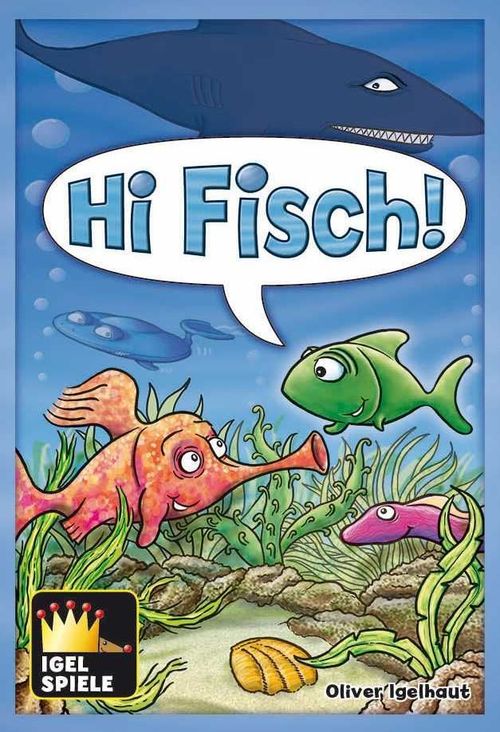
Hi Fisch!
Hi Fisch! Rulebook
Table of Contents
Table of Contents
Gaming Components
- 29 numberfish cards
- Cards 1–5: small green fish
- Cards 6–13: orange-red fish
- Cards 14–21: flounder
- Cards 22–29: eel
- 7 shark cards
- 1 cardboard sandbank
- 10 wooden shells
Preparations
Place the sandbank in the middle of the table.
Put all cards face-down on the tabletop and shuffle them around randomly into a loose heap. If they overlap in the process, that is fine.
Place a shell on 10 random cards.
Game set-up:
Game Play
Each player gets one turn per round.
In a two-player game, each player gets two turns per round: First player one, then player two, then one again and finally two.
Take turns in clockwise order, starting with the player who last went swimming in the sea.
In your turn, flip over a card. Does it have a shell on top, place it on the sandbank first before flipping over the card.
When you flip over a card with a numberfish, your turn ends. On finding a shark, flip over the next card until a numberfish comes up.
Example: You have found two sharks and finally a numberfish, which ends your turn.
Leave all flipped cards face-up in the middle until the intermediate scoring.
At the end of a round each player should have flipped over one numberfish. In a two-player game, there would be two numberfish cards per player.
An intermediate scoring takes place after each round.
Intermediate Scoring
All face-up sharks eat a numberfish each, starting with the biggest one. Put the sharks and the fish they have eaten back into the box.
Example: The shark eats eel 23. The shark and his meal go back into the box. (A second shark would eat flounder 18.)
If there are several sharks and they actually manage to eat all face-up numberfish cards, the intermediate scoring ends immediately and there is no winner. Any shells will remain on the sandbank until the next intermediate scoring.
But typically some numberfish cards survive, and then the winner of the round is determined in the following manner:
Winner is the player who flipped over the biggest numberfish still alive. The winner gains that numberfish and all face-up fish cards of the same type, as well as any shells remaining on the sandbank.
Example: Flounder 18 is the biggest numberfish still alive here. The winner takes it and also flounder 16 of the same type, in addition to two shells from the sandbank.
To finish off, flip over any leftover numberfish cards and leave them face-down in the middle of the table.
In the example above this would be numberfish 3.
Fish Storage
Players stack all numberfish cards they have won in front of them, with the shells next to them.
Who Starts the New Round?
The player who has won the last intermediate scoring begins the next round, by flipping over a face-down card ...
End of the Game
The game ends if there are less than 6 face-down cards left at the beginning of a round.
Now for the final scoring:
Small, green fish are particularly hard to catch and give you 2 points each. All other fish cards and shells gain you 1 point each. Winner is the player with the most points.
In case of a tie the highest numberfish is the tie breaker.