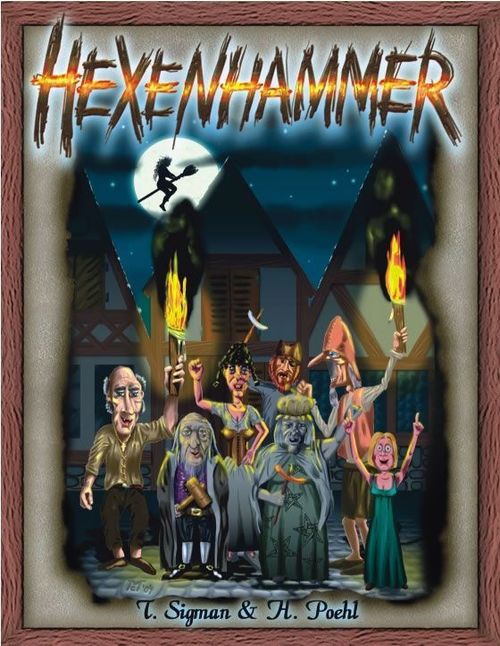
Hexenhammer
Hexenhammer Rulebook
Table of Contents
Table of Contents
I. Contents
110 cards:
- 15 Villagers (Malefici)
- 15 Burning pyres (one for each villager)
- 78 Defamation cards
- 16 Accusations (brown)
- 8 Denials (brown)
- 6 Proofs (brown)
- 4 False testimonies (brown)
- 5 Confessions (brown)
- 6 Tests (green)
- 3 Advocates (yellow)
- 14 Bribes (yellow)
- 16 surprising turns of event including Mix-up, Countercharge, Retraction, Accomplice and No Inquisition. (yellow)
- 2 Phase cards (with the four phases described on the four sides)
II. What's it all about?
This game takes us back to the time of the witch-hunt and the Inquisition's eradication and punishment of witches throughout Europe. In this game you can don the robes of the grand inquisitors and dispense "justice"!
In your village you have collected a group of informers, with whose help you will attempt to burn at the stake the malefici (evildoers) who are striking terror into the hearts of your villagers. Of course all other villagers (not belonging to your group) are suspicious and possible witches. You must therefore attempt, using your informers, to bring your opponents informers to the stake while ensuring as many of your informers as possible survive the process.
You bring your opponents to the stake by making defamatory accusations, extorting confessions by doubtful means and declaring yourself to be an inquisitor. But be careful! All too easily, you'll incite others to conspire against you and before you know it you'll be moving from hunter to hunted.
You will gain points both for the burning of others at the stake and for every member of your group who survives the ordeal.
III. Preparation
Remove from the game a number of villager cards (malefici) as follows:
- In a three player game: all those with 4 and 5 on the back (the side with the burning stake)
- In a four player game: all those with 5 on the back (the side with the burning stake)
- In a five player game: none
Shuffle the villager cards and deal three cards to each player.
Shuffle the stake (pyre) cards and deal three cards to each player. The remaining stake (pyre) cards (in a three or four player game) are laid aside and not used for the remainder of the game.
Each player places their villagers (with the "Malefici" side up) before them.
Now each of the villagers receives a burning pyre card. Place one pyre beneath each villager with the yellow-flames face up (blue-flames face down), such that only the lowest number on the card is visible (see illustration). They don't all have the same lowest value upon them, and some will protrude more than others from beneath the villager.
Tip: the more that a pyre is exposed (from beneath a villager) the greater the heat on that villager and risk of burning at the stake. The villagers with the most pentagrams on them are worth most as victory points at the end of the game, and so it is advisable to place these on the lowest valued pyres.
Give each player six defamation cards (the cards with the torch-bearer on the back). The remaining defamation cards are placed in the center of the table as a draw pile. A discard pile will form beside the draw pile during the game.
Place the two phase cards, one on top of the other, such that the card with "1. The Accusation" is on top and visible to all.
IV. The Cards
The Hammer of the Witches is a game that comes alive with cards. Understand the cards, and the rest will fall into place. Thus before we present the rules themselves, an explanation of the cards is in order.
A) The villager cards
To the left of the villager depicted on the poster, there are pentagrams, to the right there are matches. The number of pentagrams indicates how many victory points you will receive if this villager survives the game. The number of matches indicates how many victory points you will receive if you burn an opponents villager at the stake as an inquisitor.
Beneath the depicted villager are notes with a particular value shown. The value relates to defamation cards with the same name or other villagers in the game and can influence the effect of cards played (see below).
B) The burning pyre cards
The pyre cards indicate how much heat is on a villager and how close that villager is to burning at the stake. The villager card is moved up and down on the pyre in response to defamation cards. For example, if a "Proof – You have a familiar!" (+2) is played on the villager, the villager is moved two places up the pyre such that a value two points higher than before is visible. If a value of over 9 is reached, the pyre card is turned over so that the side with the hotter blue flames is visible and the villager is moved to the required value.
The pyres have varying start values. A villager can never be moved below the start value on his pyre. This is the lowest value that a villager can reach. If a defamation card requires the villager to move down below this value then the villager is moved to this value and further downward movement is not possible. Eighteen is the highest value that a villager can reach on any pyre. If a defamation card requires the villager to move up over this value then he is moved to the 18 and no further upward movement is not possible.
C) The phase cards
The Hammer of the Witches is played in rounds, each of which is divided into four phases. The two double-sided phase cards contain the symbols indicating which phase is currently being played. They are placed in the centre of the table, or held by the inquisitor at any one time. They also provide a short summary of the rules for each phase. The phase cards are place one on top of the other, such that the visible face of the top most card indicates the current phase. You should therefore (most especially if you are inquisitor) ensure that at all times the correct phase is indicated in this manner. Each phase card has a unique symbol on it which is used on defamation cards to indicate the phase in which they may be played.
D) The defamation cards (cards with the torch-bearer on the back)
The symbols
There is a symbol on each card which indicates the phase in which the card may be played. The symbols used are those which appear on the phase cards to indicate each phase.
Ordinarily you may play a card only when it is your turn to play, but cards on which a black five pointed star appears in each corner can be played even when it is not your turn to play. These are usually played in response to other cards, which are not marked with a black star. Precisely when such a car may be played is described in the text on the card. The effect of a card with a black star cannot be negated, even with another card marked with the black star.
Further, there is a symbol indicating the type of card in each corner of the card (sometimes in front of the black star). These serve to make the type of card more easily visible in a hand full of cards.
The numbers
On many cards there is a number preceded by plus (+) or minus (-). These indicate accusation points and denote how much more, or less, heat the villager is under as a result of the card. The villager is moved that many spaces up or down on their pyre. For cards which display a plus and a minus (+/-) before the number, the person playing that card may choose the direction (to raise or lower the heat on the villager).
The colours
There are three different background colours on the defamation cards.
Brown cards: These cards represent accusations. They are always played from one villager on another villager. A villager can even play a brown defamation card upon himself or herself. When you play a brown defamation card you must identify one of your villagers from whom the card is played – this villager is the accuser. You must also identify a village upon whom this card is played – this villager is the accused. If you forget to nominate an accuser then the villager with the most heat on them is considered to be the accuser (i.e. the one with highest value shown on their pyre).
Each of your villagers may play only one brown defamation card in your turn. You cannot play more brown defamation cards than you have villagers. You can however play as many brown cards as you like upon a particular villager (that is any villager may only be accuser once in your turn, but may be accused any number of times).
The nomination of an accuser is important because the effect of the card can be influenced by the accuser. For example, a Confession +6 is worth +7 if it is played from Toothbreaker Carl, because Carl has "+1 on Confession"; a False Testimony is worth 2 accusation points less if the girl Griseldis is the accuser (who believes a small girl after all?); the Bailiff has +2 on any accusation he makes against the Widow Ottheinrich; or +1 on any accusation he makes against the Maid; the Pet Pig Berta may never act as accuser.
If a yellow card is played in defence it is also important to know who the accuser is.
Yellow cards: These cards represent defences. To play these cards you do not nominate a villager as an accuser. There is thus, no limit to the number of yellow defamation cards you may play in your turn. For example in the Arrest phase you can play as many Bribe cards as you like. Yellow defamation cards may always be played on any villager. Yellow cards can be played on any accused villager.
If you play a Mix-up card, then you may move the defamation card that is accusing one villager to another villager of your choice (but not to the accuser). If you play an Accomplice card then you may nominate another villager (with the exception of the accuser) as your accomplice, who then receives as many accusation points as the accused.
The effect of a yellow defamation card can be influenced by the accused if the played card is listed the accused's card. For example if the Fortune Teller is accused and defends with the Accomplice card, her nominated accomplice receives one more accusation point than she does.
Green cards: These cards represent tests. These tests were performed by the inquisition in order to unmask witches. As these tests were not accepted by the church, they cannot be played by the current inquisitor. There are three tests (the ordeal by water, the scales of justice and the diabolical mark) each with two possible results.
A test can be played any time (even outside of your turn) by anyone (except the current inquisitor) in a phase indicated on the card. A test may be played only on the current witch. The current witch is always that villager with the most heat on them (the pyre with the highest value exposed). In the case of a tie, the inquisitor decides which of those villagers on the hottest pyres is the current witch.
A test can always be negated by playing the partner test card. For example if an ordeal by water is played on one of your villagers, you can immediately play another ordeal by water card (if you have one) to defend that villager. Both played cards are placed on the discard pile without effect. If a test card is not negated in this way then it takes immediate effect. A test cannot be negated using a yellow card, only using the partner test card.
The effects of each of the test cards is very different:
- Ordeal by water "Witch floats": The current phase ends immediately and the game continues at the end of phase 3 "The Trial" with the burning of the current witch at the stake. The burning is evaluated for the inquisitor in the normal manner. The player of the test card keeps the card "Witch is lighter than water" (it is worth two victory points at the end of the game, one point for each match depicted).
- Ordeal by water "Witch drowns": The current phase ends immediately and the game continues at the end of phase 3 "The Trial". Because the witch drowned (and was not burned) victory points are evaluated as if the player of the card were the inquisitor (see below).
- Scales of justice "Witch lighter than Bible": The current phase ends immediately and the game continues at the end of phase 3 "The Trial" with the burning of the current witch at the stake. The burning is evaluated for the inquisitor in the normal manner. The player of the test card keeps the "Witch lighter than Bible" (it is worth one victory point at the end of the game, for the match depicted)..
- Scales of justice "Witch heavier than Bible": The card is placed on the current witch and play continues at phase 4 "Collecting Evidence". No one may accuse this villager until the next Trial (phase 3 of the next turn) – i.e. no one may play a brown defamation card on this player until then. At the beginning of phase 3 "The Trial" the test card is removed from the game.
- The "Diabolic Mark +18": The current witch is adjusted to display its highest value on the pyre (very hot!).
- The "Diabolic Mark -18": The current witch is adjusted to display its lowest value on the pyre (the heat is off!).
After a test is played the game continues with Phase 4 "The Interrogation". The test card which was played is then removed from the game (or placed before the player if it earned any victory points) and not placed on the discard pile.
Transcriber's note: the source prints this phase as "The Interrogation" here, but names phase 4 "Collecting Evidence" everywhere else (including the phase cards and the Trial section). Transcribed as printed.
V. Play
The game progresses in rounds, each of which contains four sequential phases. The duration and progress of the individual phases is very different and can sometimes be influenced by the players.
1. The Accusation
The first player in this phase is always the player to the left of the last inquisitor. In the first round the player who has the Pet Pig Berta begins. The players play in turn, clockwise around the table until someone calls an inquisition.
In your turn you:
- a. may call an inquisition, in which case another player may play a "No Inquisition" card or the Accusation phase ends immediately.
- b. may play up to one accusation (brown defamation card) for each villager you have.
- c. must draw one defamation card and place it into your hand. If the deck is empty, the discard pile is shuffled and turned over to form a new deck.
If you call an inquisition any player may immediately play a "No Inquisition" card to prevent the inquisition and play continues in the Accusation phase with their turn. That is, if you play a "No Inquisition" card in response to another players call of an inquisition, the inquisition does not take place and it is now your turn in the Accusation phase. Play then continues as normal. Of course, anyone who plays a "No Inquisition" card may immediately call an inquisition themselves.
If you call an inquisition and no one plays a "No Inquisition" card then the Accusation phase is immediately over, you are the Inquisitor and play continues with phase 2 "The Arrest". Take the phase cards and place them before you (to indicate that you are now the inquisitor). Turn the topmost phase card over to indicate it is now phase 2. Note: you cannot play any accusations (brown defamation cards) and you do not draw a defamation card into your hand if have called an inquisition.
Any player's turn can of course be interrupted by the play of any defamation cards marked with a black star (which can be played out of turn order).
2. The Arrest
Now an inquisition sweeps the village in order to arrest suspicious villagers. The village is as a result in a state of panic and orderly conduct is out the window. In this phase players do not play in turns, any player may play a defamation card at any time and the defamation cards are evaluated in the order in which they are played. You may play as many defences (yellow defamation cards) as you like (notably Bribe cards), but maximally one accusation (brown defamation card) per villager you have.
Furthermore, during the entire Arrest phase no player may draw new defamation cards from the deck.
The phase ends as soon as no player desires to play a card. The inquisitor places the phase card with the face indicating phase 3 "The Trial" displayed, on top of the other phase card.
3. The Trial
Beginning with the inquisitor each player (clockwise around the table) has one turn in which to optionally play a card. In this phase also no defamation cards can be drawn from the deck.
Once each player has had the opportunity to play a card, the current witch is identified. The current witch is always that villager with the most heat on them (on the pyre with the highest value visible). In the case of a tie, the inquisitor decides which of those villagers on the hottest pyres is the current witch.
The current witch must burn!
If the current witch is not one of the inquisitor's villagers, the villager card is turned over (such that the burning side is visible) and placed before the inquisitor where it represents as many victory points as it has matches depicted. The pyre is removed from the game.
If the current witch is one of the inquisitor's villagers, the villager is removed from the game and the pyre is left in place. At the end of the game every unoccupied pyre you have counts as one victory point to all other players.
Special cases (Ordeal by Water and Scales of Justice cards): These tests may be played at any time by any player, outside of the normal sequence of phases and turns. When one of these cards is played, if it is not negated by another player (by playing an identical card) play is immediately interrupted and continues here (at the end of the Trial phase - that is, players do not have an opportunity to play one more card).
If you played "Witch is lighter than water" or "Witch is lighter than the Bible", then place the card you just played before you so that the matches on the card are visible – these are your victory points.
If you played "Witch is heavier than water", then play as if you were the inquisitor. That is the witch is either burned and placed before you (and you received the victory points), or if the witch is one of your villagers, the villager card is discarded and the pyre stays in place. The "Witch is heavier than water" card is then removed from the game.
Play now continues with phase 4 "Collecting Evidence". The inquisitor turns over the topmost phase card to indicate this.
4. Collecting Evidence
Beginning with the inquisitor (and continuing clockwise around the table) each player may now discard as many cards as they like and then draw from the deck to replenish their hand to six cards. If the deck is empty, the discard pile is shuffled and turned over to form a new deck.
A new round then begins with Phase 1 "The Accusation" again. The inquisitor indicates this by placing the appropriate phase card face up on top of the other one and resigns the post of inquisitor by placing them into the centre of the table.
VI. End of the Game
The game ends immediate if at the end of Phase 3 "The Trial" there are only as many villagers left alive as there are players in the game (e.g. four villagers left in a four player game). Now every player receives one victory point for each:
- pentagram on a living villager of theirs, and
- match on a witch they burned, and
- match on a green defamation card they played.
- unoccupied pyre before an other player
Add all the victory points together and the player with the highest total has won.
Card Lists
Brown Defamation Cards
- False Testimony – You kissed the Devil's ass! – Devil
- False Testimony – You brew evil weather! – Weather-magic
- False Testimony – You rode a goat backwards! – Naked lady riding goat
- False Testimony – You take to the wind! – Broom riding
- Proof! – You have a familiar! – Owl
- Proof! – You have a familiar! – Cat
- Proof! – You have a familiar! – Toad
- Proof! – You use a cauldron! – Cauldron
- Proof! – You make magic ointments! – Crucible
- Proof! – You use magic herbs! – Plant
- Confession – Stool
- Confession – Cauldron
- Confession – Hook
- Confession – Rack
- Confession – Wheel
- Accusation – You practice the art of witches! – Pointing finger
- Denial – Untrue! – Open hand
Yellow Defamation Cards
- Accomplice! (3x): Another villager (but not the accuser) receives as many accusation points as the accused. Cannot annul a Bribe.
- Countercharge (3x): The accuser, not the accused, receives the played accusation points. Cannot annul a Bribe.
- Mix-up (3x): The accusation has no effect upon the accused and is moved to another villager (but not the accuser). Cannot annul a Bribe.
- No Inquisition (4x): Can be played when someone calls an Inquisition. Play continues in the Accusation phase with the player who played this card.
- Retraction (3x): Annuls a Confession card!
- Advocates (3x): Matthias/Tyler/Henning
- Bribe (14x): +/-1 or +/-2
Your Honour, take note of this small detail: Bribers must not be identified.
Green Defamation Cards
- Ordeal by Water (1x), "Witch floats": The witch is immediately burned at the stake. You receive 2 victory points. Cannot be played by the Inquisitor.
- Ordeal by Water (1x), "Witch drowns": The witch is immediately burned at the stake. You receive the victory points. Cannot be played by the Inquisitor.
- Scales of Justice (1x), "Witch lighter than Bible": The witch is immediately burned at the stake. You receive 1 victory point. Cannot be played by the Inquisitor.
- Scales of Justice (1x), "Witch heavier than Bible": No more accusations until next Trial. Cannot be played by the Inquisitor.
- Diabolical mark found (1x): +18 (Set the fire to its highest value). Cannot be played by the Inquisitor.
- No diabolical mark found (1x): -18 (Set the fire to its lowest value). Cannot be played by the Inquisitor.
The Villagers
- Toothbreaker Karl: +1 on Confession
- Pappenheimer Burckardt: +1 on Mix-up
- Father Luitger (Priest): -1 on Denial
- Gravedigger Markwart: +1 on Proof
- Gravedigger's Daughter: +1 on Priest; +1 on Fortune-Teller
- Bailiff Heinbichl: +2 on Widow; +1 on Maid
- Fortune-Teller Martha: +1 on Accomplice
- Girl Griseldis: -2 on False Testimony
- Beggar Theresa: +1 on Gravedigger; +1 on Toothbreaker
- Pig Keeper Katharina: +1 on Pappenheimer; +1 on Tramp
- Maid Maria: +2 on Bailiff; +1 on Weaver
- Weaver Bertram: +1 on False Testimony
- Pet Pig Berta: Cannot play any accusation card
- Tramp Raphael: +1 on Countercharge
Phase Cards
- 1. The Accusation – "The manner in which witches be known!" Each player may in turn: 1) Play one or two cards and then draw one card, OR 2) Call an Inquisition (the Inquisitor turns this card over and places the phase cards before him).
- 2. The Arrest – "When the witches be incarcerated!" Cards are played in any order. No cards are drawn! When everyone is ready, the Trial begins (the Inquisitor places this card beneath the card "3. The Trial").
- 3. The Trial – "How a trial be conducted and the verdict be delivered." Beginning with the Inquisitor everyone may play one card. No cards are drawn! After every player has had a chance to play a card, the current witch is burned at the stake. (the Inquisitor turns this card over).
- 4. Collect Evidence – "The horror of witches be observed!" Each player fills their hand to 6 cards. (The Inquisitor places this card beneath the card "1. The Accusation" and places the phase cards in the middle of the table.)