Hexen, Zauberer & Drachen (fan expansion for Catan: Cities and Knights)
Hexen, Zauberer & Drachen (fan expansion for Catan: Cities and Knights) Rulebook
Table of Contents
Table of Contents
- Setup
- Rules
- Citadel Upgrades
- Progress Card Explanations
- White Magic (Weiße Magie) (1x)
- Witch's Curse (Hexenspruch) (1x)
- Favour of the Stars (Gunst der Sterne) (1x)
- Little Magic Dragon (Kleiner Zauberdrache) (1x)
- Great Magic Dragon (Großer Zauberdrache) (1x)
- Magic Strength (Zauberkraft) (2x)
- Dance of the Unicorns (Tanz der Einhörner) (1x)
- Magic Current (Magische Strömung) (1x)
- Magic Land (Zauberland) (1x)
- Wizard (Zauberer) (6x)
- Magic Veto (Zauberveto) (1x)
- Game End
Setup
Players: up to 6.
Duration: depends on the number of players.
Material: the base game and the "Cities & Knights" expansion; optionally the "Seafarers" expansion.
The 18 new progress cards, the commodity cards "Magic Crystal" (12 cards), the fold-out cards (for 4 to 6 players) and the "Citadel" tiles (4 to 6) must be printed, cut out, and their front and back sides glued together. All cards are supplied as zipped files. The fold-out cards can be spiralled at a copy shop or office supply store. Another option would be to order two new city calendars from the KOSMOS order service (at the time, 4,-- DM each), cut each into three separate blocks, and cover them with the purple fold-out cards.
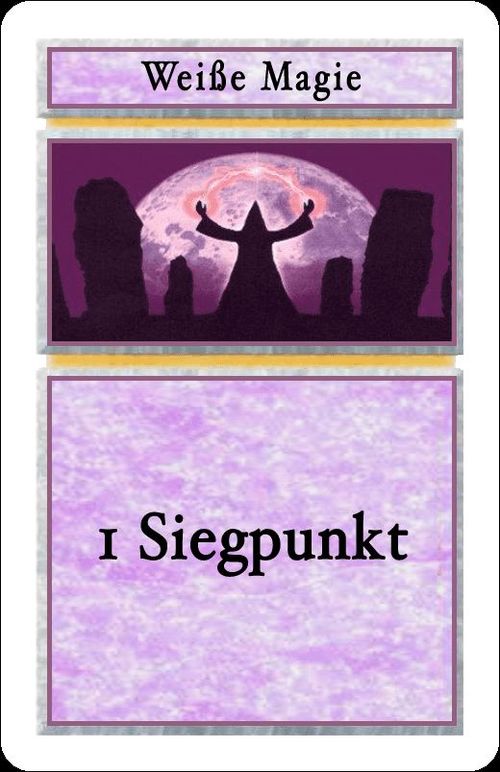
Example images in the original: a citadel tile, the commodity "Magic Crystal", and the event card "White Magic".
A six-coloured die (coloured dots on a light background) and a somewhat larger wooden figure must be bought in a toy shop.
The die keeps the colours green, blue, yellow and black. The colours white and red are painted over in purple and black (recommended: "Revell" paints; the purple should be lightened with some white paint, otherwise it is very hard to tell from the black). This die becomes the new event die, which, besides black (= the barbarian ship, now present only twice), green, yellow and blue, also has the colour purple.
The "Merchant" takes the position of the "Wizard", since it is already purple. The new wooden figure (the author's is white) becomes the "Merchant".
A fourth metropolis (called the "Magic Realm" from here on) is also needed. This is not really a problem, since a piece can quickly be made from a block of wood with a fretsaw and some sandpaper. Anyone who finds that too difficult can order a metropolis from the KOSMOS order service. The authors painted their Magic Realm purple, since their other metropolises are already green, blue and yellow (the idea of coloured metropolises comes, by the way, from the "Strategietipps zu Städte und Ritter" by Björn Weng). That way all the metropolises and the Magic Realm can be recognised at a glance.
Rules
The standard rules are used.
It is now possible for each player to convert one settlement into a citadel. A citadel is represented by a city together with a "Citadel" tile.
Converting a settlement directly into a citadel costs 3 ore, 2 grain and 2 brick. (This sounds like a lot at first, but is justified by the advantages from the progress cards.) Upgrading an existing city into a citadel afterwards costs 1 ore and 2 brick. Note: the player who chooses to convert a settlement directly into a citadel is favoured by the lower resource cost.
A citadel may also receive a city wall, so that the player may hold more resource cards in hand.
Citadels can only be built on hills (or on gold rivers or volcanoes, if these are in play). On a hills tile a citadel produces 1 brick (resource) and 1 magic crystal (commodity). If it also borders another resource tile, that tile produces resources and commodities as for a city. If the source of magic crystals dries up (for example by swapping land tiles with the progress card "Magic Land") and the citadel only touches grain, lumber, ore, wool or desert tiles, the citadel tile must be removed from the board. The citadel then becomes an ordinary city. Of course, the affected player may at any time build a citadel again at another position.
Citadels count as cities, worth 2 victory points.
Citadels can be blocked by the "Saboteur" just like cities, and then produce only the yield of a settlement. The repair cost is the same as for a city (1 lumber and 1 ore).
From the third citadel upgrade, the "Magic Kitchen", a citadel gives a significant extra benefit, as do the Aqueduct, the Fortress and the Guildhouse: the player may trade brick as often as they like at a 1:1 ratio for other resources. Commodities, however, are excluded from direct 1:1 trading.
The "Wizard" (see progress card no. 10) is worth 1 victory point, like the "Merchant".
Because the chance of the barbarian ship being rolled is lower than with the original die, the ship is moved forward two spaces each time. This keeps the threat from the barbarians present and the struggle to save Catan exciting.
Of course, this scenario can be combined and played with other scenarios (for example "Auftrag ausgeführt" or "Der Vulkan").
Tip: to prevent the printed cards from being recognised when drawing hand cards, it is a good idea to stack and shuffle the cards. The player who may draw a card names one card (for example the 3rd from the top) and receives that one handed to them.
Citadel Upgrades
Image captions in the original, shown in stage order:
- Spellbook (Zauberbuch)
- Stone Circle (Steinkreis)
- Magic Kitchen (Zauberküche): from now on, until the end of the turn, the player may trade brick as often as they like at a 1:1 ratio (commodities are excluded from this trade).
- Magic Mill (Zaubermühle): provisional "Magic Realm" ownership.
- Magic Castle (Zauberschloss): permanent "Magic Realm" ownership.
The example in the original shows the third upgrade stage.
Progress Card Explanations
Each card below gives its name, its count in parentheses, its printed card text (from the card-text reference, "Kartentexte") and the authors' explanation. The authors' heading is kept in English translation; the German name appears in brackets.
Note on card counts: the authors' text says the scenario uses 18 new progress cards, but the counts listed in the explanations add up to 20. The counts for the Wizard also differ between the two sources: 6 in the explanations and 4 in the card-text reference. Both counts are reproduced as printed; the transcriber has not corrected either.
White Magic (Weiße Magie) (1x)
Card text: 1 victory point.
Explanation: Place this victory point card face up in front of you. Victory point cards may not be held face down in hand.
Witch's Curse (Hexenspruch) (1x)
Card text: All knights of any one opponent are enchanted by a witch and can only be activated again after three turns.
Explanation: All active knights of a player are deactivated. With 5 or 6 players, the affected player can activate their knights at the earliest after 3 dice turns, in an extraordinary building phase, at the usual cost (1 grain per knight). With four or fewer players, the player can of course activate their knights again only when it is their own dice turn and at least three dice turns have passed. In the worst case, the affected player would have to play six rounds without an active knight.
The blockade applies to all knights of the affected player, including those that were already inactive before the "Witch's Curse"!
Favour of the Stars (Gunst der Sterne) (1x)
Card text: Swap any two number tokens.
Little Magic Dragon (Kleiner Zauberdrache) (1x)
Card text: The little magic dragon makes resources invisible. On a rolled "7" you may hold four more resource cards than usual.
Explanation: This card may be played without the player being on their dice turn. If the player also owns city walls, they may hold two additional cards in hand for each city wall, in addition to the four.
Great Magic Dragon (Großer Zauberdrache) (1x)
Card text: Remove any city upgrade from an opponent and build the same one yourself.
Explanation: This process must of course be carried out in accordance with the rules. A player may not, for example, remove a 3rd-stage upgrade if they themselves have only the 1st-stage upgrade and therefore could not build a 3rd stage. When the 4th stage changes hands, the metropolis / Magic Realm also changes owner without being asked.
Exception: a permanent metropolis / Magic Realm ownership (5th-stage upgrade) is excluded from this action!
Magic Strength (Zauberkraft) (2x)
Card text: When the barbarian ship arrives, the number of your own activated knights doubles.
Explanation: This card may be played without the player being on their dice turn. If, on a successful defence, the player holds the largest knight power, they receive a "Defender of Catan" card.
Dance of the Unicorns (Tanz der Einhörner) (1x)
Card text: Determine the result of the event die.
Explanation: Play this card before your dice turn and determine the result of the event die. Then roll the other dice. This card may also be played together with the "Alchemist" (then you determine the result of all dice).
Magic Current (Magische Strömung) (1x)
Card text: Move the barbarian ship two spaces forward or back.
Explanation: Depending on the strength of your own knights, this card can be very valuable.
Magic Land (Zauberland) (1x)
Card text: Swap any two land tiles.
Explanation: Only the land tiles are swapped; the number tokens remain in their original positions.
Wizard (Zauberer) (6x)
Card text: Place the wizard on one of your own settlements, cities or citadels to protect it from the robber's blockade.
Explanation: This card should be played before the player rolls the dice. For as long as the wizard protects the settlement, city or citadel, the player receives resources and commodities even when the resource tile is blocked by the robber. Owning a wizard is worth one victory point.
Magic Veto (Zauberveto) (1x)
Card text: This powerful spell negates bad events for you once.
Explanation: "Bad events" means all actions that harm the player in some way, such as discarding surplus cards on a rolled "7", losing progress cards, giving up a resource card when the robber is activated, removing a knight from the board, and so on. The exception is placing the robber on a resource tile: here the Magic Veto offers no protection!
Magic Formula (Zauberformel) (1x)
Card text: Each opponent must give you one of their progress cards. From all these cards you may choose one and keep it.
Explanation: The remaining cards are put back under the corresponding supply decks.
Magical Providence (Magische Fügung) (1x)
Card text: Building a settlement costs you two arbitrary resources less.
Explanation: When this card is played, you pay for a settlement with only any two of the usual four resources.
Magic of Nature (Zauber der Natur) (1x)
Card text: Take three arbitrary resources of your choice.
Explanation: Take three resource cards of your choice (not commodities) from the supply.
Game End
There is no fixed number of victory points needed to win. Depending on the number of players and the time available, the authors recommend 15 to 17 points.