HexDame
HexDame Rulebook
Table of Contents
Table of Contents
Terminology
The rules mention men and kings. A king is a promoted man. If the difference doesn't matter, they may also mention pieces, for instance 'the number of pieces on the board' or 'the number of captured pieces'.
Initial Position
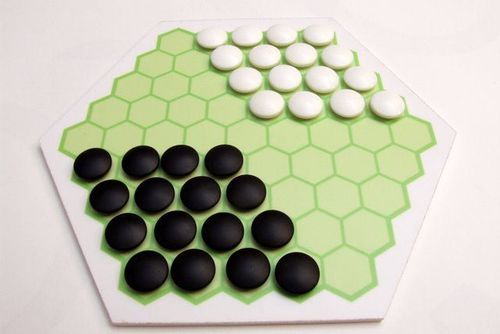
The diagram shows the board and the pieces in the initial position. A cell is identified as the intersection of two oblique files. There are two players, black and white. White begins. Players move - and must move - in turn.
Object
If a player has no legal move he loses the game. In Draughts, having no move may come about in two ways: the player is either eliminated or blocked completely. In HexDame it is virtually impossible to leave a player literally without a move. Of course a player may be blocked in a strategical or tactical sense, which means he is left without a good move.
The game may end in a draw by 3-fold or mutual agreement.
Movement
Capture has precedence over a non-capturing move. If the player to move has no capture to make, he has the following options:
- Moving a man
- Moving a king - a king is a promoted man
A man moves one cell straight or oblique forward, provided it is vacant. If a man ends its move on any of the nine cells of the back rank, it promotes to king. A king moves any distance of free cells along an open line.
(Diagram: King's move.)
Promotion
An important detail concerning promotion has to be addressed. Since men capture by jumping opponent's pieces both forward and backward, a situation may arise where a man, in the course of a capture, visits the backrank without ending its move on it.
Be it first established that completing the capture has priority!
In order to promote, a man must end its move on a square of the back rank.
If a man, in the course of a capture, visits a cell of the back rank without ending its move on it, it does not promote!
Capture
Capture is compulsory. The mechanics are identical to Draughts, but in six instead of four directions.
Next to the oblique lines, like the central e-line and the 5-line, we will also call the columns 'lines', like the central a1/i9-line.
Men
If a man is on a particular line, and next to it on that line is a cell occupied by an opponent's piece, then the man captures the piece by jumping over it to the cell immediately beyond, which must be vacant for the capture to take place.
If the man can proceed in a similar way in another direction, except a 180 degrees turn, it must do so, taking care beforehand to establish the route that brings the maximum number of captured pieces. A captured king counts as one piece.
If there are more than one way to meet this criterion, the player is free to choose.
Kings
A king looks along open lines. If it sees, at any distance, an opponent's piece and immediately beyond one or more subsequent vacant cells, it captures by jumping the piece and landing on one of these cells.
A king is subject to the same rules regarding majority capture: if it can proceed in a similar way in another direction, except a 180 degrees turn, it must do so, taking care beforehand to establish the route that brings maximum number of captured pieces. A captured king counts as one piece.
If there are more than one way to meet this criterion, the player is free to choose.
The expression 'it captures by jumping the piece and landing on one of these cells', does not necessarily imply choice. In fact, during the capture the king will usually have no choice because it is subject to majority capture. After jumping the last piece it may have choice where to land.
Removal of Captured Pieces
After - and only after - a multiple capture has taken its complete course, the captured pieces are removed from play.
In the course of a multiple capture a piece may visit the same cell more than once, but it may not capture the same piece more than once.
Both rules are illustrated simultaneously in the 'Coup Turc', a combination that illustrates the implications of the rule that the capture must be completed before the captured men are taken from the board, and the rule that a piece may not be captured twice.
Notation
A white man on f4 can choose 3 directions: f45, fg4 and f4g5. A capture does not necessarily keep a particular line and may end on the square of origin. The 'x' sign comes after the indices, for instance e8g6x, eg8x or f6x.