Hexagonal Chess
Hexagonal Chess Rulebook
Table of Contents
Table of Contents
Board and Men
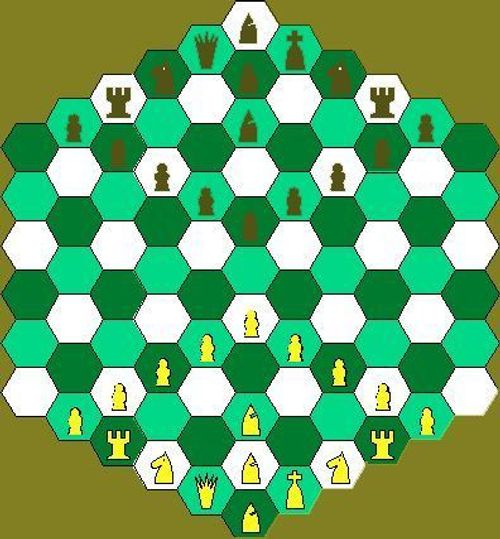
The hexagonal chess board as shown in Fig. 1 is divided into ninety-one hexagons of three colours alternately, no two hexagons of the same colour touching. There are thirty dark hexagons, thirty light hexagons, and thirty-one medium coloured hexagons. The size of the chess board may be according to the size of the chess men, there may be sets of bigger or smaller dimensions of men. The chess board may be made out of wood, or other substance.
Every hexagon on the chess board has its own identification. One can find any required hexagon by using letters and numbers, which are marked round the chess board.
The game is played by two persons, and the same kind of chess men, made out of wood or other substance may be used, as in the old chess game; but here, each person shall play not with a set of sixteen men, but with a set of twenty-two men; one set to be light coloured and called "white", and the other set to be dark coloured, and called "black".
The men in each of the sets are: a King, a Queen, three Rooks, three Bishops, three Knights, and eleven Pawns.
The men shall be arranged on the chess board before the commencement of a game, as shown in Fig. 1.
Object and Turn Order
The object of the play is to checkmate the opponent's King, and the player who checkmates thereby wins the game.
The first move in a game shall be made with a white man. The persons shall play alternately, one move at a time.
Movement of the Pieces
Rook
The Rook may be moved in six directions as shown in Fig. 2. The Rook there could be moved at choice to any of the hexagons marked with an "X". A Rook may have less directions than six, if it is on the edge of the chess board. Conditions of the moves, as well as conditions of capturing opposing men are the same as at the old chess game.
Bishop
The Bishop may be moved in six directions (each of the 3 Bishops of both sets on "his own" colour of hexagon) as shown on Fig. 2. The Bishop there could be moved at choice to any of the hexagons marked with an "O". A Bishop may have less directions than six, if a Bishop is near, or on, the edge of the chess board. Conditions of the moves, as well as conditions of capturing opposing men, are the same as at the old chess game.
Queen
The Queen may be moved as a Rook, and as a Bishop so the Queen can be moved in twelve directions. The Queen may have less directions than twelve, if the Queen is near, or on, the edge of the chess board. Conditions of the moves, as well as conditions of capturing opposing men, are the same as at the old chess game.
Knight
The Knight commands twelve hexagons, as shown on Fig. 3. The Knight there could be moved at choice to any of the hexagons marked with an "X". A Knight may command less than twelve hexagons, if it is near, or on, the edge of the chess board. Conditions of the moves as well as conditions of capturing opposing men, are the same as at the old chess game.
King
The King commands twelve hexagons, as shown on Fig. 3. The King there could be moved at choice to any of the hexagons marked with an "O". The King may command less than twelve hexagons, if a King is near, or on, the edge of the chess board. Conditions of the moves, as well as conditions of capturing opposing men, are the same as at the old chess game. The King is governed by the same conditions in this chess game as in the standard game, i.e. he may be stalemated, checkmated and may never be taken, or moved into check.
Pawns
The Pawns move straight forward. A Pawn cannot move backwards, it is the only man which cannot. Out of all 11 Pawns of both sets, 8 Pawns may be moved in their first move one hexagon straight forward, and 3 Pawns (one at either end, and the one in the centre, see Fig. 1) may be moved in their first move one hexagon straight forward, or they may be moved 2 hexagons straight forward at once. These three Pawns are: white "a2", "f3" and "l2"; black: "a5", "f9" and "l5". (Scan note: the black first pawn is read here as "a5" from the complete specification; the provisional specification prints it as "a3". The scan does not settle this and the two printings should be checked against the original.) After making the first move, all 11 Pawns of both sets may be moved always straight forward one hexagon at a time.
Promotion
There are for each set of Pawns two hexagons on which the Pawns (while entering) may be changed always, without any conditions, to a Queen (only to a Queen). These hexagons are for the white Pawns: "e10" and "g10"; for the black Pawns: "e1" and "g1", and we call them "Permanent hexagons of promotion" or "Queening hexagons".
There are for each set of Pawns eight hexagons on which the Pawns (while entering) may be changed to a Rook, Knight, or to a Bishop, but only on condition that the new man will at once check (or checkmate) the opponent's King. Otherwise a Pawn may also enter one of these hexagons, but he will remain as a Pawn. These hexagons are for the white Pawns: "a6", "b7", "c8", "d9", "h9", "i8", "k7" and "l6"; for the black Pawns: "a1", "b1", "c1", "d1", "h1", "i1", "k1" and "l1". We call them "Inconstant hexagons of promotion".
In what manner the Pawns proceed towards the "Hexagons of promotion", two examples are given in Fig. 4. The white Pawn there on "c4" may move as the arrows are showing, and will reach the "Inconstant hexagon of promotion" c8, where on entering he will remain as a Pawn and move towards the "Permanent hexagon of promotion" e10, in order to be changed to a Queen, as the player did not wish, or found it impossible to change this Pawn to another man on the hexagon "c8". The white Pawns reaching the "Inconstant hexagons of promotion" on the right side, will proceed towards the hexagon "g10". Relatively the black Pawns will proceed towards "e1" or "g1". A Pawn may never be changed to any other man, while moving from one "Inconstant hexagon of promotion" to another. The Pawns moving on the line "e" or "g" will reach their "Permanent hexagon of promotion" moving straight forward, as shown in Fig. 4 by the black Pawn on "g6".
Capture
Examples of how the Pawns may capture enemy's men are given also in Fig. 4. The hexagons near the Pawns, those marked with "Xs" are the hexagons on which the Pawns may capture opponent's men. Conditions of the moves, as well as conditions of capturing opponent's men by the Pawns, are the same as at the old chess game, but when a Pawn is present on an "Inconstant hexagon of promotion" (see Fig. 4), the white Pawn on "k7" or the black Pawn on "k1", he may not only move on the hexagon marked with small arrow, but may also capture enemy's men from the same hexagon. Therefore it is marked also with an "X". When a black Pawn is present on the hexagon "f2", as shown in Fig. 4, he may in his next move enter on "e1" or on "g1", and simultaneously he may be changed to a Queen. He could at the same time capture an enemy man from one of the two hexagons, if any is present. A white Pawn if present on hexagon "f10" is entitled to the same, in comparison to hexagons "e10" or "g10". On the hexagons "f1" or "f11", no Pawn can ever enter.
En Passant
Capturing "en passant" exists in this game, as in the old chess game, but here only in respect of those three Pawns of both sets which may be moved in their first move two hexagons at once. The reason for capturing "en passant" is here the same as at the old chess game. The manner in which capturing "en passant" may be performed is shown in Fig. 4 by the white Pawn "l2", and the black Pawn "k4". If the white Pawn there has been moved from "l2" to "l4" (two hexagons at once), the black Pawn "k4" may capture him, moving to "l3". Conditions of capturing "en passant" are here the same as in the standard game.
Other Rules
All other laws (rules) of this chess game are substantially the same as in the old chess game except that no "castling" as at the old chess game may be used here.