Hex
Hex Rulebook
Table of Contents
Table of Contents
Equipment
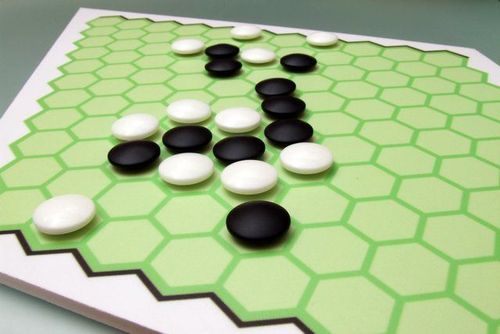
The Hex board is composed of hexagons arranged in an n × n rhombus, where n is an integer greater than zero. This allows Hex to be played on boards of various sizes. No single size is considered standard:
- 10 × 10 — used to be offered on Kurnik until 2008.
- 11 × 11 — the size Piet Hein used. Offered on Kurnik as default, on Richard Rognlie's Play-By-eMail server as the standard size, on Board Game Arena as default, and on Little Golem.
- 12 × 12 — the size used by Con-Tac-Tix. Offered on Board Game Arena.
- 13 × 13 — the original size on Little Golem (games at this size are still called "hex" by the site engine, while 19 × 19 Hex games are named "hex19"). Offered on Board Game Arena and on Kurnik.
- 14 × 14 — the size John Nash used. Offered on Board Game Arena.
- 15 × 15 — offered on Board Game Arena and on Little Golem.
- 18 × 18 — used to be offered on Playsite and Lycos, but they no longer offer Hex.
- 19 × 19 — offered on Board Game Arena, on Little Golem, and on Kurnik.
10 × 10 is considered by many a lower bound for interesting games. PlayHex offers all sizes from 1 × 1 to 53 × 53.
The edges of the board are colored with two colors, with parallel edges having the same color. The board is empty at the start of the game.
How to Play
Hex is played by two players, who take turns placing a single stone on the board. One player uses red stones and the other uses blue stones.
The objective of the game is for a player to build a solid chain between their designated edges (red for one player and blue for the other).
The game is guaranteed to end with a winner, as it is impossible for one player to surround one edge of the opponent without connecting their own two edges.
Overall, the strategy of the game is to connect one's designated edges while preventing the opponent from doing the same.
The Swap Rule
To balance the game, the "swap rule" (also known as the "pie rule") is used at the start of the game. The first player places a red stone on the board, and then the second player chooses which player will use the red stones and which will use the blue stones. Whichever player ends up being Blue makes the second move, and then the game continues as usual. This ensures that the first player does not have a significant advantage.
Reason for the Swap Rule
When playing Hex without the swap rule, the first player has a considerable advantage. The swap rule was devised to make the game more even: if the first player plays a move that is too strong, the second player will swap and be in a strong position; if the first player plays a move that is too weak, the second player will not swap (and therefore also be in a strong position). The swap rule therefore creates an incentive for the first player to play a move that is as fair as possible.
The swap rule is sometimes called the "pie rule" because it resembles the "you cut, I choose" method for fairly dividing a pie between two people: one person cuts the pie in two, and the other chooses which piece to eat. The incentive for the first person is to make the two pieces as equal as possible.
Since each opening move is theoretically either winning or losing, no opening move is exactly fair. For this reason, the second player theoretically has a forced win when playing with the swap rule. However, the second player's advantage is very small — much smaller than the first player's advantage would be without the swap rule.
Implementations of the Swap Rule
Swapping can be implemented in two ways. As usual, assume the players are Red and Blue, with Red going first.
- "Swap sides" — the players perform the swap by switching colors: Red becomes Blue and Blue becomes Red. After the swap, it is Blue's turn.
- "Swap pieces" — the players perform the swap by switching pieces. The initial red piece is replaced by a blue piece in the mirror-image position, mirrored with respect to the board's long diagonal (for example, a red piece at a3 becomes a blue piece at c1). The players do not switch colors: Red stays Red and Blue stays Blue. After the swap, it is Red's turn.
In face-to-face play, "swap sides" is most practical, since it is easier for players to switch colors than to remove and add pieces on the board — especially when playing with pencil and paper — and it is less error-prone. On online game sites, "swap pieces" is more common, since colors are usually determined at the start of the game and it is easier to change the board position than the color designation; this also keeps the game record readable, since it is always clear which player was "Red" and which was "Blue".