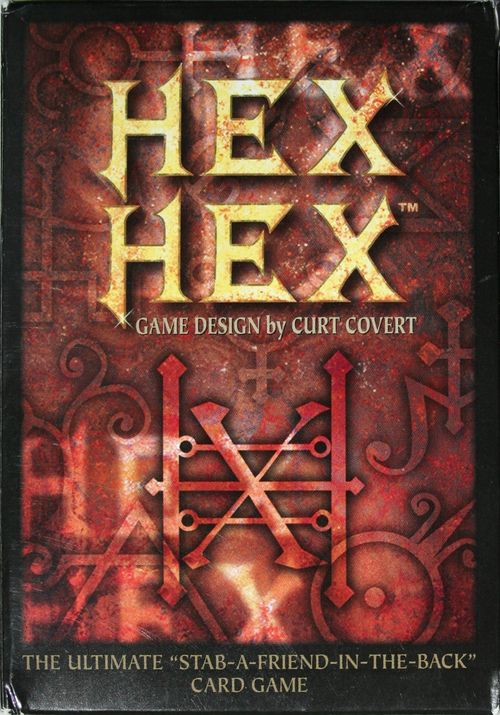
Hex Hex
Hex Hex Rulebook
Table of Contents
Table of Contents
Game Components
- 94 HEX•HEX Cards
- 6 Voice Cards (To track your score)
- 8 Voice Tokens (Black triangles - one for each player and extras)
- 12 Hex Tokens
- 6 Standard Hex Tokens [Red], 3 Maddened Hexes [Green]
- and 3 Enhanced Hexes - one side for Boosted Hexes [Blue], the other for Escalated Hexes [Purple]
Setting Up
Carefully punch out all 12 Hex Tokens and 8 Voice Tokens (the small black triangles) from the Token Sheets. Discard the waste. Remove the top six cards entitled VOICE from one of the two wrapped card decks and place them aside. Then shuffle the remaining 94 cards together thoroughly. Be sure to break up clumps of cards with the same name.
Determine the number of rounds to be played. Each game of HEX•HEX is composed of a number of rounds (or hands) equal to the number of players plus one. So if you've got 5 players, play 6 rounds.
Give each player a VOICE Card. Voice is the measure of how much power and influence you command in the group. All players begin the game with an equal Voice. Represent this by placing a Voice Token (or if you prefer, a glass bead of your favorite color) on the diamond-shaped number 5 on the Voice Card. During play, players will gain and lose Voice through the casting of Hexes at one another. At the end of the game, the player with the most Voice wins, earning them the right to have the final word and lay down the law.
Choose a player at random to be the dealer. Deal each player 5 cards face down. The remaining cards are placed face down beside the dealer. When the deck runs out of cards, reshuffle the discard pile into the deck - but not until then.
The HEX•HEX Deck
The HEX•HEX Deck is composed of 94 cards that players will use to deflect Hexes away from themselves and towards other players - as well as to alter the Hex's power or abilities. HEX•HEX cards fall into 5 distinct categories and are detailed here with representative cards for each group. Only a portion of the available cards in each group are shown.
Basic Deflections
Basic Deflections are just that. They deflect the Hex away from you, towards another player. Basic Deflections make up most of the deck.
NULL - You may play this card even if it is not your turn. Cancel the last card played. If the player has another card, they may play it instead. (HEX HEX may not be Nulled)
TURN ASIDE LEFT - Hex passes to the player on your left.
TURN ASIDE RIGHT - Hex passes to the player on your right.
DEFLECT ACROSS - Hex passes to a player across the table. If more than one player, choose one.
Enhanced Deflections
Enhanced Deflections also pass the Hex, but alter it in some way or cause additional effects as a result of having played the card.
BOOST LEFT / RIGHT - Hex passes to the player on either your left or right. This Hex will cause the loss of an additional Voice when it goes off.
TWAIN - The Hex is duplicated. Simultaneously, one Hex passes left, the other right.
CUT TO THE CHASE - Hex passes to a player you choose. Before doing so, all players must discard at random, down to a hand of no more than two cards.
Counter Hexes
These cards are used to disrupt the best laid plans of others. You may cancel cards they play, dispel Hexes, or blow 'em up in their faces. Many can be played out of turn. Save them for critical moments.
DETONATE - May not be played as your first card during the round. Play on another player as they are passed a Hex, but before they play a card. The Hex goes off on that player. You and the player who passed the Hex gain a Voice.
DISMISS - May not be played as your first card during the round. Play only when you are The Intended. Dispel the Hex. You gain two Voice.
"Play Only When Hexed"
These cards are time bombs. Most are either good news for you or bad news for someone else. But here's the trick... they only trigger if the Hex actually "goes off" on you. So, if you have cards that would allow you to pass the Hex, you must play those first. But when HEXED as a result of having no other cards that allow you to legally pass the Hex or because another player causes the Hex to "go off" on you prematurely (as with Detonate) they must be played, for good or ill. If you hold more than one card of this type in your hand, choose one to play for each time you are HEXED.
CURSE - Play only when Hexed. Suffer the loss of two additional Voice when the Hex goes off on you. (yeah, this is a bad card to have)
REFLECTION - Play only when Hexed. Both you and the player who targeted you lose Voice.
WHAT THE HEX UP WITH THAT? - Play only when Hexed. All other players lose one Voice. Then, you gain a Voice for each point lost this way. Other scoring effects are canceled.
Play When Dealt / Standing Effect
These cards are played immediately when dealt and resolved before a round of play begins. Some may have Standing Effects and continue to affect play until the round ends. Check for these as soon as you get your hand.
DECEPTION - Play immediately when dealt. Standing Effect - This round, play all your cards face down and announce the card by name. Other players may challenge the stated card. If it is the card you named, they lose 3 Voice and play continues. If not, you are Hexed and lose 6 Voice.
MARKED MAN - Play immediately when dealt. Draw three new cards up to a hand of seven.
Starting the Game
After dealing each player 5 cards, give players ample time to read and understand the cards in their hand. If you received any cards that read, 'Play immediately when dealt', play those cards and resolve their effects before beginning the round. No other cards may be played until the round officially begins. Note: Since these cards are played before the round begins, they do not count as 'the first card you play during a round' and do not satisfy the condition listed on cards like Dismiss or Detonate. When all players are ready, the round may begin.
Playing the Game
Play begins with the player to the left of the dealer. This player casts the first Hex, not with a card, but by saying aloud, "HEX•HEX, (target player name)". The named player is now The Intended target. Place a standard (red) Hex token in front of that player. When a Hex token is passed to a player, it becomes their turn. In response, The Intended may play a card from their hand onto the table face up in front of them. In most cases, it will be a basic deflection that redirects the Hex to another player. When a Hex is deflected, pass the Hex token to The Intended target after playing your card.
Other cards may pass the Hex to another player with additional effects. For example, the Hex may become more powerful, force a discard or create a duplicate Hex that gets passed around simultaneously. Follow the specific instructions on the card. Where those instructions conflict with the general rules printed on this sheet, the card prevails. Note: All effects on a Hex are cumulative. For example, it is possible to Boost an already boosted Hex. Stack the appropriate tokens as you pass them to make it easier to keep track of all effects on a Hex.
Getting Hexed
Play continues in rapid-fire succession as player after player deflects the Hex around the table. At some point, a player will be unable to pass the Hex, either because they hold no cards in their hand or the cards they are holding do not allow them to pass the Hex. When this occurs, the player is HEXED. Under normal circumstances, when a Hex "goes off" on a player, The Hexed loses one point of Voice and the player who targeted them gains one point of Voice. If The Hexed would lose additional Voice through a card like Boost, the player who targeted them still only gains one Voice. Record the scoring of this loss or gain by moving the token along the scoring track on your Voice Card.
A player may also become HEXED as a result of certain cards (Detonate, Maddening Compulsion) which cause the Hex to "go off" prematurely. Players may not, however, simply allow themselves to be HEXED if they have the means to pass the Hex instead. Nor can players cause themselves to be HEXED by naming themselves the target of Detonate, Reap What You Sow or other similar cards. (Someone might be tempted to do so if they hold a card that gives a benefit to being HEXED. But don't let 'em.)
Dealing with Multiple Hexes
Through the use of cards like Twain or Double Back, more than one Hex can be in play at a given time. When cast, these cards cause the Hex to be duplicated – including any effects the Hex currently carries. So if you Twain a Boosted Hex, the duplicate is also Boosted.
It is not unheard of for there to be three or four Hexes ricocheting around the table at once – often times with different effects placed upon them. This is where those Hex Tokens really come in handy. You have six for standard Hexes, three for Enhanced Hexes (Boost or Escalating Obsession) and three for Maddening Compulsion. The tokens will help you keep straight which Hex carries which effect / or effects. When you play any one of the 3 named cards above, swap the standard red Hex Token with the appropriate Hex Token for the card you played. Pass that Hex Token or stack of tokens (for Hexes with multiple effects) to The Intended as they become targeted, starting with the very first one cast in the round. Do it consistently and you'll never get confused.
IMPORTANT: When more than one Hex is in play, all Hexes are passed simultaneously. So, if someone takes a moment to consider a card, do not allow one Hex to out-pace another. You may play your card, but do not pass the Hex Token to The Intended until all Hexes are ready to be passed AND any pre-pass effects (like Choke's discard effect) are resolved.
Yes. It is possible to be targeted by more than one Hex at a time. Should this happen, each Hex must be redirected with a separate card. If a player is unable to redirect one or more Hexes in a round, they are HEXED for each that goes off upon them.
Play continues until all Hexes have gone off or have been dismissed. A HEXED player is never out of the round - and may be hit by other Hexes still in play.
Ending the Round
Once all Hexes have "gone off" or are dismissed, the round is over. Assess the loss or gain of Voice and record it on your Voice Card. Once all scoring has been recorded, players discard any remaining cards in their hands and those they've played to the discard pile. Begin a new round. The new dealer is the person who cast the Hex last turn. The new person to cast the Hex is the player on their left. The deal rotates clockwise in this fashion until all players have had a chance to both deal and cast a Hex once.
Cards Worthy of Special Mention
HEX•HEX – This card may be played even if it is not your turn, especially in the heat of battle or while someone is chatting when they should be Hexing. When played, the entire deck of cards becomes cursed. The last player to drop their cards and raise their hands high over their head is HEXED and loses three Voice. No one gains Voice as a result of playing this card. No card in the game may cancel HEX•HEX or change the amount of Voice lost. The previous Hex or Hexes in play and their effects are dismissed. The round ends.
HEX•HEX - You may play this card even if it is not your turn. The entire deck is Hexed. The last player to drop their cards and raise their hands over their head is Hexed for three Voice. This Round ends.
MADDENING COMPULSION - The Hex passes to a player on your left or right (there are two versions of this card). The first player who can not pass the Hex in the named direction is automatically Hexed. Any card that passes the Hex in the named direction is legal. Duck, Twain, Called Shot, and Boost are all examples of legal cards that allow the Hex to continue in the proscribed direction.
Maddening Compulsion trumps all other cards once it is in play, so Dismiss, Hex Sign, Theft of Thought and any other card that does not pass the Maddened Hex as indicated causes the Hex to go off. (NOTE: If you are not The Intended, cards that may be played out of turn like Detonate or Null MAY still be played without triggering Maddening Compulsion.) And yes, you can trump the trump by playing another Maddening Compulsion - even if the new Maddened Hex goes the opposite direction.
MADDENING COMPULSION - Hex passes to player on your right. The first player who can not pass the Hex to the right by any means is automatically Hexed. This effect supercedes all other card effects.
HEX SIGN – This card is played when you are The Intended. Instead of passing the Hex or resolving the Hex normally, the Hex is dismissed. In it's place, all players play 'Rock, Paper, Scissors' in unison. The sign made by the person who played this card is the Hex Sign. Any player matching the Hex Sign gains one Voice. Any player who chose a different sign loses one Voice. A player who chose a sign subordinate to the Hex Sign (i.e. choosing Paper when Scissors is the Hex Sign) loses an additional Voice.
If there is more than one Hex in play when Hex Sign is played, wait to resolve this effect until all other Hexes have 'gone off'. Since everyone plays a bit differently, agree beforehand how you plan on doing it. Ours goes "1-2-3-SHOOT!" with everyone revealing on "Shoot!" And just so we're clear:
Rock beats Scissors • Scissors beats Paper • Paper beats Rock.
HEX SIGN - Dispel the Hex targeting you. All must play Rock, Paper, Scissors. You and anyone who matches your sign gains one voice. Players with different signs lose one Voice and anyone with a subordinate sign loses an additional Voice.
'cause games are a lot more fun when you can stab a friend in the back.
Key Card Phrases Defined
"Play even if it is not your turn" – A player may play this card at any time after the initial casting of the Hex, even if it is not that player's turn.
"Play when you are The Intended" – A player may play this card any time that they are the current target of the Hex.
"Play only when Hexed" – A player may not play this card until they are HEXED. If you can otherwise legally pass the Hex by playing another card, you must do so. You may only play this type of card if you can not pass the Hex or if another player causes the Hex to 'go off' on you prematurely (as with Detonate). Play only one for each time you are HEXED.
"Hex is dismissed" – The Hex and its effects are canceled and no voice is gained or lost. If this is the only Hex in play, the round ends. A card that dismisses a Hex may have effects to replace those of the canceled Hex.
"Hex passes to a player across the table" – A player across the table is defined as any player not sitting to your immediate right or left. If there is more than one player sitting across from you, choose one. In a three-player game, you may choose either player. In this instance, the pass still counts as 'across' not 'left' or 'right'.
"Standing Effect" – These cards have a continuous effect once played. If the card is removed during the course of play, the effect ends. In either case, the card is discarded after the round ends.
"Discard / Discard at Random" – If a card calls for you to discard a card from your hand, discard face down to the table in front of you. If a card calls for you to discard at random, have another player choose the cards blindly for you.
The Last Round
Once all players have had a turn dealing and casting a Hex it is time for the last round. The player with the least share of Voice selects a player to deal the last hand and then begins the round by casting the Hex.
Winning the Game
The player with the most Voice at the end of the set number of rounds wins. If two or more players are tied, play a tie-breaker round. All Voice losses and gains are doubled in a tie-breaker. The player with the least share of Voice selects a dealer and casts the Hex. Keep playing until someone's Voice carries the day. And remember… the winner gets to lay down the law!
Laying Down the Law
The winner of each game earns the right to make up a rule for the next game. Be sure to set a penalty for violating the rule as well. We recommend that you not set a penalty that would end a round prematurely. A loss of Voice, a loss of cards or other penalty that keeps the game moving is far more fun. If you are playing a series of games, all the added rules are cumulative.
Sample rules include…
- Anyone who points a finger during the game loses one Voice.
- Before playing any card, touch it to your chin or you must discard the card instead.
- Cancel that stupid rule.
- Any Hex passed to the right must be passed with your right hand, any passed left must be passed with the left hand – or lose two voice.
- Any player with a Voice of 0 or less may not speak until their Voice is raised to at least 1 Voice.
- A particular card is removed from the deck permanently.
- Players who are Hexed in a round may cause an equal loss of Voice to any target player.
Be creative. This keeps the game lively. Just remember, you've got to live with any rule you create.
That's the game. If you play multiple games, and you will, the new dealer will be the player to the left of the player who dealt the first hand last game.
Other rulings, FAQs and interesting "laws" will be published on our web site at www.smirkanddaggergames.com. Or e-mail us at [email protected]
© 2003 Smirk & Dagger Games. All rights reserved. HEX•HEX is a registered trademark of Smirk & Dagger Games. This work is protected by international copyright law and may not be reproduced in whole or in part without the written consent of the publisher.