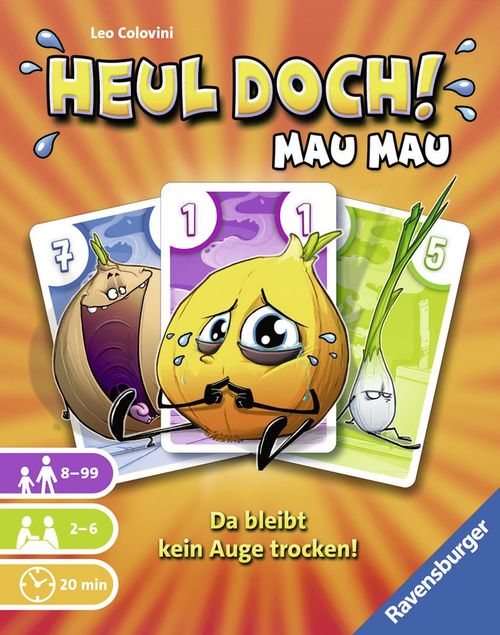
Heul doch! Mau Mau
Heul doch! Mau Mau Rulebook
Table of Contents
Table of Contents
Components
- 98 number cards (the numbers 1 to 7, twice each, in 7 colors)
- 12 special cards (used only for the variant)
- 1 handkerchief (only for those who have particularly much to cry about)
Setup
Shuffle all 98 number cards well and place them as a face-down draw pile in the middle of the table.
Per player: 1 face-up (table) card and 4 face-down cards (hand).
Going around the table, each of you receives 1 random card from the pile and lays it face up in front of you. This is the first card of your personal discard pile. Each of you also receives 4 more cards from the pile, which you take into your hand so that only you can see them.
Set the handkerchief within reach for whoever ends up having particularly much to cry about during the game.
How to Play
Whoever is the biggest crybaby at the table begins, then play continues clockwise around the table.
If it's your turn, you must play one of your hand cards.
You'll always basically want to play this card onto your own pile, matching it, because that's the only way it earns you victory points at the end of the game. To do so, the card must — just as in "Mau Mau" — match either the color or the number of the card currently on top of your pile.
For example, if you have a red 5 on top of your pile, you may place any red card or any 5 of any color on it.
But watch out! Does either of your two neighbors (left or right) have a card on top of their pile that your played card (by number or color) matches? Then you must place your card on their pile instead, whether you want to or not. So you'll naturally always try to play a card that matches only your own pile and not your neighbors'. Obvious, right? But it doesn't always work out that way...
If you can place your card on either neighbor's pile, you decide which one to place it on. By the way, you never take the piles of other players who are not sitting directly next to you into account!
In the example above, your left-hand neighbor has a blue 4 showing and your right-hand neighbor has a green 2. That means you would have to "gift" a blue 5 or a red 4 to your left-hand neighbor, or a green 5 or a red 2 to your right-hand neighbor, even though all four of those cards would also fit on your own red 5! So it's best to simply place a red 6 or 7 on your own pile instead...
Can't or don't want to play onto your own pile or a neighbor's pile? Then you have a second option for playing: you place any one of your four hand cards (its color or number doesn't matter) face down — so that it shows the gray-backed Heul doch! onion — onto your own discard pile. On this Heul doch! onion, on your next turn you may then place any card face up. Except, of course, if it matches one of your neighbors — then of course you have to place it there instead! Maybe it'll work out with your own pile the turn after next?
Additional Rules
- You may voluntarily place a Heul doch! onion on your own pile even if you had matching number cards.
- You may also place another Heul doch! onion on top of your own Heul doch! onion, if that seems necessary and sensible to you.
- You may never place anything on an opponent's Heul doch! onion — they are taboo!
- Watch out! You may not go back through your discard pile later to search it. So you should always keep track of how many Heul doch! onions you already have in your pile, since their number becomes important when scoring at the end of the game!
At the end of your turn, you draw the top card from the draw pile so that you have 4 hand cards again. Then play continues around the table and the next player takes their turn, and so on. Once the draw pile is used up, you no longer draw cards. However, you keep playing until everyone has played all their hand cards.
End of the Game
Once you have all played your very last hand card, the game ends.
Each of you now first counts all the Heul doch! onions in your pile. Their number devalues the matching number cards in your own pile — that is, those cards no longer score any points. If someone has more than 7 Heul doch! onions in their discard pile, all of their 7s, and the corresponding number above 7, also lose their value as a result.
For example: if you have 5 Heul doch! onions in your pile, all your 5s are worth nothing. If you have 9 Heul doch! onions, all your 7s and your 2s (7 + 2 = 9) are worth nothing.
All other cards score as many points as their number value (each 1 = 1 point, each 2 = 2 points, and so on, up to a 7 = 7 points). Whoever reaches the highest total with their cards is the winner.
In case of a tie, whoever lost more points to their Heul doch! onions wins. If that is also equal, there are multiple winners.
The Special Cards
If you want a bit more variety, simply shuffle the 12 special cards in among the number cards at the start of the game.
If you receive a special card right at the start as the first card of your discard pile, shuffle it back in and take a new one instead, until you have a number card showing.
On your turn, instead of a number card, you can also play a special card. To do so, lay it face up onto a separate discard pile in the middle of the table. Then resolve it as follows:
Catapult — discard the most valuable card(s)
If you play the "Catapult," whoever has the card with the highest number value showing on top of their discard pile must discard it onto the Catapult's discard pile. If several of you (possibly including yourself!) have the highest number value showing, all of you must discard your card. If this leaves someone with no card left on their discard pile, it counts as if a Heul doch! onion were now showing there — that is, on their next turn they may play any card they like (the neighbor rule must still be observed!).
Beach Towel — swap 2 cards
If you play the "Beach Towel," you swap the top card of your discard pile with the top card of any other player's discard pile. This may also be Heul doch! onions. If you have no card showing at this point (see "Catapult"), your fellow player simply receives no card from you. Note: it does not matter here whether the two swapped cards would fit on either discard pile or not.
Carousel — pass cards left or right
If you play the "Carousel," you decide whether the top card of every discard pile is passed one place to the left or to the right. If a player has nothing showing in front of them at this point (see "Catapult"), the affected neighbor simply receives no new card, but must still pass on their own top card. Here too, it does not matter whether the swapped cards would fit on any discard pile or not.
Werewolf — flip cards over
If you play the "Werewolf," all players (including you!) must then flip over the top card of their discard pile — that is, a number card becomes a Heul doch! onion, or vice versa!