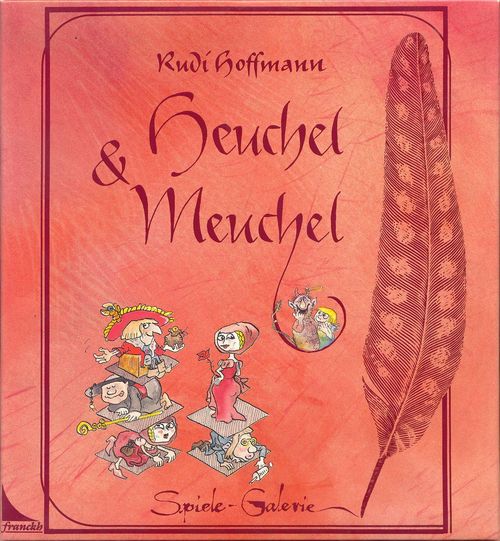
Heuchel & Meuchel
Heuchel & Meuchel Rulebook
Table of Contents
Table of Contents
This Is What You Need to Play
- 1 game board
- 1 die (for the variant only)
- 36 cards with pawns, 6 each for the 6 different classes:
- Prince
- Bishop
- Lady (Patrician)
- Quack
- Minstrel
- Fire-Eater
The game board has been designed in imitation of Burgundian book illustrations of the late 14th century. The higher the rank in society of a pawn, the higher up is its starting square in the lower half of the board (marked by the same background pattern on the square and the pawn), and the higher is its goal square in the upper half of the board.
Each player is allocated a vertical column of squares. Only in this column he moves his pawns. Still, he will be interested what is happening in the other columns: you can feign your favours on other pawns of lower rank and pull them over to your own column.
(Figure: STARTFELDER = starting squares, ZIELFELDER = goal squares)
The 6 pawn cards of each social class are numbered with values 1 to 6 in the shield. Those values are the rank inside their own class. For example, the Minstrel with a value of 6 is higher than the "5" Minstrel but lower than the Quack with the value of 1.
This Is What the Game Is About
The pawn cards must be moved from their starting squares to their goal squares. In doing this you will encounter a back-stabbing competition right across all ranks for the best positions. In the end, the values of the cards on their goal squares decide who has won. Hypocrisy and assassination are running wild wherever you look. Thank god all this is so very different today! (?)
You Start Out Like This
Decide who is the start player, the other players will take their turns clockwise from there. Each player chooses one column in which he will help his pawns to promotion.
Now it is decided how the group of each player is composed: All 36 pawn cards are shuffled face-down. In turn, each player takes 6 cards and places them face-up on the squares showing the pawn card's background pattern, in the bottom half of the game board (starting squares).
If you have more than one card for the same square you may decide for yourself in which order you place the cards as a stack. The other players need not know which values are hidden in the stack. A stack placed on the board may not be sorted differently afterwards. ("Once placed it's placed.")
When all players have placed their cards the game begins.
When It's Your Turn
You have nothing better to do than move your pawns towards the goal. Move one card or stack
- to the next higher square if it is free
- or jump over directly adjacent occupied squares to the next free square. If the square adjacent to the target field is also occupied you may continue to jump.
Examples:
- The Quack in the first column moves to the 4th square and must stop there.
- The Fire-Eater in the 2nd column jumps to the 7th square. He can not move further, but he has the option to end his move on the 5th square already if the player deems it wise for tactical considerations.
Everybody aspires to higher positions. Therefore, all pawns always move upwards, never down, sideways or diagonally. The background pattern of the squares is irrelevant, it only marks starting and goal squares.
If a card stack is on the square you may decide whether you will move the complete stack or only one or more cards taken from the top of the stack (in this case, the rest of the stack would remain on the square, unmoved). You may not change the order of cards in a stack.
It is not done to idle: in your turn, you must move, nobody can skip his turn.
And This Is How You Feign Favours
The august purpose of each player's game is to take care of other player's pawns, in an attitude of splendid magnanimity. To convert them to one's faction with a patronizing air helps to gain power and prestige - and the victory points needed in the final tally.
If, at the end of your move, you have cards or stacks with a lower rank in another column but in the same row, you may give proof of your generosity and shelter those cards under your wings. Just put them under your card or stack (see figure next page).
You may only give this favour with the one card or stack you have just moved.
How many cards of a stack you take is entirely up to your noble disposition. You may, at your choice, take only part of a stack and leave the rest where is is. But it won't do to peek at the cards before parting the stack! Of course, you may renounce entirely to take cards, for tactical reasons.
Generous patronage carries its own reward: When you have taken care of other pawns you may immediately take another turn if you want to. You may take that turn with the same or another card or stack if you like. If you collect other pawns under your wings in the process you may take yet another turn and so on until you cannot find any more victims for your generosity.
Figure: Feign a favour: pawns of lower rank are placed beneath ones own card or stack.
Example:
- The Bishop (value 4) moves to row 6 and impresses his favours to the Lady in column 3 and to the Bishop (value 3) in column 5. The Prince is of higher rank and stays put.
Every Ascent Has an End
As you can see by the background pattern of the squares the way from start to goal is only 7 squares for any pawn. No pawn may move into a square above its own goal, as this would be presumptuous. However, if it is moved inside a stack it is allowed to ascend higher since then it is under protection of the upmost pawn of the stack.
Cards or stacks that have reached their goal square are flipped over (back side up). They are then safe from the greed -pardon me, form the magnanimity of other players and may not be taken over any more. Goal squares with flipped cards are considered free for other pawns with the same goal, they count as occupied for pawns of higher class.
Example:
- In the first column, the Lady may not move higher than to her goal square. In the second column, she is hidden in the stack lead by a Prince. He may take her up to his goal square as long as she is inside the stack.
If, in the top half of the game board, only part of a stack is taken over by another player and the upmost pawn showing on the remaining stack is found in a position higher than its class would allow this arrogance is punished immediately: the complete remainder of the stack is discarded. The cards are taken from the board and placed before the owning player. In the final tally they count as penalties and their values are subtracted from the score.
So Who Has Won?
The game ends when only one player has pawns that may move while the other player's pawns have all reached their goal squares.
The values of all cards that have reached their goal, or have moved beyond it inside a stack, count as victory points.
The values of all cards that have not reached their goal or that have been placed as discards before the player count as penalties and are subtracted from the score.
The player with the highest score may pat himself on the back: he has won and given proof to his noble disposition.
Game Variant with Dice
Play of the Game
In his turn, each player rolls a die and moves a card or stack of his choice exactly that number of squares to a higher, free square. Occupied squares count but are skipped in the movement. The number rolled must be used completely. You do not get another roll if you roll a 6.
Even in the variant with dice these rules apply:
- You may move a stack, or only part of it, at your choice.
- Cards or stacks may not be moved beyond their goal square.
- You may take over pawn of lesser rank that are in the same row as your card/stack.
This last rule also allows you to take another turn immediately. You may refuse to do so, but once you have rolled for an additional move you must take it. Else, you are subject to punishment as described under "Zugzwang".
Zugzwang
You must move in your turn. If you cannot do that because the number rolled does not fit any possible movement you immediately lose one card of your choice. This card is taken from the board and discarded in front of you. In the final tally it counts as a penalty, and its value is subtracted from the score.
Cards or stacks already at their goal are immune.
If you take a card from some stack in the upper half of the game board and reveal a new top card that has moved beyond its goal, this pawn is also discarded immediately and placed to your penalty cards. This process is repeated until a pawn shows up that is of higher class or that has his goal square exactly there. In the latter case, it has reached its goal and the card (or remaining stack) is flipped over.
Example:
- You roll a 5 which you cannot use in the present situation. You remove the Prince and discard him before you, because he will give a penalty of only 1 in the tally (the Quack would count -5). However, by doing this you reveal a Minstrel that has moved beyond his station. The Minstrel must also be discarded, revealing another Quack that has reached his goal hex there and is flipped over together with the remainder of his stack immediately.
End of Game
Each player takes turns until all his cards have reached their goals or until he has no card left. This implies that the last player may have to take several turns in succession while the other players are done already.
Points are scored as in the game without dice.