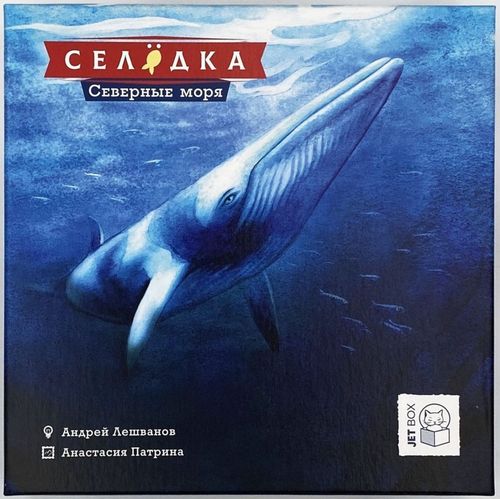
Селёдка: Северные моря (Herring: Northern Seas)
Селёдка: Северные моря (Herring: Northern Seas) Rulebook
Table of Contents
Table of Contents
Setup
- Place the scoring board in the centre of the table.
- Each player takes a player aid of any colour and places a marker of the same colour on the 0 space of the scoring track.
- Shuffle the animal cards and deal each player 7 cards as their hand.
- Place the remaining animal cards face down beside the scoring board. This is the plankton. Leave room beside it for an animal discard pile.
- Shuffle the destruction cards and place them face down beside the plankton. Leave room beside them for a destruction discard pile.
- Place the destruction marker on the scoring track, on the space matching the number of players (see the table).
- The first player is the one with more herring cards in hand. If tied, the youngest of those players becomes first player.
| Number of players | 2 | 3 | 4 | 5 |
|---|---|---|---|---|
| Initial destruction | 12 | 8 | 4 | 0 |
Animal Cards
The main cards in the game of Herring are the animal cards. During play you will play them, eating other animals and increasing species diversity. Animal cards show:
- Species name. In one action you may play any number of cards, but only of one species.
- Level — shows how much suitable food (other cards or plankton) must be eaten to play this card. Animals may be small (level 1), medium (level 2) or large (level 3).
- Diet — shows what this animal may eat when this card is played.
Animals may eat other animals (in which case the "eaten" cards are discarded from the table) or plankton (in which case the player takes new cards from the plankton deck into their hand).
Eating other animals is the main way to score points.
Game Turn
Players take turns in order, starting with the first player. On your turn you may perform the following actions:
- Play one destruction card from hand.
- Play any number of small animals (level 1) of one species from hand.
- Play any number of animal cards of any one species from hand.
- Perform a current change (смена течений).
A player must perform at least one of these actions, but may skip any of them. Actions are performed strictly in the order given above. Each action may be performed only once per turn. After the player has performed all the actions they wish to, they pass the turn to the next player clockwise.
Feeding
When you play animal cards, they must be fully fed. The amount of food required depends on the animal's level. Animals may eat plankton, other animals, or both; their diet is printed at the bottom of each card. On the cards of the apex predators (marked with the apex predator icon) the card shows what they cannot eat.
If an animal eats plankton, the player takes a card from the plankton deck. Each card counts as one unit of food. Cards gained this way may be played in the same action, if they are animal cards of the same species. A player gets no points for eaten plankton.
If an animal eats other animals, the player discards those animals' cards from the table. Only animals listed in its diet may be eaten. The level of the animal being played determines how many other cards must be discarded from the table. Animals of one or several suitable species may be eaten at once. The player gets 1 point for each eaten animal and moves their marker forward on the scoring track by the corresponding value. Eaten animal cards are placed face up in the discard pile.
When feeding, only the number of cards matters; the level of the eaten animals has no significance.
If a player cannot fully feed an animal, they cannot play that card either.
If an animal feeds on both plankton and other animals, the player chooses the ratio in which to eat them.
Plankton is an infinite resource in the game: if the plankton deck runs out, it is immediately reshuffled from the discard pile. Animals that feed on plankton will therefore always have food available.
Example 1. Lena decides to play a white-sided dolphin (level 2). The dolphin needs 2 food matching its diet (mackerel and herring). There are two herring and two mackerel on the table. Lena can feed the dolphin with two herring, or two mackerel, or one herring and one mackerel.
Example 2. Vanya wants to play three squid (level 1). There are only two mackerel and no herring on the table. So he plays only two squid, receiving 2 points for this. He cannot feed the third squid and therefore cannot play it.
Player Actions
1. Play one destruction card from hand
The player reveals one of their destruction cards and applies its effect. After this, the card is placed face up in the destruction discard pile. Players receive destruction cards when playing large animals (level 3), including apex predators.
2. Play any number of small animals (level 1) of one species from hand
The player lays on the table any number of cards of one species of small animals (level 1) from their hand. Each animal must be fully fed (see Feeding). The player is not obliged to play all cards of this species from their hand. If the player cannot feed an animal, they cannot play that card either.
Do not forget to check species diversity and species extinction (see the next page).
Example. There are two dolphins and one orca on the table. Anton plays the destruction card "British Fishermen" (Британские рыбаки). He discards from the table all dolphin and orca cards. He receives 4 points (two for each species) and increases the destruction value by 2 (one for each species). The card reads: for each species, +2 points and +1 destruction.
Example. Maxim plays a mackerel. He decides to feed it with plankton. He gets no point, but takes one card from the plankton deck. It turns out to be a mackerel, and Maxim decides to play it immediately in this same action. This time he eats a herring and gets 1 point for it.
3. Play any number of animal cards of any one species from hand
The player lays on the table any number of animal cards of one species from their hand. Animals of any level may be played. The player must immediately feed these animals fully (see Feeding). The player is not obliged to play all cards of this species from their hand.
Do not forget to check species diversity and species extinction (see below).
For each large animal (level 3) played, the player must take the top card of the destruction deck into hand.
Example. Sasha plays a giant shark (Гигантская акула), a large animal (level 3), which needs 3 food. He decides to feed it with two herring and one plankton. So he discards two herring cards from the table, receiving 2 points for this, and takes one card from the plankton deck into his hand. For playing a large animal he receives one destruction card, but he will not be able to play it in this turn.
4. Perform a current change
The player discards any number of animal cards from their hand and draws one more card from the plankton deck. The player may discard zero cards and draw one. Destruction cards cannot be discarded with this action.
Example. Sveta has 3 animal cards left. She decides she does not need these cards and discards them all. Then Sveta takes 4 cards from the plankton deck. She will be able to play them on her next turn.
Species Diversity and Destruction
If at the start of the player's action there were no animals on the table of the species to be played in this action, the player immediately receives 1 point for species diversity.
If, during the feeding of an animal, all animal cards of one species were eaten from the table, that species is considered extinct. For each extinct species, the destruction value immediately increases by 1.
Played destruction cards increase destruction depending on their effects. The effect of a destruction card must be applied in full.
Example. There are no animals on the table. Andrei plays a herring and takes one card from the plankton deck. He receives 1 point for species diversity. With his next action he plays a squid and eats the only (last) herring. He receives one point for the eaten animal and one more for species diversity. The destruction value immediately increases by 1, because herring has disappeared from the table.
End of the Game
The game ends immediately in one of two cases:
- The turn reaches a player who has no animal cards in hand.
- The turn reaches a player who has 25 or more points.
After the game ends, each player loses 1 point for each card remaining in their hand (both animal cards and destruction cards count).
Players who have fewer points than the destruction value lose. If all players lose, the ocean ecosystem is destroyed.
If this does not happen, the player with the most points wins. In a tie, the player (or players) with the most cards remaining in hand wins.
Commonly Forgotten Rules
- Animals do not need to be fed every turn; they are fed only when they are played.
- Medium and large animals must be fed fully: they require 2 and 3 food respectively.
- If an animal card lists several kinds of food, it may be fed with one kind or with several kinds. For example, a white-sided dolphin may eat either 2 herring, or 2 mackerel, or 1 herring and 1 mackerel.
- Apex predators are large animals.
- A destruction card may be played even if it scores no points (but you must still apply its effect).
Card Effect Clarifications
- The "Old Mine" (Старая мина) card may be played on yourself, discarding all other destruction cards and receiving 1 point for each of them.
- The "Storm" (Шторм) card can be used to give away not only animals but also destruction cards.