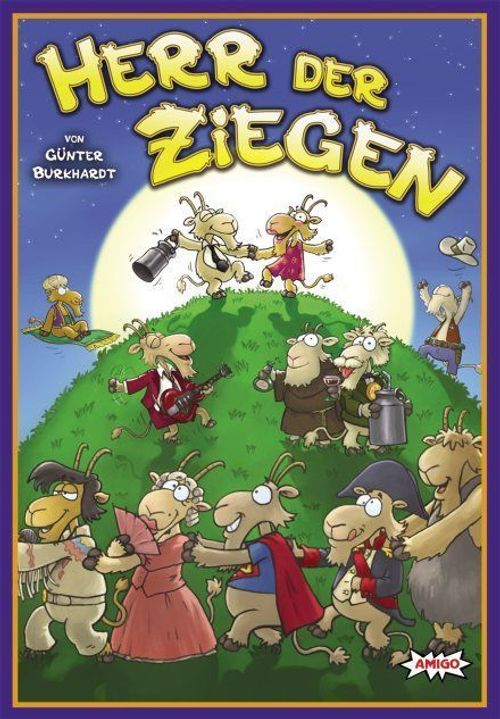
Herr der Ziegen
Herr der Ziegen Rulebook
Table of Contents
Table of Contents
Contents
- 121 Cards:
- 90 Goat Cards (18 sets of 5, valued 1-5)
- 15 Dog Cards
- 16 Milk Shake Cards (8 valued 1, and 8 valued 2)
- 5 Large Goat Tokens (1 per player color)
- 50 Small Goat Tokens (10 per player color)
- 5 Goat Pens (1 per player color; assemble them before the first game)
Game Objective
The goats are loose! In this wild and fun goat game you earn points by claiming majority in as many different sets of goats as possible. There are 5 goats per set, each with a value of 1 to 5. With the majority in a set you claim all the remaining goats in the set. Double points are earned using a dog to drive goats to one's goat pen. The player collecting the most milk shakes scores bonus points at the end of the game. The player with the most points wins.
Game Setup
First, each player selects a color, takes the matching Goat Pen, Large and Small Goat Tokens of that color. Put your Small Goats in your Pen. Then, depending on the number of players, remove the following cards from play and place them back in the box:
- 5 Players: no cards removed
- 4 Players: 2 sets of Goats, 2 Dogs and 2 Milk Shakes (value 1)
- 3 Players: 5 sets of Goats, 5 Dogs and 5 Milk Shakes (value 1)
- 2 Players: remove 8 sets of Goats, 8 Dogs and 8 Milk Shakes (4 x value 1, and 4 x value 2)
The remaining cards are thoroughly shuffled and placed face up on the table in a 7x7 Pasture (only 6x6 in a 2-player game) along with each player's Goat Pen, and Large Goat Token, as shown in the setup illustration in the rules booklet. The setup depends on the number of players. The remaining cards are put face down next to the Pasture and form the draw pile.
Draw 2 cards from the draw pile and keep them hidden in your hand. A Dog Card may be returned and a new card drawn to replace each. The Dog Cards are then shuffled back into the deck before play starts.
Gameplay
The youngest player starts and play continues in clockwise order from there. Each turn consists of the following four phases:
- Play a Card
- Move Your Large Goat
- Take a Card
- Score (if possible)
1. Play a Card
You must play one of the two cards in your hand. Thus there will be more and more face up cards in front of each player. Each player's cards must be grouped into sets of matching Goat Cards, and Milk Shakes.
2. Move Your Large Goat
Next you must move your Large Goat Token clockwise a number of spaces (card edges) equal to the value of the card you played. The Large Goats move around the outside of the Pasture, not on the cards. If a Dog Card is played, the Large Goat does not move.
Example: Red plays a "5" Goat Card and moves his Large Goat 5 spaces.*
3. Take a Card
You must take a card from the Pasture, from the row/column that starts next to your Large Goat and ends on opposite side of the Pasture (see illustration*), and add it to your hand.
Note: During play, Small Goat Tokens will mark ownership of the Goat Cards in the Pasture; Goat Cards marked with Small Goat Tokens may not be taken.
The top card of the draw pile is immediately placed face up in the gap created by taking a card from the Pasture.
Note: If the draw pile is exhausted, the space remains empty.
4. Score (if possible)
Certain plays trigger scoring. There are two ways this can happen:
A) A set of your goats total 8 or more points.
Since there are only 5 cards in each set, valued 1-5 or 15 points total, if you have 8 points you clearly have the majority in the set. You now claim all the Goat Cards of your majority set in the Pasture, by placing Small Goat Tokens on each of them. This designates that you will receive the value of these Goat Cards at the end of the game as victory points.
If some of the goats in your majority set are still in the draw pile, then set aside the required Small Goat Tokens near the matching cards played in front of you as a reminder, and when the goats appear immediately place a Small Goat Token on them.
If another player has a Goat Card of your majority set played in front of them, they must discard it (back in the box).
Note: There is no limit to the number of Small Goat Tokens that you may play on Goat Cards in the Pasture. In a 2-player game you may run out of your 10 tokens rather quickly, so please substitute tokens of one of the colors not used.
Example: Red has already played a value 5 "Pool Goat" and now plays the 3 of the set.*
B) The card is the 4th Goat Card played of its set.
The player with the highest sum of Goat Cards in the set claims the last remaining 5th Goat Card in the set. In case of ties, the player with the most Goat Cards in the set wins. If still tied, the winning player is the one who triggered scoring.
Example: Red has "Elvis 2"; Yellow has "Elvis 5" and Blue has "Elvis 4". Now Red plays "Elvis 3" and wins ownership of "Elvis 1."*
As before, if an opponent has a Goat Card of your majority set in front of him, it is discarded. The winner of the scoring places a Small Goat Token on the 5th Goat Card if it is in the Pasture. If it is not there yet, set aside a Small Goat as a reminder.
Note: It is possible during scoring that the 5th Goat Card of a set is in a player's hand. This player must then reveal the card, but keeps it. This is bad luck for the player who scored the set. While they won the scoring, they are unable to take possession of the 5th Goat Card and therefore score no points for the set.
Dog Cards
A Dog Card allows you to move one of your claimed Goat Cards, on which you have a Small Goat Token, swapping places with another card in the same row/column of the Pasture.
You do not move your Large Goat when playing a Dog Card, but take a card from the Pasture as normal from the row/column next to your Large Goat.
The following alternatives are available when driving Goat Cards:
a) Swap places with one of your Goat Cards and a Goat Card not claimed by another player.
b) Swap places with a Goat Card claimed by another player, with that player's consent.
c) Move your Goat Card to an empty space in the Pasture (this is possible toward the end of play).
At the end of the game, cards that contain your Small Goat Tokens next to your Goat Pen, or connected to it through other such cards in a continuous line, earn double points.
Example: Red has played a dog and exchanged the card with his own small goat with a neutral card (gray). Now the card with his small goat is next to his stable and brings Red twice the usual score.*
Milk Shake Cards
When you play a Milk Shake card, you collect them together on the table in front of you. Then move your Large Goat according to the number on the card (1 or 2 spaces) and take a new card from the Pasture as usual.
End of the Game
The game ends when the last card in any row/column has been taken. It also ends if a player can no longer take a card because all the available cards in that row/column are marked by Small Goat Tokens.
Final Scoring
Total up your points; that is, the combined value of the Goat Cards in the Pasture marked with your Small Goat Tokens. The cards are worth double their value if adjacent to, or in the same row or column as, your Goat Pen. Cards played on the table or in your hand are worthless.
The player with the most Milk Shake Cards at the end of the game receives points equal to the sum of their values. The player with the second most Milk Shake Cards only receives half the points (rounded up) of the sum of their values. In case of a tie, each receives their points accordingly.
Whoever has the most points wins the game.
For example, final reckoning for Red:
Example: Final scoring for Red.
- Goats adjacent to the Pen (double points): 1 + 1 + 4 = 6 x 2 = 12
- Other Goats: 1 + 2 + 4 = 7
- In addition, Red has collected the most Milk Shakes: 1 + 1 + 2 + 2 + 2 = 8
- Total: 12 + 7 + 8 = 27 Points*
Notes
* The source translation states: "Yes, you must refer to the official rules booklet to see the illustrations referred to in this rules translation." The illustrations (setup, card-taking row/column, examples) are not reproduced here.