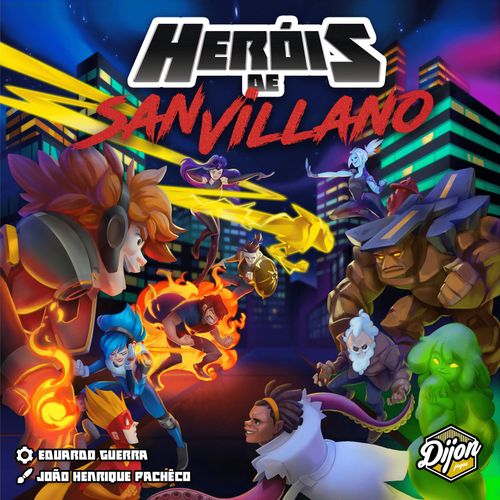
Heróis de San Villano
Heróis de San Villano Rulebook
Table of Contents
Table of Contents
Components
- 18 City cards (4 Spring, 4 Summer, 4 Autumn and 6 Winter);
- 20 Hero cards;
- 11 Helper cards;
- 5 Super-Agent cards;
- 22 Villain cards (14 Scum, 8 Elite);
- 1 Opportunity card;
- 6 Nickname cards;
- 4 Organization cards;
- 4 Guide cards;
- 1 Round marker;
- 12 Fire tokens;
- 48 Resource tokens;
- 8 Agent tokens;
- 3 Special character tokens;
- 10 plastic stands;
- 12 Tracking tokens;
- 1 Rulebook.
Setup
-
Separate the City cards and shuffle them according to their backs. Place the 4 Spring (I) City cards face down on the table, forming a 2x2 grid. Then draw 4 Winter (IV) cards and return the remaining 2 to the game box. Follow the diagram: place the 4 Winter (IV) cards face down at the corners, interspersed with Summer (II) and Autumn (III) cards, as shown on page 5. Reveal all the Spring (I) cards and the top and bottom Summer (II) cards.
-
Separate the Hero, Helper, Scum Villain and Elite Villain cards, forming 4 distinct decks. Place the Hero, Helper and Scum Villain decks beside the City cards, and reveal 3 cards from each deck below them, forming columns called Recruitment Rows. If any Scum Villain shows the "On Reveal" symbol, return it to the bottom of its deck and reveal a new one. Place the Elite Villain deck near the Scum Villain deck, but do not reveal any of its cards.
-
Shuffle the Super-Agent cards and deal one to each player. Return the rest to the game box. The players choose which organization (colour) they will play. Each player receives 1 Agent token and their 3 Tracking tokens. Pieces of organizations that were not chosen are returned to the game box.
-
Shuffle the Organization cards and place them near the City cards, forming a row. Then place the Opportunity card at the end. This is the initial player order, with the leftmost card representing the first player (first-player icon). Place the Round marker above the first card, and turn the cards over so that only the last (rightmost) card shows the Strategist face (Strategist icon).
-
Shuffle the Nickname cards and reveal a number of them equal to the number of players. Place them where everyone can see them, and return the remaining cards to the game box.
-
Place the Resource tokens (Clue and Money), the remaining Agent tokens and the Special tokens where all players can reach them.
-
Shuffle the Fire tokens and form a stack with them, face down, in a place easily reached by everyone.
-
The first player takes 1 Resource of their choice, the second player takes 2, the third player takes 3 and the fourth player takes 4.
Object of the Game
Your goal in Heróis de San Villano is to establish your organization as the greatest defender of the city. To do so you must recruit Heroes and Helpers, track and confront Villains, acquire Nicknames, and protect the city from Fires. The organization with the most Reputation Points at the end of the game is declared the winner.
The Game Cards
City Cards
City cards are divided into 4 seasons, identified by their backs: Spring (I), Summer (II), Autumn (III) and Winter (IV).
The front of a City card is divided into two locations, where players allocate their agents to take actions. Each location has 4 elements:
- Location name;
- Location illustration;
- Location action;
- Number of agents allowed in the location at the same time (if there is no symbol, only 1 agent is allowed).
Hero, Helper and Super-Agent Cards
Heroes and Helpers are characters that the organizations of each player can recruit. Super-Agents are characters that begin the game with the organizations. They have 6 elements:
- Character name;
- Character illustration;
- Recruitment cost (Super-Agents have none);
- Character weakness (Helpers have none);
- Character focus or foci (Helpers have none);
- Character ability.
Villain Cards
Villains are the characters the players will face during the game. They are divided into two distinct decks, Scum and Elite, and have 9 elements:
- Character name;
- Character illustration;
- Tracking cost;
- Confronting cost;
- Fire indicator;
- Character focus or foci;
- Character weakness;
- Reputation Points;
- Character ability.
Round of Play
A round of play consists of at least two turns for each player. On your turn, you take only one of the following actions:
- Allocate an available agent from your play area to one of the 4 central City cards and activate the location where it was placed.
- Move an agent across the City cards up to two cards away and activate the location where it stopped.
When you finish your action, you move the Round marker to the Organization card of the next player and end your turn. So, in one round, the Round marker passes twice over each player's Organization card, as well as over the Opportunity card. When passing from the Opportunity card to the first player, turn the marker over to its other side. A round is complete when the marker turns from the Night (Action 2) side to the Day (Action 1) side.
Allocating Agents
When you take the allocation action, you must choose an available agent from your organization and place it on a revealed Spring (I) City card. When doing so, the player chooses which location the agent will occupy and activates it, executing its action.
Moving Agents
Players may move an agent one or two cards away, placing the agent on one of the locations of that card and activating it, executing its action. Movement follows these rules:
- You cannot occupy a location that is already occupied by another agent (yours or another player's), unless the location's symbol allows more than one agent.
- Movement must always be orthogonal. Diagonal movements are not allowed.
- You cannot move an agent to the other location on the same card where it already is (but you may place another of your agents, one that was on a different card, in that location).
- You may move to a location and decide not to activate it, if you prefer.
- Some Heroes or Villains modify the movement rules. In that case, follow what is written on the character's card. If there is any conflict, the abilities of Heroes and Helpers take precedence over the abilities of Villains.
Extra Actions
As soon as the last player finishes their turn, the Round marker must be placed above the Opportunity card. Those players who have one or more Tracking tokens on this card must take an extra action for each token, respecting the player order. Return each token to its player at the start of that player's extra action.
Revealing New City Cards
After the actions of the Opportunity card have been carried out, the Round marker must be turned to its other side. Whenever you turn the marker from the side showing Night (Action 2) to the side showing Day (Action 1), the player who is the Strategist must reveal a new City card and gain one Resource of their choice, thereby ending a round.
City cards are revealed by season, following their order. That is, to reveal an Autumn (III) card, all Summer (II) cards must already be revealed, and Winter (IV) cards may only be revealed after all Autumn (III) cards have been revealed.
Example: Luiz, of the Punho Rubro (Red Fist) organization, has finished his action. He must therefore reveal a City card. As there are still Summer (II) cards, he must reveal one of them, and cannot yet reveal any Autumn (III) or Winter (IV) card.
Special Events
At the end of each season, a special event takes place:
- As soon as the last Summer (II) card is revealed, all players receive their second Agent token.
- As soon as the last Autumn (III) card is revealed, replace the Scum Villain deck with the Elite Villain deck. Do not replace Villains that have already been revealed. From then on, whenever a new Villain must be revealed, reveal it from the Elite Villain deck.
Location Actions
The actions at the City's locations are:
- The player receives a Clue token.
- The player receives a Money token.
- The player chooses and receives either a Clue token or a Money token.
- Prepare icon (heart): the player prepares all of their exhausted Heroes, Helpers and Super-Agents.
- Ability icon (lightning bolt): the player executes the ability of one Hero in their organization.
- Recruit icon: the player recruits one Hero and/or one Helper from those revealed in the Recruitment Rows, paying the recruitment costs shown on the character cards. Then they reveal characters from the respective decks to refill the rows.
- Track icon: the player tracks as many revealed Villains as they wish, paying the tracking costs shown on the character cards. Tracks happen in the order the player chooses. When doing so, place a Tracking token of your organization on each Villain tracked in this action.
- Laurel icon: after passing the Round marker to the next player, the player moves their Organization card to the leftmost position in the player order, becoming the first player.
- Strategist icon (map): the player turns their Organization card over to show the Strategist icon, and turns over the card of the current Strategist. The player order is not changed.
- Confront icon (fist): the player may use one of their Heroes (or Super-Agents) to confront a Villain, paying the confronting costs shown on the Villain. The Hero (or Super-Agent) used must be prepared, and the Villain confronted must have a Tracking token of the player's organization on it (see Confronting Villains).
- Move 3 icon (three arrows): the player may move their other agent up to 3 cards away and execute the action of the location where it stops.
- Move 5 icon (five arrows): the player may move their other agent up to 5 cards away and execute the action of the location where it stops.
- Question mark icon: the player may execute the action of a location occupied by an agent from another organization.
Some locations have two or more different types of actions. In that case, the player may execute them in any order they wish. Each location may only be activated once per action.
Character Abilities
Heroes, Helpers and Villains have abilities printed on their cards. These abilities are activated in different ways, depending on the type of character and the symbols in its text.
Hero Abilities
A Hero's ability can only be executed when the player who controls it activates a location with the Ability symbol (lightning bolt). Only prepared Heroes (card horizontal) can execute their abilities. Some Heroes become exhausted (card vertical) after executing their ability. This is represented by the exhausted symbol.
Helper and Super-Agent Abilities
Unlike Heroes, the abilities of Helpers and Super-Agents can be executed at any moment of the player's turn (unless the card specifies the exact moment), represented by the clock symbol. As with Heroes, Helpers may also become exhausted after executing their ability. However, there are Helpers whose abilities are passive and always active, and others that must be discarded in order to execute their abilities.
Villain Abilities
Villains have 4 different ways of activating their abilities:
- On Reveal (eye icon): as soon as the Villain is revealed on the table, execute its ability.
- On Confront (fist icon): as soon as a player confronts this Villain, execute its ability.
- On Track (target icon): as soon as a player tracks this Villain, execute its ability. Repeat the effect whenever a player tracks this Villain.
- Passive (clock icon): while this Villain is revealed on the table, its ability is active.
If there is a rules conflict, the abilities of Heroes and Helpers take precedence over the abilities of Villains.
Confronting Villains
To perform the confront action (fist icon), the player must declare a prepared Hero (or Super-Agent) in their Organization. Then they must choose a single Villain that has a Tracking token of their organization on it, and pay the costs to confront it. To determine the outcome of the combat, compare the Foci and Weaknesses of the chosen Hero and Villain.
Place the cards side by side, Hero on the left and Villain on the right, joining their Focus and Weakness bars. Foci and Weaknesses can be of 6 types: Intelligence, Power, Speed, Strength, Technology and Special.
The action always results in the defeat of the Villain, but what happens to the Hero depends on the Foci and Weaknesses of both. The following conditions must be evaluated in order:
- Heroic sacrifice: if the Villain has as a Focus one of the Hero's Weaknesses, that Hero ends up badly wounded and must be discarded by the organization.
- Ready for another: if the Hero has as a Focus one of the Villain's Weaknesses, the Hero remains prepared.
- Epic struggle: if none of the conditions above is satisfied, the Hero becomes exhausted, turning its card to the vertical position.
Example: Renan, of the Lebre Fantasma (Ghost Hare) organization, chose the Hero Nervos to confront the Villain Gélida. As their Foci and Weaknesses do not match on any of the bars, Nervos returns exhausted to his organization.
Heroes that have no symbol in their Focus bar always return exhausted to the organization. Villains that have no symbol in their Weakness bar always exhaust the Heroes that confront them.
Whenever a Helper or Hero is discarded, place it underneath its corresponding deck. Super-Agents are returned to the game box.
After a Villain is confronted, it is captured by the organization, and its card is collected by the player who defeated it and placed face down in that player's play area. At the end of the game, the Villain's Reputation Points are added to the final score of the organization. The Tracking token of the player who confronted that Villain returns to their play area. The Tracking tokens of the other players are placed on the Opportunity card.
Some Villains, when defeated, may cause a fire in the city (see Fires). As soon as a Villain is defeated, a new Villain card must be revealed from the current Villain deck to replace it.
Whenever a Tracking token must return to a player who did not confront the tracked Villain, that token goes to the Opportunity card. At the end of the current action phase (Day or Night), all players with tokens on that card receive an extra action, in player order.
Fires
When a player confronts a Villain with the Fire symbol, they take the top token from the Fire stack and, without looking at it or showing it to the other players, place it face down on a location of their choice on a City card that is already revealed. The player may not place it on a location that already has agents, other Fire tokens or character tokens.
For an agent to enter a location that has a Fire token on it, the player must exhaust one of their active Heroes. Then reveal the Fire token. The player may perform this action in addition to the location's actions, in whatever order they choose, as if it were printed on the card. If the player performs the action, they take the Fire token and gain the Reputation Points shown on it. If they do not perform the action, the token stays on the location to be resolved in a future action. Even once the token has been revealed, a Hero must still be exhausted to enter the location with the Fire token.
The Fire tokens that can be found are:
Top row:
- Gain one Money token and one Clue token. (1 Reputation Point)
- Gain two Money tokens. (1 Reputation Point)
- Gain two Clue tokens. (1 Reputation Point)
- Prepare all of your exhausted characters. (1 Reputation Point)
- Execute the ability of one of your Heroes. (3 Reputation Points)
- Perform a recruit action. (3 Reputation Points)
Bottom row:
- Perform a confront action. (3 Reputation Points)
- Perform a track action. (3 Reputation Points)
- Lose two Clue tokens. (4 Reputation Points)
- Lose two Money tokens. (4 Reputation Points)
- Exhaust one of your Heroes. (4 Reputation Points)
- Remove one of your Tracking tokens from a Villain. (4 Reputation Points)
Recruit, track and confront actions must have their costs paid as normal.
Nicknames
Nicknames are objectives available to all players, representing milestones reached by the organizations and recognized by the San Villano city hall. The first player to fulfil a Nickname's requirement takes its card and receives the Reputation Points shown on it at the end of the game. A player may fulfil several different Nicknames during the game.
The six Nickname cards in the game are below. Titles are translated from the Portuguese, and the Portuguese title is given in brackets.
- "I Am the Night" (Eu sou a noite): the first organization that has 5 different Foci among its Heroes receives 8 Reputation Points.
- "To the Clearest Day" (Ao dia mais claro): the first organization that has 4 Helpers receives 10 Reputation Points.
- "I Am the Best at What I Do" (Eu sou o melhor no que faço): the first organization that has 3 Heroes with the same Focus receives 8 Reputation Points.
- "With Great Powers" (Com grandes poderes): the first organization that has 5 Heroes receives 7 Reputation Points.
- "On Fire" (Em chamas): the first organization that has 3 Fires receives 6 Reputation Points.
- "It's a Brawl" (Tá na mão do pau): the first organization that has 2 Heroes with different Foci receives 6 Reputation Points.
Translator's note: the Nicknames were read from low-resolution card art in the source PDF, so the numbers and the wording of the requirements should be checked against the physical cards. The figures for "On Fire" and "It's a Brawl" are the least certain, and the second Hero line of "It's a Brawl" is partly hidden by an overlapping card in the scan. Its count of 2 is taken from the icons printed on the card.
End of Game and Final Scoring
The game ends when the Strategist of the round has to reveal a City card and there are no more cards left to reveal.
The Reputation Points of each organization are calculated as follows:
- Efficiency: the Reputation Points on the defeated Villain cards;
- Heroism: the Reputation Points on the resolved Fire tokens;
- Team: 2 Reputation Points per Hero and 1 Reputation Point per Helper in your organization;
- Recognition: the Reputation Points on the Nicknames you have acquired;
- Fundraising: 1 Reputation Point for every 5 Money and/or Clue tokens.
The organization with the most Reputation Points is declared the winner and protector of San Villano. In case of a tie, the player who confronted the most Villains wins. If the tie persists, the player with the most Heroes wins. If it still persists, the victory is shared among the players.
Solo Variant
Coming soon! The source booklet's solo variant section reads "Em breve!" ("Coming soon!") and contains no solo rules, so none are transcribed here.