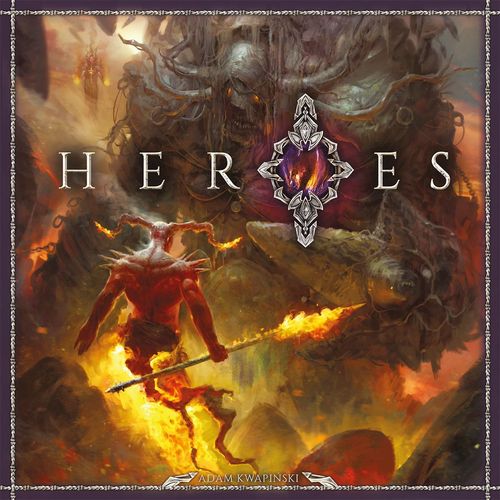
Heroes
Heroes Rulebook
Table of Contents
Table of Contents
Game Objective
"Heroes" is a real-time strategy game. The players take the roles of the eponymous Heroes and use magic spells and armies of fantasy creatures to defeat their opponents. The game ends when there is only one Hero alive on the battlefield.
IMPORTANT: In boxes like this you will find more detailed explanations of some rules and the most important rules will be repeated. Read each such box carefully, so that you do not miss any crucial rules.
YOUR FIRST GAME: "Heroes" is not a complicated game, but due to the exciting real-time gameplay, certain rules may be hard to remember when playing it for the first time. This is why we recommend ignoring some rules during your first game and use a simplified variant. Boxes like this tell which rules may be ignored during the first game.
Components
- 4 player boards
- 25 six-sided dice
- 20 Basic Spell cards (4 sets of 5)
- 60 Spell cards
- 4 Special Spell cards (1 for each Hero)
- 4 Hero cards
- 92 Creature cards (23 for each Hero)
- 18 Permanent Spell tokens
- 81 double-sided Wound/Power tokens
Game Setup
Prepare the Decks and Accessories
- Divide the Creature cards according to the cards' backs and place them next to the corresponding Heroes.
- Divide the Spell cards according to their type:
- A) Put the Special Spells (there is an eligible Hero's name under the name of the card) next to the corresponding Heroes.
- B) Take the Basic Spell cards (silver frame on the front side) out of the main deck and divide them into 4 sets with 5 cards each (2 Magic missile cards, 2 Command cards, 1 Dispel card). Each player should get one set. Return the remaining Basic Spell cards to the box; they will not be used in the game.
- C) Shuffle the remaining 60 Spell cards and place the deck in easy reach of all players. Then draw cards from the deck to create two rows of face up cards, 4 Spells in each.
- Give a set of 6 dice, a player board and a wound token to each player. The board is double-sided. One side shows the starting setup for the players who want to skip the stage of creating their army in their first game. After choosing the side of the board, place the wound marker on number 21.
- Make a common pool of wound/power tokens and Permanent Spell tokens and place it in easy reach of all players.
Choose Heroes and Starting Spells
Beginning with a randomly determined starting player, the players take turns to choose a Hero and/or Spell for their own deck. In your turn you may take any available Hero (if you do not already have one) and that Hero's Special Spell and Creatures, or take one Spell from the bottom row. Then, the next player makes their choice. Repeat this procedure 4 times, until each player has exactly one Hero and 3 additional Spells.
Choosing a Spell
After a player takes a Spell from the bottom row, move the card directly above it in the top row down to replace the taken card. Then fill the free space in the top row with a new Spell from the top of the deck.
Before the beginning of the game each player shuffles their 9-card deck and draws 4 cards to hand.
Choosing a Hero
During the Spell deck building procedure each player must choose an available Hero (during their turn, only once and instead of choosing a Spell card). When a player decides to choose a Hero, they take the Hero card together with the corresponding Creatures and add a Special Spell (unique for each Hero) to their deck. If a player already has a Hero (chosen earlier), they cannot take another one.
BEINGS, HEROES AND CREATURES: There are two types of cards that can be placed on the player boards. These cards are called Beings. Beings include Heroes and Creatures. If the rulebook or a card refers to a Being, this means a Hero or a Creature. The rules that affect Creatures do not affect Heroes and vice versa.
EXPOSED AND UNEXPOSED BEINGS: In "Heroes" you will often encounter the term "exposed Being". This means a card on a player board which is in the front (top) line or, when in the back (bottom) line, has a free space in front of itself. A Being is considered unexposed if it is in the back line and the space directly in front of it is occupied by another card (a Creature or a Hero).
Heroes
There are four Heroes, each one represented by a Hero card. Each card is double-sided - one side shows only the Hero's picture, name and the starting number of hit points. The other side has additional text describing the Hero's special ability and weakness (both attributes are related to the element that the Hero commands). In the first game we recommend using the side with no text and not using the rules related to the Heroes' special abilities and weaknesses.
- HERO'S NAME
- HIT POINTS - the number of the Hero's starting hit points.
- GAME TEXT (only on the card's back) - it describes the Hero's special ability and weakness, related to the element that the Hero commands.
Spells
Each player starts the game with their own deck of 9 Spells (5 Basic Spells, a Special Spell and 3 Spells taken from the track). During the game, players play Spell cards from their hands. Specific element symbols or Leadership symbols (in the case of the Command card) are necessary to use them. Each Spell card has the following information:
- NAME - the name of the Spell.
- REQUIREMENTS - the symbols you need to roll on your dice to cast a particular Spell - the type of the symbols determines which element a Spell belongs to. Magic missile, Command and Dispel are not related to any element in the game.
- TARGET - the type of the target the Spell can be cast on. There are various types of targets in the game:
- Any Being - any card (a Creature or a Hero) on any player board may be targeted.
- Any Creature - as above, but the card cannot be played on a Hero.
- Any player - any participant of the game can be targeted.
- Any exposed Being - the card may be played on any Being (a Creature or a Hero) which is in the front line on the board or is in the back line, but it must have a free space in front of itself.
- Any own Creature - any Creature (but not the Hero) on the board of the player who casts this Spell.
- Any own Being - as above, but also the Hero controlled by the caster can be targeted.
- EFFECT - the effect of casting the Spell. Every description starts with whether a spell is "Instant" or "Permanent" (permanent spells remain in play after being cast).
- ENHANCEMENT - a better effect you may achieve by enhancing the Spell while casting it. The detailed rules of enhancements are described later in the rulebook (see: Enhancing your Spells).
Building the Army
When the players have finished selecting their Heroes and starting Spells, proceed to the next phase of the preparations, that is creating the armies from the available Creatures.
Each player chooses the Creatures from the cards related to their Hero. You may choose any number and type of Creatures available for your Hero, but the total cost of the selected cards cannot exceed 10 points. You choose the Creatures for your army in secret.
When all players have finished selecting the Creatures, they place their cards on their boards. Starting from the player who was the first to choose a Spell (or the Hero), they take turns to place one card (a Creature or the Hero) on their boards. Repeat this until all the Creatures and Heroes are placed on the player boards.
YOUR FIRST GAME: If this is your first game, we suggest using the pre-defined starting armies (including their setup). To do this, turn the player board to the side showing the types of the Creatures and their starting spaces. Place the appropriate Creatures on their spaces on your player board.
PROTECT YOUR HERO: Remember to protect your Hero as well as you can (place them in the back line, behind your Creatures). When the Hero's hit points are down to zero, you immediately lose the game, regardless of how many Creatures there are on your board.
Creatures
Each player's army consists of a Hero and Creatures (collectively referred to as Beings) chosen before the game. These cards are placed on the player boards and play a crucial role in the game. Remember that in a single game you may only use those Creatures you have bought during the game setup. Choose the Creatures for your army carefully, since this may become the key to victory. Each Creature card has the following information:
- NAME - the name of the Creature.
- COST - the cost of buying the Creature. The total cost of all the Creatures chosen by a single player cannot exceed 10.
- ACTIVATION COST - it determines the number of Leadership symbols (1-3) required to activate the Creature. The stronger the Creature, the higher is its activation cost. The activation cost does not matter while moving a Creature.
- STRENGTH - the number of wounds (physical) the Creature inflicts by its basic attack.
- TOUGHNESS - the number of wounds the Creature can endure before it is killed. When the number of wounds inflicted to a Creature equals or exceeds its Toughness, the Creature card should be removed from the game (taken off the board).
- ATTACK DIRECTIONS - represented by arrow symbols. They determine the spaces occupied by an opponent's Beings that may be attacked by this Creature. The detailed rules of attacking are described later in the rulebook (see: Attacking).
- SPECIAL ABILITY - the Creature's special ability that may be used while activating the Creature (instead of its basic attack) or it is a Static Ability, which is constant and does not have to be activated (this is indicated at the beginning of the description on the Creature card). Some Creatures do not have any special ability. In such a case the card contains flavor text in italics that does not affect the gameplay.
Game Overview
A game of "Heroes" is a real-time game. The players roll their sets of dice simultaneously, trying to get sets of symbols that enable them to take various actions. When a player decides that they have rolled a satisfactory result, they may stop the game. All the players stop rolling and the player who has stopped the game takes the action allowed by their dice. After the player's action, all the participants resume rolling their dice and continue doing so until any player stops the game again.
Below you will find the game overview, divided into particular phases.
1. Preparation
This is the most important phase of the game, taking place entirely in real time. Simultaneously (and as fast as they can), the players roll their dice, trying to get sets of symbols required for taking actions. While rolling, you may keep the results from any number of your dice, taking them to your hand and rerolling only those you do not like. When you decide you have rolled a satisfactory result, you may stop the game by saying aloud "Stop!". When this happens, all the players must stop rolling at once (though everyone still rolls the dice they had in hand when the game was stopped, so that all the dice are on the table).
2. Taking Actions
The player who has stopped the game may take one action allowed by the set of symbols on their dice. But before this happens, they must apply the effect of their Hero's weakness and all the effects of Permanent Spells that are activated when the game stops.
EFFECTS OF STOPPING THE GAME: The effects of Permanent Spells and the wounds the Heroes suffer because of their weakness (susceptibility to their opposing element) are applied immediately after stopping the game, even before a player takes any action. All this affects only that player who has stopped the game. When a player stops the game, such effects are not applied to other players. For example, the opponents' Heroes do not suffer wounds from opposing elements at that time, regardless of the symbols on their dice.
2.1 Wounds Dealt by the Opposing Element
Each Hero has a special ability and a weakness. A Hero's weakness is the element opposing the element which the Hero commands (the opposites are arranged in pairs: water-fire, earth-air). This means that each time a player stops the game (before taking an action), their Hero suffers as many magical wounds as the number of opposing element symbols on their dice. The player will be able to use these symbols, regardless of the wounds. Players suffer these wounds only if they themselves stop the game, not if another player stops the game.
YOUR FIRST GAME: We suggest ignoring this rule during your first game and using the Heroes with no special ability or weakness. To remember this use the side of the Hero card without any text.
WATCH YOUR OPPONENTS: Remember the fair play spirit, and keep in mind that "Heroes" is a very dynamic game and the players may often forget some rules (especially those that affect them in a negative way). This is why all the players should keep an eye on the number of wounds that the active player's Hero suffers due to their weakness (the active player being the player who has stopped the game).
2.2 Actions
After applying the effect of the Hero's weakness and all the other effects resulting from stopping the game, the active player may take one action. Stopping the game once allows you to take one (and only one) action out of the 4 actions described below:
Action - Cast a Spell
This is the main action in the game. If you select it, then you must play one Spell card from your hand. Each card has its requirements (a set of symbols required for playing it) - a player may cast a Spell only when the result on their dice contains the required set of symbols. A player may only play one card during an action.
When a player decides to cast a Spell, they choose an eligible target and apply the effect. A Permanent Spell affects the chosen target with effects which last until the Spell is dispelled. Some Permanent Spells have special tokens that help you remember which Being has been targeted by a given Spell. If a target is currently affected by a Permanent Spell, then another identical Permanent Spell cannot be cast on it (for example, two Poisons cannot be played on one Being). After playing a card with an instant effect, place it on the controller's discard pile (face up). Permanent Spells go to their controllers' discard piles only after they have been dispelled.
Enhancing your Spells
Most Spells played during the game may be enhanced (the exceptions are Magic missile, Command and Dispel). Enhancing a Spell provides different effects, according to the information at the bottom of the card. In order to enhance a Spell a player must discard 2 Spell cards from their hand (they are placed on their discard pile face up) while casting the Spell. A Spell may be enhanced any number of times when it is cast. Each pair of cards discarded from hand provides one enhancement. The possible enhancements are:
- Permanent +1 - each enhancement lets you put one power token onto the Spell. Power tokens make it more difficult to dispel a Spell. This type of enhancement is available for all Permanent Spells.
- Discard +1 (Energy drain) - each enhancement makes an opponent discard one extra card from their hand.
- Wounds +1 - each enhancement increases the basic damage inflicted by this Spell by 1.
- Healing +1 (Healing, Life drain) - each enhancement lets you heal an extra wound of a chosen Being.
- Additional target (Chain lightning, Teleport) - each enhancement lets you add an extra target to the effect of the Spell, according to the rules on the card.
- No enhancement (Magic missile, Command and Dispel) - the Spell cannot be enhanced.
Additionally, each Hero has a special ability that increases the power of the Spells they cast which are the same type as the hero's own element: such Spells receive one free enhancement (with no need to discard 2 cards). The player can still enhance such a Spell further, discarding chosen cards from hand (an extra enhancement per each 2 cards discarded).
YOUR FIRST GAME: We suggest ignoring the above enhancement rules during your first game. This includes all possible ways of enhancing Spells in the game: Heroes' special abilities, discarding Spell cards from hand, and using Elementals' abilities to enhance Permanent Spells (treat all Elementals as if they had no special ability). In this game ignore all the game text referring to enhancements.
After casting any Spell (and only then) the active player may activate and move their Creatures, in any order desired, freely interleaving activation and movement.
Activate Creatures
After applying the effect of the Spell, a player may use the remaining dice (those that were not used to cast the Spell) to activate their Creatures. A player gets 1 Activation point per each Leadership symbol rolled, except those used to cast the Spell, of course. The activation cost of a Creature is printed on its card (the number of the helmet symbols in the bottom left corner).
An activated Creature immediately either attacks a chosen opponent's Creature or uses its special ability (if it has any). A player may activate any number of Creatures (as long as they have sufficient Activation points), but each Creature may be activated only once per action.
A Creature may be activated in two ways - by casting the Command Spell or by using the Leadership symbols on the dice after playing any card from hand. After activating a Creature (choosing the target according to the attack directions and inflicting the number of physical wounds equal to the Creature's Strength), a player may make an attack with it or use its special activated ability (if it has any).
- A CREATURE'S ATTACK - when a Creature has been activated, the player may attack an opponent's Being. Attacks can be performed only by exposed Creatures (those in the front line on the board or those in the back line and with a free space in front of them). Only an opponent's exposed Being can be targeted. To resolve an attack, first check which targets are within the activated Creature's range. Treat the player boards as if they were connected at their front edges. The attack direction symbol on a Creature card shows which spaces on an opponent's player board may be attacked. There are several symbols indicating the possible attack directions:
- (one arrow) the Creature may attack only an exposed Being on an opponent's board in the column directly in front of it.
- (forward and right arrows) the Creature may attack an exposed Being on an opponent's board in the column directly in front of it and in the column to the right.
- (forward, left and right arrows) the Creature may attack an exposed Being on an opponent's board in the column directly in front of it and in both adjacent columns (on the right and left).
- (all-directions symbol) the Creature may attack any exposed Being on a chosen opponent's board.
On the next page you will find several examples of different Creatures' possible attacks. While attacking, a player chooses only one Being on an opponent's player board that becomes the target, according to the given Creature's attack directions. The chosen target receives a number of (physical) wounds equal to the attacking Creature's Strength.
Examples of attacks (illustration): Triton may attack the Phoenix or the Glimmer. Ice Dragon may attack the Phoenix, the Ifrit or the Glimmer. Water Elemental may attack the Glimmer. Leviathan may attack the Glimmer or the Ifrit.
Physical and Magical Wounds
During the game the players inflict wounds to their opponents' Beings by means of Spells or their Creatures' attacks. Due to the effects of the Creatures' special abilities, it may sometimes be important what type of damage has been inflicted. Wounds can be physical or magical. All the basic attacks of Creatures (but not necessarily their special abilities) inflict physical wounds. Spells and Creatures' special abilities inflict the type of damage described on their cards. All wounds caused by having rolled a particular symbol on your dice (for example, due to a Hero's weakness to their opposing element) are always magical.
HEALING AND INFLICTING WOUNDS: When a Creature suffers wounds, place as many wound tokens on its card as the number of wounds it has suffered. When a Hero suffers wounds, move the token on their wound track the appropriate number of spaces to the left. When you heal wounds, remove as many tokens from a Creature card as the number of wounds that have been healed. If you heal a Hero's wounds, move the token on their wound track the appropriate number of spaces to the right.
- USING A SPECIAL ABILITY - if an activated Creature has a special ability (there is no information on the card saying that it is a Static Ability), a player may use it during the activation instead of making a basic attack. Creatures' special abilities may be used regardless of their attack directions and even if a targeted Creature is unexposed, unless the text on the card says otherwise.
- MOVING BEINGS - After applying the effect of the Spell, a player may also use the remaining dice (those that were not used to cast the Spell) to move their Beings. One Leadership symbol allows you to move a chosen Being (regardless of its normal activation cost) to an empty adjacent (orthogonally, not diagonally) space. Unlike activation, a given Being can be moved more than once in an action (spending a Leadership point for each move). A given Being can be activated (once) and moved (several times) during the same action - possibly interleaved with activations and movements of other Beings.
ACTIVATING/MOVING YOUR BEINGS: A player may activate/move their Beings only after casting a Spell during this action. Only Leadership symbols not used to cast the Spell may be used for activation/movement. Other actions (drawing cards, dispelling magic, learning new Spells) do not let you activate/move Beings. You cannot select "Cast a Spell" action merely to activate/move your Beings without actually casting a Spell.
Action - Draw Spells
If a player rolls at least 3 Card symbols on their dice, then they may spend an action to draw Spells from their deck. The player draws 1 Spell, plus 1 additional Spell for each extra Card symbol more than 3 (for example, 5 dice with the Card symbol will allow you to draw 3 Spells from your deck). When taking this action, a player cannot do anything else (cast Spells, activate Creatures or move Beings - even if they have any Leadership symbols on their dice).
DECK AND DISCARD PILE: If at any moment of the game a player's deck runs out of cards and they need to or are about to draw a new Spell, they shuffle their discard pile to create a new deck.
Action - Learn New Spells
Apart from drawing Spells from their own deck, a player may learn new Spells from the Spell tableau on the table. This action lets you take 1 Spell from the tableau. With 4 Card symbols, you may take a Spell from the bottom row; with 5 or more Card symbols, you may take a Spell from either row. The tableau is filled in exactly the same way as during the deck building procedure at the start of the game: after taking a Spell from the bottom row, move the Spell that is directly above to the free space. Then draw a new Spell from the top of the Spell deck and place it on the free space in the top row.
A card drawn during this action is added to the player's hand. Similarly to other actions, a player who learns a new Spell cannot cast Spells or activate/move their Beings - even if they have any Leadership symbols on their dice.
Action - Dispel Magic
During the game the players use two types of Spells. Some of them have an instant effect (apply them immediately after playing the card, then put the card face up onto the discard pile), but some remain in play after being cast. A Permanent Spell remains in effect until it is dispelled. In order to dispel a Permanent Spell a player must have rolled a set of all 4 element symbols on their dice. The active player chooses a Permanent Spell in play and removes one power token from it (if any) or (if the Spell has no power tokens) discards it to its owner's discard pile. Similarly to other actions, a player cannot combine dispelling magic with casting Spells or activating/moving their Beings - even if they have any Leadership symbols on their dice.
DISPELLING AND THE HEROES' WEAKNESSES: Since the "Dispel magic" action requires all 4 element symbols, it always involves inflicting at least one wound to your Hero, due to their weakness (susceptibility to the energy of the opposite element). The only exception is when you are playing for the first time and you have decided not to use the Heroes' special abilities and weaknesses.
Similarly to casting Spells, you may use the enhancement rule when dispelling magic. Each pair of cards discarded from your hand while dispelling magic allows you to remove an extra power token from the chosen Permanent Spell (or even discard a Spell with power tokens in a single action). All enhancements apply to the single targeted Spell: you cannot use enhancement to remove power tokens from several Spells in one action.
No Action Possible
If a player has called "Stop!", thus stopping the game, and then cannot or does not want to take an action, their Hero suffers 2 wounds (magical). Additionally, the player must take all their dice to their hand and start rolling again.
YOUR FIRST GAME: We suggest ignoring this rule during your first game and not penalizing the players when they stop the game and cannot take any action. As a real-time game, "Heroes" requires decisions under time pressure, so new players may make mistakes. If an experienced player is introducing a new player to the game, we suggest letting the beginner have this advantage to help handicap the game.
3. Other Players' Actions
After the player who stopped the game has completed their action, all other players may each do one action using their current dice results, starting with the player to the left of the active player and continuing in clockwise order. If a player decides to do so, this is done in accordance to the normal rules of taking an action, as explained above. Remember to apply all the effects which are activated by stopping the game (including the Hero's weakness). After a player has performed one action, or not, the next player decides if they want to take any action or not, etc.
4. Resume the Game
After all players have had a chance to take an action, return to the Preparation phase. Each player who had taken an action must take all of their dice back to hand and start completing their sets again. The others may take to their hand any number of dice of their choice, retaining the results they like. In this way they can continue collecting symbols for an action they were already planning.
End of the Game and Winner
The game ends immediately once there is only one Hero left in play - that Hero's controlling player is the winner!
Before the game starts, you may agree on an additional winning condition (we recommend this especially for your first games). According to this optional rule, the game ends not only when the last Hero is left standing, but also when no more Creatures are left on any player's board (only two or more Heroes are still alive). If you decide to use this rule, the game ends immediately as soon as the final Creature is defeated. In this case the player whose Hero has the most hit points is the winner. In case of a tie, continue playing until only one Hero survives.
Multiplayer Game
Basically, the rules as explained above are identical for 2-player games and multiplayer games. In multiplayer games the players just must always remember that with each action they can affect only one other single player at a time, no matter which action they perform. Players can never attack, cast a Spell on or affect in any other way more than one player with one action. Of course a different player can be targeted during a later action.
Multiplayer Game Variants
Once the players are familiar with the game, they may try the following multiplayer variants.
Variant Without Player Elimination
In this variant players do not get eliminated: everyone participates in the game until the end. If any Hero's hit points reach 0, they are stunned. The player who controls the Hero cannot take any actions until they manage to roll 5 Card symbols on their dice - then they may stop the game and place their wound token on number 5 (they cannot take any other action at that time). Then they take all their dice and start rolling again, playing as usual. This special action does not cause a round of actions for other players.
Your Heroes do not die in this variant, so the winning condition is gaining 21 victory points. Each time you wound an opponent's Hero in any way, you earn as many victory points as the number of wounds inflicted. Mark victory points with a power token on your wound track. The first player to reach 21 victory points wins the game.
Team Variant
This variant allows you to play in teams. The game setup is identical as before, the only difference being that at the beginning of the game the players form teams, consisting of 2 players each. They are free to decide which players will join forces. Team members sit next to each other on the same side of the table, each facing one of their opponents, as if in two adjacent 2-player games. Each pair of opponents has its own separate Spell tableau, both during setup and during play. All Spells are drawn from a single shared Spell deck, but players may only take Spells from their own pair's tableau. The game proceeds like two separate 2-player games. The players cannot affect the other pair in any way (including stopping the game) and they play according to the normal 2-player rules until any Hero is defeated. Then the 3 surviving players pause the game, shuffle the main Spell deck (but not individual players' decks) and both Spell tableaus together to form a new Spell deck and deal out a new single Spell tableau (2 rows of 4 cards each). From now on only 3 players continue the game, but one player fights against two opponents. The game ends when both Heroes of one team are killed. The team with at least one Hero still alive is the winning team.
Tournament
The last variant of a 4-player game is similar to the team variant. The difference is that during a tournament each player plays on their own, and after one player has been defeated in any pair, the winner waits for the winner of the other duel. When it ends, both winners place their boards in front of themselves (keeping the cards, hit points and Creatures from the first battle, but shuffling and dealing a new Spell tableau) and fight for the ultimate victory. Meanwhile, the players who have lost their first duels may compete for 3rd place (we suggest reducing the number of hit points to 15 and the cost of the armies to 6).
Clarification on Some Card Effects
Spells
BLESSING - once this Spell enters play you roll 7 dice. When it is dispelled, you must forfeit one die of your choice.
CHAIN LIGHTNING - when you enhance this Spell, you may choose its additional target. It must be adjacent to the previous target (the spaces on the board are considered adjacent only if connected by their edges, orthogonally) and as a result it suffers 1 wound less than the previous target. You may enhance this Spell three times in this way (4 Beings will be targeted then, the first one will suffer 4 wounds, the second one 3 wounds, the third one 2 wounds and the fourth one will suffer 1 wound). You cannot choose a Being that has already been wounded by this Spell as a target (Chain Lightning cannot "return" to the same Being).
CONCENTRATION - this card is activated each time the targeted player casts a Spell. If you have any Card symbols on your dice, you may draw 1 card from your Spell deck after casting this Spell.
DAZE - the activation cost of a given player's Creatures increases by 1. This means, that Creatures with an activation cost of 3 now require 4 Leadership symbols (Activation points), Creatures with an activation cost of 2 require 3 symbols, and Creatures with an activation cost of 1 require 2 symbols. The combined effects of Daze and Haste result in no change to the activation cost. The activation cost of a hasted Creature that is controlled by a player affected by Daze is equal to the cost printed on its card.
DISPEL - to cast this Spell you need 5 identical symbols of any element. Dispel allows you to discard any Permanent Spell in play, no matter how many times it has been enhanced (i. e., how many power tokens there are on it). Place the targeted Spell card on its controller's discard pile, same as if performing the Dispel magic action.
FIRE-RAISING - immediately after this Spell has been cast, the target suffers 2 wounds. From now on, each time the owner of the targeted Being stops the game, this Being will suffer as many wounds as there are Fire symbols on the owner's dice.
FIREBALL - the wounds suffered by the Beings adjacent to the target are calculated based on the total damage including the enhancement effects. For example, if you enhance Fireball twice (inflicting 5 wounds to the original target), all the adjacent Beings will suffer 2 wounds (half of 5, rounded down).
FREEZING - immediately after this Spell has been cast the target suffers 1 wound. From now on the frozen Creature cannot perform any actions. It cannot attack, move or use its activated special ability. Its Static Ability still applies (if it has any). The frozen Creature can be targeted by attacks, Spells and other Creatures' special abilities.
HASTE - the targeted Creature requires 1 Leadership symbol (Activation point) less to be activated. Playing this card on a Creature with an activation cost of 3 reduce the cost to 2, an activation cost of 2 is reduced to 1. Notice! Since the activation cost can never equal 0, playing this card on a Creature with an activation cost of 1 will have no effect.
LIGHTNING - if there is another Being directly behind the target, it suffers half of the wounds inflicted by the Spell. Enhancement increases the basic damage and thus increases the damage inflicted to the Being behind the target.
MAGIC MISSILE - to cast this Spell you need 3 identical symbols of any element. Similar to other Basic Spells, Magic missile cannot be enhanced.
MISFORTUNE - if, after stopping the game, the targeted player has at least one Card symbol on their dice, their Hero suffers 2 wounds. It does not matter how many Card symbols there are on the dice or what action the player intends to take - the Hero always suffers 2 wounds, whether there are 5 Card symbols or just 1, for example.
RAGE - after playing this card the targeted Creature suffers 1 wound. If it survived, then it may attack any opponent's exposed Being, inflicting the number of wounds it has itself. The number of wounds inflicted may be increased by enhancing this Spell.
REGENERATION - this card is activated each time the targeted player casts a Spell. After applying the effects of the Spell the player may heal 1 wound from any Being they control.
TELEPORT - you may move any one of your Beings to a free space on your board. An enhancement allows you to choose another target for this Spell (move another Being) after the first one has been moved.
WALL OF FIRE - if any opponent's Creature makes its basic attack against a Being controlled by the targeted player, the attacker suffers 2 wounds before the attack is resolved. This means that the attacker may be killed by Wall of fire and not inflict any wounds (although formally the attack takes place).
Creatures
ELEMENTALS - you may enhance only those Permanent Spells which have already been in play when your Elemental is activated. Elementals cannot enhance Instant Spells in any way.
GLIMMER - it may use its special ability even if unexposed. After using the ability, remove the activated Glimmer from the board, then choose any player's exposed Being (regardless of the Glimmer's attack directions). The target suffers 3 wounds, and all the adjacent Beings suffer 1 wound.
GNOME - when you use the Gnome's special ability, you may activate your chosen Golem and perform its basic attack. It is not possible to activate the same Golem more than once per action in any way (by means of two different Gnomes or Leadership symbols and then a Gnome). It is also impossible to activate two Golems by the same Gnome during one action.
GRIFFIN - when a Creature attacks the Griffin using its basic attack (not its special ability), the attacker suffers 2 wounds (physical) before inflicting wounds to the Griffin. If the attacker is killed as a result, it does not inflict any wounds to the Griffin (the dice used to activate the Creature are used up).
NYMPH - the Nymph's special ability affects only Creatures. Your Hero cannot be targeted by this ability, even if they are adjacent to your Nymph.
PHOENIX - after your Phoenix has been killed, place this card next to your player board. Only thereafter you can use its special ability. In order to do this you must activate the Phoenix (as if it was on the board) and use its special ability to place it on any free space on your board. The Phoenix is resurrected with half of its life - put 4 wound tokens on it. The same Phoenix may be resurrected multiple times.
SALAMANDER - it may use its special ability even if unexposed. Any opponent's Being may be targeted (regardless of the Salamander's attack directions and whether the target is exposed or not).
SIREN - using the Siren's special ability forces a player to reroll all their dice immediately. Obviously, if your opponent is lucky, they will still be able to perform an action with the new result.
STORM DRAGON - it may use its special ability only when exposed. Any opponent's Being may be targeted (regardless of the Storm Dragon's attack directions and whether the target is exposed or not).
SYLPHID - these Creatures cannot be wounded physically (if the Sylphid is to suffer physical wounds, ignore them). They may be wounded only by Spells and other Creatures' special abilities (if these abilities inflict magical wounds).
THUNDERBIRD - it may use its special ability even if unexposed. Any opponent's Being may be targeted (regardless of the Thunderbird's attack directions and whether the target is exposed or not).
TRITON - it may use its special ability even if unexposed. Any opponent's Being may be targeted (regardless of the Triton's attack directions and whether the target is exposed or not).