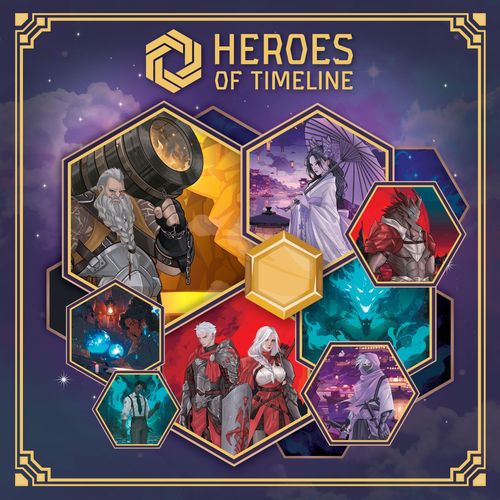
Heroes of Timeline
Heroes of Timeline Rulebook
Table of Contents
Table of Contents
- Overview
- Box Contents
- Teams
- Pre-game: Cards
- Pre-game: Bases Assembly
- Pre-game: Team Assembly
- Pre-game: Board
- Deployment: Walls
- Deployment: Heroes
- Battle: Turns
- Battle: Pre-Turn Abilities
- Battle: Activations
- Battle: Movement
- Battle: Ranged Attacks
- Battle: Melee Attacks
- Battle: Armor
- Battle: Abilities
- Battle: Team Skills
- Battle: Reflex Move
- Battle: Turn End
- Battle: Börd's Punishments
- Winning
- Frequently Overlooked Rules
Overview
Each game of Heroes of Timeline is a battle between two Teams of Heroes. It can be as quick as 15 minutes, and every move can define the outcome.
Victory can be achieved in two ways. You can secure a victory by eliminating all enemy Heroes before the end of Turn 5. Otherwise, at the end of Turn 5, a Player who dominated the battlefield for more Turns is victorious.
Each game can be divided into the following phases:
- Pre-game: select your Teams, set the Board, and put on the Armor Tokens.
- Deployment: build the defenses by setting up the Walls and position your Heroes in the Deployment Zones.
- Battle: lead your Teams into the battle, maneuver and attack with your Heroes, and take advantage of their unique Skills and Abilities in a turn-based combat.
Box Contents
- Game board
- Rulebook
- Turn Counter
- 18x Wall Tokens
- 10x Hero bases
- 16x Hero portraits
- 16x Hero cards
- 8x Team cards
- 32x Regular Armor tokens
- 16x Superior Armor tokens
- 2x Punishment Tokens
- 4x Skill/Ability Tokens
Teams
The first step of the game is selecting Teams to play with. Once you have played a few games, you will know the play style of each Team, and you will have your favorites. If it is your first game, just let your heart choose.
The Dragon Hunters
Dragon Hunters are the family of war heroes, coming from the time of humanity's struggle against the Dark Flame dragons.
Their strong sides are excellent armor and high characteristics of each Hero. This is compensated by a smaller number of Heroes in the Team.
Difficulty: easy
The Guards of Witgat
The Guards of Witgat are the ancestors of a mountain tribe that witnessed the Celestial Fall. They adapted to the cataclysmic changes that followed: they are stronger than ever, and their Alchemy knowledge is unparalleled.
It is the only Team capable of raising Walls mid game, but this is countered by the average characteristics of the Heroes.
Difficulty: medium
The Hidden Temple
The ninjas of the Hidden Temple are the anonymous protectors of the grand Gaang Port of the East, keeping the city safe from a threat of an invasion of the Deepsea Folk.
Their high maneuverability and far-reaching ranged attacks are compensated by the weak armor of the Heroes.
Difficulty: medium
The Institute
The mysterious Institute comes from a Point on the Timeline that is rich on anomalies and paradoxes. The Professor leads the research to tame these forces. It is the only Team to come to Börd's home, Origin of the Timeline, without an invitation.
Their reality-warping abilities are unique and unmatched, and they are the biggest Team in the game, although with the weakest Heroes.
Difficulty: hard
Pre-game: Cards
Once you have selected the Teams to play with, pick up the corresponding cards.
There are two types of cards in the game: Team Cards and Hero Cards.
Team Cards provide the characteristics of each Hero from this Team and their Hero Abilities, as well as description of the Team's Skill on the top.
The game comes with two Team Cards for every Team – one for each Player to reference during the battle.
Players also take one Hero Card for each Hero from their Team. Hero Cards show characteristics and skills of the Heroes:
- Hero's Portrait
- Team
- Hero's Name
- Hero's Ability
- Movement range
- Ranged attack distance
- Sides with Regular Armor
- Sides with Superior Armor
Pre-game: Bases Assembly
If it is the first time you're playing, an assembly of bases will be needed. They consist of two plug in pieces.
Pre-game: Team Assembly
After you have picked the Team and gathered your cards, it's time to assemble your Hero Tokens. Take the Hero portraits of your Team, then a corresponding number of bases, and install the portraits on them. Also, now is the time to equip the Armor tokens (the armor rules are explained later).
- Installing character portraits on the bases: put the Portraits in the brackets on top of the base.
- Putting on armor tokens: simply plug them in between the top and bottom parts of the base.
- Your Heroes are ready: this is how a Hero with 3 Superior Armor tokens equipped looks like.
Pre-game: Board
With your Team ready to enter the battle, it is time to set up the Board, place the Wall tokens, and position your Heroes in the dedicated Deployment Zones.
The Board consists of hexagonal tiles, each representing a space for one Hero to occupy. Six sides of a hex tile are the different directions your Heroes can face. The arrow indicator on the Hero base shows the side your Hero faces.
Your Hero Token's base should be aligned with the tile sides to correctly indicate the side your Hero is facing.
Sector
The Board is divided into six Sectors. Controlling Sectors is key to the Domination type of victory (victory by winning Turns, will be described later).
The center of the board is the Key Tile. Like other tiles, a Hero can occupy or move through it. However, it also has unique features:
- it is not bound to any sector,
- occupying it by the end of the Turn means winning the Turn and getting closer to the Domination type of victory.
Deployment: Walls
Wall Tokens modify the battlefield and make each game unique. Heroes cannot walk through the Walls, so they affect all maneuvers in the game. Also, they can protect your Heroes from enemy attacks. Walls are placed between the sides of two tiles.
Once the Board is set, the next step is setting up the Walls. Start with determining who goes first:
- If one Team has more Heroes than the other, the Player with the bigger Team starts.
- Otherwise, toss a coin. (There are pros and cons of both being first and second.)
The Player who goes first starts setting up the Walls. Each player sets up a total of 6 Wall Tokens.
Players take turns and place 2 Wall tokens in each of 3 sectors that are closer to their starting side.
Order of Sectors is up to the Players.
Walls can be placed on Sector borders, but they cannot be placed closer than 2 tiles away from the Key Tile – as shown in the picture.
Deployment: Heroes
The last step in the Deployment phase is positioning your Heroes.
Players will deploy Heroes in two opposite Sectors.
Each player has a dedicated Deployment Zone. As shown in the picture, these zones are two lines in your starting sector furthest from the Key Tile.
The Player who goes first starts the positioning. This Player places one Hero from their Team on any tile in their Deployment Zone. Players then take turns and set up Heroes one by one. The flow of the setup is: one Hero from one Team, followed by one Hero from another Team.
Reposition: Teams may have number of Heroes differing by 2 or more. For example, in a game of 3 Heroes vs 5 Heroes, the Player with a smaller Team may reposition one of their Heroes. It is done before the Player with the larger Team places their last Hero.
(The printed example shows the positioning order for a 3-Hero Team against a 5-Hero Team, including the reposition step; the diagram is omitted here.)
Battle: Turns
Once all the Heroes of both Teams are positioned, it's time for the main action. The game lasts up to 5 Turns.
Each Turn lasts until every Hero has been activated.
Turns have following structure:
- (Optional) Pre-Turn Abilities – declaring the Team or Hero abilities that have "declare at Turn start" in the description.
- Activations – Players take turns and activate their Heroes, performing the Move-Turn-Attack Sequence.
- (Optional) Reflex move – Players with smaller Teams perform reflex moves with already activated Heroes.
Battle: Pre-Turn Abilities
Some Heroes and Teams possess abilities that are declared before the activations start. These abilities have "declare at Turn start" in their description, and the game features 4 Ability tokens to track that such abilities were declared and are active.
Ballista and Berserk have tokens to indicate that their skills were declared. The Institute and the Hidden Temple Teams also have Ability tokens.
Declaring Abilities before Turn One: After a Player deploys the last Hero, the other Player uses their Pre-Turn Abilities first, followed by the first Player.
Declaring before Turns Two, Three and Four: After one Player has activated last Hero in the preceding Turn and the Turn results have been determined, the other Player will declare their Pre-Turn Abilities, followed by the first Player.
Battle: Activations
After the last Player declared Pre-Turn Abilities, another Player selects and activates a Hero from their Team.
Players can activate their Heroes in any order, but Heroes are Activated only once per Turn. To keep track of Heroes that have already been activated, we recommend turning their cards over. (The printed example shows the Hero card of a not activated Hero and of an activated Hero side by side; the illustration is omitted here.)
The Move-Turn-Attack Sequence
The Activated Hero will perform the Move-Turn-Attack Sequence:
- Move a Hero up to their movement range.
- Turn them so they face the desired direction.
- Make a ranged or melee attack.
Some abilities can alter the Move-Turn-Attack Sequence, allowing for special actions. More on this in the following sections.
Battle: Movement
Each Hero has a designated movement range. The value on the Hero card shows the number of steps a Hero can take from their current tile to an adjacent one. Heroes cannot walk through Walls or through other Heroes.
Turning is a second part of Movement. After you have moved to the destination tile, you can turn your Hero to face any direction. Turning your Hero allows Players to direct their ranged or melee attacks, as well as to turn sides with better armor to counter potential attacks.
Golem's Hero card shows that he has a movement range of 3. He can move 3 steps from the starting tile in any direction. After a Hero moves, this Hero can turn to face any direction.
Battle: Ranged Attacks
After movement, each Hero can make either a ranged or a melee attack.
Almost all Heroes can make ranged attacks (poor Greg(?) is an exception). Ranged attacks come from the front side of your Hero. It is marked by the arrow indicator. The Hero Card shows the maximum distance of your Hero's ranged attack. These attacks do not penetrate through Walls or Heroes. However, ranged attacks can destroy Walls.
Golem's Hero card shows that the distance his ranged attacks cover is 4. A Hero with ranged attack distance of 4 can attack an enemy Hero that is 4 tiles away. Ranged attacks destroy Walls. On the picture in the source, Golem with a ranged attack distance of 4 destroys a Wall.
Battle: Melee Attacks
All Heroes can make melee attacks. To make a melee attack, a Hero must be able to reach the enemy Hero's tile in a movement phase.
A Hero on the left has the movement range of 3 and can reach the enemy Hero's tile. Melee attack is possible.
Once you confirmed a Hero can reach the enemy Hero's tile, the melee attack occurs in the following steps:
- The Hero moves to the tile that is adjacent to the enemy Hero's tile. The distance covered must be less than the Hero's movement range. In the example, Golem has the movement range of 3, but moves only 2 steps.
- The Hero turns to face the enemy Hero and attacks him.
- The attack hits the enemy Hero's side faced. Unless you attack the side with Superior Armor, enemy Hero is eliminated and removed from the Board.
- The attacking Hero occupies the eliminated Hero's tile, facing the same direction as before the attack.
Battle: Armor
If any attack hits the Hero's side without an Armor, the Hero is eliminated.
To be less vulnerable, Heroes use Armor. There are two types of Armor: Regular and Superior, and every Hero has a set amount of each type specified on the Hero Card.
You can place Armor to protect any side you choose, but not more than 1 token per side.
Regular Armor provides defense against ranged attacks. If a ranged attack hits Regular Armor, the Armor is destroyed (take the token off), but the Hero stays in the game. Melee attacks pierce through Regular Armor, and enemy Hero is eliminated.
Superior Armor is rare and provides defense even against melee attacks. If a ranged Attack hits Superior Armor, the Armor is downgraded to Regular Armor (change the token), and the Hero stays in the game. When a melee attack hits Superior Armor, this Armor is destroyed (take the token off), but the Hero stays in the game.
| Armor type | Ranged Attack effect | Melee Attack effect |
|---|---|---|
| No armor | Elimination | Elimination |
| Regular Armor | Armor destroyed | Elimination |
| Superior Armor | Armor downgraded | Armor destroyed |
Battle: Abilities
All Heroes in Heroes of Timeline have unique Abilities. Carefully studying the Abilities of your Heroes will help you use their strengths and counter your opponent's strategies.
For example, the Red Knight from the Dragon Hunters Team can walk through Walls, destroying them in the process. This also means that the Red Knight can execute a melee attack on an enemy Hero behind a Wall.
When the Lady from the Hidden Temple Team is activated, she can give up her attack. In exchange, she can turn every Hero in her current sector or one of the adjacent sectors. The turn is by 1 side of a hexagon, and the Hidden Temple player decides if it is a clockwise or a counterclockwise turn.
As the game is highly competitive, we foresee some disputes about Abilities (we had quite a few in the test plays). We decided to create a section with detailed explanations of Ability rules on our website: heroesoftimeline.com/pages/abilities
Battle: Team Skills
All Teams in Heroes of Timeline have unique Team skills. A good knowledge of the Team Skills will expand your strategic choices and allow you to foresee your opponent's plans. For example:
When declaring Pre-Turn Abilities, The Institute Player picks a Hero from their Team and grants him or her (or even Blob) the ability to walk through Walls and other Heroes. This ability must be declared before the Turn, and Skill Token is used to mark the chosen Hero.
The Guards of Witgat have the Wall Raisers Team skill. After any Hero from this Team moves and turns, this skill allows them to raise a Wall instead of attacking. The Wall can be raised on any side of a tile that is faced and is within the ranged attack distance. This includes the Key Tile and even the tiles behind Walls and Heroes.
A Guards of Witgat Hero with Range 4 can use the Team Skill and give up attack to place a Wall at any side of the highlighted tiles.
Battle: Reflex Move
When a Player has a smaller Team, or loses Heroes during a game, the regular one-by-one flow of Activations may be disrupted. To avoid this, Heroes from the smaller Teams are given the opportunity to perform a Reflex Move.
Remember: a Turn ends once all Heroes have been activated. Do not perform a Reflex move after that.
An illustration to the following example:
- Suppose there is a battle between a Smaller team consisting of 3 Heroes and a Bigger team consisting of 4 Heroes.
- During Turn 1 and 2 the Smaller team loses one Hero. At the beginning of Turn 3, the Smaller team has 2 Heroes left, while the Bigger team still has 4 Heroes.
- If the Smaller team is due to Activate first, their remaining Heroes will Activate first and third, while the Bigger team's Heroes will Activate second and fourth.
- The fifth Activation should belong to the Smaller team. But all remaining Heroes of this Team have already been Activated. In such case, the Player can perform a Reflex Move.
- A Reflex Move allows a Player to choose any of their Heroes on the Board and either:
- Move up to 1 tile and turn.
- Shoot in the direction they face.
Battle: Turn End
Once all Heroes in both Teams have been activated, the Turn ends.
One of the ways to win the game is to win more Turns. Once the Turn ends, the Turn Winner is determined:
- If a Hero from your Team occupies the Key Tile, you are the Turn Winner.
- If the Key Tile is not taken, the Player who controls more Sectors wins. You control a Sector if only Heroes from your Team are in it.
- If the Key Tile is not occupied and the Players control same number of Sectors, it's a Stalemate. This Turn has no Winner.
Domination Points are earned by winning the Turns. If you are the Turn Winner, you are awarded one Domination Point. Domination Points are key to the Domination type of victory. In case of a stalemate, neither Player receives a Domination point.
Battle: Börd's Punishments
The Player who lost the Turn suffers a Börd's Punishment. In case of a Stalemate, both Players suffer a Punishment. Punished Player(s) take a token for a Turn to mark their Punishment. The Punishments are:
- After Turn 1: -1 movement range in Turn 2 for all Heroes in your Team.
- After Turn 2: Heroes cannot use their Hero abilities in Turn 3, but Team skills can be used.
- After Turn 3: -1 ranged attack distance for Turn 4 for all Heroes in your Team.
- After Turn 4: All Armor of every Hero in your Team is downgraded (Superior to Regular, Regular to No armor).
The list of Börd's Punishments is also printed on the back of this Rulebook. For easy reference, we recommend keeping this list next to the Board during your games.
Winning
In Heroes of Timeline, victory can be achieved in two ways. The first one is:
- Total Elimination. Secure victory by eliminating all enemy Heroes from the battlefield.
If all enemy Heroes are eliminated before the end of Turn 5, the game ends and the Player who eliminated all enemy Heroes is victorious. Otherwise:
- Domination Victory. Earn more Domination Points than your opponent.
Domination Points are earned by winning the Turns. If you are the Turn Winner, you are awarded one Domination Point. In case of a stalemate, neither Player receives a Domination point. The Player with more Domination Points by the end of Turn 5 is victorious.
Frequently Overlooked Rules
- Move-Turn-Attack: Do not turn the activated Hero after an attack, either melee or ranged, unless the Hero has an ability that allows that.
- Reflex Move: If you have two or more Reflex Moves in one Turn, you can select same Hero to perform these Reflex Moves.
- Turn End and Reflex Move: Do not perform Reflex Move after all Heroes of both Teams have been activated.
- Winning a Turn: if by the end of a Turn your Hero occupies the Key Tile, you are the Turn Winner. Count the controlled Sectors only if the Key Tile is not occupied.
- Chain eliminations: Ronin from The Hidden Temple Team and Drakkar from The Dragon Hunters Team both have abilities that allow them to move after they eliminate a Hero with a melee attack. If they can reach another enemy Hero, they can use these abilities to perform one more melee attack. If this attack leads to an elimination, they can use the ability to move again, but they can not make a third elimination.