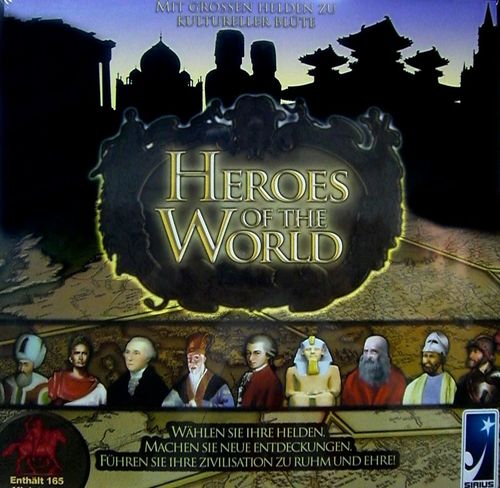
Heroes of the World
Heroes of the World Rulebook
Table of Contents
Table of Contents
- Components
- Who Wins?
- Who Are the Heroes? What Are Progress and the Wonders of the World? Where Are the Areas Located?
- How Do You Play?
- This Is How a Player's Turn Works
- What Can Be Done With a Hero Card
- Ending Antiquity
- Preparing for the Modern Age
- Ending the Game
- Special Rules for the Game With 2 Players
- Wonders of the World Cards
- Results of the Dice of Conquest
- Progress Lists
- Notes on the Source
Components
When you open the box you will find:
- 1 board with 9 areas in two different colors. In ancient times, it is played only with the 5 beige areas. In the Modern Age the 4 orange areas are also used. In each area of Antiquity there are 3 progress boxes, in each of the Modern Age, 4: during the course of the game the Progress will be placed here. Around the board is the victory points counter, on which players score their civilization points.
- 125 population figures in 5 different colors.
- 40 rider figures in 5 different colors. One rider equals 5 population figures.
- 9 Wonders of the World cards in two different colors for each era.
- 76 Hero Cards.
- 53 Progress.
- 1 screen bag.
- 1 given of conquest. (Printed as "given of conquest" in the source; presumably the conquest die.)
- 1 summary of the effects of the conquest die.
- 60 coins.
"Heroes of the World" is a family game for:
- 3 to 5 players
- from 10 years onwards
- about 75 minutes long
Who Wins?
The game ends after 8 area valuations in the Modern Age. The player with the most civilization points wins.
Who Are the Heroes? What Are Progress and the Wonders of the World? Where Are the Areas Located?
Structure of a Hero Card
- Image of the hero.
- The time in which he lived.
- Your name, title, and date of birth and death.
- Its population value, from 0 to 7.
- Your progress value, from 1 to 3.
- Its conquest value, from 0 to 4.
- Its treasure value, from 0 to 5.
- The background color symbolizes the alignment of the heroes. Red for the conquerors, blue for the discoverers and green for a mixture of both.
- Your area of influence.
Structure of Progress
- Progress name.
- The time when progress was made: beige for Antiquity, orange for the Modern Age. (The source reads "naranja", the Spanish word for orange.)
- Its value in civilization points, from 0 to 4.
Structure of a Wonder of the World
- The name of the wonder.
- The increase in civilization points that wonder brings to its buyer.
- The time when the wonder was erected: beige for Antiquity, orange for the Modern Age.
- The Skill of Wonder.
- Image of the wonder.
How Do You Play?
Setup
- Place the board in the center of the table.
- Each player receives 25 population figures and 8 riders of one color.
- Each player places a population token in box 0 of the points counter to mark their civilization points.
- Progress is sorted by color.
- The beige progress of Antiquity gets into the cloth bag. The orange progresses of the Modern Age will be used in the second epoch of the game.
- Each player receives 1 coin. The rest of the coins are left next to the board as a reserve.
- Hero cards are classified according to their color and separated. Beige cards from the Ancient Age are placed next to the board forming a deck. The orange cards of the Modern Age will be used in the second epoch of the game.
- Each player receives two cards from beige heroes upside down.
- The top three cards in the deck are discovered and left next to the board.
- Each player takes 7 population figures in his hand.
- Starting with the oldest player and continuing clockwise, each player places 1 Population figure in one of the beige areas of their choice, until all players have placed their 7 figures.
The game continues clockwise. The oldest player is the starting player.
This Is How a Player's Turn Works
1. Choose a New Hero Card
- The player chooses either one of the 3 hero cards displayed face up, or draws the top card from the reserve deck.
- The player now has 3 hero cards in his hand.
2. Play a Hero Card Hand in Hand
- The player plays a hero card from his hand, so that all other players can see it.
- The letter indicates the areas in which this hero can have influence. Only in them can the player place population figures or progress with this card, and only in them can he initiate conquests.
Continuation of the Shift
- The player now performs actions on the board based on the value of the hero card.
- Actions are executed on the board always from top to bottom.
- Actions with values of 0 are ignored.
- The player uses the number of figures corresponding to the hero's population value.
- Then place progress according to the hero's progress value.
- The player can then initiate a conquest using their hero's conquest value.
- Finally, the player uses the hero's treasure value to take the corresponding coins from the reserve and can spend them.
This order must be respected during shifts.
What Can Be Done With a Hero Card
Use Population Figures
As many figures are received as the hero's population value. These can be used as desired within the hero's areas of influence.
Example: Charles the Great divides his figures between Europe and the Mediterranean. The blue player decides to use 3 figures in Europe and 1 in the Mediterranean.
Take Progress and Place It
Appropriate progress is taken out of the bag. The player must place them in any empty progress box within the hero's areas of influence. Attention! You don't need to have figures in this area and you can only place one progress per area during one shift. If you can't place all the progress because all the boxes are already full, the player decides which ones to place. The progress that remains is returned to the stock market.
You don't need to have figures in an area to place progress in it.
Example: Charles the Great allows the blue player 1 progress. Take out the progress "Teaching" and decide to put it in Europe to complete all the boxes and go on to score the area.
Assessment of the Areas
- When the progress boxes of an area are completed during a player's turn by occupying the last empty square of the area, it is immediately passed to the area score.
The score:
- Only the 3 players with the most figures in the area get civilization points for it and move their figures on the counter appropriately.
- The player with the most figures receives the sum of the civilization points from all the progress boxes in the area.
- The second player with the most figures receives half of the total sum of civilization points (rounded up).
- The third player with the most figures receives civilization points from progress with less area value. This can be 0!
When more than one player ties in most figures, players add up the progress value of the cards they have played in front of them. The player with the highest result wins the tie. If the tie persists, it is decided based on the number of heroes used by players with a progress value greater than 0. If this still does not decide the tiebreaker, it is determined in the counterclockwise order, starting from the active player as the best.
(The source says "When more than one player draws in most figures"; "draws" is read as "ties" here, as the rest of the paragraph makes clear.)
Example: The blue player places "Teaching" and completes the Progress boxes for Europe. These add up to a total of 12 points (Banks 4, Physics 3, Painting 3, Teaching 2). All players with figures in Europe count them: the blue player has 15 figures, green 12, red 8 and yellow 4. The blue player has the most and gets 12 civilization points. Green is in second place and gets half the points, 6. In third place is the red player, who gets the points of the Progress of less value, the Teaching, of 2 points.
A punctuated area and its figures remain in play! (As printed; "punctuated" is most likely a translation of "valued" (scored) — the area is scored, and its figures stay on the board.)
Procedure in a Conquest
A conquest can only be made when the conquest value of a hero card is greater than 0. However, you can usually give up a conquest. A conquest can only be made in the hero's areas of influence where he has at least one figure. This player becomes the conqueror and chooses an area in which an opponent has at least one figure. This becomes the defender.
The die is then rolled to determine the results of the conquest. The results of the die are summarized on the card.
Conquest is only possible if the hero's conquest value is greater than 0. A conquest can only take place in the hero's areas of influence, and the conqueror must have at least one figure.
Example: The blue player wants to try to conquer the Mediterranean with Charles the Great. It has 6 figures in the area, and it attacks the green, which has 9. The blue player rolls the die and the result is "Victorious Offense". Eliminate 6 figures of the green player (the conquest value of Charles the Great +2 for the Modern Age). The green player now has 3 figures in the Mediterranean and the blue 6, majority.
(Note: the example's "+2 for the Modern Age" is printed in an Antiquity example; the rule text on the die results gives Antiquity casualties as conquest value +1, so the example as printed is inconsistent with that, and is transcribed as printed.)
Coins Received and Expenses
Coins are obtained according to the treasure value of the hero. However, they can only be spent during this phase of your shift for one of the following three actions:
It is not possible to spend the gold before this phase!
- Migration – Cost: 2 coins. The player can move 4 of their figures to an adjacent territory. Two areas are considered adjacent if they share a common border.
Example: Europe borders America, for example, and America borders the areas on the other side (Russia and Southeast Asia/Pacific).
Example: The blue player does not get any coins from Charles the Great, since his treasure value is 0. However, he has 3 coins left and decides to spend 2 to move 4 figures from Europe to the Mediterranean and America.
- Build a Wonder of the World – Cost: 7 coins. The player can build one or more wonders of the world, which provide him with civilization points and special abilities. In ancient times, beige wonders can be built that have not yet been selected; in the Modern Age, orange wonders. By building a wonder, 3 civilization points are immediately obtained. He then puts the letter in front of him, so that it is clearly seen. The wonder skill can be used once per era, at the time specified in the letter. Once the skill is used, the card is turned over. As many wonders as money allows can be erected. A wonder cannot be stolen or destroyed by other players.
- Buy civilization points: you can buy a civilization point for two coins. This can be done as many times as you want.
When the hero has performed all the actions, the player re-completes the 3 cards exposed face up by pulling out of the deck. Then it's the turn of the player on his left. The game continues in this way until the end of the Ancient Era.
Ending Antiquity
Antiquity ends when 4 valuations are carried out.
If a player manages during his turn to complete the progress boxes of the last two beige areas, he decides which of them is valued. The other is not valued, and the game passes into the Modern Age.
Example: After the 4th score, the Modern Age begins. At the end of Antiquity the green player has achieved 22 civilization points, blue 19, red 15 and yellow 13.
Preparing for the Modern Age
- Leave in each beige area the progress with the highest value. The rest of the progress is withdrawn from the game. This rule also applies to the fifth area, which was left unevaluated, provided that at least progress was placed on it.
- Beige progress is removed from the bag and set aside, as it will no longer be needed for the rest of the game. Orange progress is now being put in the bag.
- The wonders of the world used during Antiquity are turned upside down. Their skills are again available to their builders.
- The heroes played stay in front of the players. The other cards of beige heroes – cards in hand, the 3 exposed and the deck – are no longer necessary for the rest of the game and are withdrawn.
- Orange hero cards are left forming a reserve deck next to the board.
- Each player receives two cards from orange heroes upside down.
- The top three cards in the deck are discovered and left next to the board.
- Each player takes 7 population figures in his hand.
- Starting with the player whose turn it is and following clockwise, each player places 1 Population figure in one of the orange areas of their choice, until all players have placed their 7 figures.
Starting with the active player, the game continues into the Modern Age. The same rules apply as in Antiquity, but it is played now with all areas of the game!
Ending the Game
The game ends when 8 evaluations are carried out.
If a player completes the antepenultimate area of the Modern Age, it is evaluated and the game ends. If a player manages during his turn to complete the progress boxes of the last two areas, he decides which of them is valued. The last area is not valued, and the game passes. The player with the most civilization points wins.
Example: At the end of the Modern Age, the red player has achieved 52 civilization points, blue 47, green 45 and yellow 29. The red player wins the game.
Special Rules for the Game With 2 Players
- Each player chooses 2 colors for their civilization, so that they have enough figures.
- When an area is valued, the third place is ignored.
- The world wonder card "Caves of Ajanta" allows the player, however, to earn points as if they had come in third place.
- The world wonder card "Great Lighthouse of Alexandria" is not used.
Wonders of the World Cards
(Card names are given as printed, with the source's German and Spanish names in parentheses where the source gives them.)
Ajanta-Höhlen (Cuevas de Ajanta)
- In an area assessment of your choice, you get as many points as if you had been in 3rd place.
- You don't need to have figures in that area.
Great Wall of China (Muralla china)
- Remove up to 3 figures from any player in an area of your choice.
- You don't need to have figures in that area.
- You must play it during your turn.
Great Lighthouse of Alexandria (Großer Leuchtturm...)
(The source prints the German name as "GroBer Leuchtturm..."; the English name is the one the source gives in parentheses.)
- Take 3 coins from another player(s) of your choice.
- You must play it during your turn.
Hängende Gärten... (Hanging Gardens of Babylon)
- You ignore the casualties of figures that you could suffer for the die of conquest, whether you are a conqueror or a defender.
- The letters "Chinese Wall" and "Tenochtitlan" have no effect.
(As printed. The source's "letters" refers to the wonder-card letters on the card and is kept as printed; the sentence appears to refer to other wonder cards named in the source, and is transcribed without correction.)
Kremlin (Kremlin)
- Place 5 figures in any area of your choice where you already have figures.
- You must play it during your turn.
Moais
- Move as many figures as you want from one area to an adjacent area.
- You must play it during your turn.
(The source says "shapes"; read as "figures".)
Parthenon
- Change a progress from one area of your choice to another of your choice.
- You must play it during your turn.
Schloss Versailles (Palace of Versailles)
- Exchange as many coins as you want for one civilization point each.
- You must play it during your turn.
Tenochtitlan
- Remove up to 6 figures of another player from an area of your choice.
- You don't need to have figures in that area.
- You must play it during your turn.
Results of the Dice of Conquest
Victorious Offensive
- The defender loses figures, removes them from the area and returns them to his reserve.
- Casualties in Antiquity = hero conquest value +1.
- Casualties in the Modern Age = hero conquest value +2.
Deserters
- The conqueror changes population figures of the defender for his own. The defender returns his changed figures to the reserve.
- In ancient times, the conqueror changes a figure of the defender.
- In the Modern Age, the conqueror changes two figures of the defender.
Escape
- The conqueror moves figures of the defender to an area adjacent to his choice according to the conquest value of the hero. During Antiquity, the conqueror cannot move figures to an area of the Modern Age.
Looting
- The conqueror takes coins from the defender according to the conquest value of his hero. If the defender does not have enough coins, the conqueror takes them from the reserve.
Counterattack
- The conqueror and defender remove as many figures from the area as the hero's conquest value and return them to their reserves. Both can lose at most all the figures they had in the area.
Resistance
- The conqueror loses as many figures from the area as the hero's conquest value. You can lose at most all the figures they had in the area.
Progress Lists
The source gives each progress with its name in two languages as printed (the first and second names separated by a colon). Only the names are transcribed here; the source's own mistranslations are kept as printed and are flagged in the notes below.
Progress of Antiquity
- Architecture: Arquitectura
- Astronomy: Astronomy
- Befestigugsbau: Fortifications
- Mining: Minería
- Democracy: Democracia
- Epidemics: Epidemic
- Earthquake: Terremoto
- Handel: Trade
- Kriegskunst: Military technique
- Agriculture: Agricultura
- Mathematics: Matemáticas
- Medicine: Medicina
- Metallurgy: Metalurgia
- Musik: Music
- Philosophie: Philosophy
- Revoltuion: Revolution
- Font: Escritura
- Road construction: Carreteras
- Theater: Teatro
- Theology: Teología
- Pottery: Alfarería
- Currency: Moneda
- Weaving: Telar
Progress of the Modern Age
- Aktienhandel: Bag
- Alchemie: Alchemy
- Bankenwesen: Banks
- Bibliothekwesen: Librarianship
- Civil War: Guerra civil
- Dampfmaschine: Steam engine
- Die Pest: The Over
- Druckpresse: Printing
- Electricity: Electricidad
- Encyclopedia: Enciclopedia
- Impflung: Vaccine
- Industries: Industry
- Sewerage: Canalización
- Kartografie: Cartography
- Kompass: Compass
- Literature: Literature
- Painting: Pintura
- Mäzenatentum: Patronage
- Metrisches System: Metric system
- Monarchie: Monarchy
- Mill: Molino
- Navigation: Navigation
- Perspektive: Perspective
- Plough: Arado
- Physik: Physics
- Republik: Republic
- Schulwessen: Teaching
- Schusswaffen: Firearms
- Slavery: Esclavitud
Notes on the Source
- The source is a machine translation, and some names are wrong or left in German or Spanish. Examples: "Aktienhandel: Bag" (the German word means stock trading), "Die Pest: The Over" (the plague), "Befestigugsbau" (fortifications), "Revoltuion" (revolution), "Font: Escritura" (writing).
- "Teaching" appears in the rule examples as the progress name; in the Modern Age list it is the second name for "Schulwessen". Example names are transcribed as printed.
- The source's Antiquity conquest example uses a Modern Age bonus (+2); this is transcribed as printed.
- Anyone checking this transcription against a physical copy should treat the Spanish and German labels above as unverified.