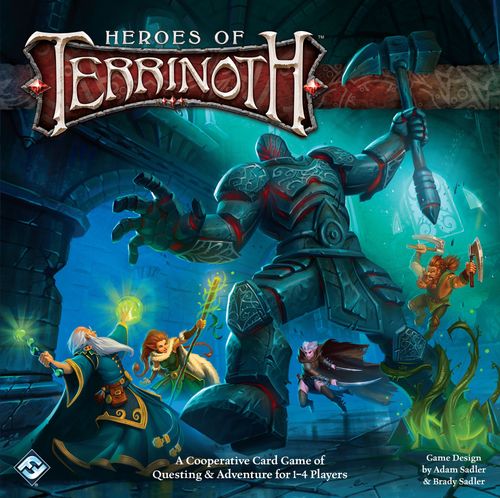
Heroes of Terrinoth
Heroes of Terrinoth Rulebook
Table of Contents
Table of Contents
- Game Overview
- Game Objective
- Components
- Setup
- Basic Concepts
- Playing the Game
- Additional Rules
- Quest Sheets
- Exploration Cards
- Party Leader
- Conditions
- Claim
- Discard
- Upgrading Heroes
- Hero Count
- Difficulty Rating
- Additional Setup
- Rules Clarifications
- Quick Reference
Game Overview
Heroes of Terrinoth is a cooperative game in which one to four players control a party of heroes working together to complete a series of quests set amid the Runebound universe.
This game features eight quests. In each game, the party chooses a single quest to undertake. During quests, heroes increase in power as they find equipment and gain abilities necessary to overcome the challenges they will face.
Game Objective
At the start of each game of Heroes of Terrinoth, players choose a quest to play, which may involve saving townsfolk, slaying a powerful monster, or recovering a valuable artifact. Each quest has a corresponding quest sheet which describes setup, special rules, and the heroes' objective.
Components
- 8 Quest Sheets (double-sided)
- 6 Dice (3 hero, 3 enemy)
- 1 Party Leader Token
- 1 Peril Token
- 23 Success Tokens
- 14 Progress Tokens (double-sided)
- 40 Wound Tokens (double-sided)
- 12 Hero Cards
- 48 Activation Cards (16 basic cards and 8 classes, 4 cards per class)
- 65 Enemy Cards
- 26 Location Cards
- 4 Reference Cards
- 12 Condition Cards (3 types, 4 cards per type)
- 37 Exploration Cards
- 5 Hero Count Cards
Setup
-
Choose Quest: Players choose a quest by randomly selecting a quest sheet or agreeing to play a specific quest as a group. It is recommended that new players begin by playing "The Goblin Problem."
-
Create Enemy Deck: Shuffle the enemy cards into one or more stacks as specified by the quest sheet. After shuffling the stacks, place them on top of each other in the order shown on the quest sheet.
Enemy cards are added to stacks in sets. Each enemy set has three cards with the same name: two minions and one, more powerful master. Always add all three cards to the enemy deck. Return all other enemy cards to the game box.
-
Create Location Deck: Shuffle the location cards into one or more stacks as specified on the back of the quest sheet. After shuffling each stack, place them on top of each other in the order shown on the quest sheet. Unlike enemy cards, location decks do not have sets; each location card is unique. Return unused location cards to the game box.
-
Create Exploration Deck: Shuffle the exploration cards into one or more stacks as specified on the back of the quest sheet. After shuffling each stack, place them on top of each other in the order shown on the quest sheet. Exploration cards are divided into a base set of 12 cards and additional sets of 5 cards each. Each card has the name of the set to which it belongs in the colored banner on the card. Return unused exploration cards to the game box.
-
Prepare Nemesis: Each quest has a banner with the name of the quest's Nemesis—a powerful foe the heroes must face. Take the Nemesis enemy card that matches the nemesis banner and place it near the quest sheet. This is the nemesis lair.
-
Place Quest and Peril Token: Read "The Story So Far..." on the back of the quest sheet. Then, place the quest sheet faceup in the center of the play area. Place the peril token on the start space of the peril track and place the enemy, location, and exploration decks near the quest sheet.
-
Create Supply: Separate the wound tokens, success tokens, progress tokens, and condition cards, placing them and all dice in piles in reach of all players. This is the supply.
-
Choose Heroes: Each player chooses one of the four available hero types—Healer, Mage, Scout, or Warrior—and collects the hero cards and activation cards for that hero type. Each player chooses one of those hero cards and places that card and hero archetype's four basic activation cards faceup in front of them. This is their play area. Return unused heroes to the game box.
-
Choose Party Leader and Distribute Player Count Cards: Players choose one player to be the party leader. That player receives the party leader token and takes the first turn when the game begins. Then, if there are fewer than four players in the game, each hero also takes a player count card matching the number of players in the game.
Basic Concepts
This section contains the basic concepts for Heroes of Terrinoth that players need to understand before learning how to play the game.
Heroes
Each hero is represented by a hero card that contains that hero's name, maximum health, and unique ability.
Each hero belongs to one of four archetypes that is represented on their hero card by one of the following icons: Healer, Mage, Scout, Warrior.
Activation Cards
Each hero begins a game with four basic activation cards that correspond to their archetype. These cards represent a hero's skills and capabilities. During a game, each hero has chances to upgrade their basic activation cards to advanced versions.
Readied and Exhausted Cards
Cards enter play readied—positioned upright so that the ability text can be read. To use some card abilities, a hero must exhaust the card by rotating it 90 degrees. An exhausted card cannot be exhausted again until it is readied by a game step or card ability.
Enemies
Various game effects spawn enemies that are represented by enemy cards. While in play, each enemy is either engaged with a hero or in the shadows.
Engaged
Heroes, enemies, and other effects can cause an enemy to become engaged with a hero. When this happens, the enemy card is placed in front of that hero.
Enemies engaged with a hero pose a threat to that hero.
Shadows
Enemies who are not engaged with a hero are in the shadows. If an enemy is in the shadows, it is in the center of the play area and is not engaged with any heroes.
Unlike enemies engaged with heroes, enemies in the shadows may be facedown, hiding their identities and information from the party until they join the fight.
Playing the Game
Heroes of Terrinoth is played over a series of rounds. Each round has four phases, during which the heroes perform actions, enemies attack, peril effects cause chaos, and the party moves between locations. During a round, the heroes resolve the phases in the following order:
- Hero Phase
- Enemy Phase
- Peril Phase
- Travel Phase
After resolving these phases, the next round begins, starting with the hero phase.
Hero Phase
Starting with the party leader and proceeding clockwise, each hero activates. When a hero activates, they choose one of their readied activation cards, exhaust it, and resolve each effect on that card from top to bottom. The hero who is currently activating is called the active hero.
Actions
The most important effect on an activation card is its action, which appears both as one of the card's text effects and as an icon in the upper-left corner of the card. An action allows a hero to roll dice to achieve a specific effect. There are four different actions in the game: Attack, Explore, Rest, and Aid.
When resolving an action, the active hero performs the following steps in order:
-
Roll Dice: The hero rolls a number of white hero dice equal to the number of dice icons shown next to the action.
At the same time, the hero rolls one black enemy die for each readied enemy engaged with them.
-
Resolve Hero Dice: The hero resolves the results on their hero dice. Hero dice have three results: successes (success), critical successes (critical success), and defense (defense).
- Successes add one success to the action. Successes have different effects for each action. These effects are described later.
- Critical Successes add one success to the action. Then, each die showing a critical success is rolled again and the new results are resolved as well.
- Defenses do not have an inherent effect, but reduce the impact of enemy counterattacks.
-
Resolve Enemy Dice: The hero resolves the results on their enemy dice. Enemy dice have two results: counterattacks and threats.
-
Counterattacks trigger enemy counterattacks. For each counterattack result, the active hero chooses one readied enemy engaged with them with which to counterattack. The active hero must choose the readied enemy with the highest attack value that has not already been chosen to counterattack.
The hero suffers a number of wounds equal to the enemy attack values of all counterattacking enemies. However, for each defense in the action's results, they can reduce the amount of wounds they suffer by one. Wounds are described in detail later.
-
Threats activate special threat effects that some powerful foes and quests possess. A threat effect is the text next to a threat symbol. If one or more threat results are rolled, the active hero resolves all threat effects on quest sheets, faceup cards in play, and faceup cards in the nemesis lair.
-
-
Cleanup: The hero checks if any heroes or enemies have been defeated during the action. A hero or enemy is defeated when it has wound tokens on its card equal to or greater than its health. The consequences of being defeated are explained later.
Resolving Successes
When resolving an action, a hero is attempting to produce as many successes as possible. The effect of successes depends on the action being resolved, as described below.
Attack
Heroes use attack actions to defeat enemies. Before rolling dice for an attack action, the hero chooses one enemy engaged with them. This enemy is the target of the attack action. After rolling dice, the target suffers one wound for each success. Wounds are explained later.
Some enemies have resilience, representing armor or exceptional hardiness. When an enemy suffers wounds from an attack, that enemy reduces the number of wounds suffered by its resilience.
Some effects allow a hero to target more than one enemy before their attack. When resolving an attack against multiple targets, after rolling dice, the hero divides the successes among the targets.
Ranged Attacks: Ranged attacks are a special kind of attack action. While resolving a ranged attack, the hero can choose any enemy in play as the target of the attack, including those engaged with them, those engaged with other heroes, and those in the shadows.
When a facedown enemy would suffer wounds, it is flipped faceup. Then, it suffers wounds normally.
Explore
Heroes use explore actions to reach new locations. Location cards represent the places the party visits during a quest. The location that is currently faceup is referred to as the active location.
For each success during an explore action, the hero places one progress token on the active location.
Each location card has an exploration value in the lower-right corner of the card. When there are progress tokens equal to or greater than this value on the location card, the location is fully explored. When the active location is fully explored, the party has the opportunity to travel to a new location during the Travel Phase.
Rest
Heroes use rest actions to recover from damage. For each success during a rest action, the hero recovers one wound, removing the wound token from their hero card and returning it to the supply.
Aid
Heroes use aid actions to help other heroes. Before rolling dice for the aid action, the hero chooses another hero. This hero is the target of the aid action. For each success, the chosen hero claims one success token, placing it in their play area. A hero can have up to five success tokens in their play area.
Readying Activation Cards
A hero's activation card is exhausted when used. Until that card is readied, the hero cannot choose to use it when they activate.
There are several methods by which a hero can ready activation cards:
- Each hero's activation card that has the rest action also has an effect that readies all of their activation cards (including itself).
- Many activation cards that have the aid action also have an effect that allows the target of the aid action to ready one activation card.
- The effects of some exploration cards, location cards, and quests allow heroes to ready activation cards.
- At the start of a hero's activation, if all four of their activation cards are exhausted, that hero suffers 2 wounds and readies all of their activation cards.
Enemy Phase
During the enemy phase, each readied enemy activates.
When an enemy activates, it may move to a different position, attack a hero, or resolve other dangerous effects. After an enemy activates, its card is exhausted.
Choosing Enemies
Starting with the party leader and proceeding clockwise, each player chooses and activates one enemy. Players continue taking turns activating enemies one at a time until all enemy cards are exhausted. While a hero is resolving an enemy activation, they are the active hero.
When choosing an enemy to activate, a hero must choose an enemy that is engaged with them, if possible. If there are none, or if all of them are already exhausted, the hero chooses an enemy in the shadows (faceup or facedown) instead. If the chosen enemy is facedown, it is flipped faceup and then activated.
Heroes cannot activate enemies engaged with another hero. If there are no readied enemies engaged with a hero or in the shadows, that hero does not activate an enemy.
Activating Enemies
Each enemy card has an effect bar that determines that enemy's behavior. Each effect bar contains one or more keywords, which are abbreviations for specific game effects.
When a hero activates an enemy, they resolve the keywords on its effect bar from left to right obeying the following rules:
- Unless otherwise specified, the target of the activation effects is the hero who is activating the enemy.
- When a facedown enemy in the shadows activates, it flips faceup before resolving anything on its effect bar. Flipping faceup does not automatically move it out of the shadows.
Basic Keywords
There are three basic keywords that appear on many enemy cards:
- Advance: The enemy becomes engaged with the active hero.
- Retreat: The enemy is placed faceup in the shadows.
- Inflict: The hero engaged with the enemy suffers a number of wounds equal to the enemy's attack value. If the enemy is in the shadows, the active hero suffers the wounds.
Unique Keywords
In addition to these basic keywords, many enemies have unique keywords such as "Swarm" or "Shield Bash." The effects for these keywords are described on the enemy card.
Passive Abilities
Some enemies also have abilities that are not associated with a unique keyword. These abilities are always in effect.
Readying Enemies
At the end of the enemy phase, after all enemies are exhausted—either by activating or already being exhausted earlier in the round—the party readies all enemies in play and proceeds to the peril phase.
Peril Phase
During the peril phase, the party increases peril by moving the peril token one space to the right on the quest sheet's peril track.
After moving the peril token to a new space, the party resolves any peril effects that match the color of that space on the peril track.
If the peril token moves to a gray space on the peril track, no peril effect is resolved that phase.
If the peril token is on the final, rightmost space of the track, each time peril would increase, it remains on the final space and the corresponding peril effect is resolved as if the token had just moved to that space.
The party leader is the active hero during the peril phase.
Travel Phase
During the travel phase, the party may travel if they have fully explored the location. If the party chooses not to travel, they proceed to the end of the round. The party cannot travel if there are no location cards remaining in the location deck.
The party leader is the active hero during the travel phase.
Traveling
When the party travels, they resolve the following in order:
-
The party leader discards the active location and any progress on it, as well as all enemies in the shadows (except those with the Nemesis trait, explained later).
-
The party leader may pass the party leader token to a different hero.
-
The party leader draws a new location card from the location deck, places it faceup in the play area, and spawns enemies based on the new location's spawn values.
Spawning Enemies After Traveling
After traveling to a new location, the party spawns enemies, one at a time, according to the two spawn values on the new location card:
Engaged: The spawn value on the red background indicates the total number of enemies which are spawned engaged with heroes.
Shadows: The spawn value on the blue background indicates how many enemies are spawned facedown in the shadows.
End of the Round
After all phases of the round are resolved, the party resolves any effects that occur "at the end of the round," such as the effects on some quests.
The party leader is the active hero while resolving end of round effects.
After all end of round effects have been resolved, the heroes start the next round with another hero phase.
Ending the Game
Each quest sheet describes how the party completes the quest. Game rounds continue until either the quest's "Victory" or "Defeat" criteria have been met.
When the party resolves the "Victory" or "Defeat" condition presented on the front side of the quest sheet, the party reads the "Victory" or "Defeat" section on the back of the quest sheet.
Additional Rules
In addition to the basics of the game round, there are a number of other rules the party needs to know in order to play the game.
Success Tokens
Before rolling dice for an action, a hero can spend up to two success tokens from their play area. For each token spent, they add one success to the results of the action.
A hero cannot have more than 5 success tokens in their play area at one time.
Spent tokens are returned to the supply.
Wounds
Many game effects cause heroes and enemies to suffer wounds. Wounds are represented by wound tokens. Each side of a wound token has a value on it, either "1" or "3." These values indicate the number of wounds the token represents.
Suffering Wounds
Each time a hero or enemy suffers a wound, a wound token is placed on that hero's or enemy's card.
When an enemy suffers wounds from an attack action, its resilience reduces the number of wounds it suffers. When an enemy suffers wounds from another source, such as an activation card effect, resilience does not apply.
If the value of wound tokens on a hero's or enemy's card meets or exceeds the health value on that card, that hero or enemy is defeated.
Recovering Wounds
Each time a hero or enemy recovers a wound, a wound token with the appropriate value is removed from that hero's or enemy's card and returned to the supply.
Defeated
A hero or enemy is defeated when the total value of the wound tokens on its card is equal to or greater than its health.
If a hero or enemy would be defeated while a hero is resolving an action, that hero or enemy is not defeated until step 4 of action resolution.
When an enemy is defeated, that enemy's card and any wound tokens on it are discarded.
When a hero is defeated, that hero is eliminated from the game using the following steps:
- Wound tokens on the hero's card and exploration cards and success tokens in the hero's play area are discarded.
- Enemies that are engaged with that hero are placed in the shadows.
- The hero's card is turned facedown.
Defeated heroes do not activate, cannot have enemies engaged with them, and cannot recover wounds. Surviving heroes may continue to try to complete the quest.
Engaging
Many game effects will cause an enemy to become engaged with a hero. When an enemy becomes engaged with a hero, that enemy is placed in front of that hero.
When a hero chooses an enemy to become engaged with them, they may choose an enemy engaged with another hero or in the shadows.
An enemy can only be engaged with one hero at a time. If an enemy engaged with a hero becomes engaged with another hero, it is no longer engaged with the first hero.
A hero cannot be engaged with more than three enemies at the same time. If a hero is engaged with three enemies and an effect causes a hero to become engaged with a fourth enemy, that hero suffers a number of wounds equal to that enemy's attack value and the enemy is placed faceup in the shadows.
Examples: Becoming Engaged
-
Kari Wraithstalker's "Piercing Strike" activation card allows her to become engaged with 1 enemy. She chooses the Bandit engaged with Elder Mok. The Bandit moves in front of Kari Wraithstalker and is no longer engaged with Elder Mok.
-
A Rat Swarm in the shadows becomes engaged with Kari Wraithstalker. Because Kari Wraithstalker already has 3 enemies engaged with her (one Bandit and two Cave Spiders), the Rat Swarm cannot become engaged with her. Instead, it returns to the shadows, and Kari Wraithstalker suffers 1 wound (for the Rat Swarm's attack value).
Spawning
Numerous game effects, particularly locations and perils, spawn enemies. When an enemy spawns, the party leader draws the top card of the enemy deck and places it into play.
Some spawn effects specify where an enemy should be placed, such as "in the shadows" or "engaged with the hero with the fewest wounds."
If the effect does not specify where the enemy should be placed, it becomes engaged with the active hero. If multiple enemies spawn from such an effect, they are placed one at a time. The first becomes engaged with the active hero, and each subsequent enemy becomes engaged with the next hero in clockwise order.
Unless otherwise specified, spawned enemies are always placed faceup.
Quest Sheets
In addition to the quest setup and peril effects, each quest has flavor text, special rules, and conditions for victory and defeat.
The Story So Far...
The back of each quest sheet has flavor text that should be read before each game to inform the party of their goals in the quest.
Special Rules
The front of each quest sheet has special rules in a quest rules box above the peril track. It is very important for the party to read these rules before beginning a quest.
Timing
If multiple abilities would occur at the same time, the active hero chooses the order in which the abilities are resolved.
Traits
All enemy and location cards have traits, such as Goblin or Dungeon, presented beneath their name. Most of these traits have no inherent effect, but are referred to by some game effects. The exception is Nemesis, which marks the enemy as a uniquely powerful foe and contains some special rules.
Nemesis
Enemies with the Nemesis trait are not shuffled into the enemy deck, but are instead placed next to the quest sheet in the nemesis lair. Nemeses follow the same rules as other enemies with the following exceptions:
- Heroes cannot target a Nemesis in the nemesis lair with any game effect unless the quest sheet specifies otherwise.
- A Nemesis in the nemesis lair does not activate during the enemy phase.
- When an effect spawns a Nemesis, the Nemesis is removed from the nemesis lair and put into play following the normal rules for spawning.
- Unlike other enemies in the shadows, Nemeses are not discarded when the party travels.
Exploration Cards
Some game effects, especially activation cards with the explore action, allow heroes to draw exploration cards from the exploration deck. There are two types of exploration cards: Items and Events.
Items
Items are objects that heroes find while exploring a location. Most items provide the heroes with helpful, single-use effects. When a hero resolves an item, they place it in their play area and can use it by following its instructions.
There is no limit to the number of items a hero can have in their play area at the same time.
Events
Events are either helpful or harmful occurrences. When a hero resolves an event, they read and resolve the effect. Then, they place that card in the exploration discard pile.
Party Leader
The party leader is the player with the party leader token. The party leader activates first each hero phase and many game effects require the party leader to make a decision.
The party leader is considered the active hero during the peril phase and the travel phase. When resolving game effects during those phases, if there are multiple equally valid outcomes, the party leader chooses the outcome.
When multiple heroes must resolve the same effect, they start with the party leader and proceed clockwise.
Conditions
There are three conditions, each of which applies an ongoing effect to a hero: Poisoned, Weakened, and Focused. When a hero receives a condition, they place the corresponding condition card in their play area.
Each condition card describes what that condition does and how it is removed. A hero cannot have more than one copy of the same condition card at once. If a hero would receive a second copy, they do not receive the condition.
Claim
When a hero claims a card or token, that hero places that card or token in their play area. While a card or token is in a hero's play area, that hero may use the card or token's game effects.
Discard
Each deck in the game has a discard pile. When an enemy, location, or exploration card is discarded (such as by defeating an enemy or using an exploration card's effect), it is placed in the appropriate discard pile.
If the enemy deck or exploration deck is ever expended, that deck's discard pile is shuffled to create a new deck.
When a token or condition card is discarded, it is returned to the appropriate supply.
Upgrading Heroes
Quest effects will give heroes the opportunity to improve their abilities to prepare for the coming challenges by upgrading their activation cards.
Advanced Activation Cards
Each hero starts a quest with a set of basic activation cards, one for each of the four actions. Each hero type also has several sets of advanced activation cards. The advanced versions of each activation card include the same action as the basic versions, but come with new, potent secondary effects.
Each advanced activation card belongs to a particular class, like Thief or Knight. A class represents a unique specialty the hero has developed over the course of their adventures, and each class has different strengths and weaknesses. When prompted by the current quest, each hero upgrades one basic activation card, replacing the card with its advanced version. The replaced card is returned to the game box.
If a hero does not yet have any advanced activation cards, they may choose one from any class belonging to their hero type. If a hero already has one or more advanced activation cards, they must choose an advanced activation card of the same class as those they already have.
Advanced activation cards enter play in the same state as the card they are replacing (ready or exhausted).
Hero Count
When playing with fewer than four heroes, each hero has additional health, and some heroes may activate more than once during each hero phase:
- Three Heroes: After all heroes have activated, the party leader chooses a hero to activate a second time. Each hero's maximum health is increased by 4.
- Two Heroes: Each hero activates twice, alternating their activations. Each hero's maximum health is increased by 10.
When playing with fewer than four heroes, each hero should take the hero count card corresponding to the number of heroes in play.
Solo Play
When playing Heroes of Terrinoth with one player, that player controls two heroes and uses the same rules as if they were playing a two-player game.
Difficulty Rating
Enemies and locations have a difficulty rating icon (Trivial, Challenging, or Formidable) in the upper-left corner of their cards.
These icons represent the increasing difficulty of enemies and locations. The difficulty rating is used during quest setup to add a number of random enemies and locations of the appropriate difficulty into each quest, and is referred to by some abilities.
Formidable is a higher difficulty than Challenging, and Challenging is a higher difficulty than Trivial.
Additional Setup
Each quest sheet in Heroes of Terrinoth includes instructions for setting up the enemy, location, and exploration decks for the quest. Some quests also have special setup instructions relating to the quest's unique rules.
Special Setup Rules
Some quests have special setup rules for one or more decks. Before setting up the decks for a quest, the party should read any special setup rules the quest has.
If a quest has special setup rules that contradict the normal rules for quest setup, the special setup rules take priority.
Randomization
Some quests include stacks in their deck setup with a number of unspecified groups, such as a stack in the enemy deck which calls for "2 Challenging Sets." When this occurs, after gathering all card sets specified by name in deck setup, randomly add the specified number of card sets to the stack from the remaining sets.
Quest-Specific Cards
Some enemy, location, and exploration cards have the quest-specific icon next to their name. These cards are unique to specific quests, do not belong to any sets, and are used only when specified by quest setup.
Rules Clarifications
This section contains clarifications for rare rules interactions. If players encounter a situation that was not addressed in the main rules, consult this section.
Golden Rules
- If there are multiple equally valid ways to resolve a card or quest effect, the party leader decides how to resolve the card or quest effect.
- If a card or quest contradicts this rulebook, the card takes precedence. If a card or quest uses the term "may," that effect is optional. If a card or quest uses the term "cannot," that effect is absolute and cannot be overridden.
- Wounds, success tokens, and progress are not limited to those provided in the game. If players need additional tokens, they can use coins or other suitable substitutes.
- If an effect causes a hero to recover damage, discard tokens, or exhaust activation cards, but the hero does not have enough to recover or discard, they recover or discard as much as possible.
Actions
- When a hero resolves an action, they must roll 1 enemy die for each ready enemy engaged with them. Enemy dice are not rolled for exhausted enemies engaged with them.
- If an effect allows a hero to reroll one or more dice, they may choose the same die for each reroll. If the effect does not specify hero or enemy dice, the hero can reroll either kind of die.
- A hero must resolve the action on their activation card.
Active Hero
- During the Hero Phase, the active hero is the hero currently resolving their activation.
- During the Enemy Phase, the active hero is the hero currently activating an enemy.
- During any other phase, the active hero is the party leader.
Difficulty Rating
- Enemies and locations which are Formidable have a higher difficulty than those which are Challenging, and those which are Challenging have a higher difficulty than those which are Trivial.
- When resolving effects that refer to the enemy with the "highest difficulty" or "lowest difficulty," enemies with the Nemesis trait are treated as higher difficulty than other enemies of the same difficulty level and enemies with the Master trait are treated as higher difficulty than enemies with the Minion trait of the same difficulty level.
Grim Rule — Players who wish to have the most challenging gameplay experience possible may choose to follow the Grim Rule. Under this rule, when resolving enemy activations, if there are multiple equally valid ways that an enemy can resolve a keyword, the heroes should choose to resolve it in the way that is most punishing to the heroes.
Enemy Dice
- When a counterattack is rolled, if there are multiple enemies that can counterattack with the same attack value, the enemy with the higher difficulty performs the counterattack. If there is still a tie, the party leader chooses.
- Exhausted enemies cannot counterattack.
- A faceup Nemesis can resolve a threat regardless of whether they are engaged with a hero, in the shadows, in the nemesis lair, exhausted, have counterattacked that action, etc.
Enemies
- If a card or quest effect targets an enemy, it can affect any enemy engaged with a hero or in the shadows. If a card or quest effect targets a specific name or trait, it can only affect an enemy with that name or trait.
Enemy Phase
- When an enemy activates, it only engages the active hero if its effect bar causes it to do so.
Engagement
- If an effect allows a hero to become engaged with an enemy, they may choose an enemy in the shadows or engaged with another hero. They may not choose an enemy that is already engaged with them.
- A hero may never have more than 3 enemies engaged with them at one time. When a fourth enemy engages a hero, it inflicts its damage on the hero then retreats to the shadows.
Locations
- Locations may have more progress on them than their exploration value.
Quick Reference
Phases
Each game round includes four phases that heroes resolve in the following order:
- Hero Phase — Heroes use activation cards to perform actions.
- Enemy Phase — Each ready enemy activates using its action bar.
- Peril Phase — The peril marker advances and any peril effects are resolved.
- Travel Phase — Location abilities occur and the party may travel to a new location.
Actions
Each activation card includes one of the following actions:
- Attack: For each success, the target enemy suffers 1 wound.
- Explore: For each success, add 1 progress to the active location.
- Rest: For each success, the active hero recovers 1 wound.
- Aid: For each success, the target hero claims 1 success token.
Enemy Keywords
Most keywords are defined directly on the enemy cards with the exception of those listed here:
- Inflict: The hero engaged with the enemy who is resolving the keyword suffers a number of wounds equal to that enemy's attack value. If the enemy is in the shadows, the active hero suffers the wounds.
- Advance: The enemy resolving the keyword engages the active hero.
- Retreat: The enemy resolving the keyword is placed in the shadows.
Symbols
Success, Critical Success, Defense, Counterattack, Threat, Success Token, Wound.
Difficulty
Formidable, Challenging, Trivial.