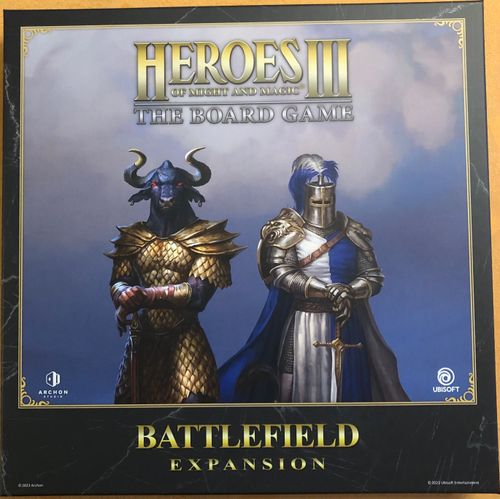
Heroes of Might and Magic III: The Board Game – Battlefield Expansion
Heroes of Might and Magic III: The Board Game – Battlefield Expansion Rulebook
Table of Contents
Table of Contents
Component List
- 1 × Rulebook
- 2 × Player's aid
- 1 × Battlefield board
- 1 × Initiative token
- 10 × Obstacle token (double-sided)
- 50 × Adventure card
- 10 × Positive Morale card
- 10 × Negative Morale card
Battlefield Setup
Adventure Mode
Follow these steps and prepare the required elements from the Core Game:
- Both players choose one of the available factions and take the following:
- a) 1 Hero card
- b) 1 Town board
- c) 7 Unit cards (double-sided)
- d) 7 Unit models
- e) 3 Hero-specific Specialty cards
- f) 1 Hero-specific Ability card
- g) 20 Faction cubes
- Prepare the Artifact, Spell, and Ability decks normally. Remove the following Ability cards from the play: "Diplomacy," "Logistics."
- Segregate the resource, Damage, and Paralysis/Defense tokens into piles.
- Prepare all Attack, Resource, and Treasure dice.
- Place a Black cube on the first space of the Round tracker (the space is represented by a "1").
- Place one of your faction cubes on the Level 1 space on your Hero card.
- Give each player the following starting resources: 15 Gold, 3 Building Materials, and 1 Valuable.
- Set your income to 10 Gold, 0 Building Materials, and 0 Valuables.
- Prepare the starting deck of Might and Magic (see page 9, Core Game Rulebook).
Follow these steps and prepare the required elements from the Battlefield expansion:
- Place the Battlefield board between players.
- Prepare the Adventure deck, as well as the Positive and Negative Morale decks.
- Prepare the Obstacle and Initiative tokens.
- Both players roll 2 Resource dice. The one with the highest result is the first player.
Skirmish Mode
Follow these steps and prepare the required elements from Core Game:
- Both players choose one of the available factions and take the following:
- a) 1 Hero card
- b) 7 Unit cards (double-sided)
- c) 7 Unit models
- d) 3 Hero-specific Specialty cards
- e) 1 Hero-specific Ability card
- f) 20 Faction cubes
- Prepare the Artifact, Spell, and Ability decks normally. Remove the following Ability cards from the play: "Diplomacy," "Logistics."
- Segregate the Damage and Paralysis/Defense tokens into piles within reach of both players.
- Prepare all Attack and Resource dice.
- Place one of your faction cubes on the Level 1 space on your Hero card.
- Prepare the starting deck of Might and Magic (see page 9, Core Game Rulebook).
Follow these steps and prepare the required elements from the Battlefield expansion:
- Place the Battlefield board between players.
- Prepare the Positive and Negative Morale decks.
- Prepare the Obstacle and Initiative tokens.
- Both players roll 2 Resource dice. The one with the highest result is the first player.
Morale Deck
In the Adventure and Skirmish modes, use the two Morale decks instead of the tokens from the Core Game. Shuffle them separately and place them near the Round tracker.
Positive Morale Card – 1. Name, 2. Effect, 3. Battlefield Symbol. Negative Morale Card – 1. Name, 2. Effect, 3. Battlefield Symbol.
Effect – Resolve it when the indicated condition is met. Battlefield Symbol – Remove or ignore the card with this symbol during the regular game.
Positive Morale Deck
Every time you gain Positive Morale, discard 1 Negative Morale card (if you have any); otherwise Search (2) from the Positive Morale deck. Place the newly gained card face-up near your Hero and put the remaining cards at the bottom of the Positive Morale deck. During an Adventure or Skirmish, you can have up to 2 Positive Morale cards simultaneously. You can use these cards at any moment to resolve their effects. Once you resolve a Positive Morale card, put it at the bottom of the Positive Morale deck.
Negative Morale Deck
If you gain a Negative Morale card, first, you have to discard a Positive Morale card for every Negative Morale card you must take. If you need to draw Negative Morale cards and have no Positive Morale cards to discard, draw them and place them face-up beside your Hero. You will resolve them when the situation indicated by the card occurs. Once you resolve a Negative Morale card, put it at the bottom of the Negative Morale deck. There is no limit to the number of these cards.
Adventure Mode
This is a competitive mode for two players (1 vs. 1), in which you use the Adventure cards to upgrade your decks, gain resources, upgrade armies, and much more. You can also control up to 7 units.
If you either have or draw a card (including a Hero's Specialty card) that gives resources or movement, or reduces costs, instead of putting it into your deck, place it near your Hero card. You can single-use it and then remove it from play. During Adventure, you gain Expert like in the Core Game but they are single-use. At the start of Combat on board, your Expert limit is renewed.
Choose the map size and game length:
- Small – The Adventure ends with the 9th round.
- Medium – The Adventure ends with the 13th round.
- Large – The Adventure ends with the 16th round.
Round Structure
At the start of each round, the starting player draws 3 Adventure cards, keeps one of them, and passes the remaining 2 to the enemy player, who keeps one of the cards and discards the other. Each player resolves their chosen card or saves it (on their Hero card) for later. If both players chose to resolve a card, the player who started this round resolves their card first. Place resolved cards near your Hero card. Then the round ends.
NOTE: During every round in the Adventure mode, you can use Town actions just as you would in a regular game.
NOTE: The odd rounds are started by the first player, and the even ones – by the second player.
After drawing the cards but before making your choice, you can use the Movement effect from one of the previously set-aside cards to shuffle any number of the cards you have just drawn back to the Adventure deck and draw that many cards. Although in this game mode your Hero does not have Movement as such, you can still use the Movement effect from some cards this way.
NOTE: Each player can save up to 1 card for later use. Place this card face-down on your Hero card. This card can be replaced with another Adventure card, discarded, or played.
In the last round, the players do not draw cards from the Adventure deck. They can still play their saved card or spend resources to upgrade buildings or armies. After the last round, perform Battlefield Combat.
Astrologers Rounds
In every Astrologers round, instead of drawing an Astrologers Proclaim card, the players choose one of the following:
- Increase your preferred income by 1 tier,
- Roll 1 Resource die and, based on the result, increase the income of the corresponding resource by 1 tier, and then gain the basic income for that resource, which is 5 for Gold, 2 for Building Materials, and 1 for Valuables.
NOTE: To increase the income by 1 tier, move the cube that marks the income to the next slot, just as if you obtained a new Mine.
Resolving Adventure Cards
Every Adventure card belongs to one of the following types: Combat or Event.
Adventure-Event Card – 1. Name, 2. Type, 3. Effect. Adventure-Combat Card – 4. Combat Power, 5. Battle Reward, 6. Basic Reward.
To resolve a Combat, check "Combat during Adventure." To resolve an Event, check "Event during Adventure."
Combat during Adventure
Choose one of the available Combat Powers from the card. Select 2 of your units, add their Attack Values, and roll 2 Attack dice. If your power total is equal to or greater than the power value of the battle you have chosen, take the Basic Reward and the Battle Reward for this Combat.
If your total power is lower than the Combat's power value, take the Basic Reward and put a Paralysis token on one of your units that took part in this Combat. This unit is stunned. If a stunned unit is chosen for Combat, do not add its Attack Value to your power; then remove the Paralysis token from this unit.
Event during Adventure
Resolve the effect of a chosen Adventure card.
NOTE: The effect of Event Obelisk cards grows stronger with every Obelisk card played.
Victory Condition
To achieve a victory, one of the players must defeat all the units deployed by the other player during the Battlefield Combat.
Battlefield Combat
In Adventure mode Battlefield Combat is triggered at the end of the last round, while in Skirmish mode it starts when the deck is ready.
NOTE: Remove all Paralysis tokens placed on your units during the Adventure rounds.
Draw Cards
This step is performed only in Adventure or Skirmish modes.
Draw cards from your deck up to your hand limit (see p. 12 in the Core Rulebook).
Place Obstacles
Obstacle tokens are double-sided and are divided into 3 types: Effect, Obstacle, and Wall/Gate. These tokens replace and work as Combat Obstacles from the Core Game (see page 30, Core Game Rulebook).
NOTE: All unit models also count as obstacles.
NOTE: To mark the effect of the "Fire Wall" spell, place the "Fire Wall" Effect Obstacle on an empty hex and place the "Fire Wall" Spell card next to the Battlefield board as a reminder.
Starting from the first player, both players take turns placing their chosen Obstacles on the Battlefield board. No Obstacle can be adjacent to another Obstacle or to any player's deployment zone.
NOTE: A deployment zone is the gray area where the players place their units on the battlefield.
Obstacles and models placed correctly are marked with the green border, and incorrectly – with the red one.
Place Units
Starting from the first player, the players take turns placing their units on the battlefield. When the last unit is placed, the Combat begins.
NOTE: The first player selects a deployment zone by placing their unit, and the other player places their units in the deployment zone on the opposite side of the battlefield.
Changes to Combat Rules
Unit Movement
Each unit's movement is equal to its initiative – a unit of initiative 8 can move up to 8 hexes. Once a unit's activation ends, mark it with your faction cube. The cubes are removed at the start of the next round.
Ranged Units
These units can either move or attack, and suffer a combat penalty when attacking an adjacent unit or a unit that is 8 or more hexes away from them.
The Deck of Might and Magic
The limit of Expert level cards you can play is per one Combat round, not for the whole Combat. At the end of the Combat round, each player draws 2 cards from their deck. Additionally, recover 1 Expert up to the Hero limit.
Initiative Token
At the start of Combat, the first player gains the Initiative token. Use it to break any initiative ties of opposing units (the player with the token acts first). Once all units with that initiative activate, pass the Initiative token to the other player.
NOTE: The rest of the Combat rules from the Core Game remain unchanged.
Skirmish Mode
Skip the Adventure part and – instead – use one of the pre-made templates to jump straight into battle.
Choose one of the scenarios and follow the instructions.
Large
Set your Hero level to 7. Create your starter deck and modify it in the following way:
- Add all Hero Specialty cards.
- Draw 6 random Ability cards, Remove 2 of them, and add the remaining cards to the deck.
- Draw 4 random Artifact cards, Remove 1 of them, and add the remaining cards to the deck.
- Draw 3 random Spell cards for a Might Hero or 5 Spell cards for a Magic Hero, and add them to the deck.
Shuffle your deck. Flip all of your 7 Unit cards to the "Pack" side, and follow the Battlefield Combat section.
Medium
Set your Hero level to 5. Create your starter deck and modify it in the following way:
- Add level I and level IV Hero Specialty cards.
- Draw 4 random Ability cards, Remove 1 of them, and add the remaining cards to the deck.
- Draw 3 random Artifact cards, Remove 1, and add the remaining cards to the deck.
- Draw 2 random Spell cards for a Might Hero or 4 Spell cards for a Magic Hero, and add them to the deck.
Shuffle your deck. Flip all of your Bronze and Silver Unit cards to the "Pack" side and follow the Battlefield Combat section.
Short
Set your Hero level to 3. Create your starter deck and modify it in the following way:
- Add the level I Hero Specialty card.
- Draw 3 random Ability cards, Remove 1 of them, and add the remaining cards to the deck.
- Draw 2 random Artifact cards, Remove 1 of them, and add the remaining card to the deck.
- Draw 1 random Spell card for a Might Hero or 2 Spell cards for a Magic Hero, and add them to the deck.
Shuffle your deck. Flip all of your Bronze and Silver Unit cards to the "Few" side and follow the Battlefield Combat section.
Victory Condition
To achieve a victory, one of the players must defeat all the units deployed by the other player during the Battlefield Combat.
Battlefield in Regular Games
With these rules, you can use this expansion in regular games. We recommend using the Battlefield Combat board only for player vs. player Combat. If you decide to use it in Combat with Neutral Units, ignore the round limit – do not spend Movement Points to gain additional Combat rounds. Be aware, however, that this may significantly extend the playtime.
Place Obstacles
Obstacle tokens are double-sided and are divided into 3 types: Effect, Obstacle, and Wall/Gate. These tokens replace and work as Combat Obstacles from Core Game (see page 30, Core Game Rulebook).
NOTE: All unit models also count as obstacles.
NOTE: To mark the effect of the "Fire Wall" spell, place the "Fire Wall" Effect Obstacle on an empty hex and place the "Fire Wall" Spell card next to the Battlefield board as a reminder.
Starting from the attacking player, both players take turns placing their chosen Obstacles on the Battlefield board. No Obstacle can be adjacent to another Obstacle or to any player's deployment zone.
NOTE: A deployment zone is the gray area where the players place their units on the battlefield.
Obstacles and models placed correctly are marked with the green border, and incorrectly – with the red one.
Place Units
Starting from the attacking player, the players take turns placing their units on the battlefield. When the last unit is placed, the Combat begins.
Changes to Combat Rules
Unit Movement
Each unit's movement is equal to its initiative – a unit of initiative 8 can move up to 8 hexes. Once a unit's activation ends, mark it with your faction cube. The cubes are removed at the start of the next round.
Ranged Units
These units can either move or attack, and suffer a combat penalty when attacking an adjacent unit or a unit that is 8 or more hexes away from them.
Initiative Token
At the start of Combat, the attacking player gains the Initiative token. Use it to break any initiative ties of opposing units (the player with the token acts first). Once all units with that initiative activate, pass the Initiative token to the other player.
NOTE: The rest of the Combat rules from the Core Game remain unchanged.
Siege
During Siege setup only Walls and Gate Obstacle tokens are placed on the Battlefield board (as shown on the next page). The defender's units can move through the Gate as if it were an empty hex.
- Wall
- Wall
- Gate
- Wall
- Wall
NOTE: Just as in the Core Game, to destroy a Wall or a Gate, one of your units must attack it from an adjacent hex. Destroyed elements are removed from the Battlefield board.
The red border marks incorrectly placed Obstacles.
Morale Decks in Regular Games
You can use the decks in regular games instead of tokens. Follow the "Morale Deck" rules with 1 exception: Every time you gain Positive Morale or Negative Morale, draw 1 card from the corresponding deck. If, at any point of the game, you must draw from either of the Morale decks while it is empty, proceed according to the Core Game rules.