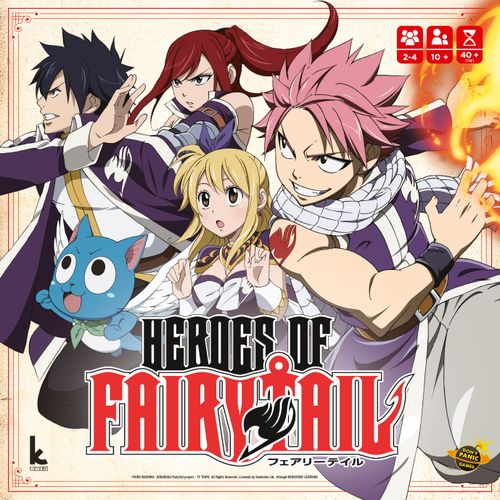
Heroes of Fairy Tail
Heroes of Fairy Tail Rulebook
Table of Contents
Table of Contents
Overview
Heroes of Fairy Tail is played over 3 rounds. During each round, players will recruit Heroes to their team and send them into battle or on Missions to earn Prestige points. At the end of the game, the player with the most Prestige points wins.
Components
- 60 Hero cards
- 42 Adversary cards
- 18 Constellation tiles
- 15 Mission cards
- 3 dice (1 green, 1 yellow, 1 red)
- 1 Prestige track
- 24 Damage counters
- 4 Activation tokens
- 12 Objective tokens (in 4 colors)
- 4 Prestige tokens (in 4 colors)
Game Setup
- Place the Prestige track in the center of the playing area.
- Separate the Mission Cards into 3 piles: B, A, and S. Set aside the starting cards from each of the 3 piles. Shuffle each pile and place them face up (the face in English) in the center of the playing area. Place the corresponding starting card (its crest is darker), face up, on top of each deck.
- Place the Constellation tiles in the playing area, face down, and mix them well.
- Shuffle the Adversary cards face down and form a stack. Draw the first 3 Adversary cards, reveal them, and place them in a line.
- Each player takes the Activation token and the 3 Objective tokens of their color.
- Form a stack of Hero cards. Shuffle them and place them face down in the playing area.
Gameplay
Heroes of Fairy Tail is played over the course of 3 rounds. Each round is divided into 4 different phases, played in the following order:
- Preparation
- Recruitment
- The Adventure
- The Return to Fairy Tail
Phase 1: Preparation
Deal 5 Hero cards from the deck face down to each player. Each player takes their cards in hand and looks at them secretly.
Phase 2: Recruitment
At the same time, each player chooses one of the Hero cards in their hand and places it face down in front of them. The remaining cards are passed to the player on their left.
Then each player reveals the chosen card and places it in their team: either to the left or to the right of any cards they have already placed. It is not possible to leave a space between 2 Heroes or to place a card between 2 Heroes already in their line-up. If there are no cards already in the line-up, the card is placed in front of the player without constraints.
This action is repeated until everyone has placed 4 Hero cards out of the 5 dealt. The remaining cards are discarded.
Hero Cards
Each Hero card has the following parts:
- Strength Points: the red banner in the top-left corner of the card.
- Energy: the energy symbols on the card's left and right edges (Lightning, Fire, Ice). These are used when placing cards next to each other to form complete energy icons.
- Prestige Space: the coin in the top-right corner. At the end of the round, if this space is not covered, the player gains the number of Prestige points indicated.
- Action: the box at the bottom of the card, showing the action the Hero performs during the adventure.
This is the most important part of the game. Think carefully about what you can and cannot use during your turn. There's no point in fighting if you don't have space for your Damage counters! There's no point in healing yourself if you don't take wounds first!
Energies and Damage
By cleverly placing cards next to each other, it is possible to create complete icons representing the different energies unleashed by the heroes. There are 3 types: lightning, fire, and ice.
These energies are used to take damage later in the round. When a player receives a point of damage, they place a Damage counter on a space matching that energy type, or on any available space if an energy type is not specified.
In addition, some heroes have damage slots that do not have energy symbols. These slots can accommodate Damage counters as long as they are not specific to a particular energy type.
Be careful: some of these generic slots also grant Prestige points, which are only earned at the end of the round if they are not covered by a Damage counter.
Phase 3: The Adventure
Players take turns going on an adventure and performing different actions. Each player places their Activation token on the left-most card in their Hero line-up.
Determine the first player
The next step is to determine the first player for this round. Each player adds up their team's Strength points by adding up the Strength symbols on all of their Hero cards. The player with the most Strength points starts this phase. If there is a tie, the players involved compare who has the most Strength on their left-most Hero card. If there is another tie, they compare the second card, then the third, and so on until a difference is made. If they are all tied after checking all the cards, then the youngest player starts.
Go on an adventure
Starting with the first player and moving clockwise, each player performs one of the actions indicated by the card where their Activation token is located. Then, the token is shifted to the next card to the right and it's the next player's turn. Players continue taking turns until they have all completed the actions on the card furthest to the right in their Hero line-up.
Fight
There are several possible actions. If there are 2 actions separated by a slash you must choose only one of them.
When a player fights, they will attack a number of Adversaries up to the number displayed (1, 2, or 3). The player may choose to face fewer Adversaries than allowed, but never more.
For each Adversary faced, the player must roll one of the 3 dice, all at the same time. A different colored die must be used for each Adversary they are fighting. Of course, the green die is less dangerous than the yellow die, which is less risky than the red die.
In order to win the fight, ALL of the damage indicated on the dice must be taken by the player's Heroes. For each point of damage rolled, they must find a symbol on their Hero cards that is not already covered by a Damage marker and place a Damage marker on it. Be careful: some damage must be assigned to a specific type of Energy (Fire, Lightning, Ice).
See Damage details on page 14.
If the player's Hero cards cannot take ALL of the damage, they lose the fight: they receive no rewards, but their heroes must still take as many damage points as they can.
If the player's Hero cards can take all of the damage, they win the fight! For each die rolled, they take 1 Adversary card of their choice from the line-up and place it in front of them. Each Adversary will award Prestige points at the end of the game.
After the fight is over, reveal new Adversary cards until there are 3 available again.
See Adversary card details on page 15.
Go on a Mission
Action icon: the Fairy Tail emblem, followed by a green cross.
The player chooses one of the 3 available Mission Cards on which they have no Objective token.
To achieve the Mission, they must fulfill the condition requested in the center of the card. Most of the time, they have to take several wounds of a specific type, or determined by a die. Other Missions require the player to hold at least a specified number of Adversary cards.
If these conditions are met, the player advances their token on the Prestige track as many spaces as the leftmost uncovered Prestige point icon on the card and place one of their Objective tokens on it. If all the spaces on the card are covered, the Mission card is placed on the bottom of the deck and the next one is revealed. Players who had Objective tokens on the card get them back.
On the Mission card, the letter shows the Mission type, the first number is the 1st Prestige rank, and the second number is the 2nd Prestige rank.
Aim for first place! Finishing a mission first earns many more points for the same cost as second place.
Pick a Constellation tile
Action icon: a cluster of stars, followed by a green cross.
This action allows you to randomly pick a Constellation tile.
There are 3 types of Constellation tiles:
- Immediate effect: the tile is discarded once played. It does not require a slot.
- Activation (three black triangles): the tile can replace an action and is placed on top of an action space on one of your cards. If the card is kept for subsequent rounds, the tiles placed on top of it are also kept.
- Interaction (three red triangles): the tile can be played to slow down an opponent.
Healing
Action icon: green crosses.
For each green cross the player removes 1 Damage token from one of their Hero cards.
Slots with Prestige points are your priority when you heal yourself!
Shine
Action icon: stars, followed by a green cross.
The player gains as many Prestige points as the number of stars shown, recorded on the Prestige track.
Do nothing
Some Heroes have an empty action space on their card.
Some Heroes have no action on their card. In this case, they do not take any action during their activation. However, it is possible to place a Constellation tile on this location, in which case the newly placed action can be performed when that Hero is activated.
Phase Four: The Return to Fairy Tail
In this phase, if a player has any damage spaces with Prestige points not covered by Damage counters, they earn as many Prestige points as the values shown. Then all the Damage counters accumulated on the Hero cards are discarded.
Finally, each player discards 3 of the Hero cards in their Hero line-up. It is not possible to leave holes or swap the positions of cards. However, it is possible to slide the cards to the left or right to close up any holes created by discarding cards.
If this was the third round, proceed to the End of Game. If not, start a new round, beginning with the first phase, Hero Recruitment.
End of Game
Now it's time to see who wins!
Each player adds the Prestige points from their Adversary cards to their current score.
The player with the most Prestige wins. In the event of a tie, the tied player with the most Adversary cards wins.
The Combat Dice
There are 3 different combat dice: green, yellow, and red. The green die is the safest, the red die is the most dangerous.
Green Die
- Green die, 4 faces: Take 1 Damage counter and place it on an available space on one of your Hero cards. If this is not possible, the battle is lost.
- Green die, 1 face (2 symbols): Take 2 Damage counters and place them on available slots in your Hero line-up. If this is not possible, the combat is lost.
- Green die, 1 blank face: Your opponent missed! Whew!
Yellow Die
- Yellow die, 2 faces: Take 1 Damage counter and place it on an available space on one of your Hero cards. If this is not possible, the battle is lost.
- Yellow die, 1 face (2 symbols): Take 2 Damage counters and place them on available slots in your Hero line-up. If this is not possible, the combat is lost.
- Yellow die, 2 faces (Lightning): Take 1 Damage counter and place it on an available Lightning Energy slot on one of your Hero cards. If this is not possible, the battle is lost.
- Yellow die, 1 face (Ice): Take 1 Damage counter and place it on an available Ice Energy slot on one of your Hero cards. If this is not possible, the battle is lost.
Red Die
- Red die, 1 face: Take 1 Damage counter and place it on an available space on one of your Hero cards. If this is not possible, the combat is lost.
- Red die, 2 faces (2 symbols): Take 2 Damage counters and place them on available slots in your Hero line-up. If this is not possible, the combat is lost.
- Red die, 1 face (Lightning): Take 1 Damage counter and place it on an available Lightning Energy slot on one of your Hero cards. If this is not possible, the battle is lost.
- Red die, 1 face (Lightning and Fire): Take 2 Damage counters and place them on matching Lightning and Fire Energy slots on your Hero cards. If this is not possible, the battle is lost.
- Red die, 1 face (Fire): Take 2 Damage counters and place them on matching Fire Energy slots on your Hero cards. If this is not possible, the combat is lost.
Anatomy of an Adversary Card
- Colors: There are 4 colors: brown, green, blue, and red. The colors represent different types of Adversaries that are similar to one another. You should try collecting different colors!
- Prestige points: These points are gained at the end of the game.
- Conditional Prestige points: These points are gained at the end of the game, but only if the indicated conditions are met:
- Collections: This card is worth more points if the player can make a set of 3 cards with the colors shown. Each card can only count towards 1 set at a time.
- Majority: At the end of the game, the player earns extra Prestige points if they have the most Adversary cards of the color shown. In case of a tie, this bonus does not apply.
- Strength: The player wins additional Prestige points if they have the highest Strength score (red banner) at the end of the game. In case of a tie, no one wins these points.
- Number of cards: At the end of the game, the player wins extra Prestige points if they have at least as many Adversary cards as the number shown.
- Color: At the end of the game, the player wins extra Prestige points for each Adversary that matches the color shown. Collect the matching color to score more points!
- Constellation: At the end of the game, the player wins 1 Prestige point per Constellation tile on their cards or in their possession.
Some Adversary cards are worth more Prestige points if they are part of a set. This applies to you, but also to others. Don't hesitate to put obstacles in their way by taking the cards they need!
Constellation Tiles and Their Effects
A Constellation tile can be an immediate effect tile or an activation tile.
Immediate Effect Tiles
- Three Damage counters: An opponent of your choice must place 3 Damage counters on their Hero cards. If they can't, they must place as many Damage counters as possible.
- Green die, yellow die, and one Damage counter: An opponent of your choice rolls the green and yellow dice. They must place as many Damage counters on their Hero cards as the result indicated by the dice. If they can't, they must place as many Damage counters as possible.
Activation Tiles
Activation tiles are placed on an action slot and are used in one of two ways: on your cards, or on an opponent's cards.
On your cards:
- Green cross with "max": Remove all the Damage counters from your Hero cards.
- Green cross and Fairy Tail emblem: Remove 1 Damage counter from one of your Hero cards, then complete a Mission.
- Adversary symbol with "3": Fight up to 3 Adversaries.
- Three stars: Gain 3 Prestige points.
On an opponent's cards:
- Constellation icon and yellow die: This tile is played on an action slot on an opponent's Hero. The slot must have a Constellation icon. The action becomes: Gain 1 Constellation tile and roll the yellow die; place as many Damage counters on your Heroes as the result shows.
- Two stars and Shine icon: This tile is played on an action slot on an opponent's Hero. The slot must have a Shine icon. The action becomes: Gain 1 Prestige point and designate an opponent who also gains 1 Prestige point.
- Adversary symbol with "2" and red die: This tile is played on an action slot on a Hero belonging to an opponent that has the Fight action. The action becomes: Fight up to 2 Adversaries but add the red die to the roll for those fights.