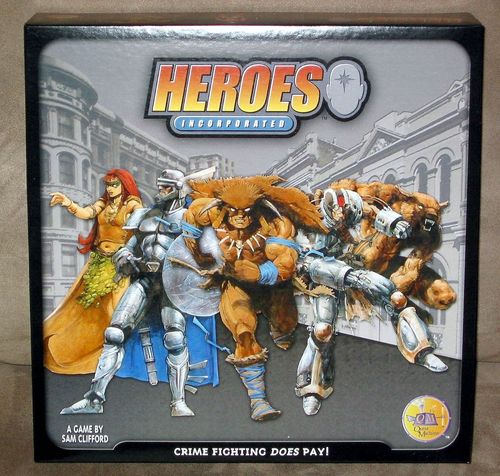
Heroes Incorporated
Heroes Incorporated Rulebook
Table of Contents
Table of Contents
Object of the Game
The first player to gain the required number of Hero Points wins the game. With 2 players, the game is played to 36 Hero Points. With 3 or 4 players, the game is played to 30 points.
Notes about the Rules
Sections in grey boxes contain examples and frequently asked questions. You can skip these while you are reading the rules the first time through, but they may answer questions that will arise as you are playing.
This manual is a complete rewrite of the rules, including the original Heroes Incorporated rules, and the S.U.P.E.R. expansion. There are a few new rules that have been added:
- Setup: Players now draft their heroes. (See the Setup rules.)
- Team HQ Gadgets: These powerful items give you bonus actions.
- Justice Tokens: These help balance the capricious nature of the Fight Crime rolls.
- Supervillain Lairs: Supervillains now hang around and cause trouble.
- 5 New Heroes: Each new Hero has some very different powers.
- Power Changes: Traveller and Paragon have changes to their powers involving Justice Tokens.
The Stuff of Heroes
To fight the crime rampant within MEGALOPOLIS, hero teams have many tools at their disposal.
CITY BLOCKS - 25 City Blocks are used to build the city of MEGALOPOLIS. Each City Block has a point value representing the difficulty of fighting the crime as well as the number of Hero Points you gain from beating the crime. Several City Blocks also have a special power which is used by the player who scores the Hero Points for that block.
CRIME PAWNS - A number of Crime Pawns (7 in the box) move around the board randomly. City Blocks containing Crime Pawns are the spaces where Heroes Fight Crime. For your first game, add the crime labels to the Crime Pawns. Two identical crime labels go on each pawn, one on each side.
CRIME DIE - At the end of each round, this 8-sided die is used to move the Crime Pawns.
HERO CARDS - Aside from just a famous name and mask, each hero has distinct powers and abilities that enable them to fight the tide of evil. Each Hero Card contains the following:
SUPER POWERS - Just as superpowers alter nature, each power in the game alters the rules.
ORIGIN - Heroes can be Tech, Mutant, Chosen, or Alien. This is the source of the Hero's powers, and determines how the hero is affected by certain supervillains, city blocks, and cards. In the super-powered future, powers can be granted, discovered, or accidentally acquired. A CHOSEN hero was selected to be a champion by some great power, whether an ancient protector of earth or a benign cosmic being. A MUTANT was selected by chance - either born with genetic powers which awakened during adolescence or the product of a scientific accident gone horribly right. TECH heroes are self-made men or women whose powers come from their toys. ALIEN Heroes have bodies and minds that just don't work like us pitiable humans.
PLAYER CARD - Each player gets a Player Card which serves as a reference as well as provides a place to put Action Markers as they are used.
ACTION MARKERS - Each player receives 4 Action Markers matching his color, one white Marker and Bonus Markers matching his heroes. Action Markers are used to keep track of how many Actions you have taken. The Bonus Markers and white Marker let you know when you have performed your Bonus Action or drawn a Research Card in that round - these actions can only be performed once per round.
White Action Markers and Markers matching the player color are played onto the 4 Normal Turn spaces on the Player Card marked "1st", "2nd", "3rd", and "4th". Hero Bonus Markers are played on one of the 2 Bonus Spaces on the Player Card.
RESEARCH CARDS - You may draw one of these per turn by using your white Action Marker. To play a Research Card usually requires an action, and can give you a perk or harass an opponent.
COMBAT +1 TOKENS - You may have 3 of these round tokens on a hero. These add +1 to a hero's attack die roll to Fight Crime.
GADGET TOKENS - You may have 3 of these square tokens on a hero. Each of these tokens provides a hero with a special ability for fighting crime. Note: ALIEN Heroes cannot be equipped with Gadget Tokens.
TEAM HQ GADGETS (S.U.P.E.R. Expansion only) - Each Hero Team may have ONE of these powerful items when directed to take one by a Research Card. Team HQ Gadgets give you extra actions each round to perform some particular type of action.
JUSTICE TOKENS (S.U.P.E.R. Expansion only) - Heroes have such a strong sense of justice and honor that they just keep on fighting when beaten. If you lose a combat, you get a Justice Token. These may be spent in future fights to add a +1 to a fight die roll.
Setup
(If you are starting with the new S.U.P.E.R Expansion: remove the old Supervillain Cards from the Research Card Deck. Add the new S.U.P.E.R. Expansion Research Cards to the deck, and shuffle. Also remove Shadowboxer's white Action Marker and replace it with the rather less confusing black Action Marker.)
Drafting Heroes: Shuffle the Hero Card deck. Deal three Heroes to each player. Each player chooses one of the three heroes to keep, passes one Hero to the left, and one to the right. When all the passing is done, each player chooses a second hero from the two just passed to him. The third Hero is removed from the game.
Give each player a matching set of the same color consisting of a Player Card, Hero Stands, and four Action Markers. Each player also receives one white Action Marker.
Some heroes receive an extra Bonus Action Marker:
- Shadowboxer: One Black Action Marker
- Stampede: One Brown Action Marker
- Dr. Illusion: One Pink Action Marker
- Silver King: One Grey Action Marker
- Cloner: One Natural Action Marker
- Huntaar, Werebeast, Thunderhawk: One Orange Action Marker
- Titan, Werebeast, Andron: One Combat +1 Token
- Scrap: One Gadget Token of the player's choice. Remove the corresponding Gadget card from the Research Card Deck and set it aside.
Shuffle the Research Card Deck and the City Block tiles. Deal each player a number of Research Cards:
- 2 Players = 3 cards each
- 3 Players = 2 cards each
- 4 Players = 1 card each
Build MEGALOPOLIS using a 5 by 5 grid of City Block tiles. CRIMELAND is always placed in the center. Crime Pawns are then placed on the City Blocks according to one of the following diagrams (rows and columns numbered 1 to 5 from the top left):
- 2 Players (5 Pawns): row 2, columns 2 and 4; row 3, column 3; row 4, columns 2 and 4.
- 3 Players (6 Pawns): rows 2, 3 and 4, each in columns 2 and 4.
- 4 Players (7 Pawns): row 2, columns 2 and 4; row 3, columns 2, 3 and 4; row 4, columns 2 and 4.
Take 3 Combat +1 Tokens and place them on the indicated blocks in the city: GENICON INC., THE MAKERS GROUP, and DWENGINE LTD. Place the player pawns on the scoreboard for each player in the game.
Beginning the Game
The player with the largest comic book collection starts the game. Each player in turn places one of his Heroes on the board in any space not already containing a Hero.
After all Heroes are on the board, roll the crime die once for each crime on the board. Start with crime A, and follow the letter sequence. Each crime moves one block in the direction rolled.
The player who placed his hero first then begins the first round.
Order of Play
The game is divided into several ROUNDS. Each player has four TURNS in each round. Each player performs ONE turn in clockwise order, followed by the next player, until everyone has had four turns.
On a turn a player:
- Performs one Normal Action
- Performs any number of Bonus Actions
Each round always begins with the player with the MOST Hero Points. If there is a tie, roll a die to decide the starting player. Players take turns clockwise from the starting player.
At the end of each round, players score points for crimes successfully fought; then the crimes move randomly.
Normal Actions
When a player takes their Normal Action for a turn, they place one of their player-colored Action Markers (or the white Marker to draw a card) onto their Player Card.
Possible Choices for the Normal Action are:
MOVE: Move one hero one block vertically or horizontally. Heroes may move into any space on the board; including occupied spaces, Crimeland, and destroyed City Blocks.
FIGHT CRIME: If a player is in a block containing a Crime Pawn, the player may use an action to Fight Crime by rolling a die to try and equal or beat the target number of the City Block. (See Combat below for more detail)
PLAY A RESEARCH CARD: It costs an action to play any Research Card except for Supervillains.
DRAW A RESEARCH CARD: Your white Action Marker is used as a Normal Action instead of one of your 4 player-colored markers to draw a Research Card. This means that you can normally only draw one Research Card per round. (Some Bonus Actions may allow you to draw Research Cards as well.)
PASS: Sometimes you just can't do anything else useful in a round and so you may pass. You cannot save actions for later, but must place a player-colored Action Marker onto your Player Card just as if you did something useful.
Bonus Actions
Heroes and Team HQ Gadgets allow players to take Bonus Actions. You can use as many Bonus Actions in a turn as you have Bonus Action Markers available and spaces (in the Bonus area and on Team HQ Gadgets) to play them on.
Bonus Actions and Normal Actions may be intermixed in any order.
Start each round by placing Bonus Markers on the appropriate Hero Card. Move them to the player card as they are used.
Note: The Bonus Action gained from a Team HQ Gadget uses one of the player-colored Markers (or the White Marker for the Crime Computer). Move the appropriate Marker to the Team HQ Gadget when it is used. Using a Team HQ Gadget makes it possible to use ALL 5 (4 player colored and one white) of a player's base Action Markers in a round. If a player has a Team HQ Gadget, and both of his Heroes have Bonus Action Markers, the maximum number of Actions a player can have is 7! (4 Normal, 1 HQ Gadget Action, 2 Hero Bonus Actions.)
Example: Dan has Shadowboxer (black Bonus Marker to draw a card), and Werebeast (Bonus Marker to Fight Crime). Dan uses Shadowboxer's bonus to draw a Research Card. He draws the Hovercraft - a Team HQ Gadget which allows a Bonus Action to move a Hero. Dan then uses his Normal Action to play the Hovercraft. He then uses the Hovercraft Bonus Action to move Werebeast into a space with a Crime Pawn. Then Werebeast uses his Bonus Action to Fight Crime in the area. Dan has burned through all of his Bonus Actions for the round in one turn, but he got a lot done.
Fighting Crime
When a Crime Pawn is on a block, any hero can Fight Crime on that block. Heroes cannot Fight Crime on a block without a Crime Pawn. The number on a City Block is both the target number for Fight Crime rolls, and the Hero Points given out at the end of the round.
To Fight Crime, the hero takes an action and rolls a Fight die. If the result with modifiers is equal or greater than the City Block number the player leaves the rolled die on the City Block to mark his successful crime fighting. If the roll fails the player receives a Justice Token if the optional Justice Rule is being played. (See Optional Rules: Justice Tokens).
If there are multiple crimes in a block, this does nothing special. Treat any result the same as if only a single crime was in the block.
While a Hero's die is on a City Block, that Hero can no longer Move nor Fight Crime. The Hero is assumed to be spending the rest of the round involved in the fight. If another Hero later beats that die roll, the original Hero regains his die and may then Move or Fight Crime as usual. If multiple heroes tie, they both are locked down fighting that crime.
Remember, if your die roll gets beaten by another Hero, Super Villain, or you lose a Combat Token, your die is removed from the City Block and your Hero can again take actions.
Example: Sam and Frank are fighting over a 5 City Block. On Turn 2 of the round, Frank rolls a 5 and places it on the block. On Turn 3, Sam rolls a 5 and places his die on the block as well. Both Heroes are now locked in fighting the crime. Dan then moves in and rolls a 6. His die is placed on the block. Sam and Frank's heroes are both beaten and their dice are handed back to them.
Modifiers: Combat +1 Tokens are NOT added to the die roll by changing the die, but you have to remember to add them in when comparing the Fight Crime Die to the Block Number and future Fight Crime Rolls. Justice Tokens actually change the die FACE. This means two things: If your Combat +1 Token goes away before the end of the round, it will reduce your final fight value. Also, Combat +1 Tokens are the ONLY way (so far) to take your Fight Value over 6. Justice Tokens can only take your Fight Value to 6 Points, because you can't actually turn the dice to show a 7. (See Optional Rules: Justice Tokens).
Example: Jose rolls a 3 to Fight Crime on a City Block with a value of 4. His hero has a +1 Combat Token so the die is successful and stays on the block. Jose has 3 Justice Tokens and chooses to spend all 3, changing his die roll to a 6 - making his total Fight Value a 7. This will help prevent other Heroes from claiming the crime.
Supervillains
Supervillain cards are the only Research Cards that may be played out of turn, without spending an Action Marker. When a player declares that they are Fighting Crime any opponent may play a Supervillain BEFORE the die is rolled. The player has to beat a much harder number in order to successfully Fight Crime.
Supervillains do not change the Hero Point Awards at the end of the round, just the target value.
A Super Villain card stays on the City Block through the end of the round or until someone defeats the value on the card. When a player defeats the Super Villain, it is discarded.
If a die is already on the City Block, it is also compared to the Super Villain Card. If it is not strong enough to beat the Super Villain, it is removed and given back to its owner.
If the roll fails the player receives a Justice Token if the optional Justice Rule is being played. (See Optional Rules: Justice Tokens).
Multiple Super Villains may be played as long as they are all played when someone tries to fight a crime. If multiple Super Villains are on a space, the target number is the highest Super Villain combat value for each hero. Any special powers from Villains, however, are ALL applied.
Example: Huntarr and Scrap are both fighting for the same block. There are four villains on this block: Evolver (Combat 6, 8 for Mutants), Mammoth (Combat 7), Mind Ripper (5), and Berserker (5). Scrap needs a 7 to fight, Huntarr needs an 8, because he is a Mutant. If either misses a crime roll, he also has to discard a Research Card (Mind Ripper's power) and a Gadget Token (Berserker's power).
Research Cards
Research cards let you do very unusual things - surprising your opponents. However, you have to spend two actions to use a Research Card - one to draw it, and one to play it. Research Cards come in many varieties:
KO GADGETS - One type of single-shot Gadget is a KO card. This means that the targeted Hero is knocked out. Lay the Hero on its side, it can no longer do any actions or bonus actions. If the Hero already has its Fight Die on the board, remove the die.
EQUIPPED GADGETS - Each Hero can carry 3 Gadgets. Once added to a Hero by a Research Card, the Gadget can be used immediately. Only the Hero actually holding the Gadget can use it.
TEAM HQ GADGETS - Each team can have one of these special Gadgets useable by either member of the team. The Team HQ Gadget has a space for an Action Marker so you can activate the HQ Gadget's power once per round WITHOUT spending a Normal Action.
In most cases you place one of your player-colored Action Markers onto the Team HQ Gadget. The Crime Computer, however, requires you to place your white Action Marker. Even though you are placing a Normal Action Marker, using a Team HQ Gadget does NOT count as your Normal Action for that turn, but works like a Bonus Action.
Example 1: Mark wishes to use the Crime Computer. However, he already used his white Action Marker this round to draw a Research Card. Therefore, he cannot use the Crime Computer.
Example 2: Dan used the Hovercraft in his first turn this round, placing one of his player-colored Action Markers onto the Hovercraft. This means that he has only 3 player-colored Action Markers and his white Action Marker left to use for his 4 normal actions. At some point this round, Dan will be forced to use his white Marker to draw a Research Card.
FAME CARDS - Fame cards each have a special requirement to play them in addition to the lost action to play a Research Card. The one Hero Point you get from a Fame Card is scored at the same time you score your City Block points each round. You may only have one Fame Card at a time.
FATE CARDS - Fate cards are played like any other Research Cards. Simply do whatever the card says.
ADVENTURE CARDS - Adventure cards give you an immediate 1 or 3 Hero Points when you play the card. All Heroes have a special adventure card that nets them 3 points.
SUPERVILLAIN CARDS - Unlike the other cards, Supervillain cards are played on another player's turn. You may play one whenever another player is preparing to roll a die to Fight Crime. Supervillain Cards do not cost an action to play.
POWER UP CARDS - When played receive a Combat +1 Token that can be placed on either hero.
Hero Powers
Each Hero has one or two special powers that affect the game.
Transform: Start the game with a +1 Combat Token.
Fly: Move diagonally as well as horizontally and vertically.
Blast: May Fight Crime in orthogonally adjacent City Block. (This mostly just saves you the action of actually moving into the City Block. All other normal combat rules apply.)
Noble: Gain 1 extra Hero Point per round. (S.U.P.E.R. Game Only: May also spend TWO Justice Tokens at any time in order to gain 1 Hero Point.)
Magic: Roll 2 dice to attack, and take the highest number.
Teleport: Roll a die. If you roll a 1 move to CRIMELAND. If you roll a 2-6 you may move to any City Block of your choice. (S.U.P.E.R. Game Only: If Traveller rolls a 1, he gains a Justice Token as if he had blown a Fight Crime Roll. He may also instead spend TWO Justice Tokens to change the 1 to a valid move.)
Detective: 1 Bonus Action Marker (Black) per round to draw a Research Card.
SuperSenses: 1 Bonus Action Marker (Orange) per round to Fight Crime.
SuperSpeed: 1 Bonus Action Marker (Brown) per round to Move, Fight Crime, or play a Research Card.
Inventor: Start the game with 1 Gadget Token (player's choice: remove the matching card from the deck) AND can play Gadget Cards for free.
Illusion: 1 Bonus Action Marker (Pink) per round to move 1 Crime Pawn to an adjacent block. Cannot move a crime from Crimeland, or if a successful Fight Roll is on the block. Crime Pawn must also be orthogonally adjacent or in the same space as the Hero.
Mind Control: Player can discard a card from his hand to cancel the effect of any Research Card after it is played. Both Research Cards are discarded from the game. The Research Card affected by Mind Control does not need to be targeted at Cera, she only has to decide that she doesn't like it.
Minions: 1 Bonus Action Marker (Grey) per round to successfully Fight Crime and instantly gain Hero Points in a block with a Crime Pawn and block value of 2. The target block must be the one Silver King occupies, or an orthogonally adjacent block. The Minion can be used each round in addition to Silver King's normal Fight Crime Actions. The Minion cannot fight crime if a successful roll is on the block. Move the target Crime Pawn to Crimeland after power is used.
Rocket: Can use a single action to both move and Fight Crime.
Outsmart: Wins combat roll ties.
Mimic: 1 Bonus Action Marker (Natural) per round to instantly duplicate a super power of ANY hero in the same space or an orthogonally adjacent space.
If the Mimicked power is a Bonus Action, the Hero gets to act as if he has the appropriate Bonus Marker. If the Mimicked Power normally requires an action to use, the Hero must spend a Normal Action Marker to effectively use the power.
Example 1: Cloner is standing next to Silver King (Minions power) and a Value 2 Crime Pawn. Cloner Mimics the Minions power and claims the 2 Hero Points, moving the Crime Pawn to Crimeland. Because Minion is a Bonus Action, Cloner has not used his Normal Action for this turn.
Example 2: Cloner is standing next to Slingshot, and desperately needs to move and fight a crime this round. He Mimics Slingshot's Rocket Power to move to an orthogonally adjacent space and fight the crime there. He must still spend a Normal Action Marker in addition to his Bonus Action Marker. Also, while Slingshot can normally move diagonally, Cloner only get to Mimic ONE of Slingshot's Super Powers, so he cannot move diagonally.
Ending a Round and Scoring
At the end of each round, players collect their Hero Points from City Blocks, Fame Cards, and any special powers.
The current leader always scores all of his end of round points FIRST, followed by the remaining players in order from most to fewest Hero Points.
The player with the highest die roll on a City Block with a crime receives the City Block's value in Hero Points. That player may also at this time use the City Block's special power if it has one.
If multiple players tie for fighting crime, they each receive the block points divided and rounded DOWN. The block's special action is ignored.
Add together points from City Blocks, Fame, and from Paragon's special power, and add it to each player's score.
After Scoring: Move all Crime Pawns on the board by rolling the crime die once for each crime. Each crime moves one block in the appropriate direction. If a Crime Pawn leaves the board, move it instead to Crimeland (but do not move it again until next round).
Players then clear their Action Markers from their Player Card and discard down to 5 Research Cards.
The next round is started by the player with the most Hero Points. If there is a tie, the tied players roll off.
Winning the Game
At the end of any round, if one player has achieved the target number of Hero Points (36 in a 2 player game, 30 in a 3 or 4 player game), that Hero Team becomes the official Super Team of MEGALOPOLIS and wins the game.
Only the first player to reach the target number of points wins. Players always score for City Blocks and Fame points IN ORDER OF HERO POINTS.
Example: Before scoring, Mike has a score of 29, Jose 27, and Frank 25. On the last round, Mike scores 1 point, Jose scores 3 points, and Frank scores 8 points. Mike wins by reaching a final score of 30 first. His points are added before Frank's, even though Frank's final total of 33 is a higher value.
There are several ways of gaining and losing points DURING a round. Playing the right Research Card can gain you three points immediately. If this pushes you into the lead right before final scoring, you can steal victory.
If two players are tied during end of round scoring, they score at the same time. If this happens, the tiebreaker between them is the most total points.
(Note: this example is printed as in the source, whose numbers imply a 30-point target.)
Hero & Player Limits
- Each player can have a maximum of five Research Cards in their hand. They must discard down to five at the end of the round.
- Each player can only have one Fame Card in play at a time. A player can play a new Fame Card, but must immediately discard the old one.
- Each Hero can only have three Combat +1 Tokens maximum, even if the hero has the Transform power.
- Each Hero can only carry three Gadget Tokens (except ALIEN Heroes who can't have any.)
- Each player may only have one Team HQ Gadget.
- Each player may only have three Justice Tokens.
Optional Rules
Justice Tokens (S.U.P.E.R. Expansion Only)
Justice Tokens are included in the S.U.P.E.R. Expansion, and helps even out the capriciousness of the luck of the dice. Whenever a Hero Fights Crime and is not able to put his die down on the City Block, he receives a Justice Token. Justice Tokens may be spent by either Hero on a team to add a point to a future Fight Crime Roll. You decide how many Justice Tokens to use AFTER rolling the die. You then add the number of Justice Tokens you just used by changing the die itself. This means that you cannot increase a Fight Crime roll to more than 6.
You may only hold three tokens at a time for your team. The Justice Tokens may be used by either Hero.
Supervillain Lairs
The Supervillain Lairs rule makes the corners of the city more interesting, and makes for a slightly shorter game. Players using this rule in a 3 or 4 player game may wish to play to 36 Hero Points, instead of 30.
When a Supervillain is undefeated by the end of the round, he goes away to his lair to spawn more nefarious schemes. The player who played the card rolls the die and moves the Supervillain to an EMPTY corner of the board indicated by the die roll. If the roll is N,S,E,or W, the player chooses an empty corner on that board edge. Reroll if an occupied corner is rolled.
If no corner of the board is empty (unoccupied by a Hero, Crime Pawn, or Supervillain), send the Supervillain off to the discard pile.
A Supervillain card acts as if a crime is always present in that corner until the crime is successfully fought. The first player to successfully fight the Supervillain IMMEDIATELY scores 6 Points for the Supervillain.
If a Crime Pawn moves into a Supervillain Lair, move the Crime Pawn instead to Crimeland.
A Supervillain card may NOT be played while another hero is fighting a Supervillain in his Lair.
S.U.P.E.R. Game Components
- 32 Research Cards
- 5 Hero Cards
- 5 Hero Markers
- 4 Player Cards
- 3 Gadget Tokens
- 4 Team HQ Gadget Tokens
- 4 Bonus Action Markers (1 Black, 1 Pink, 1 Grey, 1 Natural)
- 12 Justice Tokens
- 1 Rule Book