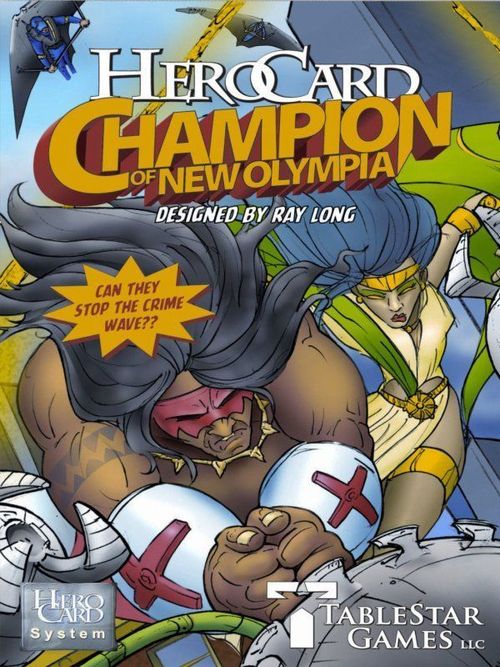
HeroCard Champion of New Olympia
HeroCard Champion of New Olympia Rulebook
Table of Contents
Table of Contents
Quick Start
HeroCard Overview
In HeroCard, each player takes on the identity of a Hero and uses his or her Action Deck to battle against other Heroes. Each HeroCard deck includes three Attribute cards, which represent the capabilities of your Hero, and a deck of Action Cards, which you use to duel your opponent.
Your goal is to launch successful attacks against your opponent while defending against his or her attacks. You attack and defend by playing Action Cards.
Getting Started
Select your Hero, and familiarize yourself with your Attribute and Action Cards. Then, set up your play area as shown.
Note: Your Attribute Stacks are empty at the beginning of game play, since you have not played any cards yet.
Attributes and Action Cost
Each Character's Body, Mind and Attribute X Cards list his or her Attribute scores. These limit the cards you can play. Each Action Card has an associated Action Cost in Body (B), Mind (M) or Attribute X (X). The combined Action Cost of all the cards you have in play must be equal to or less than your Character's corresponding Attribute score. These Attribute points remain expended until you clear some or all of your in-play cards.
In the example shown in the rulebook, the To'a King player has spent 5 Attribute points, leaving 5 available.
Action Types
Each Action Card lists an Action Type, which determines when you can play the card.
- Fast: Play as many as you have free Attribute points for on any player's Action Phase.
- Restricted: Play as many as you have free Attribute points for on your own Action Phase only.
- Exclusive: You can play only one Exclusive action per turn (even if you have enough Attribute points to play more), only on your own turn during your Action Phase.
Sets: You can play your Action Cards one at a time, or you can play certain cards together as a set. Whether you play cards singly or in a set, you must let your opponent respond before playing more cards.
Four Phases of a Turn
There are four phases to every turn. Complete them in the following order: Discard, Draw, Clear, Action.
-
Discard: Discard as many cards as you wish, placing them face up on your discard stack.
-
Draw: Draw up to three cards from the top of your Action Deck. Do not exceed seven cards in your hand. If your Action Deck runs out of cards, shuffle your discard stack, place it face down and continue drawing Action Cards from the top.
-
Clear: Remove up to three cards from your Attribute Stacks and place them in your discard stack (see Action, below, on placing cards into your Attribute Stacks). This frees up the Attribute points those cards cost to play. If you have more than three cards in your Attribute Stacks, the Attribute points for any uncleared cards remain spent, but the cards have no further effect on the game. Always clear the top card from a given Attribute Stack (i.e., the most recently-played card) first.
Some cards allow you to clear outside of your Clear phase. Reduce the current attack or block value by the appropriate amount, if applicable. Other immediate effects remain.
-
Action: Attack, block, and play other Action Cards. Observe the rules for attacking and blocking below, as well as the Action Type rules and any restrictions listed on the card.
Refreshing your Hand: Forego your Action Phase to refresh your hand. Discard all of the cards in your hand and draw the same number. When you refresh, you can not play any cards or take any other Actions of any kind.
Attacking
On your turn, you can attack during your Action Phase. You can play Base Attacks, Attack Modifiers (Mods), and Special Attacks.
- Base Attacks (generally Exclusive): Play only one Base Attack on your Action Phase. Each Base Attack card shows a number representing the strength of the attack.
- Attack Mods (Fast): Play as many Attack Mods as your available Attribute points allow. Attack Mods increase the value of a Base Attack, so you must play a Base Attack either before or in a set with your Attack Mod(s). You can play multiple Attack Mods provided you have played a single Base Attack in the current Attack Sequence. Each Attack Mod shows a number representing the points it adds to a Base Attack.
- Special Attacks (Fast or Restricted): Play as many Special Attacks as your available Attribute points allow.
Attack Sequence: An Attack Sequence begins when you play a Base Attack, and includes all attack, block and other Action Cards you and your opponent(s) play in the course of resolving that attack. A card played during the course of an attack sequence is considered "Active" until the end of that Attack Sequence. Normally there is only one Attack Sequence per Action Phase, but there are cards that allow you to play more than one Base Attack per Action Phase. Attack and block cards apply only to the Attack Sequence in which they are played.
To attack, select your Base Attack and any Attack Mods. The total Action Cost of the cards may not exceed your Hero's Attribute scores. Place the cards face up to the right of their corresponding Attribute Card, with the Action Cost of each card visible, and with the most recently played card on top. Announce the total value of your attack. Allow your opponent to play blocking cards. You can continue your attack with more Action Cards up to your Attribute limits. The Attack Sequence ends when all players pass. At the end of the Attack Sequence, if your total attack value exceeds your opponent's total block value, your attack is successful.
Blocking
On your opponent's turn, defend against his or her attacks. You can play Base Blocks, Block Modifiers (Mods), and Special Blocks.
- Base Blocks (Fast): When your opponent attacks, play as many Base Blocks as your available Attribute points allow. Each Base Block card shows a number representing the strength of the block. If you play more than one Base Block, add the block values together.
- Block Mods (Fast): Play as many Block Mods as your available Attribute points allow. Block Mods increase the value of a Base Block, so you must play a Base Block either before or in a set with your Block Mod(s). You can play multiple Block Mods provided you have played at least one Base Block in the current Attack Sequence. Each Block Mod card shows a number representing the points it adds to a Base Block.
- Special Blocks (Fast): Play as many Special Blocks as your available Attribute points allow.
To block, select your Base Block(s) and any Block Mods. The total Action Cost of the cards may not exceed your Hero's Attribute scores. Your current block value must equal or exceed your opponent's current attack value, or the attack is successful. Place the cards face up to the right of their corresponding Attribute card, with the Action Cost of each card visible, and with the most recently played card on top. Announce the total value of your block. Your opponent may increase the attack by playing additional attack cards. The Attack Sequence ends when all players pass. At the end of the Attack Sequence, if your total block value equals or exceeds your opponent's total attack value, the attack fails.
Board Game
Players: 2 to 4. Ages: 10 and up. Duration: 1-2 hours.
Components
- 2 HeroCard Action Decks: Deva and To'a King
- 1 deck of Plot Cards
- 1 deck of Powers Cards
- 9 Map Tiles
- 16 Contact Tokens
- 4 Base Tokens
- 2 Pawns
Action Decks represent a Hero's abilities. You take on the role of a Hero and use your Action Deck to resolve combat and conflicts, using the HeroCard dueling system.
Plot Cards show a location in New Olympia on one side and a crime in progress on the other. You move to the location and battle to stop the crime.
Powers Cards represent new abilities your Hero gains during the course of a game. You can use Powers Cards to help win battles.
Map Tiles comprise the game board. You put the map tiles together to form a custom city and move your Hero pawns around the board.
Contact Tokens represent sources who can tell you about crimes in progress. Some contacts are unfriendly, and you must fight them for information.
Base Tokens mark the location of your Hero's base. You return to your Base when you are defeated in combat.
Pawns indicate your Hero's location. You move your Pawn around the board between Contacts, your Base, and crime scenes.
Overview
Become the ultimate Champion in New Olympia! Heroes consult Contacts to learn the Location of crimes to thwart. Stopping crimes gains you Fame Medals, which earn you glory and help you win the game, and Powers cards, which upgrade your abilities. Be the first to collect enough Fame Medals to win the title of Champion!
Goal
The first player to earn 3 Fame Medals gains the title of Champion of New Olympia and wins the game.
Setup
To battle opponents in Champion of New Olympia, you use the HeroCard dueling system. Before playing, please read the HeroCard Core Rules (enclosed) and play a practice duel. These rules assume that you know how to play a HeroCard duel.
Pick a Hero
Each player chooses a Hero. Champion of New Olympia comes with two Heroes:
- Deva: the Mistress of Mental Might
- To'a King: Pillar of Strength and Pride.
You can also use Heroes from other HeroCard games or a custom HeroCard deck. Familiarize yourself with the cards in your Hero's Action Deck.
Each Hero has an Action Deck, a Base Token, and a Pawn. Find the Base Token and Pawn that match your Hero.
Lay Out the Board
Use the Map Tiles to build the game board according to Figure 1 located after the Arrange Cards section. There are optional rules for building custom cities as well.
The game board contains four kinds of spaces. All spaces are outlined in red. Figure 1 shows the different kinds of spaces, an assembled game board and Base Tiles.
- Named Spaces contain a named location, such as Kirby Field. Crimes occur at locations in Named Spaces.
- Contact Spaces contain the Contact symbol. You can place Contact tokens on Contact spaces.
- Road Spaces are long and multidirectional to allow quick travel across the board.
- Neighborhood Spaces are any spaces that are not Named, Contact, or Road spaces.
Place your Bases
You start at your Base, and you return there when you are defeated in battle. You can place your own Base Token on the game board. Each Base Token is unique and matches a specific Hero's symbol.
You can place your Base Token on any Neighborhood Space on a Base tile. There can only be one Base per Base tile.
Draw a random Base Token to determine who places their Base first. Then proceed clockwise until all players have placed their Base Tokens.
Place Contacts
You can talk to Contacts to learn about crimes which you can attempt to stop. You place Contact Tokens to represent the location of Contacts.
Contact Tokens have the Contact symbol on one side and a Hero's symbol on the other. Four Contact Tokens match each Hero. Contacts with your Hero's symbol automatically give you information when you land on a space with their Contact Token. Contacts with another Hero's symbol you must battle to shake them down for information.
To place Contact Tokens on the game board:
- Take out a number of Contact Tokens matching the symbol of each Hero in play for this game. The number of Contact Tokens you use depends on the number of players:
- 2 player game, use 4 Contact Tokens for each Hero (8 total).
- 3 player game, use 3 Contact Tokens for each Hero (9 total).
- For a 4 player game, use 2 Contact Tokens for each Hero (8 total).
- Place the Contact Tokens on the play area with the Contact symbol facing up and randomize them.
- Each player takes an equal number of randomly chosen Contact Tokens, picks them up, and looks at them.
- Each player takes turns placing their Contact Tokens on Contact Spaces on the game board. The player to the left of the one who placed the first Base Token places the first Contact Token.
Arrange Cards
You use three kinds of card decks in Champion of New Olympia:
- Action Decks: Your Action Deck represents your Hero's attributes and abilities. Place your three Attribute cards in a column according to the HeroCard core rules. Shuffle your Action Deck and place it face down to the left of your play area. Draw 7 cards and keep them in your hand. Setup for your Action Deck is exactly like setup for a normal HeroCard dueling game.
- The Powers Card Deck: You can win Powers cards in battle. Powers cards give your Hero new abilities. Shuffle the Powers card deck and place it face down to one side of the game board.
- The Plot Card Deck: Plot Cards represent crimes occurring around New Olympia. They have a Crime side, showing information about a crime, and a Location side, showing where the crime is taking place. Shuffle the Plot Card deck, Location side up. Then split it in half and place one half, Location side up, on each side of the Powers card deck.
You are now ready to play!
Figure 1: City Setup and Space Definitions
Figure 1 is a diagram of an assembled city board, with the Named, Road, Contact and Neighborhood Spaces labelled (for example, Kirby Field is a Named Space) and the Base Tiles marked. It is a picture of the layout that setup refers to and carries no further rule text.
Setup Example
Deva and To'a King are competing for the title of Champion of New Olympia. They lay out the game board according to Figure 1. To'a King takes the red Base Token with his symbol on it, and Deva takes the green Base Token with her symbol on it. Deva and To'a King each place their Base Tokens on a neighborhood space on a Base tile.
Next, Deva finds the 4 Contact Tokens with her symbol on them, and To'a King finds the 4 Contact Tokens with his symbol on them. They place the 8 Contact tokens face down and randomize them. They each pick 4 random tokens, look at them, and take turns placing them face down on the various Contact Spaces, with 1 token per Contact Space.
Finally, they each draw 7 cards from their Action Deck and place their pawn on their Base. They're now ready to fight for glory in New Olympia!
Taking a Turn
Exactly as in a HeroCard duel, there are four phases to every turn. Complete the phases in the following order:
- Discard: Discard unwanted cards from your hand.
- Draw: Draw up to three cards.
- Clear: Remove up to three cards from your in-play area.
- Action: Move from 0 to 3 spaces then: Attack, play Action Cards, consult Contacts, resolve Plot Cards, or battle other Heroes.
If you don't remember what to do during the Discard, Draw or Clear phases, please refer to the HeroCard Core Rules or the Champion of New Olympia reference card included with this game. In Champion of New Olympia, you can take a variety of different Actions during your Action Phase (in addition to attacking with your HeroCard Action Deck):
Moving
You can move through spaces across the game board, towards Contacts, crime Locations, or even to attack other Heroes.
- You can move up to 3 spaces in a turn.
- You cannot move diagonally.
- Consulting a Contact, resolving a Plot Card, or battling another Hero stops your movement.
- Only one Hero may occupy a space at a time.
- To pass through a space with another Hero in it, you must play a single base attack card. The other Hero can choose to let you pass or can play a single base block to try and stop your attack. If the defending Hero blocks successfully, you cannot enter the space and your movement is stopped. If your attack succeeds, you can pass through. Neither Hero must return to their Base or loses a Fame Medal.
Note: Attempting to just pass through a space occupied by another Hero works differently than attacking a Hero to try to steal a Fame Medal. For more information on Hero vs. Hero battles, see below.
Consulting Contacts
You talk to Contacts to find out about crimes in progress throughout New Olympia. Some Contacts are friendly to you and give you information freely. Others are unfriendly, shady characters whom you must shake down for information.
To consult a Contact, move to a Contact Space with a Contact Token on it. Flip over the Contact Token to reveal which Hero's symbol is on the token.
If another Hero's symbol is on the Contact Token, you must fight the Contact for information. The player whose symbol is on the token can play one, and only one, Base Block or Special Block to defend the Contact. You must attack for higher than the single block card the defender is playing. You may play as many cards as you can while the defender is only allowed one card to defend the contact. If the attack succeeds then you can draw one Plot Card. If your attack fails, the Contact remains face up and you return to your Base. If an opponent reaches the Contact before you, they can get the Plot Card instead by following the same process.
Once a Contact has yielded a Plot Card, remove the Contact Token from the board. If you remove all Contact Tokens from the board, randomize them and redistribute them as you did during setup.
You can look at a Plot Card after you draw it, but do not need to show it to other players until you arrive at the crime Location.
If your symbol is on the Contact Token, the Contact gives you information without a fight. Draw a Plot Card from either Plot Card Deck.
For Example: To'a King goes to a Contact Space looking for information and flips the token. The Contact Token matches his symbol, so the Contact gives him the information in the form of a Plot Card taken from either deck. If the Contact Token does not have To'a King's symbol, then Deva can play a single Base Block or Special Block to try to stop him from getting the information. If Deva fails to defend the Contact, the Plot Card goes to To'a King. If Deva succeeds, To'a King must return to his Base, and the Contact stays face up. If Deva can get to it before To'a King, she can claim the Plot Card for herself.
Crime Busting
Once you get a Plot Card from a Contact, you can go to the Location on the Plot Card to try to stop the crime. Stopping crimes gains you Fame Medals and Powers Cards. Each player can have no more than 2 Plot Cards at a time.
When you arrive at the Named Space on the Plot Card, flip the Plot Card over to reveal it to the other players. The number on the crime side of the Plot Card represents the difficulty of the crime. This one number tells you two things:
- The number of cards an opponent can play to try to stop you from solving the crime
- The number of Power Cards you can draw if you succeed in solving the crime
Note: In a 2 player game, your opponent plays cards to attempt to stop you from stopping the crime. See the Multiplayer Rules for information on crime busting in a game with 3 or 4 players.
When you try to solve a crime, your opponent can play a number of cards up to the difficulty rating of the Plot Card to attempt to prevent you from solving the crime and gaining a Fame Medal. Your opponent determines whether to play an attack or a block sequence. You must respond and attempt to thwart them. You can play as many cards as you want to try to stop a crime. The opposing player can only play the number on the Plot card. If the opposing player plays fewer cards than the difficulty number then the attack sequence continues.
If you succeed in busting the crime, you can draw a number of Powers cards equal to the difficulty of the crime. (Remember that you can't have more than 3 Powers cards at a time). If the difficulty rating was 2 or higher, you also turn the Plot Card vertical to display the Fame Medal to the left of the crime name. You just earned one of the three Fame Medals you need for victory!
Note: Plot Cards with a difficulty of 1 have no Fame Medal. You still get to draw a Powers Card for solving these crimes, but you do not get a Fame Medal. Discard the Plot Card after you stop the crime.
For Example: Deva arrives at the Daily Mercury and flips her Plot Card over to reveal a crime: Arson, Value 2. The 2 tells To'a King how many cards he can play to try to prevent her from stopping the crime. To'a King may choose Attacks or Blocks. If he chooses Attack he can play an Exclusive Attack Action and one more Fast Action; if he chooses to Block he can play two Base Blocks or a Base Block and one more Fast Action. To'a King plays an Exclusive Attack of 5 against Deva, who stops it with a Base Block 5 card. To'a King still has one more card to play and adds an Attack Mod of +5 for a total Attack of 10. Deva adds a Block Mod +2 and a Block Mod +3 to bring her total Block to 10. To'a King can play no more cards, as he reached the two card limit outlined by the Plot Card.
Battling Other Heroes
You can attack other Heroes in an attempt to steal their Fame Medals. If you defeat a Hero, you can steal one Fame Medal and send them back to their Base.
To attack another Hero, move into an adjacent space on the Action phase of your turn and state your intent to attack. You can play one Base Attack and any number of Fast actions. You can also use Powers cards.
The defending Hero can use any number of Block cards or other allowed actions as per the core HeroCard rules. If they defend successfully, they can choose to turn the tables and attack on their turn.
In games with more than 2 players, other players in adjacent spaces can interact with a battle of Heroes on their turns. See the Multiplayer Rules for details.
For Example: To'a King moves to a square adjacent to Deva and uses his Action to attack her. He plays a Base Attack 8 exclusive action card. Deva responds with a Base Block 5 and Block Mod +3 for a total block of 8. To'a King presses his advantage by adding an Attack Mod +3 for an Attack total of 11 versus Deva's Block of 8. Deva responds with a Block Mod +4 of her own, bringing her total block to 12. In a last ditch effort, To'a King adds an Attack Mod +2 for a total attack of 13. This is too much for Deva. She must return her pawn to her Base, and To'a King claims one of her Fame Medals.
If you fail to bust the crime, move your pawn back to your Base and place the Plot Card in the Crime Wave.
Crime Wave
The Crime Wave is a stack of failed Plot cards above the Plot deck. It serves as a reminder of rising crime levels in the city and represents the failure of Heroes to protect New Olympia from crime. If the Crime Wave reaches 5 cards, everyone loses, and the Heroes are all expelled from New Olympia.
Powers
Successfully solving a Crime grants Heroes a draw from the Powers Deck equal to the number of the difficulty of the Crime. If a Hero stops a Crime with a difficulty of 2, then they get to draw 2 Powers cards.
A Hero can only have 3 Powers cards in their hand at a time. If a player draws more than 3 they can choose which 3 to keep and the rest are discarded to the bottom of the Powers Deck. Powers cards can be used at anytime while Consulting a Contact, Resolving a Crime or Battling another Hero.
Powers cards are used once and then discarded to the bottom of the Powers Deck. The exceptions are the Mutation and Scanalyzer cards. Mutation grants a permanent +4 to one Attribute chosen at the time the card is drawn. The Mutation card is slid under the enhanced Attribute to show the +4 to the right of the Attribute number. The Scanalyzer card goes under the Hero's Action Deck and grants a +1 to a Hero's hand size. These two cards count towards the Hero's 3 card limit and may be discarded at any time.
Ending the Game
The game ends when either of the following happens:
- A player gains 3 Fame Medals. If you earn 3 Fame Medals, you win. Congratulations! You are the Champion of New Olympia!
- The Crime Wave reaches 5 cards. If there are 5 cards in the Crime Wave, everyone loses. Crime overruns the city and the Heroes leave New Olympia in disgrace.
Hero Reference: Attack Specialties
- Deva: Focused Telepathy Bash: Telepathic Discord + Kinetic Bash + Psychic Focus + Psychic Focus = 10 Offense. Astral Storm: Astral Blitz + Psychic Focus + Psychic Storm = 19 Offense.
- To'a King: Punishment: Punishing Blow + Jab + Hip Toss (+ Spirit Attack) = 13 Offense. Coup de Grace: Uppercut! + Follow Through + Follow Through + Follow Through = 17 Offense (+Break the Defense).
Multiplayer Rules
You can play Champion of New Olympia with 2-4 players. When playing with 3 or 4 players, use the following modifications to the rules.
Contact Tokens (Multiplayer)
Use fewer tokens per player with more players.
- 3 Player Game: use 3 Contact Tokens for each player.
- 4 Player Game: use 2 Contact Tokens for each player.
Crime Wave (Multiplayer)
The more players, the more Plot Cards must be in the Crime Wave for everyone to lose the game.
- 3 Player Game: 6 Plot Cards in the Crime Wave ends the game.
- 4 Player Game: 7 Plot Cards in the Crime Wave ends the game.
4 Player Team Option
If you have 4 players, you have the option of playing in 2 teams of 2 people each rather than with 4 players acting individually. If you form teams, the following rules apply:
- Bases: Each team shares one Base.
- Contact Tokens: Each team shares 4 Contact Tokens.
- Plot Cards: Members of a team share Plot Cards.
- Crime Wave: 7 Plot Cards in the Crime Wave ends the game with a universal loss.
- Powers Cards: Teammates share Powers Cards. The maximum number of Powers Cards in this shared pool is 5.
- Fame Medals: The first team with 5 Fame Medals wins.
- Teammates must sit across from each other.
- Teammates cannot attack each other, but can defend attacked teammates if they are in an adjacent space.
Crime Busting with Teams
As in a regular game, Crime Busting starts when a Hero arrives at a crime scene and flips over a Plot Card to reveal the crime difficulty.
- Turns start with the player to the left of the active player and proceed in clockwise order.
- Each player can choose to pass or play any valid Action card.
- If all players pass, the active player automatically wins the challenge.
- Teammates cannot play cards as part of resolving the crime. For instance, Kidnapping is a 2 card crime. A teammate cannot play one of those two cards and cannot assist with solving the crime. A teammate can only help during a Hero vs. Hero battle and only if they are adjacent.
- Once a player plays an Attack or Block card, other players can respond accordingly in turn.
- When the turn order comes back to the active player, they must beat any cards played against them or lose the challenge.
- If the total number of opposing cards is less than the difficulty number on the Plot Card then the attack sequence continues.
- Opposing Heroes may only communicate with each other during Plot Card battles using the words "Offense" and "Defense." They cannot talk about their cards or form strategies beyond a basic choice to attack or block.
For Example: Deva arrives at the Daily Mercury and flips her Plot Card over to reveal a crime: Arson, Value 2. The 2 tells To'a King and Talon (the players on the team opposed to Deva) the number of cards they can play to try to prevent her from stopping the crime. They can play an Exclusive Action card and a Fast Action for a total of 2 cards. To'a King plays a Base Attack of 5 against Deva, who stops it with a Base Block 5 card. To'a King and Talon still have one more card to play, so Talon adds an Attack Mod of +5 for a total Attack of 10. Deva adds a Block Mod +2 and a Block Mod +3 to bring her total Block to 10. To'a King and Talon can play no more cards, as they reached the two card limit outlined by the Plot Card. Deva stops the Crime. She receives 2 draws from the Powers deck and turns the Plot Card sideways, turning it into a Fame Medal.
Hero vs. Hero with Teams
The only change in Hero vs. Hero clashes in multiplayer is teammates can assist each other if they are in adjacent spaces. Teammate Talon can add Mods to To'a King's attacks on opposing Hero Deva because both are adjacent to Deva. Teammate Ferrion can add Mods to Deva's block because Ferrion is adjacent to Deva. (The printed figure illustrates these adjacency rules with Teammates Talon and To'a King bringing the fight to the Deva and Ferrion duo.)
Creating Custom Cities
Randomly choose a first player via draw of a Contact token.
- 2 Player: Place the City Hall in the center and both players are dealt 4 random tiles. The first player gets to place their first tile and the two players take turns until all tiles are placed. After all tiles have been placed each player places their Base token in reverse order on a Neighborhood space on an outer tile.
- 3 Player: Each player is dealt 3 random tiles. The first player gets to place their first tile and the players take turns clockwise until all tiles are placed. After all tiles have been placed each player places their Base token in reverse order on a Neighborhood space on an outer tile.
- 4 Player: Place the City Hall in the center and each player is dealt 2 random tiles. The first player gets to place their first tile and the players take turns until all tiles are placed. After all tiles have been placed each player places their Base token in reverse order on a Neighborhood space on an outer tile.
The roads on the tiles must match and make sure the roads do not infringe on the neighborhood spaces.
A custom city example (Urban Sprawl) is printed alongside these rules as a diagram of Base Tiles; it carries no further rule text.
Core Rules
HeroCard Dueling Rules
Game Overview
In HeroCard, each player takes on the identity of a character, called a Hero, and uses his or her Action Deck to battle against other Heroes. Heroes come from a variety of genres: you might play a Japanese samurai, a starship commander, a cyberspace hacker, or one of many other Heroes. Each Hero and associated Action Deck is unique, and you can even mix and match cards to further customize your own Hero and deck!
HeroCard takes only a few minutes to learn and is easy to play. Your HeroCard Action Deck contains everything you need to face other Heroes in battle.
Game Materials
Your HeroCard deck contains three Attribute Cards, which represent the capabilities of the Hero you are playing. In addition, your deck has a variety of Action Cards, which you use to attack, block, and strategize as your Hero. Each card describes how you can use it, so game play proceeds smoothly and quickly.
Game Setup
Each player picks a Hero. A Hero includes three Attribute Cards, which correspond to that Hero's strengths and weaknesses, and a twenty- to thirty-card Action Deck representing what that Hero can do in battle.
Place your three Attribute Cards in a column, with the Body (B) card at the top, the Mind (M) card in the middle, and the Attribute X (X) card at the bottom. (Don't worry, we'll explain the B, M and X Attributes and how to use them below.)
As you play your Action Cards, you'll place them face up to the right of the Attribute Cards in piles called Attribute Stacks. When you start the game, this area is empty, since you have not yet played any Action Cards.
Place your Action Deck to the left of your play area. When you discard cards during game play, put them in a face-up Discard Stack near your Action Deck.
To set up your play area, lay out your cards as shown in the rulebook's setup illustration.
Dueling Overview
As your Hero, your goal is to attack your opponent in duels and overcome his or her defenses. You must also defend yourself against your opponent(s)' attacks.
Your attacks and defenses are limited by your Attributes. Each Hero has Body (B), Mind (M) and Attribute X (X) Attribute scores. What is the Attribute X? It's an Attribute that changes depending on the genre of your Hero. If you're playing a Cyberspace hacker, it represents Gene X; if you're taking on the Galaxy as a starship commander, it stands for Xenoscience. Check your rules to see which Attribute X your Hero has.
You attack and defend by playing Action Cards. Each Action Card has an associated Action Cost in Body, Mind or Attribute X. The combined Action Cost of the cards you play must be equal to or less than your Hero's corresponding Attribute score. Once you "spend" Attributes in this way, they remain expended until it's your turn again. You must use strategy and creativity to launch successful attacks while still leaving yourself enough free Attributes to defend when it's your opponent's turn!
You win a duel by mounting an attack that is stronger than the defenses your opponent can muster.
Taking a Turn: The Four Phases of Game Play
There are four phases to every turn. Complete the phases in the following order:
- Discard: Discard unwanted cards from your hand.
- Draw: Draw up to three cards.
- Clear: Remove up to three cards from your Attribute Stacks.
- Action: Attack, and otherwise affect the game by playing Action Cards.
Discarding
Begin your turn by discarding as many cards from your hand as you wish. Place your discarded cards face up on your discard Stack.
Drawing
Next, draw up to three cards from the top of your Action Deck, adding them to your hand. You may never hold more than seven cards in your hand at any time.
Note: If your Action Deck runs out of cards, shuffle your Discard Stack, place it face down in your draw area, and continue drawing Action Cards from the top.
Clearing
As you play Action Cards, you place them next to your Attribute Cards in Attribute Stacks. You'll place each Action Card to the right of the Attribute Card with which it corresponds, on top of any cards you previously played using that Attribute and arranged so that the Action Cost of each card remains visible. For example, if an Action Card costs 5 Body to play, you'll place it to the right of your Body (B) Attribute Card, on top of any previously-played cards that cost Body.
During your Clear phase, you may remove up to three cards from your Attribute Stacks and place them in your discard Stack. When clearing cards from a given stack, you must always begin with the top (i.e., most recently-played) card in that stack.
Note: If you take the first turn in the game, you won't need to clear, since you haven't played any cards yet.
If you have more than three cards in your Attribute Stacks, you won't be able to clear them all. The Attribute points for any uncleared cards remain spent, but the cards themselves have no further effect on the game. They simply tie up your Attribute points until you're able to clear them.
Some Action Cards allow you to clear cards at times other than during your clear phase. If the cleared card is part of a current attack or block, the attack or block value is reduced by the appropriate amount. If the cleared card has an immediate effect, the effect remains even though the card is removed from play (unless otherwise specified by the clearing card).
Action Cost
Each Action Card has an associated Action Cost in Body (B), Mind (M) or Attribute X (X). The combined Action Cost of all the cards you have in play must be equal to or less than your Hero's corresponding Attribute score. These Attribute points remain expended until you clear some or all of your in-play cards on your next turn.
Action Type
Each Action Card has an Action Type listed on it, which determines when you can play the card. There are three Action Types: Fast, Restricted, and Exclusive.
- Fast: You can play as many Fast actions as you have free Attribute points for on any player's turn, during the Action Phase.
- Restricted: You can play as many Restricted actions as you have free Attribute points for, but only on your own turn during your Action Phase.
- Exclusive: You can play only one Exclusive action per turn (even if you have enough Attribute points to play more), only on your own turn during your Action Phase.
Playing Sets
You can play your Action Cards one at a time, but you can also play cards simultaneously, as a set. Once you have played a card or card set, you must allow your opponent to respond (he or she may play cards or pass) before playing more cards. Either approach can be the best choice, depending on the situation: playing a set prevents your opponent from interfering with your action (for example, he or she might play a card that forces you to discard cards in your hand), but playing cards singly allows you to conserve cards. For details on which cards can be played together as sets, see the "Attacking" and "Blocking" sections, below.
Taking Actions
Now you can play Action Cards. When playing Action Cards, observe the following rules:
Refreshing your Hand
Instead of taking an Action Phase, you can refresh your hand. To refresh, discard all of the cards in your hand and draw the same number of cards from your Action Deck. When you refresh, you forego your Action Phase completely: you can not play any cards or take any other Actions of any kind.
Attacking
On your turn, you attempt to mount a successful attack against your opponent. You can play Base Attacks, Attack Modifiers (Attack Mods) and Special Attacks. Of course, you can also play other cards on your turn provided you follow any limits imposed by the Action Type and otherwise specified by the card, and provided you have the available Attribute points.
- Base Attacks (generally Exclusive): On your Action Phase, you can play one Base Attack. A Base Attack is generally an Exclusive action, so you can only play one Base Attack per turn, and only on your own turn (note that there are some cards that allow you to play more than one Base Attack per turn). You must also have enough available Attribute points to play the card. Each Base Attack card shows a numeric value representing the strength of the attack.
- Example: The Action Card "Attack from Above" lists Attack 4. This is a 4-point attack.
- Attack Mods (Fast): On your Action Phase, you can play as many Attack Mods as your available Attribute points allow. Attack Mods add points to the strength of a Base Attack, and they can only be played in conjunction with a Base Attack. Each Attack Mod card shows a numeric value representing the number of points it adds to a Base Attack.
- Example: The Action Card "Stone Falls through Water" lists Attack Mod +5. Played in conjunction with "Attack from Above", this card adds 5 points to the value of the attack, for a total of 9 points.
- Special Attacks (Fast or Restricted): On your Action Phase, you can also play Special Attacks. Special Attacks may allow you to take actions, force your opponent to take actions, or otherwise affect game play. You may play Special Attacks as your available Attribute points allow. You must also obey any limits imposed by the Action Type and otherwise specified by the card.
- Example: The Action Card "Forfeiture" states, "Target discards one block card." The opponent on whom you play this must discard one block card (any kind of block card, whether Base Block, Block Mod or Special Block) from their hand.
The Attack Sequence: When you play a Base Attack, you begin what's called an Attack Sequence. An Attack Sequence includes your Base Attack and any other attack cards, block cards, and other cards you and your opponent play in the course of resolving the attack. A card played during the course of an attack sequence is considered "Active" until the end of that Attack Sequence. Normally, you can only play one Base Attack per Action Phase, so there is only one Attack Sequence per Action Phase. However, there are cards that allow you to play more than one Base Attack per Action Phase. Playing a new Base Attack starts a new Attack Sequence. It is important to note that Base Attacks and Attack Mods only apply to the Attack Sequence in which they are played. Once an Attack Sequence has ended, these cards have no further effect on the game (remember that until cleared, these cards do continue to tie up the Attribute points they cost to play).
Playing Sets: You can play your Base Attack first and then play Attack Mods separately, waiting for your opponent to respond to each action you play. Or, you can play your Base Attack and one or more Attack Mods simultaneously, as a set. You can only play a Base Attack and Attack Mods in a set of attacks; you cannot include Special Attacks or any other Action Cards in a set of attacks. Also remember that you must always play an Attack Mod at the same time as, or after, a Base Attack during a given Attack Sequence. An Attack Mod cannot stand alone.
To Attack
Select the Base Attack and any Attack Mods you wish to play. Compare the total Action Cost of the cards to your Hero's Attribute scores, to be sure you can play the cards. Place the Action Cards to the right of the corresponding Attribute Card, on top of any cards you previously played using that Attribute. Arrange these Attribute Stacks so that the Action Cost of each card remains visible, and the most recently played card is on top. This begins the Attack Sequence.
Announce to your opponent the total value of the attack you are making.
Your opponent may choose to defend by playing Base Blocks and Block Modifiers. He or she will attempt to block a number of points equal to or more than the value of your attack. Your opponent may also use other Action Cards as appropriate to prevent your attack from succeeding.
After your opponent plays Blocks, Block Mods or other Special Blocks, you can continue your attack by playing more Action Cards, up to your Attribute limits. Your opponent can continue to defend, and other players can play appropriate Action Cards as well. The Attack Sequence continues until all players pass.
If your total attack value is higher than your opponent's total block value, your attack succeeds! If your opponent's block value equals or exceeds your attack value, your attack fails.
Spent Attributes
The combined Action Costs of the cards you played during this duel are "spent". They remain spent until you can clear some or all of them on your next turn.
Blocking
On your opponent's turn, he or she can attempt to mount an attack against you, as above. You can defend by playing Base Blocks, Block Modifiers (Block Mods) and Special Blocks. Of course, you can also play other cards on your turn provided you follow any limits imposed by the Action Type and otherwise specified by the card, and provided you have the available Attribute points.
- Base Blocks (Fast): On your opponent's Action Phase, he or she can attack you with a Base Attack plus Attack Mods. You can respond by playing one or more Base Blocks. Unlike Base Attacks, you can play as many Base Blocks as your available Attribute points allow, adding the value of the Base Blocks together. Each Base Block card shows a numeric value representing the strength of the block.
- Example 1: The Action Card "Unbroken Defense" lists Block 9. This is a 9-point block.
- Example 2: The Action Card "Efficient Block" lists Block 4. This is a 4-point block. Provided you have available Attribute points, you can play this card in conjunction with "Unbroken Defense." Together, these two Base Blocks equal a 13-point block.
- Block Mods (Fast): In response to your opponent's attacks, you can also play as many Block Mods as your available Attribute points allow. Similar to Attack Mods, Block Mods add points to the value of a Base Block, and can only be played in conjunction with one or more Base Blocks. Each Block Mod card shows a numeric value representing the number of points it adds to the Base Block.
- Example: The Action Card "Cross Block" lists Block Mod +5. Played in conjunction with "Unbroken Defense", this card adds 5 points to the value of the block, for a total of 14 points.
- Example 2: "Cross Block" (5-point Block Mod) played in conjunction with "Unbroken Defense" (9-point Base Block) and "Efficient Block" (4-point Base Block), equals total block value of 18 points.
- Special Blocks (Fast): In response to your opponent's attacks, you can also play Special Blocks. Special Blocks may allow you to take actions, force your opponent to take actions, or otherwise affect game play. You may play Special Blocks as your available Attribute points allow. You must also obey any limits imposed by the Action Type and otherwise specified by the card. (Note that Special Blocks are generally Fast Action Types, so you aren't limited to playing them only in response to an attack; you can play them at other times too.)
- Example: The Action Card "Distracting Smile" states, "Target discards two attack cards from their hand." The opponent on whom you play this card must discard two attack cards (any kind of attack card, whether Base Attack, Attack Mod or Special Attack) from their hand.
The Attack Sequence: When your opponent plays a Base Attack against you, an Attack Sequence begins. The Attack Sequence includes the Base Attack and any other attack cards, block cards, and other cards you and your opponent play in the course of resolving the attack. A card played during the course of an attack sequence is considered "Active" until the end of that Attack Sequence. Remember that Base Blocks and Block Mods only apply to the Attack Sequence in which they are played. If your opponent uses a special card to play a new Base Attack during the same Action Phase, a new Attack Sequence begins. Any Base Blocks and Block Mods you previously played have no further effect on the game (remember that until cleared, these cards do continue to tie up the Attribute points they cost to play). You must play new Base Blocks and Block Mods to defend against the attack.
Playing Sets: You can play your Base Block(s) first and then play Block Mods separately, waiting for your opponent to respond to each action you play. Or, you can play your Base Block(s) and one or more Block Mods simultaneously, as a set. You can only play Base Blocks and Block Mods in a set of blocks; you cannot include Special Blocks or any other Action Cards in such a set. Like an Attack Mod, you must always play a Block Mod at the same time as, or after, a Base Block during a given Attack Sequence. A Block Mod cannot stand alone.
To Block
Your opponent begins the Attack Sequence by playing a Base Attack and any Attack Mods. To block, select the Base Block(s) and any Block Mods you wish to play. Compare the total Action Cost of the cards to your Hero's Attribute scores, to be sure you can play the cards. Also make sure the total value of the block equals or exceeds your opponent's attack value; otherwise the attack succeeds and your opponent earns a Victory Point. Place the Action Cards to the right of the corresponding Attribute Card, on top of any cards you previously played using that Attribute. Arrange these Attribute Stacks so that the Action Cost of each card remains visible, and the most recently played card is on top.
Announce to your opponent the total value of the block you are making.
Your opponent may then choose to increase the attack by playing additional Attack Mods, Special Attacks, or other Action Cards as appropriate. You can continue to defend by playing more Action Cards, up to your Attribute limits. Other players can play appropriate Action Cards as well. The Attack Sequence continues until all players pass.
If your total block value equals or exceeds your opponent's total attack value, the attack fails. However, if your opponent's attack value is greater than your block value, the attack succeeds.
Spent Attributes (Blocking)
The combined Action Costs of the cards you played during this duel are "spent". They remain spent until you can clear some or all of them on your next turn.
Finishing a Turn
An Attack Sequence is finished when the player whose turn it is confirms that all players pass and opponents determine the success or failure of the attack. Play then proceeds to the left.
In some cases, the attacker may launch multiple Attack Sequences in the same Action Phase (remember that some special cards allow more than one Base Attack per Action Phase). A given Attack Sequence must complete as above before a new one is launched. Each new Attack Sequence proceeds and completes as above. When all Attack Sequences are complete, play proceeds to the left.
Contradictory Rules
If the text on a card contradicts the game rules in this booklet, the card text overrules the game rules.
Creating Your Own Decks
Building Customized Heroes
Each HeroCard deck represents a full Hero, ready to be pitted in duels against other Heroes. Each includes three Attribute Cards and about thirty corresponding Action Cards. You can create your own Heroes and Action Decks as well. Here's how:
- Combine different Attribute Cards from different Heroes. Your custom Hero must always have three Attribute Cards: one Body (B), one Mind (M) and one Attribute X (X) card.
- Combine different Action Cards from different Action Decks. Your custom Action Deck must always have at least 20 Action Cards, and may contain no more than six copies of the same card.
Balancing Customized Heroes
Each Attribute Card shows a hero point number in the bottom left corner of the card. When creating a custom Hero, add up the hero points on your three Attribute Cards. This is your hero point total. In general, the higher the hero point total, the more powerful the Hero.
For dueling to be fun for all players, Heroes must be similar in power. When using customized Heroes, all players in the game must agree to a maximum hero point total. No player may use a Hero that exceeds this limit. The standard limit for Heroes is 30 points.
Playing Head-to-Head Duels with HeroCard
HeroCard Action Decks are designed for use with TableStar Games Board Games such as Galaxy, Cyberspace and many others. However, you can play head-to-head duels with your friends using just your HeroCard Action Decks. In head-to-head HeroCard, your goal is to win by earning the required number of Victory Points. You must earn three Victory Points in a two-player game, five in a three-player game, and seven in a four-player game.
Each time you successfully attack your opponent, you earn a Victory Point. A successful attack gains you only one Victory Point, so you must launch separate, successful attacks on separate turns to earn the required number of Victory Points. No matter how much the attack value exceeds the block value, a successful attack always gains only one Victory Point.
To play direct duels, randomly determine who starts. Shuffle your decks and draw seven cards. Begin play, with turns proceeding in a clockwise direction. On your turn, launch attacks against your opponent. On your opponent's turn, he or she does the same. Proceed through turns exactly as described above. Whoever earns the required Victory Points first, wins!
HeroCard Glossary
- Action Card: A card you play from your Hero's Action Deck.
- Action Cost: The number of Attribute points you must spend to play an Action Card.
- Action Deck: The collection of Action Cards you may play as a particular Hero. An Action Deck may not contain fewer than 20 cards, nor more than 6 of the same card.
- Action Type: The rule that governs when you can play an Action Card. There are three Action Types: Fast, Restricted and Exclusive.
- Action Phase: Fourth phase of a turn, in which you may play Action Cards.
- Active Card: A card played during the current Attack Sequence.
- Active Player: The player whose turn it currently is.
- Attack Card: Any Base Attack card, Attack Mod card, or Special Attack card.
- Attack Mod: An attack card that increases the value of a Base Attack by a constant or variable amount.
- Attack Sequence: An Attack Sequence begins when the active player plays a Base Attack and includes all attack cards, block cards, and other cards opponents play in the course of resolving the attack. The attack sequence ends when all players involved have passed.
- Attack Value: A numerical value, shown on the face of each attack card, that represents the force of the attack. If you play multiple attack cards (e.g., a Base Attack plus one or more Attack Mods) within a single Attack Sequence, add their individual attack values to find the total current attack value.