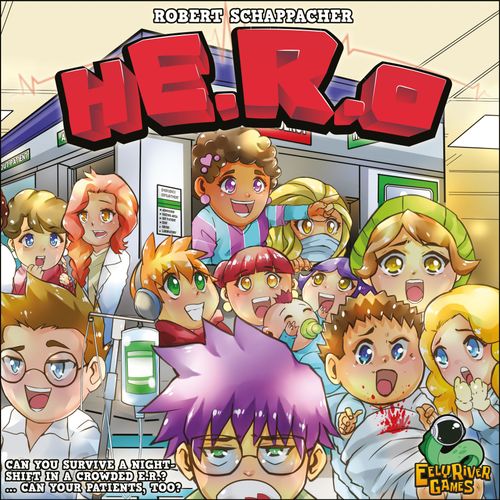
HE.R.O
HE.R.O Rulebook
Table of Contents
Table of Contents
Components
Cards and miniatures
Heroes: Heroes are your playable characters. There are 8 of them, with their corresponding character cards and miniatures. On the cards you will find your primary resources and special skills. Then use arrows to show primary resources (physical labour force, surgical skill, knowledge of internal medicine and knowledge of neurology — see The Resources below) and special skills.
Staff/NPCs: Staff members are hospital workers who you cannot control directly. You will find 32 cards and corresponding miniatures. All effects on a staff card affect the whole room they are in and you MUST respect their effects (if a card states, you may use an effect, only then it is not a must).
Consultants: These are special staff members and never show up in the hospital unless you specifically call them. Once they are on the board, they are treated like all other staff members.
Patients and Journals
Patients
Treating patients is your primary objective in the game. At the start of every round and of every player turn, new patients will show up (usually). On their cards, you will find several information:
- Timer: indicating how many rounds you have left to treat said patient.
- Chaos tokens: that EVERYBODY will receive, if you fail to treat the patient in time.
- Skills: needed to treat the patient. You will need to have all the skills indicated on the card at your disposal to treat the patient successfully. Sometimes, patients offer different ways of treatment. In that case, you have to chose one of the options and present all the required skills.
- Reward: Heroic deed tokens you will receive if you were the player treating the patient.
- Clinical Notes: special effects that the patients bring into the game and can either be beneficial to you or get you into even more trouble.
- Freeloader Reward: Heroic deed tokens you will receive for just being there (in the same room), while treatment takes place.
Journals
Journals are your primary upgrade cards and immediately increase your skills for the remainder of the game. Keep them at your HERO card, so you can keep track of your skills.
However, even doctors have their limits. If not indicated otherwise, HEROes can only keep 4 journals in their mind. If you ever read a fifth journal, you have to discard another one.
(Exception: some journals give you a sleep token instead. Immediately take a sleep token and discard the journal. This does not count against your limit of 4 journals per player.)
Tokens
In HE.R.O you have to keep track of some tokens. These are:
- Sleep tokens: indicating how much sleep you got during your night shift.
- Chaos tokens: indicating how much chaos you caused during your night shift.
- Timer tokens: indicating how long you have time to treat a patient.
- Heroic deed tokens: indicating how many patients you treated during your night shift.
The Board
The Game clock
On the very top of the board you will find the game clock. You can decide at the very start whether you want to play a regular night shift or a short night. Every hour on the clock represents one round in the game. Whenever a card or a rule refers to a round, it also refers to an "hour" and vice versa.
A regular night shift would take 12 rounds while a short night would only take 8 rounds. Don't worry though, a game will not really take you multiple hours to complete.
After you decided on your game length, put one timer token on either the 12 for a regular game or on the 8 for a quick game.
Hospital Staff track
Located on the left of the board, you will find the hospital staff track as well as a spot for the hospital staff deck of cards. This tracker will show you for how long staff members will be at your aid.
Rooms
The board represents the hospital, in which you have to work your night shift. It consists of a few separate rooms. You will find the following rooms:
- The Operation Room: The best room to perform surgeries. In here, you get +1 surgical skill.
- The E.R.: This is where new patients show up. You have 10 treatment stations available in the E.R. Note, that the whole E.R. is treated as one single room. Keep an eye on those freeloaders around!
- The intensive care unit: +1 knowledge of internal medicine.
- The hallway: The hallway connects all other rooms. This is where new staff members show up every round (not the consultants though).
- The library: Here you can read journals and upgrade your skills.
- The on-call room: This is where you sleep.
The Resources
To perform your heroic deeds and save patients, you'll have to keep track of these resources:
- Physical labour force: Some conditions require many hands to be successfully treated.
- Surgical skill: Some conditions require not only many hands, but skilled hands. As soon as a patient requires surgery, you'll need some surgical skill.
- Knowledge of internal medicine: This is the common base for almost all conditions. You'll need some.
- Knowledge of neurology: As soon as the patient's nervous system is involved, you should have at least some basic knowledge about the nervous system.
Before you start: Before you start your game, please note that there are two ways to play HE.R.O. You can either play fully cooperative or you can play a competitive game.
Set-Up
- Place all HERO figures in the Hallway. Every player also takes his Hero card as well as a bag.
- Shuffle the staff cards. Then place two cards on the "three-hours-to-go"-part of the hospital staff track.
- Place the corresponding staff miniatures in the hallway.
- Place the Consultant cards face up on the "consultants" spot on the game board.
- Shuffle the patient cards and place them on the field marked "patients" next to the E.R.
- Shuffle the journal cards and place them on the field marked "journals" in the library.
- Put the heroic deed tokens, the chaos tokens and the sleep tokens next to the board.
- Put a timer token on either the 12 hour or 8 hour field on the top of the board, as described before.
- You're all set. Now go save some lives!
The Game
Actions
Players may perform up to 3 actions during their turn.
- Move: Move your HERO to an adjacent room. You may take one (and only one!) staff member with you. You may also take a patient with you and get one chaos token.
- Run: Move your HERO twice for a single action and one chaos token. During the run, you may move one (and only one!) staff member for any part of the way. You may also take a patient with you and get an additional chaos token.
- Study: In the library, take a journal card from the deck.
- Sleep: In the on-call room, receive one sleep token. If you sleep three times during a single turn, receive four sleep tokens instead of three.
- Treat a patient: If in the same room as a patient, check your skills and those of all staff members in your room. If you fulfil the requirements, discard the patient and get the reward indicated in the upper right corner. All other HEROes in the same room will get the freeloader reward indicated in the lower right corner of the patient card. You may only treat one patient per action, regardless of your skills.
- Look around: If in the E.R., draw another patient card.
Example: Kenta and Janique want to reach the E.R. Kenta spends 2 actions and moves twice. Janique decides to run and gets one chaos token. Both of them would be able to take the paramedic with them to the E.R. for free. If they decided to move the patient to the E.R. as well, they would receive another chaos token, for a total of 1 chaos token for Kenta and 2 chaos tokens for Janique.
Example: Rob wants to treat a patient. He checks his skills and has enough surgical skill to treat the patient. He could also treat the patient with physical labour force because he has staff help. Rob receives four heroic deed tokens and all other HEROes in the same room would receive two heroic deed tokens.
Getting help
"Call for Help": Once per turn, you may call for help. You can either move one staff member from anywhere on the board to your room for one chaos token or you may take any of the consultants and put his miniature on the board in your room for one chaos token. A Consultant will stay for the remainder of the round and will count as a staff member for all purposes.
"Counsel": Add the skills of one other HERO to yours when treating one patient.
Example: Alex wants to treat this patient. He takes Tyler for a counsel to combine their skills. After treatment, Alex receives the reward of two heroic deed tokens. Tyler receives double the amount for freeloading, so he too receives two heroic deed tokens. All other players in the same room receive one heroic deed token.
Note: You can either call for help or for a Consultant, but never both in the same turn. There can always only be ONE consultant present at a time!
Turns and Rounds
In the first round, the player with the biggest collection of medical books will be the starting player and receive the starting player token. Each round will have the same series of events:
- New Patients: Patients arrive at the E.R. Draw the respective number of patient cards and put them on free spots in the E.R. Put a number of timer tokens on the card as indicated in the upper left corner. If there is no free spot left in the E.R., all HEROes receive one chaos token as indicated in the lower left corner of the patient card discarded. The number of new patients is determined by the position of the timer token on the timeline:
| Round | 1 to 4 | 5 to 8 | 9 to 12 |
|---|---|---|---|
| Patient | One | Two | Three |
- Player turns: in clockwise order, starting with the starting player. At the start of each player turn, another patient shows up!
- Discard one timer token from each patient. If a patient has no timer tokens left, remove his card from the board and all HEROes will receive a number of chaos tokens as indicated in the lower left corner of the patient card.
- The consultant leaves: remove his figure from the board and put the card back on the consultant stack.
- Advance the hospital staff track by removing the cards and miniatures of staff from the one hour to go part of the hospital staff track and moving all other staff down one hour. Then draw two new staff members and put their respective miniature in the hallway.
- Advance the timer on the timeline.
- The starting player token will be passed to the next player on the left.
Clarifications
Treating a patient: Only the active player can treat a patient. Whenever a card refers to treating a patient, only the active player is meant. The player whose turn it is treats this patient with a counsel while another player is in the same room. Only the active player, who performed the action treating a patient will receive a journal. The others will get heroic deed tokens as described before, but no journal.
Negative effects: Some cards have negative effects. While in the same room, these effects do affect you, even if (well... especially if) you don't want to!
Number of actions: You may only perform 3 actions per turn. If any card makes you spend an extra action on anything, you may never do this as your last action (as this would effectively grant you 4 actions!).
Optional effects: Some effects are optional. In that case, you may use these effects, but you don't have to. And yes, this means the Retired Consultant may trigger the effect of the paramedic :)
Consultants
Consultants are never in play at the beginning of a round. If they get called in, they will stay for the remainder of the round. As soon as their miniatures are on the board, they count just as all other staff members (and can then be called for help for just one chaos token).
Their card goes back to the consultant stack face up after the round so they can get called in again in the next round.
End of the Game (Competitive Game)
Once all twelve hours of the night shift have been played, players will open their bags. First, count all the sleep tokens.
After a regular game (a 12 hour shift)
Every player who did not sleep at least 6 times is too tired to report to his superiors and is immediately eliminated. Discard these 6 sleep tokens.
For each sleep token you have left over, you can now discard one chaos token from your bag.
After a short game (an 8 hour shift)
Every player who did not sleep at least 4 times is too tired to report to his superiors and is immediately eliminated. Discard these 4 sleep tokens.
For each sleep token you have left over, you can now discard one chaos token from your bag.
After every game (regardless of the length)
Then, count all your chaos tokens. If a resident caused too much trouble in the hospital, there is some serious punishment looming. Depending on the amount of chaos tokens a resident collected, he must discard heroic deed tokens following the table:
| Chaos tokens | 0 | 1 | 2 | 3 | 4 | 5 | 6 | 7 | 8 | 9 |
|---|---|---|---|---|---|---|---|---|---|---|
| Heroic deed tokens discarded | 0 | 1 | 3 | 5 | 7 | 10 | 13 | 16 | 20 | 25 |
For each additional chaos token, a player loses an additional 5 heroic deed tokens (example: for 13 chaos tokens, a player would lose a total of 45 heroic deed tokens).
Winning the game
Afterwards, count your heroic deed tokens. The player with the most tokens will win the game.
Special Rules (For a Cooperative Game)
During a cooperative game, players will work together to survive a never ending flood of patients. All the rules mentioned before apply, with some minor changes.
- Players don't use pouches. Every token will be kept open on the table.
- There are no freeloader tokens in a cooperative game.
- If patients leave the hospital (in one way or another), the whole party of players will receive the indicated chaos tokens on the patient card once (not once for each player).
- As soon as the players reach a certain amount of chaos tokens, they immediately lose the game. The amount of chaos tokens at which players immediately lose is 4+ the number of players. (2 players would lose the game as soon as they reach 6 chaos tokens, while a 4 player party will lose at 8.)
| Players | 2 | 4 |
|---|---|---|
| Chaos tokens at which the party loses | 6 | 8 |
- To negate a chaos token, you have to sleep. For each HERO in your team, you will need one sleep token to negate a chaos token (chart with sleep tokens needed to negate chaos tokens: 4-player party = 4 sleep tokens per chaos token, 2-player party = 2 sleep tokens).
- For a successful game, you need not only survive the night shift, but bring in a certain amount of heroic deed tokens:
- Beginner players: 40 heroic deed tokens per player.
- Intermediate players: 50 heroic deed tokens per player.
- Expert players: 60 heroic deed tokens per player.
Additional Rules for Experts
- You may only counsel once per round instead of once per player turn.
- You may only call for help once per round instead of once per player turn.
Trivia
Did you know that a "Man-Flu" is a real threat to all of mankind? It has a low survival chance, but luckily women are completely immune.
Did you know that there really is a diagnosis called Maple Syrup Syndrome? It is a metabolic disorder and causes thick, brown urine.
Did you know that there are several ways to treat a nosebleed? Depending on the cause, you can lower the blood pressure, stop it mechanically or surgically.
Did you know that our pharmacist can give you a red or a blue pill? Well, he does.
... to be continued
Quick Reference
Game Round
- New patients: 1-3 at the start of the round + 1 at the start of each player turn.
Player turns:
- up to 3 actions
- up to 1 call for help OR a consultant
- up to 1 counsel
After all player turns:
- advance round track
- remove 1 timer token from each patient
- advance hospital staff track
- pass starting player token clockwise
Actions
- Move (to adjacent room) — one chaos token
- Run (to next but second room) — one chaos token
- Study (in library only)
- Sleep (in call room only) — one sleep token
- Treat patient
- Look around (new patient)
Editor's note: the Quick Reference prints two chaos tokens for putting a consultant from outside the board into your room. The Call for Help rules on the main pages print one chaos token for the consultant (as well as for the staff member). The main-page rule is transcribed above; the Quick Reference figure is reproduced here as printed for comparison.
Call for Help
- Move one staff member from anywhere on the board to your room — one chaos token.
- Put any consultant from outside the board to your room — two chaos tokens (as printed in the Quick Reference; see note above).
Counsel
Add the resources of another player in your room to your own for a treatment. The helping player receives twice the freeloader reward.
End of Game
- Discard 6 sleep tokens (4 if it was a short night shift).
- Discard 1 chaos token for each additional sleep token.
- Count chaos tokens.
- Discard heroic deed tokens in accordance to your remaining chaos tokens (see the table under After every game above). Each additional chaos token will make you discard another 5 heroic deed tokens.
- Count heroic deed tokens.
All players who fail to bring in enough sleep tokens or who have 10 or more chaos tokens are immediately eliminated!
Note: this Quick Reference page is reproduced from the printed rulebook; its "Counsel" and "End of Game" wording differs slightly from the main-page rules above, which take precedence where they differ.
Credits: the printed rulebook's closing "About the game" page is a designer and thank-you note and has been left out of this transcription.