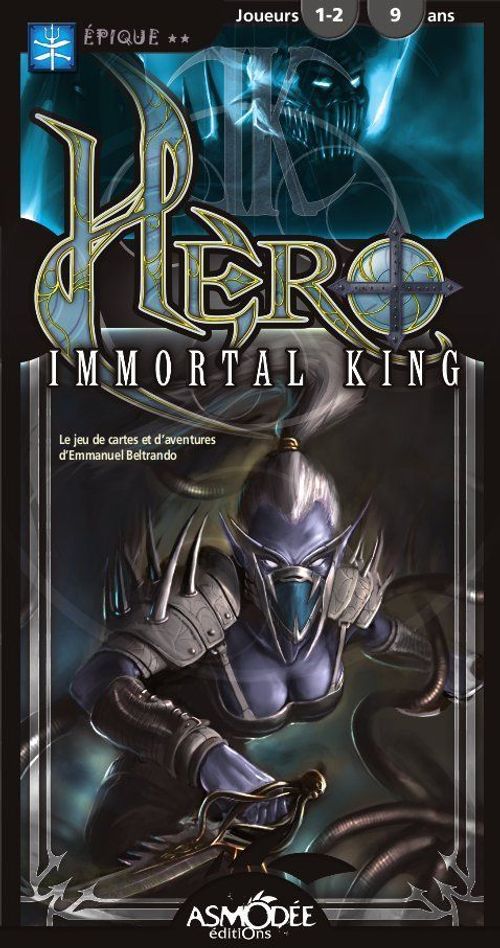
Hero: Immortal King – The Infernal Forge
Hero: Immortal King – The Infernal Forge Rulebook
Table of Contents
Table of Contents
Contents
- 4 adventurer cards
- 7 equipment cards
- 48 dungeon cards
- 1 final monster card
- 1 six-sided die
- 1 eight-sided die
- 4 Mana tokens (blue)
- 4 Tenacity tokens (yellow)
- 10 Courage tokens (red)
- 10 Fear tokens (black)
Goal of the Game
The player who leads the group of adventurers must fight and defeat the dungeon's final monster. The player who runs the dungeon must rout or block the group of adventurers so that they do not reach their goal.
Description of the Components
Adventurer Card
Each adventurer card shows six pieces of information: its name (1), its type (2) and its gender (3), which are keywords used by other cards; a gift (4), which works permanently; a temporary power (5), whose use requires spending a Mana token; and an ultimate power (6), which may only be used on very rare occasions.
There are 4 types of adventurers: warriors, priests, rogues and sorcerers.
Example: the Shana card (type: Rogue).
- Gift: +3 to odd combat rolls.
- Temporary power: reroll one die of the combat roll in progress, OR replay a rock/paper/scissors game you have just lost.
- Ultimate power: fetch the Assassin's Dagger (Dague d'assassin) from your collection and place it face up in play without paying its cost, OR place a Courage token on the Assassin's Dagger. The Courage token placed on the dagger comes from the supply, not from the total of Courage tokens held by your group.
- Quote: "She knows her weapons well." – Ichi Fu Mi
Example: the Malicia card (type: Sorcerer).
- Gift: +1 to combat rolls for each face-up undead card.
- Temporary power: destroy the monster you are fighting and lose 1 Courage token.
- Ultimate power: destroy a face-up monster and gain 1 Courage token.
- Quote: "She is even more dangerous on her own." – Goblin rumour
Using Gifts and Powers
Each adventurer has one gift and two powers. The gift is a permanent ability. To use its temporary power, an adventurer must spend its Mana token. A character may only use its ultimate power during an equipment phase of the turn. To do so, it must spend one or more dungeon cards previously won by the adventurer player (see page 10). The number and type of cards required depend on the number of adventurers in the group. If the group has 1 character, it must spend one green, one yellow, one blue and one red dungeon card (shown on page 3 of the printed rulebook as four icons). If the group has 2 characters, it must spend two of each colour, and so on.
Equipment Card
Each equipment card shows 2 pieces of information: its name (1) and its effects (2) in game terms.
Example: the Potion of Courage card (Potion de courage). Cost: free. Effect: gain 2 Courage tokens.
Using Equipment Cards
There are 3 types of equipment cards: potions, items and quests. Revealing an equipment card (and therefore triggering its effects) may require spending one or more dungeon cards previously won by the adventurer player (see page 10). The number and type of cards required are shown on each equipment card as icons similar to those found on dungeon cards.
Potions can only be used once (they are discarded after being revealed). They may be revealed and used at any time.
Items (weapons and armour): once revealed, the equipment card is placed face up beside the adventurer cards and its effects are permanent. Items may only be revealed during an equipment phase.
Quests: once revealed, the equipment card is placed face up and its effect is resolved. Afterwards, the adventurer player may trigger its effects again by paying the number of dungeon cards indicated. There is no limit to the number of times a quest may be triggered during a game. A quest may only be revealed and used during an equipment phase.
Dungeon Card
Each dungeon card shows six pieces of information: its name (1), its type (2), its family (3), its Power (4), any special abilities (5) and, in some cases, its Mana icon (6).
Example: the Orc Founder card (Orc fondeur). Type: green. Family: Greenskin. Power: rock/paper/scissors icon in a 2-player game (solitaire value 4). Special ability: Demons +1.
There are 4 types of dungeon cards, identified by colour: green (vertes), yellow (jaunes), blue (bleues) and red (rouges). There are 6 families of dungeon cards: demons, undead, dragons, Greenskins, bullœils and traps. Bullœils are only found in the Den of Dementia (antre de la folie). There are no traps in the Lair of the Lich. (Transcriber's note: this last sentence is printed as is in the Infernal Forge rulebook, but it names the Lair of the Lich, a different set. The Infernal Forge dungeon does contain trap cards, such as the Spiked Pit (Fosse à pointes) and the Goblin Engineer (Gobelin ingénieur) with its Traps +1 bonus, so the sentence appears to be carried over from the Lair of the Lich rulebook. It is transcribed unchanged here.)
Final Monster Card
The final monster card shows 4 pieces of information: its name (1), its family (2), its Power (3) and a special ability (4).
Example: the Tzu card (family: Demon – final monster). Power: 10. Special ability: if at least 3 face-up dungeon cards are demons, the adventurer player loses 1 Courage token. Usable only once per game.
Setup
One player leads a group of adventurers; in these rules this is called the adventurer player. The other player leads the dungeon, its traps, its creatures and its final monster; this is called the dungeon master.
- The adventurer player chooses the characters with which they will face the dungeon. They must choose between 1 and 4 characters and place the corresponding adventurer cards in front of them, face up. Once this choice is made, they may add between 1 and 4 equipment cards, knowing that the group must consist of exactly 5 cards in total (no more, no fewer). The chosen equipment cards are placed face down on the table. The adventurer player may look at them at any time, but only reveals them when using them.
- The dungeon master shuffles the 48 dungeon cards and forms 3 face-down piles in the middle of the table. Each pile must contain 16 cards. These three piles represent the three corridors that the adventurers must take to reach their goal. No player may look at them. The dungeon master places the final monster card face up in front of them.
- Starting tokens are distributed:
- The dungeon master starts the game with 1 Fear token for each character in the adventurer player's group.
- The adventurer player starts the game with 5 Courage tokens in front of them and 1 Mana token on each of their adventurer cards.
- Finally, the dungeon master turns face up the top card of each of their piles. These are the first three encounters the adventurers may face. These 3 cards are placed respectively in front of the 3 piles, representing the guarded path (see the diagram on page 7 of the printed rulebook).
Turn Sequence
The principle of the game is simple: each turn, the group of adventurers tries to defeat one of the 3 encounters placed in front of it by the dungeon master. Usually this involves a dice roll. When dungeon cards are defeated, the adventurer player keeps them nearby so that they can later trigger the effects of their equipment and/or ultimate powers. As the game progresses, the three piles of cards will shrink. As soon as one of the piles is completely empty, the path is clear and the group of adventurers may try to kill the dungeon's final monster. If the group is demoralised before that happens (that is, if it no longer has any Courage tokens), the adventurer player has lost the game.
Usually, when the adventurer player tries to defeat a dungeon card, they roll 1d6 and try to obtain a result greater than or equal to the Power of the dungeon card. But as you will see below, it is not all as simple as that, since all characters have gifts and powers that modify this basic rule.
The game is divided into an indeterminate number of turns. Each turn, the three phases detailed below must be carried out.
Transcriber's note: the printed text says "the three phases detailed below", but four phase headings follow (construction, equipment, combat and end of turn). All four are transcribed as printed.
Construction Phase
The dungeon master looks at the top dungeon card of each of their 3 piles. They may then choose to swap two of the three piles.
Attention: whole piles are swapped, not only the cards that were looked at! If a corridor is empty (no cards left), only the piles of the other two may be swapped.
Mana Token Management
To use its temporary power, an adventurer must discard its Mana token. To regain it, its group usually has to fight and defeat a dungeon card bearing a Mana icon. Each such marked dungeon card yields only one Mana token when defeated. An adventurer may never hold more than one Mana token. Mana tokens cannot be transferred from one adventurer to another.
Equipment Phase
During this phase, the adventurer player may reveal their equipment cards. Characters may also use their ultimate powers. In all cases, the cost of activating all these actions must be paid by discarding dungeon cards bearing the matching symbols (see page 4 of the printed rulebook). Unless stated otherwise, dungeon cards eliminated during this phase through a quest or an ultimate power are handled in the same way as those eliminated during the combat phase.
Courage Token Management
At the start of the game, each group of adventurers has 5 Courage tokens. Each time the group loses a combat, it loses one Courage token. When the adventurer player no longer has any Courage tokens, their group is completely demoralised and they have lost the game. A player may not hold more than 10 Courage tokens.
Combat Phase
The group of adventurers chooses a corridor and tries to defeat the encounter in it. If the card in that corridor is face up, the adventurer player already knows what they are facing. If not, the dungeon master turns the card face up at the start of the combat.
All the adventurers fight at the same time, and with a single dice roll against the encounter thus revealed. Unless a special rule states otherwise, the combat is resolved by rolling 1d6.
Characters may use their gifts, their already-revealed weapons and armour, their temporary powers (by spending their Mana) and any potions, before or after rolling the die. Items may not be revealed, ultimate powers may not be triggered and quests may not be used during this phase.
If the final result is greater than or equal to the Power of the dungeon card, the card is defeated and the adventurer player keeps it nearby. They may later spend it to pay the cost of a quest, an item or an ultimate power. The dungeon master must then replace the defeated card with the top card of the pile immediately behind it. Normally, the new card is placed face up, but the dungeon master may at that moment use their ambush and tenacity abilities if they wish (see Fear Token Management below). If the defeated dungeon card bears a Mana icon, the adventurer player may place 1 Mana token on one of their characters.
If the final result (after any applicable modifiers) is lower than the Power of the dungeon card, the characters must withdraw to bind their wounds and recover their strength. The adventurer player immediately loses 1 Courage token and the dungeon master gains 1 Fear token. The attacked card remains in place (exception: traps, see the box below).
Traps are handled as normal dungeon cards, with one exception: if the adventurers fail to obtain a result greater than or equal to its Power, a trap card is nevertheless defeated and kept by the adventurer player. However, they do lose 1 Courage token to represent their failure. Monsters and traps are both dungeon cards, but an effect that specifically affects a monster does not affect a trap, and vice versa. On the other hand, an effect that affects a dungeon card affects both.
Greenskins: the Power of Greenskins is only given for solitaire play (they all have a Power of 4). In a normal 2-player game, all combats against Greenskins are played as a game of rock/paper/scissors (see Annex I), the adventurer player winning all ties.
Fear Token Management
The dungeon master starts the game with as many Fear tokens as there are adventurers in the group. They then gain more according to the following scale:
- Each time the adventurer player loses a Courage token, the dungeon master gains a Fear token.
- Each time the adventurer player rolls a "1" on a die, the dungeon master gains a Fear token.
The dungeon master may spend Fear tokens in the following three situations:
- Ambush (Embuscade): when a new dungeon card is placed in front of the adventurer player (after the previous one has been eliminated), the dungeon master may choose to place it face down by spending 1 Fear token. Usable only during the combat phase.
- Tenacity (Ténacité): when a new dungeon card representing a monster (not a trap!) is placed in front of the adventurer player (after the previous one has been eliminated), the dungeon master may choose to place 1 Tenacity token on it by spending 2 Fear tokens. Usable only during the combat phase. A Tenacity token increases the Power of the monster it is placed on by 1. It is impossible to place more than one Tenacity token on the same card.
- Dire fate (Destin funeste): the dungeon master may spend 3 Fear tokens to force the adventurer player to re-roll a combat die. They must do so before the adventurer player decides to apply a power to that dice roll.
The dungeon master may very well set an ambush and make the same card tenacious by spending 3 Fear tokens in total.
End-of-Turn Phase
During this phase, if the adventurer player no longer has any Courage tokens, the game ends and they have lost. If the final monster has just been killed and the adventurer player still has at least 1 Courage token, they have won the game. In all other cases, a new turn begins.
Special Abilities of Dungeon Cards
- 1d8: the Power of this card is determined by rolling an eight-sided die. Each time the card is attacked, the die is rolled again.
- A: when this letter is associated with the Power of a card, it is equal to the number of adventurers present in the group.
- C: when this letter is associated with the Power of a card, it is equal to the number of Courage tokens possessed by the adventurer player at the start of the combat.
- Demons +X: all dungeon cards of the demon family have their Power increased by X while this card is face up.
- Bodyguard (Garde du corps): when this dungeon card is defeated, the dungeon master may immediately place a Tenacity token on the face-up monster card of their choice (never on a trap).
- Ferocious (Hargneux): when this dungeon card has a Tenacity token, it gains a Power bonus of 2 (instead of 1).
- M: when this letter is associated with the Power of a card, it is equal to the number of Mana tokens present in the group of adventurers at the start of the combat.
- Final monster: ultimate powers do not work on a final monster.
- Undead +X: all dungeon cards of the undead family have their Power increased by X while this card is face up.
- Nemesis X: this card has two Power values. If the group of adventurers includes a character of type X, the value on the right is used. Otherwise, the value on the left is used.
Clarifications About Adventurers and Their Equipment
You may freely combine several gifts, powers and effects coming from different adventurers or equipment cards. When you are granted a bonus and a multiplier, the multiplier is applied first, before adding the bonus. Note also that a combat roll may only be multiplied once.
When a gift, an equipment card or a power affects an element of the game, it is always the adventurer player who chooses what is affected.
When an effect gives a modifier (for example, +2 to your combat roll), the value is added to or subtracted from the result of the die.
Your "collection" is made up of all the Hero I.K. cards you own that are not being used in the current game.
Example of Combat
Ichi Fu Mi, Ykesha and Shana are on a boat… or rather, in a dungeon.
The dungeon has 1 Fear token. The group attacks a face-down dungeon card that has a Tenacity token, and discovers at the moment of combat a Swarm of Dragonets. Its Power is A×3 (so 9), +1 for the Tenacity token, for a total of 10. The 2 other face-up monsters both bear the Mana symbol, so Ykesha cannot make good use of her temporary power. The 3 adventurers each have one Mana token.
- The group rolls the d8 twice, thanks to the gift of Ichi Fu Mi and of Ykesha.
- Result of the dice = 1 and 1. The dungeon gains 2 Fear tokens (total = 3).
- The group uses Shana's temporary power to reroll a d8, result 7.
- The result of the die is odd, so with Shana's gift the final result should be 10, which is enough to beat the Swarm of Dragonets.
- The dungeon spends its 3 Fear tokens to force the adventurers to reroll this die.
- The group rerolls and gets a 3.
- The adventurers then decide to go all in and use the temporary power of Ichi Fu Mi. The result of the die is cancelled and the combat is now settled by rock/paper/scissors.
- The adventurers play Paper, and the dungeon also plays Paper: a draw, so they replay.
- The adventurers play Paper, and the dungeon plays Scissors. The dungeon wins the combat.
- The adventurers lose 1 Courage token.
Annex I: Rock/Paper/Scissors
Both players simultaneously make with their hand the gesture for paper, rock or scissors. Paper beats rock, but loses to scissors. Rock beats scissors, but loses to paper, and scissors beat paper, but lose to rock. Against Greenskins, in case of a tie, the adventurer player is declared the winner. Otherwise, ties are replayed.
Annex II: Constructed Play
The dungeon you have just acquired is designed to be perfectly balanced with the group of adventurers who will explore it. However, by combining several Hero I.K. boxes, you can create your own dungeons as well as more colourful groups of adventurers. You may also combine several identical boxes.
Dungeon creation rules: the dungeon must contain exactly 48 cards, plus a final monster. There must be 12 monsters of each colour, and within each colour, 6 cards must bear a Mana icon. There is no other restriction.
Adventurer group creation rules: identical to the normal game (exactly 5 cards and at least 1 adventurer), but the cards may be chosen from all the boxes you own. Important note: all adventurers are unique (see below).
Important exception: a card indicated as unique may only be present once in a dungeon or in a group of adventurers.
Annex III: Solitaire Play
Hero I.K. can also be played solitaire. Most rules are identical, but nobody plays the role of the dungeon master. In solitaire, the player builds a group of adventurers and tries to kill the final monster. If they do not manage to do so, they have lost.
After building your group, choose one of the scenarios presented below. The three scenarios are of increasing difficulty. You may create other scenarios or download some from the website www.asmodee.com.
The construction phase does not exist in solo play.
When a dungeon card is defeated, it is replaced by the next one in the relevant pile.
The dungeon starts the game with 0 Fear tokens.
The dungeon does not gain a Fear token when the player rolls a 1 on a die.
Greenskins all have a Power of 4.
When a Ferocious monster enters play, it automatically receives a Tenacity token (without spending a Fear token).
When a Bodyguard monster is defeated, a Tenacity token is placed on the monster in play that has the lowest Power. In case of a tie, it is determined randomly among the lowest. If the lowest already has one, the next monster is chosen. If they all have a Tenacity token, nothing happens.
When a Psi monster is defeated, the player chooses which adventurer loses a Mana token.
Each time the dungeon gains a Fear token, the Destiny scale (échelle du destin) of each scenario is consulted and the effects indicated are applied. Effects printed in italics are cumulative and permanent; the others are triggered only once.
Scenario: Do You Feel the Cold of Steel? (Tu sens le froid de l'acier ?) – Easy
Destiny scale:
- The Greenskins march. Greenskins gain a +1 Power bonus.
- Mental combat. Psi monsters gain a +1 Power bonus.
- Nothing happens.
- General summoning. Demons gain a +1 Power bonus.
- Nothing happens.
- Battle formation. Cards in the central corridor or corridors gain a +1 Power bonus.
- Nothing happens.
- Nothing happens.
- Destruction. All your weapons and armour are destroyed.
- Tzu wins the game!
Scenario: Demonic Alliance (Alliance démoniaque) – Medium
Destiny scale:
- The Greenskins march. Greenskins gain a +1 Power bonus.
- General summoning. Demons gain a +1 Power bonus.
- Nothing happens.
- Last bastion. All cards gain a +1 Power bonus.
- Technological prowess. Traps gain a +1 Power bonus.
- Nothing happens.
- Nothing happens.
- Destruction. All your weapons and armour are destroyed.
- Tzu wins the game!
Scenario: The Impossible Fight (L'impossible combat) – Hard
Destiny scale:
- The Greenskins march. Greenskins gain a +1 Power bonus.
- Last bastion. All cards gain a +1 Power bonus.
- General summoning. Demons gain a +1 Power bonus.
- Nothing happens.
- Nothing happens.
- Technological prowess. Traps gain a +1 Power bonus.
- Destruction. All your weapons and armour are destroyed.
- Tzu wins the game!