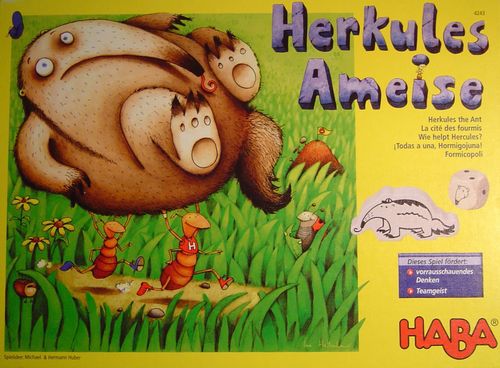
Herkules Ameise
Herkules Ameise Rulebook
Table of Contents
Table of Contents
Contents
- Game board
- Anthony, the anteater
- 19 ants (15 white, 1 red, 1 yellow, 1 green and 1 blue)
- 19 twigs
- 9 path cards
- 6 oval anthill cards (in six different sizes)
- 34 food tiles (showing one, two or three tasty morsels)
- A die
- Set of game instructions
Source note: the printed Contents list says 34 food tiles, while the competition variation below says to shuffle the 36 food tiles. Both figures are transcribed as printed.
Game Idea
You are ants building an anthill. You have to be quick though, as Anthony the anteater is already on his way and only a finished anthill will keep you safe from his long trunk.
The construction of the anthill, however, is not so easy, as first you have to locate the twigs on the back of the path cards by flipping them over. Then the twigs have to be collected and brought to the building site. This has to be done by teamwork, as the twigs can only be transported if a continuous line of ants leads up to them. What's more the twigs lie all scattered about, so the column of ants has to be re-grouped continuously to be able to reach the twigs. The aim of the game is to finish the anthill before Anthony the anteater reaches it.
Preparation of the Game
Place the game board in the center of the table. Shuffle the nine path cards and arrange them randomly in a square (3x3), with the dark green side showing up, next to the side of the game board with the starting square for the ants. Place Anthony the anteater and the 15 white ants on their respective starting squares.
Board labels: starting square for anteater Anthony; building site for the anthill; starting square for the ants.
Place the twigs, the anthill cards and the die next to the game board.
The four colored ants and the food tiles are returned to the game box. They will be needed for the competition variation.
How to Play
Play in a clockwise direction. The strongest player starts. If you can not agree, the oldest player starts and rolls the die.
On your turn, roll the die. Then, depending on the result:
Anthony the Anteater
If the die shows Anthony the anteater, Anthony moves: "Oh dear! Anthony follows the arrow and moves one square towards the starting square of the ants. You have to finish the anthill before Anthony reaches that square!"
One, Two or Three Dots
If the die shows one, two or three dots, you have two options. You can either:
a) Investigate a path card. Turn around a path card with the same number of dots. On the back are squares and also often twigs. Place a wooden twig on each twig shown on the card.
If there is no path card left with the same number of dots as on the die, you don't have any option but to move ants.
b) Move ants. Take the corresponding number of ants (1 to 3) from the starting square and place them on free squares of the path cards. Bear in mind that the column of ants has to lead continuously from the starting square up to a square with one or two twigs (marked yellow). Later during the game you can move ants from the column in order to change the direction of the column.
You don't have to place the total number of ants as dots on the die.
Both sides of the path cards show five squares where you can place ants. The five plates of this card also count as squares.
Then it's the turn of the next player to roll the die.
Collecting Twigs
As soon as a continuous line of ants leads up to a yellow square with twigs, take the twig(s) there and place it on the game board.
As there is a continuous line of ants from the starting square to the yellow square, you can take both twigs.
As there is one ant missing and the line is therefore not continuous, the two twigs can not be taken.
Building the Anthill
The anthill consists of twigs and piled up anthill cards. Here is how it is constructed:
- Place the first four twigs on the corresponding illustrations of the game board.
- Then place the biggest anthill card on top of these twigs. The following four twigs you collect are then placed on this card.
- On top of those you place the second biggest anthill card, where you then place the new twigs you collect. This continues until the last and smallest anthill card has been placed.
The anthill is finished when no anthill card is left. Now you have built a six-story anthill. (You will need 17 of the 19 twigs.)
End of the Game
The game ends as soon as:
- you finish the anthill, thus winning the game together, or
- Anteater Anthony reaches the starting square of the ants before the anthill is finished. In this case you all lose.
Competition Variation for 2 to 4 Players
The rules of the basic game apply, except for the following changes:
Preparation of the Game
- Shuffle the 36 food tiles and place them face down next to the game board.
- Each player takes one of the colored ants and places them next to the other ants on the starting square for the ants.
How to Play
- When it comes to "moving ants" you can change the place of colored and/or white ants.
- You can also move the colored ants of the other players.
- When it comes to "collecting twigs" check to see if there are one or more colored ants in a continuous column from the starting square to the square with the twig(s), as the player(s) in question may take a food tile as a reward and place it face down in front of them.
- A player gets a maximum of one food tile even if there are two twigs on the square to where the column of ants leads.
End of the Game
If Anthony reaches the starting square of the ants before the anthill has been finished, all the players lose.
If the anthill has been finished in time, things get exciting: All the players uncover the food tiles they have collected and count the tidbits. The player who counts the most has been the most diligent helper and wins the game. In the case of a draw, the player who collected the most tiles wins the game. If there is a draw again there are various winners.