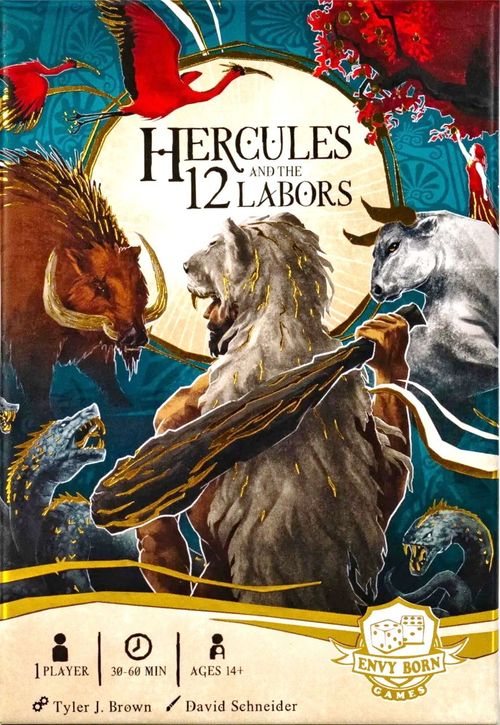
Hercules and the 12 Labors
Hercules and the 12 Labors Rulebook
Table of Contents
Table of Contents
About the Game
You are Hercules, who must accomplish twelve legendary labors. Each trial will test your endurance: roll and allocate dice to defeat mythical monsters and achieve the impossible. Watch your Courage and Divinity levels carefully — if you fail, your journey ends in ruin. But if you overcome every trial and reach the top of the Divinity track, you will rightfully earn your place among the gods of Olympus!
Components
- 56 cards:
- 1 Bow of Hercules card
- 1 Courage and Divinity card
- 14 Legend cards
- 27 Trial cards
- 13 Mood cards
- 15 dice:
- 11 Hercules dice (green)
- 4 Trial dice (gold)
- 1 Courage marker
- 1 Divinity marker
Setup
Sort the cards as described below.
- Trial deck. The Trial deck is made up of Legend cards and Trial cards. They are grouped in order and numbered from 1 to 41 in the lower left corner.
- Mood deck. Set aside the 4 special Mood cards: "Burden of Atlas," "Ghost of Hippolyta," "Ghost of Pholus," and "Ghost of Abderus." You will add these cards during the game. Shuffle the remaining 9 Mood cards and place them nearby.
- Hercules cards. Lay out the "Bow of Hercules" card and the Courage and Divinity card in front of you. Place the Courage and Divinity markers on the starting spaces of their respective tracks (marked with an "X").
- Hercules dice. Take 4 green dice — these are the Hercules dice available to you at the start of the game. Put the remaining green dice and the 4 gold Trial dice into the general supply.
| Difficulty | Starting number of dice |
|---|---|
| Mortal | 5 dice |
| Hero | 4 dice |
| God | 3 dice |
Warning. The "God" mode is incredibly difficult. If you choose it, remove the "You Are Exhausted" Mood card. We do not recommend this mode. You have been warned.
-
Set up the first trial. Read the Legend card "Nemean Lion." Place the "Nemean Lion" Trial card in front of you. Take 1 gold Trial die from the supply and place it on the die space on the Trial card, set to the indicated value (in the case of the "Nemean Lion," 6).
Nemean Lion. The first trial given to Hercules by Eurystheus was to slay the Nemean Lion. This ferocious beast, which terrorized the local people, was the offspring of Typhon and Echidna, and its hide was impervious to any weapon.
On his way to Nemea, Hercules met a poor laborer named Molorchus, who offered him lodging for the night. Molorchus intended to make a sacrifice to the gods for Hercules's success against the lion. But Hercules told him to wait: if he returned victorious, they would make the sacrifice together in honor of all-seeing Zeus; but if he did not return within thirty days, Molorchus could honor him as a fallen hero.
Hercules then set out and tracked the lion for several days. Having finally found the beast, he drew his bowstring, took aim, and loosed an arrow.
Your play area should now look like the setup diagram in the rulebook.
Now you are ready for your first trial.
Card Structure
Trial Card
- Card title. The number and name of the labor Hercules must face.
- Attack method. The specific die values or combinations needed to deal damage to the trial.
- Trial's starting health. When setting up the trial, place the Trial die here set to the indicated value. (Some trials use several such dice.)
- Card number. Helps you lay out the cards correctly when setting up a new game.
- Defeat condition. If a Trial die reaches the skull symbol, you have lost — the game is over.
- Trial consequences. The symbols on these spaces show the trial's effect on Hercules (see "Trial Consequences" below).
Reward Card (back of the Trial card)
- Card title. The name of the reward for completing the labor.
- Reward bonus. The benefit you gain immediately upon receiving the reward.
- Blue abilities. Let you change the values shown on your dice. Each can be used once per roll, but only before Gold abilities.
- Gold abilities. The dice stay on the card's spaces and produce various effects. Each can be used once per roll, but only after Blue abilities.
- Courage cost. Used when starting from any trial (see "Starting a Game from Any Trial").
Gameplay
In Hercules and the 12 Labors, you must pass through 12 trials, each harder than the last. However, completing each labor earns you a reward that will help you in the trials to come.
Trial dice. Each Trial card has spaces for one or more dice. To successfully complete a labor, you must reduce the value of every one of these dice to 0 before any of them reaches the skull symbol. To do this, you must roll your Hercules dice and achieve specific results (the attack method), as shown by the white symbols on the Trial card. Each successful attack reduces the value of one Trial die by 1.
In each trial, go through the following steps:
-
Mood card. Before the trial, draw a Mood card and apply its effects. When you complete the trial, discard this card and shuffle it back into the deck. Mood cards have various effects, positive or negative, that affect how the trial plays out. A Mood card's effect lasts only for the trial before which you drew it. (The effects of these cards relating to dice do not stack.)
If a Mood card instructs you to add or remove a Hercules die, this applies only to the current trial. Once you complete the trial and discard the Mood card, you get that die back.
-
Roll all of your available Hercules dice.
-
Change die values. You may place Hercules dice on the blue spaces of the "Bow of Hercules" card and/or on Reward cards you have obtained, to activate their abilities (see "Blue Abilities" below).
-
Allocate dice. Place your Hercules dice either on gold spaces, to activate their abilities (see "Gold Abilities" below), or on the Trial card, to deal damage (see "Attack Methods" below).
Dice placed on the Trial card (but not dice on gold spaces) deal damage to that trial.
-
If you have reduced the value of every Trial die to 0, the labor is complete! Flip the Trial card(s) over and choose one of its Reward cards, discarding the rest.
Place the new reward next to your other rewards and gain its bonuses (see "Reward Bonuses" below). Then move on to the next trial.
-
If the value of the Trial dice has not reached 0, move them to the next spaces. Immediately apply the trial's consequences, shown by the symbols at the dice's new positions (see "Trial Consequences" below).
Blue Abilities
Blue abilities let you change die values after the roll (see "Blue Abilities" below). Place a die on a blue space and change its value. Each die can be placed on only one blue space, and each blue space can be used only once per roll. Blue abilities can only be used before Gold abilities.
Gold Abilities
Once you are done with Blue abilities, you may activate Gold abilities. For this you may use either dice you have applied Blue abilities to, or dice with unchanged values. Among the effects of Gold abilities are canceling damage, boosting Divinity, and restoring Courage (see "Gold Abilities" below). Each Gold ability can be used only once per roll. Dice used for Gold abilities remain on their spaces.
After applying all abilities (Blue and Gold), you may place any unused dice on the trial's image to deal it damage.
End of Game
To win, complete all 12 labors while also reaching the top of the Divinity track. Then Hercules ascends to Olympus to take his place among the gods.
If you have not reached the top of the Divinity track, you have lost.
Starting a Game from Any Trial
If you have been defeated but want to keep playing, or you wish to take a break and resume the game from a particular trial, do the following.
Set up the game as normal.
Take the Trial cards and find, among them, all of the Reward cards that come before the trial you want to start from (for example, if you want to start the game on the 8th trial, gather the rewards for labors 1 through 7).
Choose which Reward cards (no more than one per labor) you want to keep, and pay their cost in Courage (shown in the lower right corner of the card): move the Courage marker down that many spaces.
Gain the bonuses from the chosen cards (Hercules dice and Divinity boosts), except for Courage bonuses.
Add to the Mood deck any special cards indicated on the chosen Reward cards. Disregard any effects that instruct you to discard other Reward cards.
Example: choosing this copy of the "Rattle of Athena" card will lower your Courage by 1, but boost your Divinity by 1 and add 1 Hercules die.
Attack Methods
To deal damage to trials, roll dice and achieve specific results.
- The value on the die matches the one shown.
- The value on the die matches either of two shown values.
- Any two dice with matching values.
- Any three dice with matching values.
- The sum of the values on the dice equals the indicated number.
- Three dice showing the values 1, 2, and 3.
- Three dice with any consecutive values (for example, 3, 4, and 5).
- Four dice with any consecutive values (for example, 2, 3, 4, and 5).
- The product of the values on two dice equals the value of one other die, or the sum of the values of several other dice.
- The sum of the values of two dice equals the value of a third die.
- The sum of the values of two dice, one of which shows a 3, does not exceed the value of a third die.
Trial Consequences
- Lower Courage by 1 for each broken-heart symbol.
- Add 1 to the value of this Trial die for each such symbol (but not above its starting value). Multiple symbols: resolve the effect of each.
- Until the end of the trial, remove 1 Hercules die for each broken-die symbol.
- While the Trial die is on this symbol, damage cannot be cancelled.
- Weaken Divinity by 1 for each flame symbol.
- Move the remaining Trial dice forward 1 space.
- Defeat. The game is over.
Reward Bonuses
- Raise Courage by 1 for each heart symbol.
- Add 1 Hercules die to your available dice.
- Boost Divinity by 1 for each flame symbol.
Blue Abilities
- Lower Courage by 1 to change this die's value up or down by 1. (You may change a 6 to a 1, or vice versa.)
- Place a die here (it becomes unavailable until the next dice roll) to change the value of any other die to any other value.
- Place a die here to reroll any other dice.
- Lower Courage by 2 to count this die as 2 dice with the same value. (You may use them as ordinary dice: for example, one for a Gold ability and the other to deal damage.)
- Change this die's value from 6 to 3, or from 3 to 6.
- Reroll this die.
- Change this die's value to any other value.
- Change an odd value on this die to any even value, or an even value to any odd value.
- Increase this die's value by 1.
- Flip this die to its opposite face.
- Change this die's value up or down by 1.
- Count this die as 2 dice with the same value.
Gold Abilities
Gold abilities produce 3 types of effects: cancelling damage, restoring Courage, and boosting Divinity.
Place the die matching the symbol on the gold space to receive the reward shown on it. Such a die cannot be reused — it stays on its space until the next dice roll.
Cancel damage. When applying a trial's consequences, cancel the effect of 1 broken-heart symbol for each shield symbol.
Restore Courage. Raise your Courage by 1 for each heart symbol.
Boost Divinity. Boost your Divinity by 1 for each flame symbol.
Clarifications
- Some cards instruct you to remove, for the rest of the game, any previously obtained Reward card or a specific Mood card. Cards may also add special Mood cards to the deck. The Mood deck can never hold more than 9 cards at once.
- Trial cards show lightning bolts that indicate the direction the Trial dice move. Dice always move along the lightning bolts from the thick end to the thin end. Some trials offer several paths (branching lightning bolts). When you reach such a fork, choose freely which space to move the Trial die to next.
- If a Trial die activates a health-restoring symbol, its value can never exceed its starting value on that die.
- The Cretan Bull's starting health value is 12. Place 2 dice showing a value of 6, stacked, on the starting space.
- If a trial has several dice and a single roll lets you deal damage to it more than once, you may distribute the damage however you like.
- The Erymanthian Boar, the Stymphalian Birds, and the Cattle of Geryon are special trials: defeating each of them requires several different attack methods. For each die, you must use the attack method shown next to its starting space.
- The "You Are Sorrowful" Mood card reduces every rolled value by 1 on each dice roll (a value can never drop below 1). This effect does not apply when you use a reroll.
- The "You Are Enraged" Mood card increases every rolled value by 1 on each dice roll (a value can never rise above 6). This effect does not apply when you use a reroll.
- The "You Are Haunted by the Ghost of Pholus" Mood card is placed on top of 1 Reward card of your choice — you can no longer use that Reward card's abilities. When you complete the trial, remove the Mood card and shuffle it back into the deck.
- The "You Are Haunted by the Ghost of Hippolyta" Mood card instructs that whenever a die shows a 1, you must immediately set that die aside — it can no longer be used during the current roll. This effect also applies to dice that show a 1 on a reroll.
Designer Notes
Hercules, Herakles, or Heracles?
In the Greek myths and legends that inspired us, this mighty but suffering demigod is called Hera-kles, meaning "for the glory of Hera," since he performed his labors by the will of the goddess who hated him.
In the English edition of the game, the designer chose the more widely recognized Roman form of the hero's name in Western countries — Hercules. In the Russian translation, we kept the traditional Russian form of the name — Herakles (Геракл).
Recommended Reading
The game was inspired by countless sources and retellings of the life, labors, and struggles of Hercules. If you would like to learn more, we recommend the following:
- Apollodorus, The Library.
- Stephen Fry, Heroes: The Myths of the Ancient Greek Heroes Retold.
- N. A. Kun, The Labors of Hercules: Myths of Ancient Greece (recommended by the editors of the Russian edition).
Acknowledgments
The designer thanks his wonderful wife Francesca for her constant support and playtesting, as well as the rest of his family and his furry "sons" — the cats Zazu and Prufrock. The designer also gives special thanks for help at various stages of the game's creation to: Alan Gerding, Delton Brack, Dominic Duhamel, Paul Marchbanks, and Luke Otfinowski.