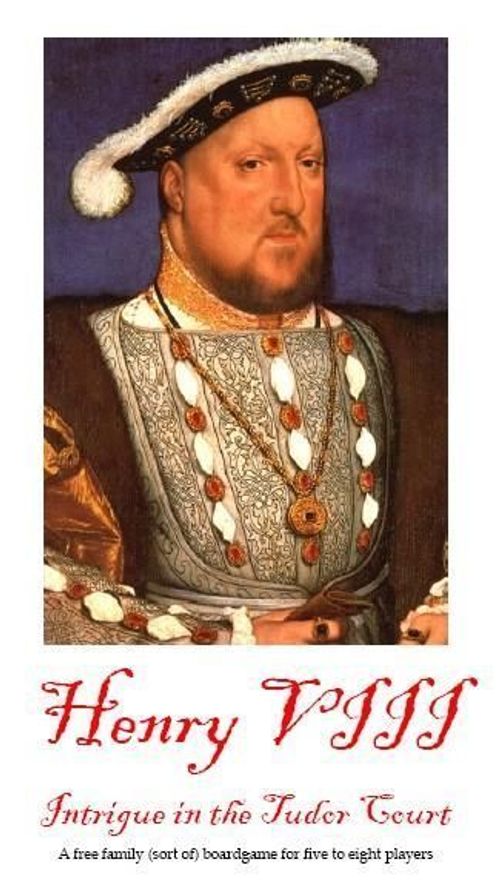
Henry VIII: Intrigue in the Tudor Court
Henry VIII: Intrigue in the Tudor Court Rulebook
Table of Contents
Table of Contents
Introduction
Henry VIII: Intrigue in the Tudor Court is a game for five to eight players. Each player runs a Faction competing for influence at King Henry's court. Each Faction consists of several Characters. You take the role of the mastermind of your Faction. Henry himself is represented by the game system as whole.
Henry was notoriously capricious, so the conflicting results thrown up as Factions compete mirror his style of government quite well, really.
The aim of the game is to be the Faction with the most Influence at Henry's death. Henry may have been a vicious old bastard, but he was no fool. No Faction can attain dominance while Henry lives, but must look beyond to achieve power.
Usually this will mean controlling the senior Heir, as well as having several influential Characters who have high Office.
The game starts well into Henry's reign, just before he became discontented with his wife, Catherine of Aragon. It ends in the Turn Henry dies, which is a variable event. Each Turn represents five years.
A game will typically be four Turns long.
Sidebar: Items in brown (like this) are changes or clarifications from the last edition of the rules.
Sidebar: Influence is shown on the various cards in the pink-purple box at lower right.
Components
- A set of Character cards.
- A set of Court cards. You use these to conduct an Endeavour in your Turn, or to Support your own Endeavour, or to support or hinder another player's Endeavour.
- A set of cards showing Offices (Bishop, Secretary, etc) and Titles (Duke, Marquess, etc).
- Special Endeavour cards, such as The Secretary Orders the Rack. Keep these to remind you of an Office's special functions.
- Succession cards. Use these to mark Heirs in the Line of Succession.
- A Board.
- A set of markers.
Sidebar: The Board contains a track round the outside to keep note of total Faction Influence. It's not essential to game play, but its nice to know who's winning.
How to Win
The winning Faction is the one with most Influence at the end of the Turn in which Henry dies.
Exception: If there is no one in the Line of Succession at the end of the last Turn, a minor civil war such as occurred with Lady Jane Grey versus Mary Tudor breaks out. The result is unpredictable and everyone loses.
Setup
Place cards onto the Board
- Place Tudor Heirs (Henry's potential children) in the Tudor Heirs space on the board.
- Place Succession cards in the Line of Succession space on the board.
- Use only those characters listed for the number of players in the game.
- Place all Titles into the Titles space on the board.
- Place Offices into the Vacant Offices space on the board.
Setup the Board Tracks
| Item | Value |
|---|---|
| Game Turn Track | Turn 1 |
| Tudor Heirs | All Tudor Heirs except Mary Tudor |
| Tower of London: Imprisoned Characters | None |
| Tower of London: Arrested Characters | None |
| Vacant Offices | All except those on 'At Start' characters |
| Titles | All except those on 'At Start' characters |
| Line of Succession | All cards except Succession 2 |
| Henry's Matrimonial Contentment | 0 |
| The King's Religion | C1 |
| Court Deck | All court cards |
Deal initial playing hands
-
Use only those characters listed for the number of players in the game.
Sidebar: Example: If you have 6 or more players, use the Characters marked "5+ Players" and "6+ Players".
-
Allocate the Characters marked 'At Start*' (At Start asterisk) as evenly as possible to each player (as shown below). These are the major characters in the game. This ensures that most people have at least one good character.
-
Allocate the remainder of the 'At Start' (At Start no asterisk) Characters. Factions who missed out on an asterisk Character in step 2 should be given an extra Character now to compensate. Exception: Mary Tudor is given to the player with Queen Katherine.
-
Allocate as evenly as possible the remaining Characters marked with an entry Turn. Place them face down in front of each Faction. They will activate at the beginning of that Turn.
-
Assign each character their initial Title, Office or Succession card.
-
Place markers on the Board to denote total Faction Influence.
"At Start" Characters who have Titles or Offices
Not all of these may be in play for a five or six person game. Ones marked with an asterisk are powerful Characters who are distributed before others.
| Character | Title | Office |
|---|---|---|
| Thomas Boleyn | V Rochford | – |
| Charles Brandon* | D Suffolk | President of the Council |
| Henry Clifford | E Cumberland | – |
| Catherine of Aragon* | – | Queen |
| Henry Courtenay* | M Exeter | – |
| John Fisher | – | Bishop of Rochester |
| William Fitzalan* | E Arundel | Chamberlain of the Household |
| Henry Fitzroy* | D Richmond | – |
Game Sequence
The game consists of a series of Turns, each Turn representing five years.
- Henry Segment
- Determine if the Act of Supremacy is passed.
- Characters may return from Beyond the Realm.
- Remove all assigned Law Suit and Investigations Cards.
- Check for Henry's death.
- Check for the birth of a Tudor heir.
- Determine Henry's Matrimonial Contentment.
- Turn over new Characters and assign Court Cards.
- Player Rounds
- Death Segment
1. Henry Segment
A. Determine if the Act of Supremacy is passed
Starting with Turn 2, the Act is automatically passed if, at the beginning of the Turn:
(a) Henry has a Queen and (b) Henry does not have a living son (that is, male Tudor Heir), by this or a previous Queen.
When the Act is passed:
- Remove the Cardinal card from play.
- Set Henry's Matrimonial Contentment to -2.
- Set the King's Religion to P3.
Sidebar: The Annulment Endeavour can only be played after the Act of Supremacy is passed.
Sidebar: Barring some misfortune (or an unlikely birth) to Queen Catherine on Turn 1, the Act will be passed on Turn 2.
B. Characters may Return
Characters can return from Travel Beyond the Realm.
Sidebar: Characters travel Beyond the Realm as a place of refuge. You may want to stay there.
C. Remove all Law Suit and Investigation Cards
D. Check for Henry's Death
See Turn Record track. Henry dies if a 2d roll is ≥ the listed number. Do not check in Turn 1.
The game finishes at the end of the Turn in which Henry dies.
Sidebar: 2d means roll two dice. 1d means roll one die.
Sidebar: You will have one Turn in the knowledge that Henry is on his deathbed.
E. Check for the birth of a Tudor Heir
If Henry has a Queen, an Heir is born if 2d ≤ Queen's Baby Value. The Heir joins the Queen's faction and takes her Religion.
If an Heir is born:
- Roll 1d for sex: 1-4 – Girl, 5-6 – Boy.
- Allocate the next available Tudor Heir card (Prince or Princess).
- Roll 1d for death of the Queen in childbirth: 1-2 – Queen dies.
- Assign a Succession card. See 'Heirs and Succession' for details.
Sidebar: The Queen cannot produce an Heir if she is in the Tower.
Sidebar: The card limit is absolute: no more cards, no more heirs.
Sidebar: Important: You also check for a birth immediately after Henry marries.
Sidebar: A high Baby Value denotes a fertile woman.
F. Roll for Henry's Matrimonial Contentment
If Henry is married, roll on the table below to see how happy he is with his Queen. Do this even if the Queen is in the Tower. If Henry is not married, his Contentment is -2 (he just hated being single!).
| Roll | New Contentment |
|---|---|
| 6+ | +2 |
| 4,5 | +1 |
| 2,3 | 0 |
| 1 | -1 |
| < 1 | -2 |
Roll on the table above.
Die-roll modifiers:
- +3 if a living son by this Queen
- –3 if no male Heir of any sort in the Line of Succession (Tudor or not, by this or any other Queen)
- +1 each Lady of the Bedchamber any Faction cares to play
- –1 each Revulsion any Faction cares to play
-
- old Contentment (if same Queen from last Turn)
Sidebar: Contentment really only effects the player with the Queen. That player must add the Contentment to all Endeavours. If Henry is unhappy, you might be in trouble.
Sidebar: If played on the Queen, the Annulment, Investigation and Trial cards are modified by the Contentment.
G. Turn over new Characters and assign Court Cards
-
Characters due to appear this Turn are turned over and join their Faction.
-
Discard any cards you had left over from the previous Turn. Every Faction then receives 5 (five) cards. Reshuffle the deck if there are insufficient cards.
Sidebar: The Treasurer's faction receives one extra card.
2. Player Rounds
Determine Player Order
The first player is the Faction with the Queen, then clockwise. If there is no Queen, it is the Faction with least Influence.
Conducting a Round
Play is conducted in Rounds. A Round consists of each Faction playing one Endeavour (a Player Turn).
Sidebar: Because Court cards can also be used as Support cards, some Factions may run out of Endeavours to play before others.
Starting with the Queen's Faction, each Player may play (and resolve) a single Endeavour, plus any number of Support cards.
The Player Turn: Playing an Endeavour
You must play an Endeavour in your part of the Round, or discard a Court card. You can also play one or more Support cards to aid you.
After you have played your Endeavour (and Supports), the next player can then play one or more Support card, and so on back to the original player. Support cards are played until no one wants to play any further cards. A Support card can only be played with the Endeavours listed at the bottom of the card.
The Endeavour is then resolved.
Sidebar: You can use a Court card as one or the other – not both.
Sidebar: It is important to realise that you can play any Endeavour to aid yourself or to aid or hinder any other player.
Resolving the Endeavour
Every Endeavour has a Difficulty.
You must achieve a number of Action Points at least equal to its Difficulty for the Endeavour to succeed.
Action Points are made of:
-
A 1d roll.
-
Modifiers for Ability, Guile, etc. These are shown on the upper-left of the Endeavour. They may be +ve or –ve, and may depend on the target of the Endeavour.
Sidebar: Some Cards mention Religious Difference (RelD). For example, the Religious Difference between a C1 (Catholic) and a P3 (Protestant) is 2. Usually this is a negative modifier.
-
Contributions from Support cards. These are the number on the Support Card's upper right. Contributions may make the Endeavour easier or harder to achieve. Note: With some cards, the player may choose whether they are plus or minus (eg Henry's Ear).
Sidebar: Support cards can only be used with the Endeavours listed at the bottom of the card. (eg "Evidence of Heresy" can only be used with "Warrant of Arrest" or "Trial")
Sidebar: Any Support Cards played are lost.
-
If you have a My Lord's Man, you must use his Ability minus 2. (This could be negative).
-
If you have the Queen, you must add Henry's Contentment (this could be negative).
Completing the Rounds
Rounds end when no one has any Endeavours to play.
3. Death Segment
Roll for each character to see if they die.
A character dies if a 2d roll is ≥ Death Roll.
Modifier:
- The Current Turn number.
Sidebar: Important: There is no death phase on the last Turn.
Sidebar: Example: Thomas Howard has a Death Roll of 14. It is Turn 3. He will die if 2d + 3 ≥ 14, that is, a roll of 11 or more.
Sidebar: As the game progresses, older characters are more likely to die.
Characters
Each Faction consists of a hand of Character cards. Every Character has an Influence rating, amongst others. A Faction can add to its Influence by winning over Heirs and other Characters.
Sidebar: A Character acquires Influence by getting an Office and/or Title.
A Character Card
Thomas Howard has an Influence of 3. He has the highest Ability and Guile of 4, and is a moderate Catholic (C1).
The card also shows the character's turn of entry (At start in this case), the die roll that will see them die (on a 14 or more), and the size of game they are used in (5 or more players).
Thomas Howard also starts the game with the Duke of Norfolk title.
(Card diagram labels: Title; Influence.)
Ability, Guile and Religion
Every Character is rated for Ability, Religion and Guile.
In general, Guile gets you places; but Ability keeps you out of trouble. Whether being Catholic or Protestant is good depends mainly on Henry's theological leanings at the moment.
Henry was always reluctant to get rid of capable people, but he was always susceptible to wily ones. So Guile will get you offices or marriage, but Ability keeps you from prison or death.
Hence both Anne Boleyn and Katherine Howard have a high Guile rating. Katherine may have been able to work her way into Henry's heart, but she was quite stupid about other dalliances, so her Ability rating is low. Anne was a bright and capable woman, so her Ability is high. Unfortunately, Henry preferred his women deferential and dumb. As soon as Jane Seymour appeared on the scene, Henry quickly tired of Anne's championing of the New Learning and other Protestant causes.
Sidebar: The higher the Ability or Guile the better.
Sidebar: Religion is rated from C (Catholic) 0 to P (Protestant) 4. A '2' is pretty much neutral.
Nobles, Royals and Commoners
A Noble is anyone with a Title shown under their name, such as Duke of Norfolk. Only males are Nobles.
Some Nobles have children who will acquire their Title when they die. In these cases, the Noble with '1' starts off with the Title (such as Duke of Norfolk 1), and when he dies, the Noble with '2' immediately inherits (such as Duke of Norfolk 2).
A Royal is the Queen and the Tudors: all of Henry's children. The Lord High Steward presides at the trial of Royals and Nobles.
Everyone else is a Commoner. The Lord Privy Seal presides at their trials.
Sidebar: In peerage law only the current holder is a Noble, but for this game everyone who could inherit the title is a Noble.
Sidebar: Some Offices are reserved for Nobles, and some for Commoners. Note that Bishops, Archbishops and the Cardinal are Commoners.
Minors
A minor is not a 'minor character', but someone who has not attained their majority (eighteen, or whatever it was in the early 1500s).
A Minor cannot be executed, attainted or married. They can be arrested and sent to the Tower.
Almost all characters who arrive as 'reinforcements' after Turn 1 do so in the Turn they historically turned 18.
There are a few exceptions to this, namely Frances Brandon and Jane Grey. These were descendants of Henry VII (not VIII) who at one time or another were advanced as claimants to the throne, usually for the Protestant cause. Since their claim exists from birth, they enter the game in that Turn. However, they remain minors until the Turn listed on their card.
Sidebar: A Tudor Heir attains his or her majority three Turns after birth. For example, a Tudor Heir born in Turn 2 achieves their majority at the start of Turn 5.
Women
I'm sorry, but women have only one function in this game, and that is to marry Henry, and to produce an heir for him. Rather like it really was back in 1525, when you think of it. For this purpose, every women has a Baby Value.
Sidebar: The higher the Baby Value, the more likely it is that the woman will produce an Heir.
Sidebar: You should try and marry one of your women to Henry so she will be Queen and produce Heirs for your Faction.
Sidebar: Try to marry off other Faction's women so they are not available for Henry.
Heirs and Succession
Some Characters are designated as Heirs, such as Henry's children (Tudor Heirs). At the start of the game Henry has only one child, Mary. He may have others.
Some other Characters are also possible Heirs (Non-Tudor or Noble Heirs). These are the remnants of the House of York (the Tudors themselves were the nearest that the House of Lancaster had to heirs).
An Heir is only useful if they are in the Line of Succession, as denoted by being assigned a Succession card. An Heir is placed into the Line of Succession in two ways:
- A child born to Henry is automatically given a Succession card.
- Another Heir successfully plays an Act of Succession Endeavour.
The higher up the line an Heir is, the more Influential he or she is. A woman can never be assigned the Succession 1 card.
Heirs have an Heir Credibility. The higher the Credibility, the easier it is to place them in the Line of Succession.
Heir Credibility can be positive (for Henry's children) or negative (others).
Sidebar: Succession 1 is the best card.
Sidebar: You should try to get any Heirs you have placed into the line using an Act of Succession Endeavour.
Sidebar: Thus it is easier to get one of Henry's children into the line of succession than non-Tudor heirs, and harder to convict them of anything.
Sidebar: Since the non-Tudor heirs have a negative Credibility, this give them a positive modifier (negative a negative) when on Trial (which is bad news for them).
If someone in the Line dies, everyone below them shuffles up one place. Change cards appropriately.
The Queen and Marriage
It may seem obvious, but the Queen is the woman married to the King. A woman remains Queen even if imprisoned or under arrest. Only an Annulment or death releases the bonds of marriage, and Henry cannot re-marry until that happens.
Sidebar: If played on the Queen, the Annulment, Investigation and Trial cards are modified by the Contentment.
When Henry marries
- Roll immediately for Matrimonial Contentment.
- Then roll immediately for Birth of an Heir.
Sidebar: If Henry is displeased with the Queen (negative Contentment), then it may be in your interests to get rid of her. The preferred manner would be an Annulment or a sad death because of illness. If she is imprisoned or executed, your Faction suffers a hard penalty.
During the marriage
Faction controlling the Queen always adds the Contentment to an Endeavour's Action Points (this could be a negative value).
On the birth of a Tudor Heir
The child is initially controlled by faction controlling the Queen. Its religion is the Queen's religion.
See the Act of Succession rules.
Loss of the Queen
A Faction controlling the Queen suffers a penalty if any of these things happen to the Queen:
- Adverse result from a Trial.
- Act of Attainder.
The controlling faction loses one Office (choose randomly), and half its hand of Court cards (round up).
The penalty is applied only once to the Faction, regardless of what else happens to her.
Endeavours and the Queen
Some Endeavours (such as trying to Arrest the Queen) are specifically modified by the Matrimonial Contentment. If such cards are played by the Faction with the Queen, this is in addition to the normal modifier they must use.
Court Cards
The Court Cards are the heart of the game.
Each player receives five Court cards each Turn. These are the player's resources. Each Court card has two halves: an Endeavour half and a Support half.
During your Round, you can play a single Court card as an Endeavour to do some action. You can also use one or more of your Court cards as Support cards to assist your Endeavour.
Every other player can also play a Court card as a Support Card to aid or hinder you.
During another player's Round, you can play a Court card as a Support to aid or hinder them.
Sidebar: You can only use a Court card as one or the other – not both.
Sidebar: It is important to realise that you can play any Endeavour to aid yourself or to aid or hinder any other player.
A Court Card
A court card has two halves. The left is the Endeavour card side (Assume Office), and the right is the Support card side (Parliamentary Support). You can play a card as either an Endeavour or a Support. Once played, the card is returned to the deck.
You can only play an Endeavour in your Turn. It has a Difficulty (5 here). When you play it, you also add the target Character's Guile to your Action Points.
You can play a Support in anyone's Turn. It has an Action Point modifier (+1 here). The list at the bottom shows which Endeavours it can be used with (Act of Attainder, Annulment, etc).
(Card diagram text: "When you play this Endeavour, you add the Target's Guile to your Action Points." Support box note: "You can use this Support card only with the Endeavours listed here.")
Assigned Cards
A card with this symbol is assigned to a character. Place it under the character. All other cards are discarded once played. With the exception of Investigation and Law Suit, the card stays there until removed by another Endeavour.
Spy Cards and Fee'd Men
If a card with this symbol is removed from a player's hand using the Fee'd Men card, it may be immediately played against the player losing the card. They have been harbouring dark secrets. Play immediately as a normal Endeavour. Any other player can play Support cards.
Sidebar: Fee'd Men were servants paid a fee to act as spies in noble households. In effect, many Tudor magnates ran small spy networks.
Endeavours
Each Endeavour has a Difficulty. Your Endeavour succeeds if you gain at least a number of Action Points equal to the Difficulty. You get Action Points by rolling a die, and by using Support Cards. Other Players can lower your Action Points by playing Support Cards against you.
Some Endeavours affect the game as a whole. Others affect individual Characters. These Characters are referred to as the Target Character.
Endeavours like this usually require you to add or subtract the Ability, Guile or Religion of the Character you are targeting.
Some Endeavours require you to add or subtract Henry's Matrimonial Contentment (if played on the Queen).
Sidebar: If you have the Queen, you must add Henry's Matrimonial Contentment as Action Points to any Endeavour you do.
Important: You Can Play an Endeavour on Any Faction
You can apply any Endeavour to any Character or Faction in the game, yours or another's. For example, you may play a Marriage Endeavour to marry a women in your Faction to King Henry – which is a good thing. Or you could play the Marriage on two Characters in another player's faction, to remove the woman as a possible wife for Henry – which is a bad thing.
Or, for example, consider the Diplomatic Mission card. This will give a reward or penalty to the Character when they return, depending on their Ability. You could play this on one of your own Characters with high Ability, to obtain the reward. Or you could play it on a low Ability Character in another Faction, so that they are penalised upon return.
Sidebar: The words "you" or "your" on an Endeavour refer to the Faction upon whom the card is played – not the Faction playing it.
Endeavour Examples
Arrest
You play an Arrest Warrant on Thomas More (the Target Character), who is the Speaker of the House. According to the card, you can only do so if (1) You or someone else simultaneously plays an Evidence Support or if (2) Thomas already has an assigned Investigation card.
Thomas is not under Investigation. A friendly Faction plays an Evidence of Heresy as a Support card. This also gives you a +1 to your Action Points (upper-right value). The Endeavours that can be used with this Support card with are noted on the bottom of the Evidence card. If they wished, your friend could have saved this card and used it with a Trial Endeavour.
But Evidence of Heresy can only be used if the Character is of a different religion to Henry, as the card notes. At the moment, shall we say, Henry is a "2" (note that "2" is neutral between Catholic and Protestant, and hence does not get a prefix) and Thomas is a "C0". The Support card is therefore playable. Being Speaker does not help Thomas with an Arrest Warrant.
The Endeavour's Difficulty is 3. That is, you must gain at least three Action Points (the Endeavour's Difficulty) for the Endeavour to succeed.
The Action Points so far are:
| Item | Value |
|---|---|
| Thomas More's Ability | -4 |
| Evidence | +1 |
| Total Action Points | -3 |
You are sitting on –3 Action Points looking to get three. The chances are slim: you will succeed only if you roll a 6 on the dice. Fortunately, another Faction plays a Henry's Ear card to help you. This gives you another plus 1 Action Points, leaving you sitting on -2. Still not too good: now you need a 5 or 6 on the die to arrest Thomas.
Trial
You play a Trial Endeavour on Edward Courtenay. The Trial President is the Lord High Steward, George Talbot, who is in your faction. Naturally, he will vote for conviction. Earlier in the Turn, Edward was Racked. He implicated himself. This gives another +1 Action Point at his trial.
You also play a Parading Royal Descent support card, which gives another Action Point in your favour. The player controlling Edward plays a Parliamentary Opposition, in a bid to help himself.
The total Action Points so far are:
| Item | Value |
|---|---|
| Trial President | +1 |
| Heir's Credibility: Minus –2 = | +2 |
| Rack | +1 |
| Parading Royal Descent | +1 |
| Parliamentary Opposition | –1 |
| Total Action Points | +4 |
You need either 6, 8 or 10 points to get a conviction. You roll a 4 for a total of 8 (4 die roll + 4 APs from modifiers). Edward is executed.
Notes on Some Endeavours
Trial Card
Action point modifiers for this card are:
- Plus/minus 1: Trial President, at his discretion.
- Minus Heir's Credibility (if an Heir is on trial). For Heirs with a negative Heir Value, the net result is to make it more likely they will be found guilty.
- Minus Matrimonial Contentment (if the Queen is on trial)
Plus any modifiers from a previous Racking.
If you have no Action Point modifiers for a Trial, you will need to roll a 6 to get any sort of conviction. Moral: Get some Evidence support cards, and make sure the Trial President is on your side.
Sidebar: A Minor or Foreign Wife cannot be executed or attainted. They are imprisoned instead.
My Lord's Man Card
It pays well to have others helping you in your Endeavours. If you have a My Lord's Man (henchman), you must also add their Ability minus 2 to every Endeavour you play. Naturally, you will try to get an able My Lord's Man. But someone else may play an Endeavour saddling you with an idiot My Lord's Man.
You can have several My Lord's Men. A My Lord's Man helps (or hinders!) only his own Faction. The card is lost if the Character dies or is in the Tower.
Sidebar: For example, you may be stuck with someone with an Ability 1. Then you would lose one Action Point (1-2 = -1) in every Endeavour you play!
War Card
War was a means to attain glory. Henry probably would have regarded a successful war against Scotland, France or the Empire as his greatest achievement. Alas, he had puny wars and no luck. His wars were only great a drain on England.
The War Endeavour is only useful if you or others play a Captaincy support card. The point is that the Character with the Captaincy will either win or lose the war. If they win, they receive a Title. If they lose, their Faction loses a Court card.
Sidebar: Try playing a War card, then use a Captaincy Support card to send an idiot from your opponent's Faction to lose a battle.
Example: You play a War card (Difficulty of 2) and a Captaincy support, using William Fitzwilliam as your Captain. The War's Difficulty is 2. An opponent plays a Bad Health and a Duplicity. Your Action Points so far are:
| Item | Value |
|---|---|
| William's Ability | +3 |
| Bad Health | -1 |
| Duplicity | -1 |
| Total | 0 |
You need to get 2 Action Points, and are standing on zero. You roll a 2, for a total of 2. You have attained glory in the War (just), and can award William a Title. Had you lost, the shame forces your Faction to lose one Court card.
Pilgrimage of Grace Card
This was the most serious uprising in Henry's reign. Amongst its varied and muddled aims was the idea of putting a Catholic (back) on the throne. You play this like a War card.
First, you roll for every Catholic male (C0 or C1) in the game to see if they join the rebellion. They use the card's Difficulty of 2, with their Guile as a negative Action Point modifier. That is, wily Catholics will stay loyal. This defines the set of rebels. They don't actually do anything, except wait for victory or defeat.
Sidebar: Don't bother reading this until someone plays it.
Example: Thomas Howard is a moderate Catholic (C1), so he must roll. He has a Guile of 4. When the Pilgrimage is played, he decides whether to join the rebellion. His total Action Point modifier is –4, because of the Guile. He rolls a 5 on the dice, for a total of 5-4= 1 Action Point. This is less than the Difficulty of 2, so Thomas stays loyal. He's no fool.
The Rebellion
Second, you must try to defeat the rebellion. Any player with a Captaincy can use it with one of his or her loyal males. They play it as a normal Captaincy, against the Difficulty of 2.
- If every Captaincy is defeated, the rebels win. The game ends immediately with Henry's overthrow. The winner of the game is the Faction with the senior Catholic (C0 or C1) in the line of Succession. If there is no such person, England sinks into civil war and everyone loses.
- Otherwise, the rebels are defeated. They are all placed under arrest in the Tower.
Sidebar: If no one has a Captaincy card, assume there is a nominal Captain with an Ability of 1. If this Captain is defeated, the rebels win.
The Tower: Arrest and Imprisonment
These are two different things. Someone under arrest is awaiting Trial, Attainder, Amnesty or License of Release. They do not count for your Faction Influence, but they might get out.
You only become imprisoned as a result of a Trial. You can only get out with a License of Release.
A Character in the Tower loses his My Lord's Man card.
Sidebar: Both sad conditions are referred to as being 'in the Tower'.
Act of Attainder (or Attainder Trial Result)
An Act of Attainder was a form of parliamentary execution. Henry often used it when he thought a trial would be embarrassing or might not go the way he wanted it. A Character can be attainted either by the Endeavour, or by a Trial result.
Execution is bad, but attainder is worse. If one of your Characters is attainted, a randomly selected member of your Faction gets the jitters and deserts you for the Faction playing the card. Further, if the attainted character has a Title, it is lost forever. It does not pass to his heir.
Use the Act of Attainder endeavour as an alternative to a Trial. It has a low Difficulty, and the only modifier is the Target's Ability (the more able a potential victim is, the harder it is get an Attainder).
The Act of Attainder also exists as a Support card. In this case, you can play it when someone plays an Execution or Royal Progress Endeavour.
Sidebar: Surprisingly, trials for heresy and other matters in Henry's reign weren't that biased. A lot of accused people were actually acquitted.
Sidebar: Henry was always reluctant to get rid of able men.
Annulment Card
You will find that an Annulment is only likely if the senior Bishop is a Protestant (P3 or P4) and Henry is displeased with the Queen (negative Contentment).
Sidebar: One of your aims should be to remove that devout Catholic William Warham as Archbishop of Canterbury and give the job to a compliant Protestant (say, how about Cranmer?).
Take Oath Card
After the passing of the Act of Supremacy, many subjects were required to take an oath acknowledging that Henry was head of the Church in England. Some staunch Catholics who put principle above life refused and were executed for treason.
You therefore actually want this Endeavour to fail. Play it on a devout but guile-less Catholic in an enemy Faction (hey, how about Thomas More?)
Act of Succession Card
You may attempt to assign a Line of Succession card to an Heir by playing this card. You can use a Succession card already assigned to a Character, or an unused one. The higher up the Line the better, of course, but you may not want to antagonise other Factions.
If you use an already assigned card, the previous holder moves one down the Line, and everyone below him or her shuffles one down as well. If necessary, use unassigned Line cards.
Sidebar: Tudor heirs are more likely to be put into the Line than non-Tudor heirs.
Sidebar: A woman can never be Succession 1.
Offices and Titles
Offices
One important way to gain Influence is to gain an Office. Offices may be awarded only to a male.
Sidebar: A Tudor Heir or a Minor cannot have an Office.
An Office that is lost returns to the Vacant Offices box.
A Character can have any number of Offices.
An Office Card
You place this card under the Character. It gives the Character an extra 1 Influence, as shown in the rectangle at lower right.
The Secretary also gets one free Rack Endeavour each Turn (not each Round). Keep the special Secretary's Rack card to denote this.
List of Offices
Most Offices have a corresponding Endeavour or Support card. Play the Endeavour or Support when you want to use the Office's special function.
| Office | Notes |
|---|---|
| Chancellor | His faction cannot be subject to a Law Suit. |
| President of the Council | May play one Arrest Warrant Endeavour each Turn. |
| Lord Keeper of the Great Seal | May play one Investigation Endeavour each Turn. |
| Lord High Treasurer | One extra Court Card each Turn. |
| Lord Privy Seal | Presides at Trials of commoners. |
| Principal Secretary | Commoners only. One Fee'd Men Endeavour each Turn. |
| Secretary | Commoners only. One Rack Endeavour Turn. |
| Lord High Steward | Presides at Trials of Nobles and Royals (Tudors and Queens). |
| Chamberlain of the Household | Can void the Play of any one Endeavour card each Turn [Support card] |
| Speaker of the House | Commoners only. Can play one Parliamentary Petition each Turn [Support card]. |
Religious Offices
A Religious Office (Cardinal, archbishop, bishop) can only be awarded to a Commoner.
After the Act of Supremacy, the Cardinal office is removed from play.
The senior bishop decides if a marriage can be annulled or not.
Sidebar: Only a Protestant is likely to annul a marriage.
Sidebar: The Cardinal is never the senior religious office.
Titles
The order of Titles is Duke, Marquess, Earl, Viscount, Baron.
A Title can be awarded to a male character who has no higher Title. A Character can advance only two ranks at a time. Commoners may advance to directly to Viscount.
Upon the death of a character the Title passes to the heir (as shown on the card), if any.
A Character can hold only one Title at a time.
Sidebar: A Tudor Heir cannot be awarded a Title.
Sidebar: A character with a religious Office cannot be awarded a Title.
List of Endeavours
Note: You will have to make 1, 2 or 4 copies of each sheet as noted on the particular sheet.
In the list below, "(Spy)" marks cards bearing the spy symbol, and "(Assigned)" marks cards that are assigned to a character.
- Accident – Nominate a character, or King Henry. They are seriously injured in an accident. Roll immediately as per usual Death roll.
- Act of Attainder (Spy) – Execute an arrested or imprisoned character. One frightened member of the unfortunate faction defects to the faction playing this card (random choice). Minors, Tudor heirs and foreign wives cannot be attainted. See Attainder rules.
- Act of Bastardy – All the living children of a current or previous Queen (as you choose) are declared bastards. Remove their Succession cards. Subsequent children of the same Queen are not affected.
- Act of Six Articles – -1 Henry's Theology (Catholic). Every Faction loses 1 card for each point of religious difference between Henry and its most influential Character.
- Act of Succession – See body of the Rules.
- Amnesty – Release all characters arrested (not imprisoned) in the Tower. Any character Travelling on the Continent may return.
- Annulment – Allows Henry to annul his marriage. Not possible until the passing of the Act of Supremacy. After that, may only be played by the senior bishop. The Queen becomes Henry's "Dear Sister" and gracefully retires to her estates. Remove the Queen card. Henry can remarry. If the bishop fails to obtain an Annulment, one Character in his Faction is placed under Investigation.
- Arrest Warrant (Spy) – You can only play this on a character already under Investigation, or together with a Evidence support card. Character goes to the Tower and remains there until Released, Tried or Attainted. Character loses any Office. Character does not count towards Faction Influence total.
- President of the Council gets one Arrest each Turn.
List of Support Cards
| Support Card | Notes | AP Modifier |
|---|---|---|
| Act of Attainder | See body of the Rules. | 0 |
| Bad Health | This can be used either to modify a Death Roll or to modify the success of certain Endeavours. | -1, -2 |
| Captaincy | Needed to captain an army. Conduct an Endeavour, using the War card's Difficulty. The Captain succeeds if he gets APs equal or greater to the War's Difficulty. | + Char's Ability |
| Duplicity | ||
| Evidence of Adultery | Playable only on the Queen. | +x |
| Evidence of Conspiracy | Playable on any character. | +x |
| Evidence of Heresy | Playable only on a character whose religion differs from Henry's. That is, only Character's of exactly the same religion as Henry are immune. | +x |
Production Notes
You will have to print and cut-out the cards (sorry). Please note that some of the Court Card sheets must be duplicated 2 or 4 times. This is indicated in small print on the card sheet face. There is also an optional sheet for card reverses. They are upside down because my printer double-sides things that way. I'm sure you'll be able to work out how to do it in your printer.
I printed out the lot on my little HP Deskjet and had a copyshop cut them for $20. It was worth it. I used up one and a half small colour cartridges to do the lot (the reverse sides use a bucket of ink, as you can see).
You will need Adobe Acrobat Reader which, since you are reading this, you already have.
The pages are designed for A4 paper, but you can fit them to US paper sizes by checking the Fit To Page box in the print dialog.
The Board is available for either A4 or US Letter. Do not check the Fit To Page box in Adobe Acrobat reader's print dialog when you print this. If you do so, you will get a very eeny-weeny board printed on a single sheet.
I am sure these rules are full of holes. Any problems, please feel free to email me at the address given on my website archsoc.com. I had a lot of fun doing this game, and I have tried to make it as "historical" as possible, while keeping it quick for a multi-player game. Historical issues we could argue until we are blue in the face; rules and playability problems are my own concern.
Historical and Gamer's Notes
Clearly, this is not a game about Reformation England. The social and political consequences of Henry's turn away from Rome, and matters such as the dissolution of the monasteries were in version one of the game, but never quite fitted in. So I made it a game about intrigue in the court of Henry, not a game about England's social history, nor about its foreign policy.
I have built in the religion factor in several ways, but not as a massive change in the social fabric. As far as I can tell, my treatment of religion fits in pretty well with what happened at Henry's court, which is the subject of this game.
I used the very best sources (ahem!): the great old BBC series Six Wives of Henry the Eighth, a grand 'autobiographical' novel about Henry whose author I forget, several histories that I have also forgotten; and a range of bits and pieces, including Debrett's (or was that Burke's?) peerage, the incomparable Dictionary of National Biography, a whole bunch of books with great colour plates, and the delightful L'Isle Letters for period colour. I did a lot of research, but I didn't spend ten years on the thing. I think the game is no worse for that.
Any Tudor historians out there who want to quibble—design your own game.
The game started off as a simpler and smoother version of Avalon-Hill's Down With the King. I like that game, but I like this one better. I know there seem to be a lot of rules here, but I think you will find that the mechanisms are quite clean and simple.
Footnote: Where, unlike so many other historical series I have seen, they actually used actors who were the spitting images of the people they were depicting. Those playing Norfolk, Cranmer and Cromwell were perfect! Keith Michel was a tad off, but what the hey?