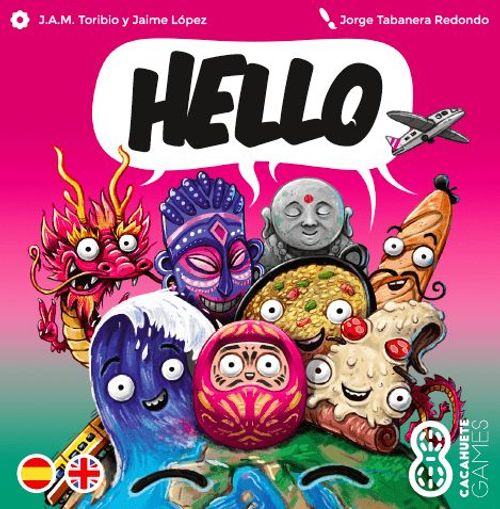
Hello
Hello Rulebook
Table of Contents
Table of Contents
Components
The game consists of 70 cards:
- 8 greeting types in 6 colours (48 cards)
- 2 gesture types in 6 colours (12 cards)
- 4 plane tickets
- 4 train tickets
- 1 airport
- 1 train station
Box information: 2-6 players, 10 minutes, age 6+.
Setup
Place the train station card and the airport card in the centre of the table, separated so that everyone can reach them.
For games of 3 or 4 players, before dealing, remove all the cards of one colour of your choice (the game is played with 5 colours). For games of 2 players, remove 2 colours of your choice (the game is played with 4 colours).
Shuffle the other cards face down and deal them equally among the players. Each player forms a face-down draw deck in front of them with their cards. In games of 3 to 6 players some players will have one extra card; don't worry about it.
Example setup for 4 players: For 4 players, remove all the cards of one colour. Then shuffle the remaining cards (not including the train station and the airport) and deal them equally among all the players.
How to Play
The player who said hello most recently starts. Play proceeds in turns.
On your turn, reveal the top card of your draw deck by flipping it face up toward the front, and place it in front of your deck so that it is visible to the other players. Always turn the card so that its face is visible to the other players. If there was no match and no ticket was revealed, the turn passes to the player on your left.
If you reveal a card and already have at least one other card on the table, place the new card on top. This forms a single pile of visible cards, visible to everyone. Note that each player can only have the top card of that pile visible.
Leave a space near your deck for your farewell zone (zona de despedidas). It is explained later.
Matches
Whenever there is at least one card in two different visible piles on the table, one of three things can happen:
-
Greeting match: The greeting or gesture of the newly revealed card matches that of another player's card. In this case, both players must say that greeting or make that gesture. The player who gets it wrong, or who does it last, places the top card of their visible pile in their farewell zone, face down.
Example: when the card on the left is revealed, both players must say "Bonjour".
-
Colour match: The colour of the newly revealed card matches that of another player's card. In this case, both players must say the greeting or make the gesture of the other player's card. The player who gets it wrong, or who does it last, places the top card of their visible pile in their farewell zone, face down.
Example: when the card on the left is revealed, the player with "Namaste" must make the "CLIC" gesture, and the player with "CLIC" must say "Namaste".
-
No match: The newly revealed card does not match any other card, so it stays on top of the visible pile of the player who revealed it. The turn passes to the player on the left.
In the rare case that several players believe they greeted at the same time, the uninvolved players decide objectively who was slower. If they cannot agree, the owner of the game decides who was slower.
Multiple Matches
It can happen that when a card is revealed, there is a colour match with one player and a greeting match with another. In that case, the first player who gets their match wrong, or who takes longer to resolve their match, adds to their farewell zone the card that caused the multiple match. (Note that the player who revealed this card has two possible response options.)
Example: the player whose turn it is reveals a green "Konichiwa". At that moment there is a colour match with the green "Ciao" and a greeting match with the yellow "Konichiwa". When the match is resolved, the slower or mistaken player takes the green "Konichiwa", which is the card that caused the multiple match.
After a Farewell
Be careful: when you remove the top card of a visible pile and add it to the corresponding farewell zone, the card underneath is automatically revealed. This can cause a match with another card (that is what the game is about). In that case, act as if a new card had been revealed from a deck. This can cause several consecutive matches.
Once all the matches have been resolved, play continues with the player to the left of the last player who added a card to their farewell zone.
End of the Game
When a player has to reveal a card from their deck and cannot do so, the game ends. The winner is the player with the fewest cards in their farewell zone. If several players are tied, they share the victory.
Gesture Cards
- Clic: Make the gesture of taking a photo and the sound of a camera with flash to the player with whom you had the match.
- Hello: Make the gesture of greeting by saying "Hello" and waving your hand to the player with whom you had the match.
Plane and Train Tickets, Airport and Train Station
When a player reveals a ticket card, whether it comes from a deck or is uncovered after the top card of a visible pile is removed, every player must immediately place their hand on the train station if it was a train ticket, or on the airport if it was a plane ticket.
The last player to place their hand in the correct location, or the first player to place it in the wrong location, places the top card of their visible pile in their farewell zone, face down.
Example: a plane ticket is revealed, so every player must place their hand on the airport. One of them gets it wrong and places their hand on the train station, so they must place their visible top card in their farewell zone.
Example Round with 3 Players
- Player A starts. A reveals a "Ciao" card, but there is no match. The turn passes to B.
- B reveals a card from their deck and "Bonjour" appears, covering B's previous "Hello" card, which was yellow. The turn passes to C.
- C reveals "Ni Hao" with no match. The turn passes to A.
- A reveals a plane ticket, covering A's green "Ciao". Every player must place their hand on the airport, but B gets it wrong and places their hand on the train station. B removes the top card of their visible pile, and in doing so reveals a card whose colour (yellow "Hello") matches the card in C's visible pile.
- B says the greeting of "Ni Hao" (when the colour matches, you say the other player's greeting), and C takes longer to make the "Hello" gesture than B, so C places their "Ni Hao" in their farewell zone. The turn then passes to the player to the left of the last player who added a card to their farewell zone. Since that player was C, the turn passes to A.
Note: to explain this example clearly, the first two cards of each visible pile are shown. During a game, only the top card of each pile can be seen.