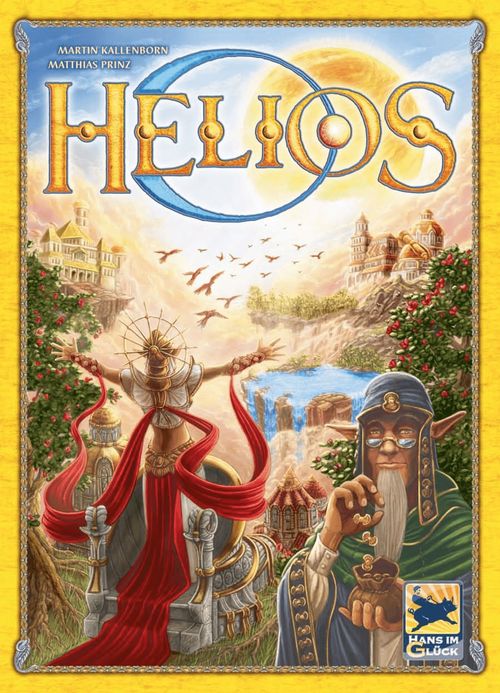
Helios
Helios Rulebook
Table of Contents
Table of Contents
Game Components
- 48 Action Tiles (16 of each of 3 symbols, in 4 different colors)
- 104 Victory Points Tokens (32x 1 VP, 28x 5 VP, 32x 10 VP, 12x 30 VP)
- 70 wooden Raw Materials cubes (14 each in blue, brown, gray, green and black)
- 30 red Mana Stones
- 35 white wooden Temples/City Buildings
- 8 Character Tiles
- 4 Player Boards
- 4 City Boards
- 4 Summary Cards
- 4 yellow Sun Markers
- 4 yellow Sun Discs
- 4 imprinted Bags
- 2 Starting Player Dragons (only one required)
- 36 Land Tiles (8 each in brown, gray and green, 6 each in blue and black)
- 8 Special Tiles (2x 4 different varieties)
The face of each land tile shows 1 of the 5 raw materials: Granite (gray), Spring (blue), Redwood (brown), Bamboo (green), Obsidian (black).
The action tiles show 1 of 3 symbols — Create Land, Construct Temple/City Building, or Move Sun — in one of 4 colors.
Game Setup
Initial game setup is the same for any number of players.
-
The 48 action tiles are sorted by symbol (not by color). The three stacks are mixed separately and placed in 3 face down stacks. Then, one of the players draws the top 6 action tiles from each of the stacks, and places them face up in 3 columns below each stack. In total, there are 18 available action tiles at the start of the game.
-
The victory point tokens, raw materials, mana stones and temples/city buildings are all placed on the table as a general supply, accessible to all.
-
The character tiles are all laid out on the table, within easy reach of all players, with the "Night" side facing up.
-
Each player receives:
- 1 player board, 1 city board, and 1 summary card, all of which he places in front of him.
- 1 sun marker to track the movement of the sun. The sun marker is placed on the "2" space on the sun track at the top edge of the player board.
- 1 sun disc, which is placed on the land space with a sun symbol on it. From now on, this disc is referred to as the Sun.
- 1 mana stone, which is placed in the mana storage area of the player board.
- 1 bag, which is used to store victory point tokens collected during the game.
-
The player who has traveled to the most continents is the first player, and receives the starting player dragon. (Note: There are 2 dragons included with the game; one is a spare and can be used as an awesome shelf decoration!)
-
Sort the land tiles by color. Beginning with the starting player, each player selects 1 land tile of his choice. The following tiles may be selected: brown (redwood), gray (granite), or green (bamboo). Since each player may choose any tile type, it is possible that several players start with the same type of land tile.
Note: The blue (spring) and black (obsidian) land tiles can not be chosen at the start of the game.
The game can now begin.
Game Play
Helios is played in a clockwise direction. The game consists of a number of rounds, depending on the number of players. The examples in this rule book will present a 4-player game, in which 4 rounds are played. Each round is made up of 3 phases. For rules changes in a 2- or 3-player game, see Rules Changes for a 2- or 3-Player Game.
Phases of a Round
Each round is made up of the following 3 phases:
- Phase 1: The 4 action turns
- Phase 2: The character tiles
- Phase 3: Replenishment and bonus raw materials
Phase 1: The 4 Action Turns
In each of the 4 action turns, each player, in player order, takes 1 of the available action tiles and performs the associated action on it.
Beginning with the starting player, each player begins his action turn by taking one of the face up action tiles on display. However, he may only choose from the tiles that are the lowest in each of the 3 columns.
Note: If any column has no action tiles remaining in it, this action is no longer available in the current phase.
The player places his selected action tile below his player board underneath the designated space with the matching color. The symbol itself on the action tile does not matter for tile placement.
In other words, the red action tiles are placed below the red space on the player board, the blue tiles are placed below the blue space, and the yellow tiles are placed below the yellow space.
Note: There is no designated space on the player board for the gray action tiles. Therefore, if a player takes one of the gray action tiles, he may place it below any of the 3 colored spaces on the board.
The action tiles are stored below a player's board with the objective of earning bonus actions. See Bonus Actions.
After placing the action tile below his board, the player performs the action shown on it.
What do the different action tiles mean and how are they played?
- The player creates one land.
- The player constructs one temple or one city building.
- The player moves the sun.
1. The Player Creates One Land
"Create one land" means that the player may take either any one of the face up land tiles (along with the raw materials cube on top of it), or any of the face up special tiles.
He may choose between any of the available face-up land tiles or special tiles. He then places the selected land tile (and raw materials cube) or special tile on his player board in the land area.
What are the rules for placing a land or special tile?
-
The player may place a land or special tile on any of the light gray hex fields on the player board. He may not place them on the orange hex fields around the edge of the land area.
-
A land or special tile may only be placed on an empty hex field that is adjacent to a field which already contains a land or special tile. The player may never place a land or special tile on a hex field that is not connected to a field with a tile.
Note: In addition, a tile may never be placed on a hex field containing the sun. A field with the sun on it is off limits!
-
The player may not place a land or special tile such that the sun is enclosed (completely surrounded by land or special tiles).
-
When a player takes a land tile, he does not reveal a new tile from the stack at this time. Special tiles, however, are always displayed face up.
Example 1: The player takes a blue "spring" land tile, along with the raw material cube on it, from the display and places it on his player board.
Example 2: On a later turn, the player takes the "temple" special tile from the display and places it on his player board.
2. The Player Constructs One Temple or One City Building
"Construct one temple or one city building" means that the player takes one of the white wooden building pieces from the general supply. This can be constructed as either:
- A Temple (A.), which is placed on his player board; or
- A City Building (B.), which is placed on his city board.
For each construction, no matter which type, the player must pay a certain amount of raw materials cubes (as described below). These raw materials cubes must be taken from land or special tiles (on the player board) that contain them. The player returns any such raw materials cubes used for construction back to the general supply.
A. Constructing a temple on the player board:
By taking this action, the player can construct exactly one temple on one of his land or special tiles. To pay the construction cost for a temple, any raw materials cubes may be used. The number of raw materials cubes needed depends on the number of temples already present on the player board:
- The first temple constructed costs 1 of any raw materials cube.
- The second temple constructed costs 2 of any raw materials cubes.
- The third temple constructed costs 3 of any raw materials cubes; etc.
If a player does not have enough raw materials cubes available, he cannot construct a temple.
After the player has paid the required raw materials cubes, he takes a white wooden building piece from the general supply and places it as a temple on one of his land or special tiles on his player board.
Note: There can never be both a temple and a raw materials cube on the same land or special tile. If there is already a raw materials cube residing on a tile on which a temple is to be built, the player must put the raw materials cube back into the general supply first. Therefore, it is wise to spend this raw material cube before deciding to construct a temple on that tile, or to construct the temple on another tile (if possible).
Only one temple may be constructed on a land or special tile. A temple may be constructed on any tile, and may be (but do not have to be) constructed adjacent to each other.
What does a player gain when constructing a temple?
Whenever a player constructs a temple on his player board, he receives 1 mana stone. The player takes the mana stone from the general supply and places it in the mana storage area on his player board.
The amount of mana stones the player receives depends on the number of temples already present on the player board:
- The first temple earns 1 mana stone.
- The second temple earns 2 mana stones.
- The third temple earns 3 mana stones, etc.
When the sun's "illumination" effect occurs, the temples also earn victory points. Refer to the section 3. The Player Moves the Sun.
B. Constructing a city building on the city board:
By taking this action, the player can construct exactly one city building on his city board.
How is a city building constructed?
Each city building shows: its cost of construction (raw materials, in the lower corner), its building function (increased movement of the sun marker, and/or special function), mana stones earned, and victory points earned at the end of the game.
Each constructed city building provides various benefits (in the form of increased movement of the sun marker or earned mana stones), special functions, and victory points at the end of the game. Not every city building provides all types of benefits and/or functions, however.
To construct a city building, the player must pay the raw materials cubes shown in the lower corner of the building.
Note: A white raw materials cube appearing in the cost section of the building represents a neutral raw material, and can be paid for with any color cube. If a player does not own a raw materials cube in a specified color, he may pay for that cube by substituting two cubes of any other color(s).
If a player does not have the specified raw materials cubes available, he cannot construct a city building.
After the required raw materials cubes are paid, the player takes a white wooden building piece from the general supply and places it on his city board, covering the pictured raw materials cubes just paid, indicating that this building has been constructed. From now on, the player gains all the benefits and/or functions of the city building.
The player immediately moves the sun marker on his sun track forward by the number of spaces shown on the city building space (if applicable). He also takes the number of mana stones shown on the space (if applicable) once from the general supply, and places them on the mana storage area of his player board.
Example: The player decides to construct the "Warehouse" city building. He returns 1 blue and 1 black raw materials cube from his player board to the general supply. He then places a white wooden building piece on the cost area of the building on his city board to indicate that the building has been constructed. The player then has access to all the benefits and/or functions of the "Warehouse" building (for a full description, see City Buildings Reference).
Some city buildings have a one-time function, while other city buildings may have a permanent function, or no function at all. All of the benefits and functions of the city buildings are described in City Buildings Reference. Victory points earned by the city buildings are awarded to the player at the end of the game, during the final scoring.
3. The Player Moves the Sun
"Moving the sun" means that the player moves his sun disc across his player board in order to earn various "illumination" rewards for his land tiles and his temples.
What are the rules for moving the sun?
The sun is moved clockwise around the player board. The sun must always move over empty hex fields (fields around the player board, without tiles) that are adjacent to fields that contain either land or special tiles. That is, the sun must always touch a land or special tile on at least one side as it moves. The sun can move along the edges of the land area (through the orange hex fields) if any land or special tiles lie at the outer edge of the light gray hex fields. (The sun can use that area for its orbit.)
Reminder: No land or special tiles may be placed in the orange hex fields around the edge of the land area.
The sun track
The sun marker's position on the sun track of the player board indicates the maximum number of spaces that the sun can be moved. At the beginning of the game, each player's sun has a maximum movement of 2 spaces, but this amount may be increased through the benefits of certain city buildings.
Note: The sun must always be moved at least one space when taking the "moving the sun" action.
What does a player gain when moving the sun?
When the sun ends its movement, it "illuminates" all land and special tiles that are adjacent to its resting space. The "illuminated" land tiles and temples then earn rewards for the player.
Note: The sun only "illuminates" the tiles and temples that are adjacent to it where it ends its movement. Therefore, any one land tile or temple will only gain its "illumination" reward once per turn.
"Illuminated" land tiles
For each empty land tile that is "illuminated" by the sun, the player receives one raw materials cube of the corresponding color. The cube is taken from the general supply and placed on the tile.
The player does not receive a raw materials cube if the "illuminated" land tile already contains one (with the exception of the "Warehouse" city building, see City Buildings Reference), or if a temple has been constructed on the land tile.
"Illuminated" temples
For each temple that is "illuminated" by the sun, the player receives victory points. 1 victory point is earned for the land or special tile on which the temple is constructed, and in addition, 1 victory point is earned for each land or special tile that surrounds the temple.
It does not matter if the "illuminated" temple is built on a land or a special tile, or whether the surrounding land or special tiles are empty or contain any raw materials cubes; victory points are earned in any case. Therefore, an "illuminated" temple may earn between 1–6 victory points.
The player takes the appropriate amount of victory point tokens from the general supply and stores them in his bag.
"Illuminated" special tiles
No rewards (neither raw materials cubes nor victory points) are earned when the sun "illuminates" a special tile. Special tiles only earn victory points during the final scoring at the end of the game. See Game End and Final Scoring.
Example: The player's sun has a maximum movement of 6 spaces, but he decides to only move it 3 spaces to maximize his earnings. The sun has "illuminated" the empty blue "spring" land tile. The player receives a blue raw materials cube for this. The sun has also "illuminated" the green "bamboo" land tile, but since that tile already contains a raw materials cube, he does not receive another one. Lastly, the sun has "illuminated" two temples. The player receives 3 victory points for one temple, and 4 victory points for the other temple. He takes a total of 7 victory point tokens from the general supply and puts them in his bag.
Additional rules and special features when moving the sun
Full orbit of the sun
The player receives 5 victory points once the sun has moved one complete orbit around the land and special tiles on the land area. This most likely will not happen in a single turn.
In other words, if the sun has circled all of the land and special tiles on the player board once, and is moved on or through the gold-outlined fields, this is considered a "full orbit", and the player takes 5 victory point tokens and puts them in his bag.
The victory points for a full orbit of the sun may only be earned once per turn. Even if the player is able to move the sun on or through the gold-outlined fields twice in a turn (a rare occurrence), he still earns only 5 victory points. The player only earns another 5 victory points the next time his sun makes a full orbit (on a future turn).
Shortcuts
Through clever placement of land and special tiles, the player can create "shortcuts" for the sun to use when performing the "moving the sun" action. By using these shortcuts, the player can move the sun more quickly to the desired hex fields.
Example: The player decides to move his sun. He may choose to either take the blue (long) route or the red (short) route. A third option, the white route, is also possible. The player can use any of these paths to move the sun to his desired resting space. The red and white routes are both legal, because the sun is always adjacent to at least one side of a land or special tile.
Dead ends
It is possible to create a "dead end" in the land area. A hex field is considered a dead end if 5 of the 6 sides of that field are adjacent to land or special tiles. Thus, the field has only one open side and if the sun were to move there, it would not be able to continue on.
Any 1-field-wide path of empty hex fields that leads to a field with only one open side, is also considered a dead end. Therefore a "dead end" can span across several fields.
The sun must never be moved into a dead end! That is, if the player has created a dead end, the sun must pass by it! It may take more than one turn to avoid a dead end.
Special case: A situation can occur where the player, over the course of the game, constructs land and special tiles in a way that creates a dead end around the sun. In this case, the next time the player performs a "move the sun" action, he must move the sun out of the dead end. He can split this "move the sun" action over multiple turns, if necessary. In this situation, the sun's movement may not lead back into the dead end on a later turn.
Example: With a recently constructed special tile, a dead end has been created around the sun. The player must now perform the "move the sun" action to lead the sun out of the dead end. Since the sun's path moves through the gold-outlined fields, the player earns 5 victory points for completing a full orbit. He puts the victory point tokens into his bag.
Additional Rules for the "4 Action Turns" Phase
Must the player always perform an action on his turn?
The player may decide not to take an action on his turn (by passing) if he doesn't wish to, or if no meaningful action is possible. He may still take an action tile, however, and place it below his player board with the others.
Bonus Actions
A player may earn bonus actions during the game, in two ways (see below). Taking a "bonus action" means that the player may choose any one of the three main actions (create one land, construct one temple or one city building, or move the sun), and perform it immediately. He may choose an action even when no face up action tiles of that type are available below the draw pile of action tiles. The player does not take an action tile when performing a bonus action.
Note: The player must immediately perform the bonus action. He cannot save it for a later time. He may pass on performing the bonus action, however, if he wishes to for any reason.
A player can earn bonus actions in two ways:
- By placing four action tiles of one color below his player board. Once a player has placed the 4th action tile of one color (gray tiles are "wild") below his player board, he receives a bonus action. (Note: The symbol on the action tile does not matter here, only the color.) This bonus action is performed immediately after the player has performed his regular action for the turn. After performing the bonus action, the player places the four action tiles used to gain the bonus action in a discard pile near the action tile draw piles.
- By constructing the "Palace" city building (see City Buildings Reference). Once a player has constructed the "Palace" city building, he first increases his sun movement by 1 space and takes 1 mana stone from the general supply, as shown on the city building. Then, the function of the "Palace" allows the player to perform a bonus action immediately, one time only.
End of Phase 1: The 4 action turns
Phase 1 of the game is ended once each player has taken a total of 4 action turns. In a 4-player game, this means that 16 action tiles will have been taken from the display of tiles below the draw piles.
The 2 remaining action tiles are then added to the discard pile. Any action tiles still below a player's board will remain there. At this point, Phase 2 of the round begins. For rules changes in a 2- or 3-player game, see Rules Changes for a 2- or 3-Player Game.
Phase 2: The Character Tiles
In this phase, players can purchase and/or activate character tiles. This can only happen in Phase 2.
What do the icons on the character tiles mean? Each character tile shows: the purchase cost of the character tile (in mana stones), mana stones earned, increase to movement of the sun marker, victory points earned at the end of the game for certain items, the activation cost (in raw materials cubes), and an Inactive ("Night") side and an Active ("Day") side.
The phase begins with the player having the most mana stones (in a tie, the player who sits closer to the starting player, in clockwise order, begins).
On their turn, each player may:
- Purchase and place 1 character tile; or
- Activate the benefits of any number of owned characters.
The order in which these actions are performed are chosen by the player. He may, for example, activate one character, then purchase another character tile and immediately activate that one. Play proceeds in clockwise order.
How does a player purchase a character tile?
The purchase cost for each character tile is shown at the top of the tile. This varies from 2–4 mana stones. The player returns the appropriate number of mana stones to the general supply, takes the character tile, and places it ("Night" side facing up!) near his player and city boards.
The player may purchase any character tiles still in the display.
Note: The player only receives the characters' benefits once they have been activated!
How is a character tile activated?
To activate a character, the player must have already purchased it and placed it in his play area.
The activation cost of a character tile is shown along the bottom of the "Night" side of the tile. Each of the character tiles has an activation cost of 3 raw materials cubes. The player must pay the appropriate raw materials cubes to the general supply.
Note: A white raw materials cube in the activation cost section of a character tile represents a neutral raw material, and can be paid for with any color cube. If a player does not own a raw materials cube in a specified color, he may pay for that cube by substituting two cubes of any other color(s).
Finally, the player turns the tile from the "Night" side to the "Day" side. This indicates that the character tile is now active. The player immediately moves the sun marker on his sun track forward by the number of spaces shown on the character tile. He also takes the number of mana stones shown on the tile once from the general supply, and places them on the mana storage area of his player board. The activated characters also earn victory points for the player at the end of the game, for certain items. See Game End and Final Scoring for further explanation.
Note: A player may only purchase 1 character tile, but may activate multiple tiles, per turn. Only when it is the player's turn again, can he purchase another character tile and/or activate multiple tiles.
Players take turns purchasing and/or activating character tiles, until all players either cannot or do not wish to continue. In this way, it is possible for a player to purchase and/or activate more than 1 character tile in Phase 2. After all players have decided not to continue with Phase 2, Phase 3 of the round begins.
Phase 3: Replenishment and Bonus Raw Materials
After all players have finished purchasing and/or activating character tiles, the round moves to Phase 3.
How are the various game components replenished for the next round?
-
Any land tiles that were not taken in the previous round are discarded from the game. One of the players now reveals 1 new land tile face up on the top of each stack, so that 6 tiles (1 for each of the 5 land types, plus 1 random tile from the additional stack) are available again for the next round. A raw materials cube of the appropriate color is placed on each face up land tile.
-
The special tiles remain as they are. There are only ever a total of 8 special tiles available throughout the entire game.
-
New action tiles are now revealed for the next round. From each of the three draw piles, one of the players reveals 6 action tiles and places them face up in 3 columns as before. A total of 18 new action tiles are laid out. (See also Game Setup.) If there are not enough action tiles available in any of the three draw piles, the discarded action tiles of the corresponding type are shuffled to create a new draw pile.
Note: Changes to this procedure for a 2-player game are shown in Rules Changes for a 2- or 3-Player Game.
-
The starting player dragon is passed to the next player in clockwise order. The players in 3rd and 4th position (clockwise from the new starting player) now select 1 bonus raw materials cube of their choice. This raw materials cube is placed on any existing land or special tile. It does not matter whether the selected tile already contains a raw materials cube or not. However, a land or special tile can never contain more than 2 raw materials cubes at a time. All other players do not receive this bonus.
The next round now begins at Phase 1.
Special Bonus Symbols on the Player Board
Bonus raw materials field (Appears 4 times on the player board)
When a player places a land or special tile on a bonus raw materials field, he immediately receives 1 of any raw materials cube from the general supply and places it on the newly-placed land or special tile. The bonus raw materials cube selected cannot match the color of the newly-placed land tile.
Bonus mana stones field (Appears 2 times on the player board)
When a player places a land or special tile on a bonus mana stones field, he receives 2 mana stones from the general supply, and places them in the mana storage area of his player board.
Bonus edge field (Appears 5 times on the player board)
When a player places a land or special tile adjacent to a bonus edge field, he will receive 4 victory points at the end of the game (during the final scoring).
Game End and Final Scoring
In a 4-player game, 4 rounds are played. In the final round, Phase 3 (Replenishment and bonus raw materials) is replaced by the final scoring. To calculate his final score, each player counts his Victory Points (VP) as follows:
- Each bonus edge field the player achieves is worth 4 VP (exception: having the "Explorer" character tile, see Character Tiles Reference).
- Each special tile placed on the player board is worth various VP (see Special Tiles Reference).
- Each city building that has been constructed on a player's city board is worth various VP (its printed value).
- Each character tile, if it has been activated, is worth various VP (see Character Tiles Reference).
- Each remaining mana stone is worth 1 VP (exception: having the "Treasurer" character tile, see Character Tiles Reference).
- Any remaining raw materials cubes are worth no VP! (exception: having the "Treasurer" character tile, see Character Tiles Reference).
The player takes victory point tokens in the amount of the final scoring total, and adds them to those accumulated in his bag during the game, to get his final score. The player with the most victory points wins the game (see Tied Scores below).
Example: In the final scoring, this player's victory points (VP) are calculated as follows:
- 2 bonus edge fields achieved: 4+4 = 8 VP
- 2 special tiles placed: one worth 5 empty fields × 1 VP = 5 VP; one worth 2 temples × 4 VP = 8 VP
- 6 city buildings earning VP as shown: 3+1+2+2+2+2 = 12 VP
- "Princess" character tile activated: 8 × 2 VP = 16 VP
- 2 mana stones remaining on the player board: 1+1 = 2 VP
- For his remaining raw materials cubes, the player gets no victory points.
During the game, the player has also accumulated 47 victory points in his bag (30+10+5+1+1 = 47 VP).
Therefore, his grand total for the game is: 8+5+8+12+16+2+47 = 98 VP Total.
Tied Scores
In case of a tie among players, the winner is the one who has more raw materials cubes. If there is still a tie, the tied players share the victory.
Rules Changes for a 2- or 3-Player Game
In a 3-player game, 3 rounds are played. Each player is the starting player exactly once (as in a 4-player game). In Phase 1 of each round, each player takes 6 action turns, instead of 4. Therefore, all 18 of the face up action tiles will be taken from the display at the end of the phase, and none will need to be discarded.
In a 2-player game, 4 rounds are played, and each player is the starting player twice. In Phase 1 of each round, both of the players take 4 action turns (as in a 4-player game). However, the following additional changes are made: In Phase 3 of Round 1, there will still be 10 face up action tiles remaining in the display. When replenishing for Round 2, these tiles are not discarded, and no additional ones are added to the display. Instead, Round 2 will be played with only those 10 tiles remaining from Round 1. In Phase 3 of Round 2, replenishing is done following the normal rules (discard the 2 remaining tiles, draw 18 new tiles). Finally, in Phase 3 of Round 3, follow the 2-player replenishing rules as in Round 1, described above.
Tips
- It is recommended (although not necessary) that each player selects a different color for his starting land tile.
- Blue and black raw materials cubes are less common than the others. Therefore, it is often useful to choose one of these colors as a bonus raw materials cube whenever possible.
- It is to your advantage to purchase character tiles. Reminder: They must be activated in order to earn victory points.
Reference Section
Special Tiles Reference
(VP = Victory Points)
For each of the special tiles, the VP earned are based on the special tile itself, along with any tiles that are adjacent to it.
- Empty Fields: In the final scoring, the player receives 1 VP for all empty fields adjacent to the special tile. The special tile itself is not considered an empty field. Example: There are 5 empty fields adjacent to the special tile. Thus, the player receives 5×1 VP = 5 VP.
- Created Land or Special Tiles: In the final scoring, the player receives 2 VP for the special tile itself, and for all adjacent land and special tiles. Example: There are a total of 5 land and special tiles for this scoring (the special tile itself, and the 4 that are adjacent to it). Thus, the player receives 5×2 VP = 10 VP.
- Raw Materials Cubes: In the final scoring, the player receives 2 VP for each raw materials cube on the special tile itself, and all adjacent land and special tiles. Example: There are a total of 6 raw materials cubes on the special tile, and all of the adjacent land and special tiles. Thus, the player receives 6×2 VP = 12 VP.
- Temples: In the final scoring, the player receives 4 VP for each temple on the special tile itself, and all adjacent land and special tiles. Example: There are a total of 3 temples for this scoring. Thus, the player receives 3×4 VP = 12 VP.
Character Tiles Reference
(MS = Mana Stones, VP = Victory Points)
Architect (Purchase Cost: 2 MS)
- Activation Cost: 1 blue, 1 gray and 1 of any raw materials cubes.
- Activation Benefit: 1 bonus raw materials cube, placed on a land or special tile.
- VP at Game End: 3 VP for each constructed temple and city building.
Prophetess (Purchase Cost: 3 MS)
- Activation Cost: 1 blue, 1 green and 1 of any raw materials cubes.
- Activation Benefit: None.
- VP at Game End: 2 VP for each created land and special tile.
Inventor (Purchase Cost: 2 MS)
- Activation Cost: 1 black, 1 gray and 1 of any raw materials cubes.
- Activation Benefit: +2 on the sun track, +1 MS.
- VP at Game End: 5 VP for each created special tile.
Cartographer (Purchase Cost: 2 MS)
- Activation Cost: 1 gray, 1 brown and 1 green raw materials cubes.
- Activation Benefit: 1 bonus raw materials cube, placed on a land or special tile.
- VP at Game End: 3 VP for each created land tile of a different color (up to a maximum of 15 VP).
Princess (Purchase Cost: 3 MS)
- Activation Cost: 1 blue, 1 brown and 1 of any raw materials cubes.
- Activation Benefit: +1 on the sun track.
- VP at Game End: 2 VP × final value of the sun marker on the sun track. Note: No VP are earned if player has also constructed the Power Plant.
Priestess (Purchase Cost: 2 MS)
- Activation Cost: 3 of any raw materials cubes.
- Activation Benefit: +2 on the sun track, +2 MS.
- VP at Game End: 12 VP.
Explorer (Purchase Cost: 2 MS)
- Activation Cost: 1 black, 1 brown and 1 of any raw materials cubes.
- Activation Benefit: None.
- VP at Game End: 8 VP for each bonus edge field achieved, instead of 4 VP (see Special Bonus Symbols on the Player Board).
Treasurer (Purchase Cost: 4 MS)
- Activation Cost: 1 black, 1 green and 1 of any raw materials cubes.
- Activation Benefit: None.
- VP at Game End: 2 VP per remaining raw materials cube, and 3 VP (instead of 1 VP) for each remaining mana stone.
City Buildings Reference
(MS = Mana Stones, VP = Victory Points)
Observatory
- Cost: 1 black raw materials cube.
- Benefit: +3 on the sun track.
- Function: None.
- VP at Game End: 3 VP.
Sanctuary
- Cost: 1 brown and 1 green raw materials cube.
- Benefit: +4 MS.
- Function: None.
- VP at Game End: 3 VP.
Solar Lodge
- Cost: 1 gray raw materials cube.
- Benefit: +2 on the sun track.
- Function: None.
- VP at Game End: 1 VP.
Sacred Grove
- Cost: 1 green raw materials cube.
- Benefit: +2 MS.
- Function: None.
- VP at Game End: 2 VP.
Power Plant
- Cost: 1 blue raw materials cube.
- Benefit: +1 MS.
- Function: The player places his sun marker on the field. From now on, when taking the "move the sun" action, he can move his sun disc any number of spaces, anywhere on the land area. However, he now no longer receives the "full orbit" VP bonus.
- VP at Game End: 2 VP.
Exchange Bazaar
- Cost: 2 of any raw materials cubes.
- Benefit: None.
- Function: Immediately and once: Up to 3 mana stones may be exchanged for 4 VP each. (Maximum 12 VP)
- VP at Game End: 1 VP.
City Council
- Cost: 1 brown and 1 gray raw materials cube.
- Benefit: +1 on the sun track.
- Function: Gain an additional 3 VP for each temple when it is "illuminated".
- VP at Game End: 2 VP.
Warehouse
- Cost: 1 black and 1 blue raw materials cube.
- Benefit: None.
- Function: When a player's land tile is "illuminated", if it already contains a raw materials cube, a second one may be placed on it as well. No more than two cubes may ever lie on a land tile.
- VP at Game End: 3 VP.
Citadel
- Cost: Either 1 black or 1 blue raw materials cube.
- Benefit: None.
- Function: The cost for constructing any number of temples is now only 1 of any raw materials cube. The number of mana stones earned for each temple remains unchanged.
- VP at Game End: 2 VP.
Land Management
- Cost: 1 brown and 1 of any raw materials cube.
- Benefit: None.
- Function: Immediately and once: The player draws 2 land tiles from the bottom of the additional stack, along with raw materials cubes of the appropriate colors, and places them both on his player board.
- VP at Game End: 2 VP.
Watch Tower
- Cost: 1 black and 1 blue raw materials cube.
- Benefit: +1 MS.
- Function: 10 VP instead of 5 VP for a "full orbit" of the sun. See 3. The Player Moves the Sun.
- VP at Game End: 2 VP.
Palace
- Cost: 1 green, 1 gray, and 1 of any raw materials cube.
- Benefit: +1 on the sun track and +1 MS.
- Function: Immediately and once: 1 bonus action. See Bonus Actions.
- VP at Game End: 2 VP.