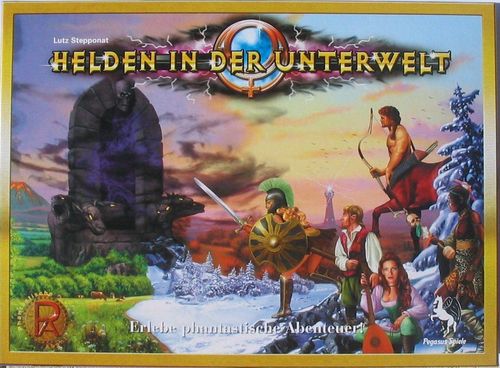
Helden in der Unterwelt
Helden in der Unterwelt Rulebook
Table of Contents
Table of Contents
- Goal of Play
- The Underworld and Return of the Heroes / In the Shadow of the Dragon
- Preparation
- Starting Player
- Preparing for the Game
- Hero Reference Cards
- The Reference Card of the Damned One
- Map Tiles
- Counters / Markers
- Setting Up the Treasure Markers
- Adventure Marker Set Up
- Markers on the Damned One's Reference Card
- Setting Up the Remaining Pieces
- Selecting Heroes
- The Styx Map Tile
- Set Up Hero Tokens
- Course of Play
- Combat
- Duels Between Heroes
- Standard Actions
- Treasure
- Life Points
- Experience
- Shadow Cubes
- The Damned One
- Solitaire Play
- Victory Points
- Heroes in the Underworld Combined with Return of the Heroes
- Heroes in the Underworld Combined with In the Shadow of the Dragon
- Heroes in the Underworld Combined with Return of the Heroes and In the Shadow of the Dragon
- The "Infinite History" Variant
- Abbreviations and Terms
- Glossary
Goal of Play
The heroes' goal is to defeat the Damned One in the Underworld. The hero which accomplishes this is the winner of the game. However, it is also possible that the dark side can win, if the Damned One becomes too powerful – in which case a lesser victory may be counted by the hero who has the most black experience cubes at the end of the game.
The Underworld and Return of the Heroes / In the Shadow of the Dragon
The Underworld can be used as an extension for the Return of the Heroes and/or In the Shadow of the Dragon games. The heroes can then move from the normal maps in those games to the entrance to the Underworld!
If In the Shadow of the Dragon is used, Kerberos (Cerberus) is considered as an entrance to the Underworld.
If the basic game of Return of the Heroes is used without extensions, use the "gate" Adventure counter included in this game as an entrance to the Underworld for Hades/Styx. The additional included gate to Hades/Lethe is only used if all three games are combined.
Preparation
Before play begins…
Starting Player
The oldest player begins and becomes starting player.
Preparing for the Game
Parts List
- 48 area maps – to develop the Underworld
- 80 counters – Adventure markers and treasure markers to display on the game board and the hero reference card. They represent enemies, tasks, articles, traps and monsters
- 5 double-sided hero reference cards (female/male for each hero) – for keeping track of your hero's experience, treasures, tasks etc.
- 1 file reference card for the Damned One – a hero reference card for the enemy
- 10 hero tokens – they represent your hero on the game board
- 10 plastic feet – "feet" for the hero tokens
- 20 points of life (LP) (red glass stones) – to track the life points on the hero reference cards
- 61 experience cubes (EC) (wooden cubes in 4 colors) – to track the experience earned on the hero reference cards
- 15 wooden pieces of gold – play money
- 32 number tokens – for tracking changed skill values on the hero reference card. The number token is placed covering the original value.
- 5 six-sided dice
- 10 round markers of the Damned One – only used when Return of the Heroes and/or In the Shadow of the Dragon are used
Hero Reference Cards
Markers are used on the hero reference card to track the status of each hero. One can see the hero's skills, life points, carried items and accepted tasks, the movement limit and the amount of money the hero currently has.
Reference
The hero reference cards from Return of the Heroes and In the Shadow of the Dragon can also be used in the Underworld – and likewise, the heroes found in the Underworld can also be used in the previous two games!
[Shown next in the German rules is a description and illustration of a hero reference card. The translator has skipped this section because it is the same as can be found in the rules for the prior games – jas]
The Reference Card of the Damned One
The Damned One has its own reference card, which is used to track the life points and the placing of the Avatars – if these are defeated and placed on the Damned One's reference card, a Mark of the Damned is put into the game.
In addition, the special weapons are put on the Damned One's reference card at the start of the game.
In the course of play, black experience cubes (Shadow Cubes, or SC) are put down from left to right. The Damned One's life points are always equal to the number of cubes on the SC track here. The game is lost for the group of heroes if an SC is placed in the last box on the SC track (well, not really absolutely lost but more on that later).
- Treasure spaces: At the beginning of play the special weapon markers are put here. They are removed when the heroes complete special tasks and do not return to the reference card, except when a hero possessing one of the special weapons dies.
- Reference box for the Damned One: The Damned One's marker is kept here, until it comes into play.
- Reference boxes for the Avatars: When they are defeated, place the marker for each Avatar in one of these boxes.
Map Tiles
Separate the Styx map tile, and turn all the others face down. From the area maps the Styx tile is segregated.
The remaining map tiles are mixed and put face down in 3 equal piles. The active player may draw one map tile from the top of any stack in Phase 1 of his/her turn.
Map tile types:
- Places: Hades, Elysion etc. On these tiles, put an Adventure marker on it when the tile is placed on the board.
- Areas: Tiles having 3 or 4 exits, but no special name. Likewise, on these tiles put an Adventure marker on it when the tile is placed on the board.
- Passageways: Tiles having 2, 3 or 4 exits. Do not place Adventure markers on these tiles when they are placed on the map.
Counters / Markers
Treasure markers and Adventure markers should each be kept in a separate group. The markers of the Damned One are needed only if playing with Return of the Heroes and/or In the Shadow of the Dragon.
How to Read a Counter
- Name
- Heart
- Combat data
- Reward
Setting Up the Treasure Markers
Place the treasure markers in a loose heap – the treasure heap – face down beside the play surface. They do not have to form a pile. If a player gets to claim a treasure marker, they do not have to take the top one on the pile, but may select any marker from the heap. The player may not look at the marker before selecting, however, or look at any other markers on the treasure heap before or after selecting his/her marker.
Adventure Marker Set Up
The gate markers for Hades/Styx and Hades/Lethe are extra markers for playing in conjunction with Return of the Heroes and In the Shadow of the Dragon.
From the Adventure markers both gates to Hades markers are segregated – they are used only if the Underworld is played together with Return of the Heroes and/or In the Shadow of the Dragon. In this case the gate to Hades/Styx Adventure marker represents on the game board the entrance to the Underworld, as soon as the marker is pulled from the bag and placed on the map.
In connection with In the Shadow of the Dragon, the gate Adventure markers are not needed – Kerberos acts as the entrance to the Underworld.
All other Adventure markers are laid out face down. Also with the Adventure markers one simply makes a pile of face down markers. If a marker is to be pulled, one may select any face down marker. The piles of counters may at any time be mixed to ensure a random selection.
Markers on the Damned One's Reference Card
Place the Damned One's marker, and the 5 special weapon markers on the Damned One's reference card. They will come into play later in the game.
The special weapons enter play when the heroes complete special tasks. The Damned One's marker is used after the Avatars have been defeated.
Special weapons:
- Mail of Persephone
- Trident of Hades
- Scythe of Thanatos
- Bow of Herkules
- Golden Staff
Note! The Avatars of the Damned One and the black creatures are Adventure markers; the traps and creatures of the Damned One as well as the black weapons are treasure markers!
Setting Up the Remaining Pieces
Set the red LP stones, the experience cubes (EC), gold, and other remaining pieces near the playing area. Select one player to act as the "banker", who will distribute the pieces as the game progresses.
Selecting Heroes
Beginning with the starting player, each player selects a hero and takes that hero's reference card.
Place the desired side of the reference card facing upward (male or female hero), and take the matching hero token. Also take gold markers, and LP stones as indicated on the reference card. Place a LP stone on each space on the life point track above the dividing line.
Place the hero token in one of the plastic feet.
The hero or heroine is ready for their journey into the UNDERWORLD…
The Styx Map Tile
Place the Styx map tile on the center of the play area.
It is the starting point of the heroes, and the Underworld will develop around it.
Set Up Hero Tokens
Place all the hero tokens being used on the Styx map tile, which is the river entrance into the Underworld.
Course of Play
During their turn, the players will complete each of the following 3 phases:
- Add a map tile to the Underworld
- Movement
- Actions
Phase 1: Extending the Underworld
The active player draws one face-down map tile from the stack if an exit exists on the tile they currently occupy.
The tile drawn is placed on the Underworld map, adjacent to the tile occupied by the hero.
The new map tile must be oriented so that the directional arrow points the same direction as the arrow on the Styx tile. If no directional arrow is present, then the tile may be oriented as the drawing player chooses.
Place an Adventure marker immediately on the new tile.
It May Not Be Possible to Place a New Map Tile
If a hero's tile is surrounded by map tiles already: if the active player's hero figure is on a tile with Underworld map tiles already placed on all four sides, a new map tile cannot be placed. Map tiles already placed are not covered by new map tiles. In this case, no new map tile is placed.
Phase 2: Hero Movement
Movement is optional. A hero can use part or none of its movement allowance during this phase.
Entering a new map tile costs 1 point of movement (MP).
If a new map tile was placed in Phase 1, then the hero's first move must be to this new tile (if the hero moves at all). If this is not possible (for example, if a wall blocks the path), then the hero cannot move.
Examine the recently entered map tile for any counters or markers. Reveal any counters at the hero's new location. Further moves may be interrupted by the instructions on the counter.
Movement may be stopped by:
- Moving the hero's maximum range (MP).
- Decision not to use the hero's full MP.
- Performing an Action.
The course of play now proceeds to Phase 3: Actions.
Movement
- An optional action
- 1 step = 1 map tile = 1 MP
- Move until:
- as desired, up to the hero's maximum range or less
- the hero takes an Action.
If a new map tile was placed in Phase 1, the hero's first move must be to that tile.
Movement in Detail
First of all, the player may decide whether to move or not at all, because adding a new map tile is voluntary.
If the player wants to add a tile, there are a few things to consider:
In general, each movement step costs 1 MP. The number of MP available per turn is printed on the hero's reference card in the foot symbol. This maximum range can change during the game. In this case appropriate number markers are put over the printed number.
If in Phase 1 of play a new map tile was placed and the hero is going to move, the hero must enter this map tile with its first MP. If that is not possible – because no connection or path exists between the current tile and the newly placed tile – then the hero must remain on the current map tile. If at the beginning of the turn the hero was on a map tile surrounded by tiles already and no new tile was placed in Phase 1, that hero can then move in any direction.
Each time a hero enters a map tile, any counters on the map tile must be examined. If no marker or counter is on the map tile, movement can be continued.
If a marker is on the tile, movement is interrupted and the marker is revealed. This also applies to already revealed markers still on map tiles.
If the marker is an Adventure marker with a red or gray edge, this indicates that an opponent has come to fight!
Adventure markers with a blue or green edge are Tasks and Encounters. Tasks can be taken by the hero and placed on the reference card, and Encounters can be used.
Phase 3: Actions
If a counter is on a map tile just entered by a hero, that hero's movement is interrupted and the counter must be examined to determine if the hero must take an action.
If this is the case, Phase 2: Movement ends and Phase 3: Actions begins.
- There can be voluntary actions, which one can take!
- Several different actions may be taken one after another (however, the same action cannot be taken twice on the same turn except fulfilling Tasks).
The actions are taken in the following order:
- Combat/Duel
- Encounters
- Accepting a Task marker
- Fulfilling a Task (can be done more than once per turn)
- Receiving treasure as a reward: may be done several times on a turn as well, for example after Combat.
Combat
Combat – General Rules
Combat rules:
- Select Combat skill.
- Roll dice.
Is the roll successful? The combat has been won!
- Take the reward.
- Remove the counter from the map tile, except: counters with a gray edge and blue base are placed on the hero's reference card as tasks.
- Avatar markers are placed on the Damned One's reference card.
Was the roll failed?
- See the counter for the specific result.
- The counter remains face up on the map tile, to be encountered again.
Combat must always be taken before any other action!
The hero cannot evade combat against a counter. If a hero moves on to a map tile which already has a face-up enemy counter (red or gray edge), or if the counter uncovered on a hero's map tile is an enemy counter, the hero must engage in combat!
If a hero enters a map tile containing another player's hero token, the active player (under certain conditions) can demand a Duel with the other hero. A hero may only demand one Duel per turn, even if other heroes are on the same map tile.
A Duel cannot be called for after combat with an enemy counter. A hero may only take a single Combat/Duel action per turn. If the active player loses a Duel, then his turn is over!
Special rules apply in combat against creatures with a gray edge (see below).
Permitted Combat Skills
Heroes may only choose a combat skill if the same colored dot is on the enemy counter.
Combat skills of enemy counters:
- Red dot = Close Combat
- Green dot = Ranged Combat
- Blue dot = Magic Combat
- Gray dot = the hero's skill with the least experience cubes (EC)
If a number other than 0 is located inside the colored dot on the enemy counter, the hero must modify that combat skill if choosing to fight with the same colored skill. With Ixion for example, any hero selecting to fight with Close Combat (red skill) must deduct 1 from their red Close Combat skill.
Opponents with a gray dot can be attacked only with the skill in which the hero has gained the least number of experience cubes so far (EC). If there is a tie for the skill with the least number of ECs, then the player may choose which of those skills to use in combat. The skill level is not important – only the number of experience cubes!
Example Combat Test
Compare the sum of 2 dice with the selected and modified combat skill level.
- Result ≤ skill level = combat succeeds.
- Result > skill level = combat is lost. However, with more ECs a hero may roll more than 2 dice and choose which 2 dice to add together, thus having a greater chance of passing skill tests.
A combat is resolved by a skill test against the chosen skill level. One proceeds as follows:
Dice: Compare the sum of two dice with the value of the selected skill.
If the combat succeeds: even if the Damned One was the opponent, if the skill test succeeds the combat is over.
Take the reward: On the bottom of the enemy counter is shown what the hero will gain as a reward if the enemy is defeated. Mostly, rewards take the form of experience cubes which are added to the hero's reference card. The cubes are placed on the track to the right of the skill level of that skill. Enemies showing a treasure symbol allow the hero to choose a treasure marker as a reward (see below).
Defeated Enemies
Defeated enemies are treated differently depending on the type of enemy:
- Markers with a red border are taken from the board.
- Markers with a gray border and blue base (black creatures) become Tasks.
- Avatars are placed on the Damned One's reference card.
- Creatures of the Damned One (treasure markers) are removed from the board.
If the combat is lost: a combat is lost if the skill test is failed. The hero loses 1 LP, 1 BP, or 1 EC and/or receives 1 SC. The enemy counter remains face up on the map tile. All further hero actions are lost, except after a lost Duel. On the next turn, the hero may move away from the enemy – the combat does not have to be continued.
Duels Between Heroes
Conditions for a Duel
In order to Duel with another hero, certain conditions must be met:
- Only the active player may initiate a Duel.
- Both heroes must be on the same map tile.
- At least one of the heroes must have one or more shadow cubes on their hero reference card.
- The active player must not have taken a Combat action.
Resolving a Duel
- Both heroes may choose which combat skill they will use.
- The skill level of the aggressor is modified.
- Skill test: the active player rolls 2 dice (experience cubes do not count in Duels).
- The winner of the Duel decides if the opponent:
- loses 1 LP,
- loses 1 item, or
- loses 1 shadow cube.
Duel Modifiers
The skill level of the aggressor minus the skill level of the defender:
| Difference | Modifier |
|---|---|
| -5 or more | -3 |
| -3 or -4 | -2 |
| -1 or -2 | -1 |
| 0 | 0 |
| +1 or +2 | +1 |
| +3 or +4 | +2 |
| +5 or more | +3 |
When a Duel may be initiated:
- When the aggressor has at least 1 SC, but the defender does not.
- When the aggressor does not have any SC, but the defender has at least 1 SC.
- When both the aggressor and defender have at least 1 SC.
Heroes with no shadow cubes may not be attacked by heroes also without any shadow cubes!
If the active player took a Combat action against an enemy counter, then a Duel is not possible that turn. A Duel must be fought instead of combat.
Characteristics of a Duel
-
Choice of skill: Each participant of a Duel can select their best combat skill. Both heroes need not select the same combat skill.
A Duel is an honorable fight – even in the Underworld – and even heroes with shadow experience cubes adhere to the rules! The skill level of the aggressor is modified in accordance with the modifier table above.
-
Fighting fairly: Each Duel is a fair fight. No experience cubes are used to affect the number of dice rolled.
Experience cubes don't count: the skill test is always resolved by rolling just 2 dice.
The aggressor wins the Duel if the skill test succeeds. The defender wins the Duel if the aggressor's skill test fails.
-
Consequences: The winner of the Duel selects the consequences for the loser (selected from the choices below).
The loser of a Duel may possibly lose 1 LP, but cannot lose their last LP; a hero is never killed in a Duel between heroes. Often, the loser must give up an item or will be set back upon the good path by the removal of a shadow cube.
-
Loser must lose 1 LP. Only possible if it is not the hero's last LP – killing a hero is not possible. It makes no difference if the last LP is "natural" or "artificial" (from an Armor item for instance).
-
Loser must give 1 item to the winner. (Pieces of gold count as 1 item as well.)
-
Loser must give up 1 shadow cube to the Damned One. This option depends on whether the winner already has an SC on his hero reference card. A Duel between heroes both possessing 1 or more SC always strengthens the Damned One: if the winner selects this option, the loser takes 1 SC from the hero reference card. If the loser has more than one skill with SCs, the loser selects from which skill the SC is lost. This SC is then placed on the reference card of the Damned One!
-
Example (Calculating the Aggressor's Skill Level Modifier)
Hippolyte initiates a Duel with Ture. Hippolyte selects Close Combat (level 7), Ture selects Magic Combat (level 8). The difference is "-1", and Hippolyte's level is modified by -1 to 6 (7 - 1 = 6, modifier shown on the table above).
Standard Actions
It is possible to take several standard actions one after another in the order of the player's choosing.
Standard actions are:
- Using a place (for example Styx)
- Having an Encounter (a green bordered marker)
- Accepting a Task (a blue bordered marker)
- Fulfilling a Task
Using a Place
Certain map tiles may be activated by the player for a special effect.
Having Encounters
When a marker with a green border is revealed, or is already revealed when entering a map tile, the hero may encounter it once per turn.
The effect of each Encounter marker is indicated on the marker itself. Green bordered markers remain on the map tile even if a hero has already used it (exception: the Low Demon).
Sometimes Encounters will have no use but will remain on the map tile nonetheless; thus Thanatos remains even if someone has already received its scythe. But visiting Thanatos does not mean that the scythe can be taken from the possession of another hero! The Thanatos counter grants the scythe only if it is on the reference card of the Damned One.
Accepting a Task
Markers with a blue border (or gray border with a blue base) are Tasks which can be fulfilled by the heroes.
If a Task marker is uncovered when entering a map tile, or if it is already revealed when a hero enters a map tile, the active player may decide to accept the Task. If the Task is accepted, the player places the marker on the hero reference card, into one of the empty boxes designated for Task markers.
If there is no empty Task box on the player's hero reference card, then no new Task markers may be taken – the player should only worry about completing the Tasks which have already been taken.
The Task counter describes the task – most likely the hero must escort somebody to a certain place (a specific map tile).
Fulfilling Tasks
If the hero is, for example, on the map tile specified by a Task, it can be fulfilled by removing the Task marker from the hero reference card and taking the reward. Fulfilling a Task is not mandatory; it is up to the player whether or not to fulfill a Task even when on the specified map tile.
Treasure
Take a treasure marker when:
- A treasure marker is shown as the reward on an enemy counter.
- A reward for a fulfilled Task is shown on the Task marker.
Treasures and Items
During play there are several chances of drawing a treasure. But the treasures of the Underworld are not always joyful surprises. Traps and creatures can be found as well as powerful weapons. Also… if a hero is entitled to draw from the treasure heap, one face-down marker is selected at random. If the hero does not want this item, or cannot carry any more items, it can be exchanged for 1 gold piece (exception: see Black Weapons). The treasure marker is put back in the heap and remains revealed. If no uncovered treasure markers remain, turn all the face-up treasure markers face down and mix them into a new treasure heap.
By the Way, a Hero May Wish for Good Luck…
A hero may wish for good fortune with treasure drawing: when a hero is entitled to draw a treasure, and before a treasure marker is uncovered, by forfeiting 1 gold piece the player may flip over 3 treasure markers and select the one desired. One of the 3 markers flipped must be selected however. The two markers not selected are put face down and mixed back into the treasure heap. If a hero is allowed more than one treasure draw, he may wish for good luck before each draw. Leave any previously unselected treasures face up until all the draws are completed, although the hero may only select from the 3 most recent draws. With each draw, the hero may decide to wish for good luck or not.
Example: Hylonome may draw 2 treasures. For the first draw she spends 1 gold, reveals three treasure markers and selects one to keep. The two unselected markers remain face up. For the second treasure draw, she likewise will spend 1 gold – again 3 treasure markers are uncovered, one of which may be selected. The two face-up treasure markers of the first "round" may not be selected for the second draw.
Handling Treasure Markers
- Keep all markers in the treasure heap face down.
- Wish for luck by giving up 1 gold piece = turn up 3 treasure markers and select 1 to keep.
If the marker is:
- A normal treasure item: place on the hero reference card.
- A creature: place 1 SC on the "Dark Side" and combat.
- A trap: place 1 SC on the "Dark Side" and perform a skill test. Turn is over.
Normal treasure items may be traded for 1 gold. Black weapons may not be traded for gold.
Creatures of the Damned One (Treasure Markers)
When creatures of the Damned One are revealed, combat occurs immediately and 1 SC is placed on the Dark Side of the Damned One's reference card. If the combat against the creature fails, the treasure marker is placed face up on the map tile occupied by the hero and will remain until it is defeated. When a creature is defeated, remove the marker from the game.
Traps of the Damned One (Treasure Markers)
When traps are revealed from the treasure heap:
- Place 1 SC on the Dark Side of the Damned One's reference card.
- The hero must immediately perform a skill check against the value of the trap.
- The skill used to perform the skill check may be selected by the hero.
If the skill check fails, the hero is stuck in the trap, and the turn ends. Heroes in traps cannot take any further actions except to attempt to escape. Heroes remain trapped until their skill check succeeds. Other actions are not possible while trapped!
A trap is removed from play as soon as the hero passes the skill check. Heroes in a trap cannot be attacked. Other heroes may ignore the trap once it has trapped a hero and simply move through the map tile unaffected.
Items (Revealed Treasure Markers)
Taking, placing and discarding items:
- When a hero picks up an item, the player must place the item marker on a free box in the item section of the hero reference card.
- If there is not a free box available on the reference card, the player can trade the treasure marker for 1 gold piece and place the marker with the face-up treasure markers.
- If all the treasure markers are revealed, flip all the revealed treasure markers face down and mix them together to form a new treasure heap.
- Treasure markers can even be traded for gold when there is an available item box on the hero reference card, if the player so chooses.
Using Healing Locations
Healing locations can only be used in Phase 3, and after any combat or Duels have been resolved.
Weapons and Armor
Weapons and Armor are items that must be carried. Their use does not have to be announced, however.
- Each hero may carry exactly 1 Armor item (plus a shield and/or helmet), and exactly 1 weapon (plus "combinable" weapons, see counters). Extra weapons and armor can be discarded. The player will receive 1 gold for a discarded weapon or armor.
- Weapons and Armor markers must be kept on the hero reference card in the section for items.
- Black Weapons may only be discarded if the hero does not have one or more Shadow Cubes in the appropriate skill. In addition, a Black Weapon can be lost in a Duel if it is demanded by the winner as a reward. The winner then takes the Black Weapon and places it on their hero reference card.
By the way: a Black Weapon can be used without the hero having any Shadow Cubes – however, would a true hero ever use the weapons of evil, even for the cause of good? Black Weapons allow no other color of experience cubes for rewards except Black!
Weapons and items can change the skill level of a hero. Movement limits can change, skill levels can increase, "artificial" life points can be granted; these changes are noted on the hero reference card. Number markers are placed on the "movement foot" or the skill numbers, and glass stones are placed on the LP track. These modifications are lost immediately if the associated item is lost!
Life Points
Life Point Track
On the Life Point Track on the hero reference card, a red glass stone is placed on each space for each Life Point the hero has remaining.
The dark red hearts above the dividing line on the LP track are "natural" LP. If a hero loses the last natural LP, he dies. The light red hearts below the dividing line are a place to track "artificial" LP which have been granted by armor or other items.
Death
Heroes do not really die.
When a hero loses his last natural LP, he "dies". That is, however, no real problem if one is already in the realm of Hades…
Each dead hero is brought immediately to the Styx map tile. On the next turn he awakens again to new life, and may continue adventuring. Only his experience and items are changed.
Rebirth
A hero who died restarts the game with the initial starting equipment on the Styx map tile.
- Loss of all experience cubes and tasks. Place all ECs back into the supply, and Task markers remain on the map tile where the hero died.
- 1 item may be kept from the hero's previous life.
- All other items (treasure markers) are placed face up in the group of face-up treasure markers. Special weapons are placed back on the Damned One's reference card, and can come into play again. The Mail of Persephone and/or Trident of Hades can be obtained without a skill test (no task must be fulfilled).
- Otherwise, restart in the next turn with the standard starting levels of LP, gold etc…
Losing and Gaining Life Points
Life Points can be lost by losing combats or other actions. The player removes 1 glass stone from the hero reference card for each LP lost.
The player decides whether to lose a "natural" or "artificial" LP (if one is available). A hero is "dead" when the last "natural" LP is lost – even if there are "artificial" LP remaining.
Natural Life Points
Natural, physical representations of life force are called natural LP.
Natural LPs are indicated on the hero reference card by the dark red hearts above the dividing line on the LP track. Only natural LP can be healed or regenerated.
The Styx map tile will heal all of a hero's natural LP if the hero spends an entire turn there.
Artificial Life Points
Life Points which a hero acquires through items or armor are called Artificial Life Points.
On the LP track, the maximum number of Artificial LP is indicated by the light red hearts below the dividing line. These LPs cannot be healed or regenerated when lost.
- If an Artificial LP is lost, the associated item is destroyed and must be discarded to the appropriate pile. Items that grant more than 1 LP are only discarded if all of the LPs granted by that item are lost.
- If an Artificial LP is lost, place the glass stone from the LP track onto the item marker in order to keep track of how many of that item's LPs have been lost.
Life Points of Opponents
An opponent is considered defeated in combat if it loses at least 1 LP (from a successful combat test).
"Life Points" of the Damned One
The Damned One has as many LPs as there are SC on the Dark Side of its reference card. Or, if there are no SCs on the Damned One's reference card at all, it has 1 LP.
Experience
Experience
Experience improves the hero's chances of passing skill tests by allowing the use of more than 2 dice. Depending on the hero's level of experience, the player may roll up to 5 dice and then choose which 2 dice to use.
Experience is represented by Experience Cubes (EC):
- Red cubes = Close Combat
- Green cubes = Ranged Combat
- Blue cubes = Magic
- Black cubes = "Dark" experience, which may be used in any category
Gaining experience in a skill improves the chances for successful skill tests. Successful combats (and some Encounters) can increase the hero's experience. The hero receives ECs which are put on the hero reference card according to their color to represent the hero's gain of experience.
In the Underworld, there are also unnatural forces! Experience can be gained which has nothing to do with the normal talents of the hero: dark powers come into play which strengthen the heroes and also give power to the Damned One. This is represented by the black experience cubes (or Shadow Cubes, SC). If a hero acquires an SC, it must be placed on the hero reference card on the experience track of any skill. SC may be used to reach further levels of experience just like any normal EC. However, as more Experience Cubes are gained in a skill with a Shadow Cube, the EC must be exchanged for an SC before being placed on the hero reference card: after a single Shadow Cube in a skill, no more normal red, green or blue Experience Cubes can be placed in that skill!
Experience Cubes
If a hero gains experience – usually through combat – an EC is given to that hero. The type of cube and number of cubes is found on the enemy counter: on the bottom are shown the experience cubes granted as a reward. This is given to the victorious hero and is placed accordingly on the hero reference card. For cubes showing multiple colors, the player may select which color is granted.
Effects of Experience
The experience tracks behind the hero's skills are divided into stages. When a hero gains enough ECs to reach the picture of the die beneath the experience tracks, this allows the hero to roll an additional die (from 3 to 5) in that skill whenever used and pick 2 dice from among those results.
Shadow Cubes
Shadow Cubes of the Damned One
Black experience cubes are placed on the Damned One's reference card (the "Dark Side") when:
- A black creature is drawn (on the reference card of the Damned One)
- By acquiring a Black Weapon of the Damned One (on the reference card of the Damned One)
- When drawing an Avatar of the Damned One (on the reference card of the Damned One)
- When drawing a Trap of the Damned One (on the reference card of the Damned One)
- When drawing a Creature of the Damned One (on the reference card of the Damned One)
- After defeating the last Avatar, if the Mark of the Damned One is put into play (on the reference card of the Damned One)
- If the winner of a Duel (who has SC on their hero reference card) demands the loss of an SC from the loser, this SC is placed on the Damned One's reference card. (The shadow cube "shifts".)
Shadow Cubes can be removed from the Damned One's reference card by completing certain actions. If there are 11 Shadow Cubes on the Dark Side, the game is over!
The Black Weapons are:
- The Soul Sword
- The Black Crossbow
- The Black Staff
Black Weapons must be taken by a hero if that hero has at least 1 SC in the matching skill – even if there is a choice between the taking of several items! The hero may not discard Black Weapons as long as at least 1 SC remains in the corresponding skill.
Example: Hippolyte draws 3 treasure markers. One of them is the Soul Sword. If Hippolyte has at least 1 SC in Close Combat then the Soul Sword must be chosen.
Shadow Cubes on the Dark Side represent the LP of the Damned One (but remember the Damned One's LP always equals 1 if there are no SCs on the Dark Side.)
When 11 SC are on the Dark Side, the game is over! The winner of the game is the player with the most Shadow Cubes.
Removing Shadow Cubes from the Dark Side – Weaknesses of the Damned One
There are several ways to remove an SC from the Dark Side:
- To defeat a black creature (gray edge with blue base), and complete the Task (turn the creature marker around 180 degrees to become the Task marker) in Tartaros or Erebos.
- Bringing Hades into the Throne Hall on the Hades map tile.
- If Persephone is brought into the Throne Hall on the Hades map tile. If Hades is already there, 2 SC are removed.
- By sacrificing and losing an EC of the player's choice on the Lethe map tile.
It is important to make use of the above actions, since the game ends if the Damned One has 11 SC on the Dark Side!
Shadow Cubes for Heroes
A hero receives an SC when:
- Losing a combat against a black creature, an Avatar, or a Creature of the Damned One (the SC can be placed in any skill, and does not have to be placed in the one used to combat the enemy).
- By using a Weapon of the Damned One (the SC must be placed on the skill used).
- By using a skill that already has at least 1 SC in its experience track (the SC must be placed on this skill). Only SC may be placed beyond an SC on an experience track; normal EC cannot be placed after an SC.
For a Duel to be initiated, at least one of the participants must have at least 1 SC on their hero reference card.
The Hades and Persephone Tasks cannot be taken or completed.
A skill with SC may never be used against the Damned One.
Removing an SC from a hero is possible in one of the following ways:
- After losing a combat (for example against the Empusa)
- On the Lethe map tile
- Encountering Hypnos
- By losing a Duel, if the winner demands it
If a hero loses a combat against a black creature, an Avatar, or a Creature of the Damned One, an LP is not lost! Instead, the hero receives 1 SC which is put on the experience track of any skill. If at least 1 SC is placed on an experience track, all normal ECs which are granted must be exchanged for SC, as ECs cannot be placed after an SC on an experience track.
Also, using a Black Weapon requires the hero to take SC instead of any normally awarded EC (even if the hero previously had no SC in the associated skill).
Shadow Cubes act as normal ECs for the purposes of improving experience levels and allowing the hero to use more dice for skill tests. However, the character of the hero will change…
Heroes with Dark Experience
Those who have the Dark power can feel the Damned One in themselves – in other words those heroes who have SC on their reference cards, or Dark Heroes – and thus have no inhibitions about attacking their fellow heroes! In addition, heroes without any SC can not only defend themselves from the Dark heroes but can also attack heroes with SC themselves.
Hades and Persephone cannot be returned by Dark heroes. (Meaning heroes with SC cannot take or complete these Task markers.) If a hero acquires an SC while in possession of the Hades or Persephone Task markers, the marker must be discarded immediately face up to the hero's current map tile.
The heroes can only attack the Damned One with a "pure" skill – a skill which contains Shadow Cubes cannot be used!
Removing Shadow Cubes from Heroes
It is not completely simple to lose Shadow Cubes, the power of the Damned One is strong, but there are several ways:
- After losing a combat and a loss of an EC is required, an SC can be lost instead.
- On the Lethe map tile, a regular EC may be sacrificed – 1 SC may be lost along with the regular EC.
- A successful encounter with Hypnos using a skill with 1 or more SC can allow converting the SC into the normal EC.
- If the winner of a Duel demands the loss of an SC of the loser, the following happens: the loser removes 1 SC from the hero reference card. If the winner of the Duel has at least 1 SC, the loser's SC is placed on the Dark Side of the Damned One's reference card. If the winner does not have any SC, then the loser's SC is placed back into the supply.
The Damned One
The Damned One – Fundamentals
- If the 3 Avatars are defeated, the Damned One appears in Chaos.
- The Damned One can only be attacked with a special weapon.
- Attacking the Damned One with a skill containing SCs is impossible.
- The Damned One has a modifier of "-3" to all skill tests.
- The Damned One's LP are equal to the SC on the Dark Side.
- Combat is to the death.
The Damned One Appears
The Damned One only appears, at first, in the form of its 3 Avatars. These appear in the course of play at various locations (in the form of Adventure counters). If a hero defeats an Avatar, the counter is placed on the reference card of the Damned One. As soon as the 3 Avatars are all defeated, the marker of the Damned One comes into play.
When the marker of the Damned One comes into play:
- If the Chaos map tile is revealed, the Damned One appears there (place the marker face up).
- If the Chaos map tile is revealed but another face-up marker is already on it, that marker is moved to a neighboring empty map tile (active player decides which tile exactly). Should all adjacent map tiles be "occupied", move one of those markers to a neighboring empty tile, then move the marker on the Chaos tile to that now-empty map tile, then finally place the Damned One on the Chaos tile.
- If the Chaos map tile is not yet revealed, the marker of the Damned One is kept aside and appears as soon as the Chaos tile is revealed. The Adventure markers which would normally be placed on the Chaos tile are placed on another empty map tile of the active player's choosing.
Attacking the Damned One
The Damned One – an entity that is strange even to the Gods – can be attacked only with a special weapon.
The Damned One cannot be attacked with a skill that contains at least 1 Shadow Cube.
Special weapons are the items which were located on the reference card of the Damned One at the beginning of play:
- The Golden Staff (increases the magic value of the user)
- The Bow of Herkules (increases the Ranged Combat skill of the user)
- The Scythe of Thanatos (increases the Close Combat skill of the user)
The Damned One may only be attacked with the skill associated with the special weapon used by the hero. A hero may not attack the Damned One with Magic, for example, if the hero carries the Bow of Herkules, even if the hero would prefer to use the Magic skill.
There is however one universal weapon against the Damned One:
- The Trident of Hades: This weapon permits the hero to attack the Damned One with any skill… should the hero feel strong enough to win the combat!
The Mail of Persephone is not a weapon, but it does offer protection against Shadow Cubes. It grants 2 artificial LPs to the wearer, and converts SC into a loss of LP. The bearer of the Mail of Persephone cannot be challenged to a Duel.
The Fight Against the Damned One
In the final battle against the Damned One, a hero faces a "-3" modifier to all skills. All skill tests are at -3 from the current value.
Life points of the Damned One are equal to the Shadow Cubes on the Dark Side.
The final battle must continue by performing the combat skill tests until either the Damned One is defeated, or the attacking hero loses the last LP. If the hero dies, the player must begin again on the Styx map tile (see sections on Death and Rebirth above). The Damned One regenerates all LP after a battle, if not defeated.
If the Damned One is defeated, that hero is the winner of the game. It is decreed by Hades and Persephone: the heroes may rejoin the mortal world and are allowed to leave.
Now, eh… Hades has never been known for his generosity.
Solitaire Play
To play the game with only 1 player, the following changes to the rules are made:
Changes to Counters and Map Tiles
Hypnos: …can only be used 4 times. No skill test must be passed, and 1 SC may be converted into 1 EC of any color. Place the Shadow Cube on the corner of the Hypnos tile to indicate how many times it has been used. After the 4th cube is placed, Hypnos is removed from the game.
Styx: …has only 4 LP. The 4 LP are placed on the 4 corners of the map tile at the beginning of the game. Once per turn, a single LP can be taken.
Low Demon: …can only be used 4 times. Place LP onto the corners of the map tile. If all 4 corners of the map tile are occupied by LP, remove the Low Demon from the game.
Well of Wisdom: …can only be used 4 times. The used gold pieces are put into the four corners of the map tile. If all 4 corners are occupied, remove the Well of Wisdom from play.
When Does the Damned One Enter Play?
Count not only the Avatars which have been defeated, but also the special treasures. The number of defeated Avatars and acquired special treasures are added together. If they total 3, the Damned One appears on the Chaos tile, in accordance with the main rules.
Example: An Avatar was defeated, and two special treasures have been acquired. The Damned One now appears on the Chaos map tile. Or: two Avatars were defeated, and a special treasure was acquired; the Damned One would then appear in Chaos.
If all 3 Avatars are in play, the Damned One will appear on the Chaos tile.
Damned One in Chaos
If the Damned One's marker is placed on the Chaos tile, on each turn 1 Shadow Cube is placed on the Dark Side of the Damned One's reference card.
Fight Against the Damned One
The Damned One must be fought with each skill beginning with Magic, and the next 2 skills may be checked in either order. Afterward the cycle begins again with the Magic skill, until either the player or the Damned One is defeated.
- Between rounds of combat, Nektar or Ambrosia can be used.
- Skill tests with Shadow Cubes automatically fail, and count as 1 LP lost to the player.
Victory Points
- Each piece of gold, each EC, and each increase in skill level grants +10 points.
- Each skill level lowered, and each SC, grants -20 points.
- The total is multiplied by the total number of remaining natural LPs and then divided by the number of Shadow Cubes that were on the Dark Side at the start of the final Duel.
Heroes in the Underworld Combined with Return of the Heroes
The 16 map tiles of the Upper World are laid out. Hero Quests must be granted at the Capital (select one). Only one Quest is allowed per hero. A Quest can be exchanged for a new Quest in the Capital, as long as the first part of the Quest has not been completed. After that an exchange is no longer possible.
The Gate marker to the Underworld/Styx from Heroes in the Underworld is mixed in with the Adventure markers of Return of the Heroes. When this marker is pulled from the bag, it is treated like a defeated enemy counter (but it is not an enemy). [I presume this means that it can be placed into any neutral clearing – jas]
Place the Styx map tile beside the map of the Upper World.
Entering and Leaving the Underworld
Using the Gate marker to the Underworld/Styx, a hero can enter the Underworld at any time; this however costs 1 GP. Also it is possible to leave the Underworld via the Gate marker.
A hero cannot leave the Underworld if that hero holds a Task marker, the Mail of Persephone, the Trident of Hades, or a defeated Black creature on their hero reference card. Tasks can be discarded on any Underworld map tile. Defeated Black creatures must be locked up first (in Erebos or Tartaros) and cannot be discarded.
When leaving the Underworld, the hero may discard 1 or more SCs. In a skill which has an SC, no more EC can be gained in the Upper World as normal ECs cannot be placed following an SC. SCs cannot be gained in the Upper World.
Black Weapons can be used in the Upper World, however they grant no experience as Shadow Cubes are not acquired in the Upper World. Against the Nameless One, they have a value of +1. They do not work against skills which are marked by an asterisk.
The Advice of Hermes marker can be used in the Upper World. The Advice makes it possible to combat an enemy with a skill not present on the enemy counter.
Horses and Carts cannot be taken into the Underworld. The Witch's Broom does not work in the Underworld, but it is possible to use it to fly to the Gate of the Underworld.
Events in the Upper and Under Worlds
If a Shadow Cube is placed on the Dark Side, at the same time an Evil Mark is placed on any Upper World area map tile. On this tile, all skill tests have an increased difficulty of -1. Only 1 Evil Mark can be on a map tile. If in the Underworld a marker is taken, also pull a marker from the bag in the Upper World.
Heroes in the Underworld cannot participate in Tournaments and Bazaars.
The magic weapons from the Upper World cannot be used against the Damned One.
Tasks from the Upper World may be discarded in the Underworld.
Jewels or parts of a Heroic Quest may not be taken as reward in a Duel.
The Nameless One may be fought only after the Damned One is defeated.
After the Damned One is defeated:
- All -1 Evil Markers are removed from Upper World tiles.
- All Black Weapons are removed from the game.
- The hero that defeats the Damned One receives a Jewel, and is healed along with any other heroes who are still in the Underworld and teleported to the Gate marker.
- The Gate marker is then removed from play.
- The magic weapons from the Underworld can be used in the Upper World and keep their same abilities. The Nameless One can be attacked with these weapons in any skill area that has an asterisk next to it on the Nameless One's card.
- All heroes may discard one Shadow Cube.
- The Mail of Persephone and the Trident of Hades are removed from play.
The game ends with the defeat of the Nameless One (or if 11 Shadow Cubes were placed on the Dark Side, in which case the player with the most Shadow Cubes is the winner).
Alternately (for a shorter game), the game can also end with the defeat of the Damned One. The Nameless One can then be fought instead of the Damned One also to achieve victory, not only after the defeat of the Damned One.
Heroes in the Underworld Combined with In the Shadow of the Dragon
The nine map tiles of the Upper World are laid out as normal. The entrance to the Underworld is the Kerberos (Cerberus) marker, which is placed on tile "R" at the beginning of the game (not mixed into the bag). Beside the Upper World the Styx map tile is placed.
Entering and Leaving the Underworld
The Underworld may be entered or exited at any time through the Kerberos (Cerberus) marker for the cost of 1 GP.
The Underworld cannot be exited if the hero has in their possession an Underworld Task, the Mail of Persephone, the Trident of Hades, or a defeated Black Creature.
Tasks may be discarded on any map tile.
Defeated Black Creatures must first be locked up in Erebos or Tartarus. The heroes may not simply discard them.
When leaving the Underworld, the hero may discard any number of Shadow Cubes (up to all of them!). In any skill in which a hero has shadow cubes remaining, no experience can be gained in that skill in the Upper World. Since only shadow cubes can be placed after a shadow cube and shadow cubes are not collected in the Upper World, gaining experience is not possible.
Heroes with Shadow Cubes can attack other heroes in the Upper World.
Heroes without Shadow Cubes can attack heroes with Shadow Cubes.
The Black Weapons can be used in the Upper World, however they grant no experience rewards since they can only grant Shadow Cubes, which are not given in the Upper World.
The Black Weapons do not function against the Dragon. They cannot be used against skills marked by an asterisk.
The Advice of Hermes marker can be used in the Upper World. The Advice makes it possible to attack an enemy in a skill which is not present on their enemy counter.
The Jumping Shoes do not function in the Underworld.
The Pegasus cannot take a hero into the Underworld; however, it can take a hero to the Kerberos (Cerberus) clearing.
Events in the Upper and Under Worlds
If a Shadow Cube is placed on the Dark Side, at the same time place an Evil Mark on any area map on the Upper World. On this tile, all skill tests have an increased difficulty of -1. Only 1 Evil Mark can be on any map tile. If a marker is picked up by a hero in the Underworld, also pull a marker from the bag for the Upper World.
Dragon events and Storms do not affect the Underworld, or heroes in the Underworld.
The magic weapons from the Upper World may not be used against the Damned One.
Weapon Scrolls, Magic Items or other parts involved in creating a Magic Weapon may not be stolen after a successful Duel.
Tasks from the Upper World may be discarded in the Underworld.
The Dragon may only be fought if the Damned One is defeated.
After the Damned One is defeated:
- All of the -1 Evil Markers are removed from map tiles.
- All Black Weapons are removed from play.
- The hero which defeats the Damned One receives the Trident of Hades as a reward, which can be used as a magic weapon against the Dragon. Afterwards the hero is healed, along with all the other heroes still in the Underworld, and all of those heroes are then teleported to the Kerberos (Cerberus) marker on the Upper World.
- The magic weapons of the Damned One can be used in the Upper World with the same abilities. However, the Dragon cannot be attacked using these weapons.
- All heroes discard 1 shadow cube.
- The Mail of Persephone is also discarded.
The game ends if the Dragon is defeated (or 11 Shadow Cubes are placed on the Dark Side, in which case the player with the most Shadow Cubes is the winner).
Alternately, for a shorter game, the game can also end if the Damned One is defeated. The Dragon may also be fought at any time, not just after the Damned One is defeated.
Heroes in the Underworld Combined with Return of the Heroes and In the Shadow of the Dragon
The 25 map tiles of the Upper World are laid out as usual. At the beginning of the game each player selects a hero. 2 dice are rolled, and the smallest total gets the first pick. Players then select their heroes in a clockwise direction.
- The player who was last in picking a hero is the first to buy one item from the Bazaar or City of Mages supplies. The other players then take turns in a counter-clockwise direction.
- After each player has purchased 1 item, the player who picked their hero last selects a starting place on the playing field. The other players then select a starting place in a counter-clockwise direction.
- The player who selected their hero first begins play as the active player. Play continues in a clockwise direction.
- The following markers are placed on the map at the beginning of the game:
- a. The owners of the three Magic Weapon scrolls (against the dragon)
- b. The Dragon marker
- c. The Nameless One's marker, and its four guards
- d. The Kerebos (Cerebus) marker
- The following markers are placed in the bag at the beginning of the game:
- a. The Servants of the Nameless One
- b. The Dragon Events
- c. The Dragon-Man
- Hero Quests are given only in the Capital map tile. The player may select which Quest is given. Only one Quest can be given per hero. A Quest may be exchanged for another Quest in the Capital, as long as the first part of the Quest has not been completed. After that, exchanging a Quest is not possible.
- The Movement score of each hero is increased by 1.
- If a hero leaves a map tile, he emerges on the opposite side again. Example: if the map tiles are laid out as A, B, C, D and a hero walks east off the "D" tile, he emerges on the west side of the "A" tile.
- Each player may only have one Heroic Quest and one Magic Weapon Scroll.
- The Dragon does not destroy items used for building Magic Weapons, or for completing Heroic Quests.
The Gate marker to the Underworld/Lethe (from Heroes in the Underworld) is mixed into the bag of markers from Return of the Heroes. When this marker is pulled, it is treated like a defeated creature marker (but it is not a creature) [I presume that this means that the marker can be placed on any neutral clearing – jas]. Place the Styx Underworld map tile next to the game board of the Upper World.
Entering and Exiting the Underworld
- The Kerebos (Cerebus) marker from In the Shadow of the Dragon can be used to enter the Underworld; however, this costs 1 Gold Piece. If the Underworld/Lethe Gate marker is revealed, the Underworld can also be entered using that marker. This does not cost 1 GP.
- The Lethe Underworld map tile is picked out and laid 4 spaces away from the Styx map tile. (Mix up the remaining face-down map tiles after Lethe is found.)
- The Underworld cannot be exited by a hero who has an Underworld Task, the Mail of Persephone, the Trident of Hades, or a defeated Black Creature. Tasks may be discarded and placed face up on a map tile, but Black Creatures must be locked up in Erebos or Tartarus. They cannot be simply discarded.
- When leaving the Underworld, a hero may discard 1 or more Shadow Cubes. In the Upper World it is not possible to gain experience in a skill containing Shadow Cubes, as Shadow Cubes are not given anywhere except in the Underworld.
- Heroes with Shadow Cubes can attack other heroes in the Upper World.
- Heroes without any SC can also attack heroes with SC in the Upper World.
- Black Weapons may be used in the Upper World, but grant no experience cube rewards. They can be used against the Nameless One, but only have a value of +1 in that circumstance. They cannot be used against skills marked with an asterisk.
- Black Weapons cannot be used to combat the Dragon.
- The Advice of Hermes marker can be used in the Upper World. The Advice makes it possible to attack an enemy with a skill not shown on its enemy counter.
- Horses and Carts cannot be taken into the Underworld. The Witch's Broom and Jumping Shoes cannot be used in the Underworld.
- Heroes cannot use the Teleporter to enter the Underworld. It is possible to teleport to the Gate markers, however.
- The Pegasus cannot take a hero into the Underworld. It is possible for the Pegasus to carry a hero to Kerebos (Cerberus).
Events in the Upper and Under Worlds
- If a Shadow Cube is placed on the Dark Side, at the same time place an Evil Mark on any area map in the Upper World. On this tile, all skill tests have an increased difficulty of -1. Only 1 Evil Mark can be on any map tile. If a marker is picked up by a hero in the Underworld, also pull a marker from the bag for the Upper World.
- Tournaments, Bazaars, Dragon Events, and Storms cannot affect any heroes in the Underworld.
- Magic Weapons from the Upper World may not be used against the Damned One.
- Weapon Scrolls, Magic Items or other parts involved in creating a Magic Weapon may not be stolen after a successful Duel.
- Jewels or parts of a Heroic Quest may not be taken as reward in a Duel.
- Tasks taken from the Upper World may be discarded in the Underworld.
- The Nameless One and the Dragon may only be fought if the Damned One is defeated.
- When the Damned One is defeated:
- All -1 Evil Markers are removed from Upper World tiles.
- All Black Weapons are removed from the game.
- The hero that defeats the Damned One may choose either a Jewel, or the Trident of Hades, which acts as a Magic Weapon against the Dragon. Afterwards the hero is healed, along with all other heroes still in the Underworld, and they are all teleported to the Kerebos (Cerebus) marker.
- The Underworld/Lethe marker is removed from the game.
- The Damned One's magic weapons may be used in the Upper World with their usual abilities. These weapons can be used to attack the Nameless One in any skill which is marked with an asterisk on the Nameless One's card.
- All heroes discard 1 SC.
- The Mail of Persephone and Trident of Hades (only if not selected as a reward by the slayer of the Damned One) are removed from the game.
The game ends if the Dragon and/or the Nameless One is defeated (or 11 Shadow Cubes are placed on the Dark Side, in which case the player with the most Shadow Cubes is the winner).
Alternately, for a shorter game, the game can also end if the Damned One is defeated. The Dragon/Nameless One may also be fought at any time, not just after the Damned One is defeated.
The "Infinite History" Variant
In this variant, no Evil Marks are placed on the Upper World maps when a SC is placed on the Dark Side. Each time a SC is placed on the Dark Side, however, the active player may turn an Upper World map tile face down instead, with a few exceptions: tiles H, V, R, N, J, S, and any tile with a hero's home cannot be rotated. Tiles are flipped according to the following priority:
- Map tiles without any markers and without any hero figures on them.
- Map tiles without any markers.
- Map tile with the fewest markers and hero figures.
All Adventure markers on the map tile which was flipped are moved back into the bag, all other markers are set aside. After a tile is turned, these markers will not be used for a long time. Hero figures are placed into the center of the face-down flipped tile. On the next turn, the hero may move normally off the face-down tile in any direction.
When an SC is removed from the Dark Side, the active player may turn one face-down map tile face up again, with no markers. If the Damned One is defeated, all face-down map tiles are again placed face up.
Abbreviations and Terms
- MP = Movement Point
- EC = Experience Cube
- RC = Ranged Combat
- GP = Gold Piece
- LP = Life Point
- MC = Magic Combat
- CC = Close Combat
- SC = Shadow (Black) Experience Cube
Glossary
Aiakos – Task. Must be brought to Kriterion. As a reward, take one treasure. In Greek mythology Aiakos was a dead judge in the Underworld.
Alekto – Creature. In Greek mythology Alekto was one of the Erinnyen, the revenge goddesses who relentlessly and without pity punished the unholy.
Amazonengurtel (Amazon Belt) – Item. Can combine with other items. One can use two at the same time.
Ambrosia – Item. Food of the gods.
Arachne – Black Creature. If this marker is uncovered, place a shadow cube on the Dark Side. If a Black Creature is defeated, it must be taken as a Task and brought to Tartarus. In Greek mythology, Arachne was an outstanding beauty who dared to provoke the Gods (in particular Athena). When she realized that she had gone too far she became afraid and hid in the forest. Athena found her, however, and transformed her into a web spider. Arachne and her descendants were condemned to weave and hang on threads their whole lives.
Asphodelion – Map Tile.
Avatar – Black Creature. The image of the Damned One. Once this marker is uncovered, place an SC on the Dark Side. Only after the third and last image is banished does the Damned One appear in Chaos. A hero that defeats an Avatar receives an EC of choice and a treasure marker.
Bow of Herkules – Item (special weapon). Increases the RC by +2. This weapon can be used to combat the Damned One.
Brunnen der Weisheit (Well of Wisdom) – Encounter. For 1 GP a test can be made against any skill with two dice. If the total of both cubes is higher than the level of the skill, the test fails, and the skill value may be increased by 1. The higher the skill level, the more difficult it is to pass the test and learn something new.
Brustharnisch – Item. Grants 2 artificial LPs. Cannot be used by the Centaur.
Chaos – Map Tile.
Chronos – Task. Must be brought to the Elysion (Island of luck). As reward take one treasure. In Greek mythology Chronos was the youngest and most large son of Gaia and Uranus. Chronos was a Titan, and killed Uranus. Its children Hestia, Demeter, Hera, Hades, Poseidon and Zeus he devoured immediately, when his sister and wife Rhea had given birth to them, in order to maintain the rule of all the Gods. In place of Zeus, who was the last born, Rhea fooled Chronos by giving him a stone wrapped in diapers to devour. Zeus grew up and defeated Chronos, took over the rule of the Gods and banished Chronos to Tartarus. The rule of Chronos was considered a luck-blessed time, a golden age. Chronos was later made the master of the Elysion.
Dianas Pfeile (Diana's Arrows) – Item. Diana's Arrows can be combined with another item to increase ranged combat value. One can then use both items to increase ranged combat value.
Donnerkeile (Lightning Bolts) – Item. They allow the increase of a skill level of the player's choosing by +2. Can only be used once.
Elysion – Map Tile.
Empusa – Creature. A ghost or demon in the service of Hecate, a frightening creature. The hero who defeats it will receive a treasure.
Erebos – Map Tile.
Falle des Verdammten (Damned Treasure Chest) – Treasure Marker. Becomes a trap of the Damned One. When revealed, place an SC on the Dark Side. To leave the trap takes an action. The hero must test against any skill pictured on the counter. If it succeeds, the marker is discarded. If it fails, the hero must attempt to escape again on the next turn and can take no further action. Other heroes are not affected by the trap. A hero in a trap cannot be attacked in a Duel.
Gebietskarte (Map Tiles) – Area Map Tile. The map tiles are large squares, and by laying them out the heroes explore the Underworld. There are 3 different types of map tiles: Places, Areas, and Passages. On Places and Areas, an Adventure counter is placed when the map tile is revealed. The names of the map tiles can be quite interesting:
- Asphodelion: The name comes from a pale flower, and grows on sad soil.
- Chaos: Here the Damned One appears after its Avatars are defeated. Chaos is the force from which the world was born.
- Elysion: Ruled by Chronos. The Elysion is meant to be a paradise, a land of eternal spring and an "island of the blessed ones". In Elysion live the blessed beings which the Gods gave immortality, especially heroes after their mortal death.
- Erebos: After being defeated, some Black Creatures must be brought back and locked up forever. Each returned Black Creature grants a treasure as a reward, and one SC from the Dark Side is removed. Erebos is the total darkness deep in the ground and born from the chaos.
- Hades: Throne room of Hades. Here Hades and Persephone must be brought. Hades is on the one hand the name for the ruler of the underworld, and on the other hand the name for the entire underworld itself.
- Kriterion: Courtroom of the three judges Minos, Rhadamanthys and Aiakos.
- Lethe: Here the heroes can give up a blue, red or green EC from their hero reference card to remove 1 SC from the Dark Side. Only 1 EC can be given up per turn. Lethe is the river of forgetfulness. Those who drink from its waters forget not only the pleasant, but also the unpleasant developments of their life.
- Tartarus: After being defeated, some Black Creatures must be brought here and locked up forever. Each returned Black Creature grants a treasure as a reward, and 1 SC from the Dark Side is removed. Tartarus was deep below the Underworld, and was a place of punishment.
Gegenstand (Items) – Items are markers with a yellow border.
Goldener Stab (Golden Staff) – Golden Staff item (special weapon). Increases the magic skill value by +2. It can be used to attack the Damned One with Magic.
Goldsack (Gold Bag) – Item. The number in the corner of the marker indicates the number of Gold Pieces granted to the hero. After taking the gold, discard the marker.
Gorgone (Gorgon) – Creature. If the combat test against the Gorgon fails, the hero's movement is modified by -1. Movement cannot go below 1, however. If a hero has a movement of 1 and loses combat, then the Gorgon will take 1 LP instead. If the hero possesses the Mirror, the penalty of -2 is ignored. In Greek mythology, the Gorgons were three monsters with snakes for hair and enormous teeth. They were so hideous that the sight of one could turn the viewer to stone.
Graue Punkte (Gray Spots) – Creatures with a gray dot on their marker can only be attacked using the skill with the least ECs collected (the skill value doesn't matter, only the number of ECs). If there is a tie for the skill with the least EC, the player can choose which skill is used.
Grauer Rand (Gray Edges) – Signifies Black Creatures. If a Black Creature is revealed, place 1 SC on the Dark Side. If combat fails against a Black Creature, the hero does not lose an LP but receives 1 SC. The hero is now affected by the Dark Side.
Hades – Task. Bring Hades to the Throne Room (the Hades map tile) and as a reward receive the Trident of Hades. In addition, 1 SC is removed from the Dark Side. This Task cannot be taken by a hero with 1 or more shadow cubes. The Task "Hades" should not be confused with the map tile of the same name. In Greek mythology Hades was the ruler of the underworld, the brother of Zeus and Poseidon.
Hades – Map Tile.
Hekate (Hecate) – Encounter. If the magic test succeeds, the hero receives the Golden Staff, a special weapon which can be used against the Damned One. In Greek mythology Hekate was a daughter of the earth goddess Demeter and a goddess of enormous strength: at the same time, Hekate was goddess of the dead, the moon, goddess of the sky, goddess of charms and the hunt, and goddess of the earth.
Hero – Heroes are the characters who represent the players in the form of the hero figure on the game board. The different values of the hero are shown on the hero reference card. Included in this game are the following heroes:
- Barde/Bardin (Bard): This hero can bypass all revealed enemy markers with a red edge, thanks to his magical song. This ability does not apply to Black Creatures, the Damned One, the Nameless One and its Guards (from Return of the Heroes), or the Dragon (from In the Shadow of the Dragon).
- Gladiator/Amazone (Gladiator/Amazon): This hero can initiate another round of combat against the same creature if she lost the first round. Whether it wins or loses the combat in the second round, she must give up 1 LP to use this ability.
- Gnom/Gnomin (Gnome): This hero can combine two of its skill values together for a skill test. If there is a difficulty modifier to the test, it is subtracted from the total of the two skill values. To determine the number of dice rolled, use only 1 of the skills totaled. When facing an enemy with a gray spot, the Gnome can only add 2 skills together if they both tie for the least number of experience cubes. If not, then only 1 skill value may be used.
- Schamane/Schamanin (Shaman): This hero may add +1 to its skill level if fighting against creatures with a gray spot. In Magic skill tests outside of combat or Duels (Encounters, or spells for example), the Shaman adds +1 to her Magic skill level.
- Zentaur/in (Centaur): This hero may carry 5 items instead of four. The Centaur cannot carry certain items such as Armor (except for a Shield), the Boots (both from Return of the Heroes), Sandals, Horses and Carts (from Return of the Heroes), the Camel and the Pegasus, which also cannot be used (from In the Shadow of the Dragon).
Hermes – Encounter. Will take the hero back to the Styx tile if the hero wishes it. In Greek mythology Hermes was the messenger of the Gods, and also led departed souls to the land of the dead.
Hypnos – Encounter. Hypnos can change an SC into a regular EC provided that a skill check is passed in the skill containing the SC. In Greek mythology Hypnos is the God of sleep, in which humans, animals and even Gods sacrifice half of their existence. But it lets them forget their concerns, fears and emergencies.
Ixion – Black Creature. If this marker is revealed, place 1 SC on the Dark Side. If the creature is defeated, it must be taken as a Task and brought to the Erebos tile. In Greek mythology, Ixion committed the first murder. For his punishment, Zeus bound Ixion to a wheel of fire.
Creature of the Damned – Black Creature. If this marker is revealed, place 1 SC on the Dark Side. If this creature is defeated, a new treasure marker may be drawn.
Kriterion – Map Tile.
Lamie – Creature. In Greek mythology, the Lamie was constantly after young human flesh and blood. In order to attract young humans, they transformed into beautiful young women and exposed their chests.
Lethe – Map Tile.
Megaira – Creature. In Greek mythology, Megaira was one of the Erinnyen, the revenge goddesses who relentlessly and without pity punished the unholy.
Minos – Task. Must be brought to the Kriterion. A treasure is taken as a reward. In Greek mythology, Minos was a dead judge of the Underworld.
Nektar – Item. Drink of the Gods.
Niederer Damon (Low Demon) – Encounter. For 1 LP, a test can be made against any skill. If the test fails (the sum of both dice is greater than the value of the skill), then the value may be increased by 1. The higher the value, the more difficult it is to learn something new. The LP is placed on one of the corners of the map tile where the Low Demon is found. If 1 LP is in each corner, the Low Demon is removed from play.
Opal – Item. Can be combined with another item to increase Magic skill value. One can use 2 items which both increase Magic value.
Orion – Encounter. If the Ranged Combat test succeeds with Orion, the hero receives the Bow of Hercules. The Bow of Hercules can be used in combat against the Damned One. In Greek mythology, Orion was a great hunter and the son of Poseidon. After his death, Orion continued to hunt in the Underworld.
Persephone – Task. Bring Persephone into the Throne Hall in Hades (see map tile) and receive as a reward the Mail of Persephone. In addition, a Shadow Cube is removed from the Dark Side. If Hades is already in the Throne Hall, remove 2 Shadow Cubes from the Dark Side. The Persephone Task cannot be taken by a hero that possesses 1 or more Shadow Cubes. In Greek mythology, Persephone is the wife of Hades and the daughter of Demeter.
Rhadamanthys – Task. Must be brought to Kriterion. In Greek mythology Rhadamanthys was one of the dead judges in the Underworld.
Rat des Hermes (Advice of Hermes) – Item. The hero can convert a gray spot on an enemy counter into a color of his choice. The hero can convert uniquely a gray point on a marker into one point of his choice.
Ring – Item. The Ring can be combined with another item to increase Magic value, thus 2 items can be used at the same time to increase Magic value.
Sandalen (Sandals) – Item. Increases MP by +1. Cannot be used by the Centaur.
Schatz (Treasure) – Treasure is given as a reward for defeating an enemy or fulfilling a Task. If treasure is given, it is indicated on the Task or enemy counter. A revealed treasure marker becomes an item.
Schleuder (Sling) – Item. Increases Ranged Combat skill by +1.
Schuhe des Hermes (Shoes of Hermes) – Item. With the Shoes of Hermes, the hero may pass over all revealed enemy counters.
Schwarze Armbrust (Black Crossbow) – Black Item. A weapon made by the Damned One. A hero with an SC in the Ranged Combat skill must take the Black Crossbow. If the item is taken by a hero, place 1 SC on the Dark Side. If this weapon is used in Ranged Combat, any EC earned as a reward by the hero is converted into a Shadow Cube. Treasure markers can be taken as normal. The Damned One cannot be attacked with the Black Crossbow. Once the weapon has been taken, it can only be discarded if the owner has no Shadow Cubes in the Ranged Combat skill or it is stolen in a Duel.
Schwarzer Erfahrungswürfel (Black experience cubes) – Black experience cubes, or Shadow Cubes, are placed on the reference card of the Damned One on the track referred to as the Dark Side. When the Dark Side contains 11 Shadow Cubes, the game is over. Also, the heroes can gain Shadow Cubes and gradually become pulled over to the dark side.
Schwarze Kreatur (Black Creatures) – When a Black Creature is revealed, place an SC on the Dark Side. If a combat test is failed against a Black Creature, the hero does not lose a Life Point. Instead, the hero is given a Shadow Cube. The hero is now affected by the Dark Side.
Schwarzer Stab (Black Staff) – Black Item. A weapon made by the Damned One. A hero who reveals the Black Staff as a treasure and has collected at least 1 SC in Magic skill must take the Black Staff. If the Black Staff is taken by a hero, 1 SC must be placed on the Dark Side. If the weapon is used in Magic Combat, any experience cube gained as a reward is converted into a Shadow Cube. Treasure markers are still taken as normal. The Damned One cannot be attacked using this weapon. Once the weapon is taken it cannot be discarded unless the hero loses all Shadow Cubes in the Magic skill or it is stolen by another player in a Duel.
Seelenschwert (Soul Sword) – Black Item. A weapon made by the Damned One. A hero who reveals the Soul Sword as a treasure and has collected at least 1 SC in Close Combat skill must take the Soul Sword. If the Soul Sword is taken by a hero, 1 SC must be placed on the Dark Side. If the weapon is used in Close Combat, any experience cube gained as a reward is converted into a Shadow Cube. Treasure markers are still taken as normal. The Damned One cannot be attacked using this weapon. Once the weapon is taken it cannot be discarded unless the hero loses all Shadow Cubes in the Close Combat skill or it is stolen by another player in a Duel.
Sense des Thanatos (Scythe of Thanatos) – Item (Special Weapon). Increases the value of Close Combat skill by +2. Can be used to attack the Damned One with Close Combat.
SC – A Black experience cube.
Sichel (Sickle) – Item. Increases Close Combat skill by +1.
Sisyphos – Black Creature. Place an SC on the Dark Side when this marker is revealed. If the hero defeats this creature, it must be taken as a Task back to Erebos. In Greek mythology Sisyphos, in Tartaros, had to roll a large stone up a steep slope. Just before the summit, however, it slips and rolls all the way down the hill again.
Spezialwaffe (Special Weapons) – Item. Only with their assistance can the Damned One be attacked. The special weapons are: the Bow of Hercules, the Golden Staff, the Scythe of Thanatos.
Spiegel (Mirror) – Item. The owner of the Mirror can look at face-down markers on the game board and decide whether to move into the area or not. In the fight against the Gorgon the owner of the Mirror does not suffer the -2 combat penalty.
Styx – Starting map tile. Here the adventure begins. Heroes who return to Styx heal all natural points of life, if they spend an entire turn here. In Greek mythology, Styx is the river into the Underworld, over which the dead were ferried by Charon the Ferryman into the realm of the dead.
Tantalos – Black Creature. When this marker is revealed, place 1 SC on the Dark Side. If a hero defeats this creature he must take it back to Tartarus. In Greek mythology, Tantalos killed his son Pelops. The Olympians brought Pelops back to life, but punished Tantalos by placing him in chin-deep water beneath a fruit tree. Nevertheless he was always hungry and thirsty, because the fruit and water would recede whenever he tried to take them.
Tartaros (Tartarus) – Map Tile.
Thanatos – Encounter. If the Close Combat test succeeds, the hero receives the Scythe of Thanatos. This weapon can be used against the Damned One. Thanatos is the Greek personification of Death, who carries the deceased into the Underworld.
Theseus – Black Creature. If this marker is revealed, place 1 SC on the Dark Side. If a hero defeats Theseus, he must bring it to Tartarus as a Task. In Greek mythology Theseus was damned after his death to Tartarus, where he had to sit on a glowing stone.
Tisiphone – Creature. In Greek mythology, Tisiphone was one of the Erinnyen, the revenge goddesses who relentlessly and without pity punished the unholy.
Titan – Black Creature. If this marker is revealed, place 1 SC on the Dark Side. If a hero defeats the Titan, it must be taken as a Task and brought to Tartarus. In Greek mythology, Zeus used the help of the Titans to become supreme ruler of the Gods from his father Chronos. After ten years of fighting the war was over, and Zeus banished the Titans to Tartarus. Because of this they are called "the underground ones".
Tityos – Black Creature. If this marker is revealed, place 1 SC on the Dark Side. If a hero defeats Tityos, it must be taken as a Task and brought to Erebos. In Greek mythology, when the giant Tityos saw the beautiful Leto, he tried to take her by force. Leto called for help, and her two children Apollo and Artemis shot Tityos with arrows. In Tartarus his punishment was to have his liver eaten by two vultures. His liver grew back each day.
Tor zum Hades/Lethe (Gate to Hades/Lethe) – Encounter. Here is found an entrance to the Underworld. The Lethe marker is used when combined with Return of the Heroes and In the Shadow of the Dragon. If the Lethe map tile is not yet uncovered, it is located in the face-down map tiles and placed 4 spaces away from the Styx map tile. The Underworld map tiles are then mixed up again.
Tor zum Hades/Styx (Gate to Hades/Styx) – Encounter. This marker is used in conjunction with the Return of the Heroes game. This gate can be used to enter the Underworld, for the cost of 1 GP. This marker is not used in conjunction with In the Shadow of the Dragon, in which case the Kerebos (Cerberus) marker takes over this function.
Typhon – Black Creature. If this marker is revealed, place 1 SC on the Dark Side. If a hero defeats Typhon it must be taken as a Task and brought to Erebos. In Greek mythology Typhon provoked Zeus. He was defeated after a dreadful fight, when Zeus rolled the Aetna over him.
Umhang of the Persephone (Mail of Persephone) – Item. It grants the holder +2 artificial LPs. In addition it protects the holder in combat against enemies with a gray skill spot. The holder of the Mail of Persephone loses one LP as normal instead of being given a Shadow Cube. The wearer also cannot be challenged to any Duels.
Verdammter (Damned) – The final enemy. The Damned One appears at first only in the form of an Avatar. Only if the three Avatars are defeated does the true form of the Damned One appear on the Chaos map tile. If the Chaos map tile is not yet revealed, the Damned One will appear as soon as the Chaos map tile is revealed. If another marker is already on the Chaos tile, it is moved to an empty adjacent map tile, then the Damned One's marker is placed on the Chaos tile. The Damned One can only be attacked with a special weapon: the Golden Staff (Magic), the Bow of Hercules (Ranged), and the Scythe of Thanatos (Close Combat). The Trident of Hades can also be used to combat the Damned One in any of the three skills. In the fight against the Damned One heroes have a difficulty modification of -3. Ex: A hero with a value of 9 attacks the Damned One. The hero's skill is modified to 6. The Damned One has LP equal to the number of SC on the Dark Side. The fight continues until either the hero or the Damned One loses their last LP, but the entire fight is considered one round. The Damned One cannot be attacked with a skill in which the hero has collected 1 or more Shadow Cubes. The Damned One also cannot be attacked with a Black Weapon (Black Crossbow, Black Staff, and Soul Sword).
Wurfspeer – Item. Increases Ranged Combat by +1.
Zepter des Ares (Scepter of Ares) – Item. Increases the Close Combat skill by +1.
Zweizack (Trident) – Item (Special Weapon). Increases all skill values by +1. This weapon allows the holder to attack the Damned One with any skill.